
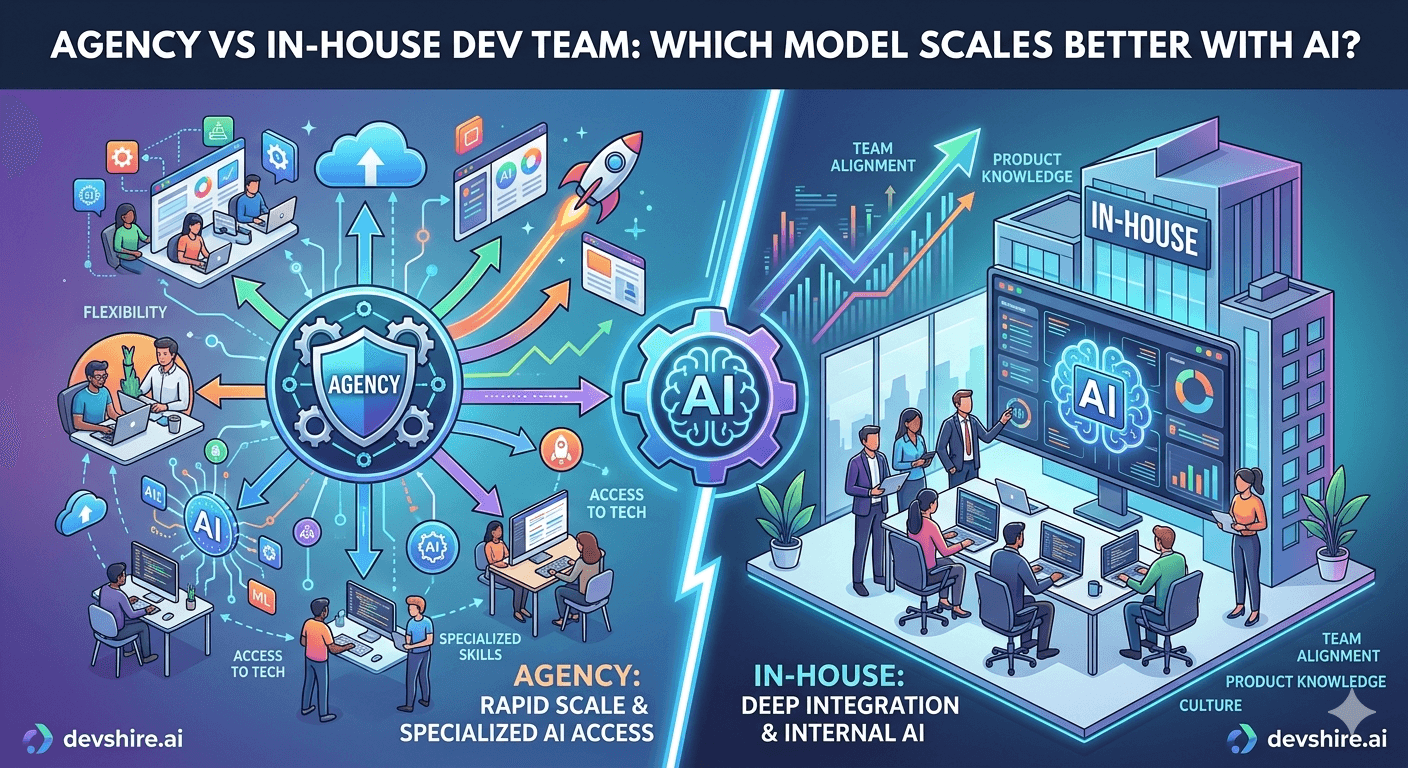
You've got a product to build and a real budget question sitting in front of you: hire an agency, or build an in-house team? It used to be a straightforward cost-versus-control trade-off. But AI has completely changed the maths — and most of the advice out there hasn't caught up. An AI-assisted agency team of three can now out-ship a traditional in-house team of seven. That changes everything about how you should be thinking through this decision.
💡 TL;DR
When AI is in the picture, agencies win on speed and cost for defined project work, while in-house teams win on long-term product ownership and institutional knowledge. The break-even point has shifted: in-house becomes cost-effective at around 18+ months of sustained dev work, up from the traditional 9–12 month estimate. For most early-stage teams, starting with an AI-powered agency and converting to in-house after product-market fit is the smarter sequence.
The Old Agency vs In-House Equation Doesn't Hold Anymore
The traditional rule of thumb was simple: agencies are expensive per hour but flexible, in-house is cheaper long-term but slow to hire. At roughly 9–12 months of equivalent work, the costs would cross over and in-house would start winning on total spend.
That crossover point has moved. Significantly. An AI-assisted agency developer ships 2–3× faster than a traditional in-house developer on most feature work. That changes the hours-to-output ratio so dramatically that the comparison almost doesn't work on a per-feature basis anymore.
⚠️ Common advice that's wrong
Most "agency vs in-house" calculators compare fully-loaded employee cost to agency day rates. That's still useful — but it misses velocity. If an AI-powered agency team ships 3× faster, the true cost comparison is not agency rate vs salary. It's agency rate vs (salary × 3) for equivalent output. That math lands very differently.
Side-by-Side: Agency vs In-House With AI in the Stack
Here's the actual comparison that matters in 2026 — not just cost, but velocity, control, and what each model gives up.
Factor | AI-Powered Agency | In-House (AI-Augmented) |
|---|---|---|
Time to first code shipped | 3–7 days | 6–12 weeks (hire + onboard) |
Output velocity | High (AI-native team) | Medium–High (depends on hire quality) |
Cost per feature (avg) | Higher day rate, fewer days | Lower daily cost, more days |
Product context / institutional knowledge | Limited — resets each engagement | Compounds over time |
Codebase ownership | Shared / handoff required | Fully internal |
Scaling up quickly | Easy — add developers in days | Slow — 4–8 week hiring cycle per head |
Scaling down quickly | Easy — adjust scope or pause | Costly — redundancy, notice periods |
Best for | Speed, defined builds, early stage | Long-term product, post-PMF |
When an AI-Powered Agency Is the Right Call
There are three situations where an agency with AI-assisted developers is clearly the better choice — and trying to build in-house in these scenarios will slow you down and cost you more.
🚀 You need to ship in weeks, not months
If you're racing to a launch, a fundraise, or a client deadline, the 6–12 weeks it takes to hire and onboard even one in-house developer will kill you. An AI-powered agency team can be briefed and shipping within a week. For time-critical builds, there's no comparison.
📦 The scope is defined and bounded
Building a specific feature, an MVP, an integration, or a client project with a clear endpoint? Agencies are built for that. In-house teams are built for ongoing, evolving product work. Hiring a full-time developer for a 10-week build is expensive and awkward for everyone involved.
💡 You haven't found product-market fit yet
Building in-house before you know what your product actually needs to be is one of the most expensive mistakes early-stage teams make. Use an agency to iterate fast, validate, and pivot. Once the product direction is clear and stable, then bring the core team in-house. Not before.
When In-House Wins — Even Against a Fast Agency
Agencies aren't always the right answer. There are real scenarios where building an in-house team — even at higher short-term cost — is clearly the better long-term move.
The first is product complexity that compounds. If your product is technically deep, highly interdependent, and requires accumulated context to work on safely, constant handoffs to an agency introduce real risk. A developer who's been inside your codebase for 18 months catches things a rotating agency team never will.
The second is competitive differentiation through technology. If your tech is your moat — not just a delivery mechanism — you can't outsource its development indefinitely. At some point, the people building your core IP need to be inside the company, fully aligned with the product direction.
📌 The Hybrid Model Most Teams Miss
The smartest setup we've seen at the 10–30 person stage: one or two senior in-house developers who own the architecture and codebase, supported by an AI-powered agency team for sprint work and feature builds. The in-house developers handle context and quality. The agency handles velocity. Total cost is often lower than a full in-house team — and output is higher.
Trusted by 500+ startups & agencies
"Hired in 2 hours. First sprint done in 3 days."
Michael L. · Marketing Director
"Way faster than any agency we've used."
Sophia M. · Content Strategist
"1 AI dev replaced our 3-person team cost."
Chris M. · Digital Marketing
Join 500+ teams building 3× faster with Devshire
1 AI-powered senior developer delivers the output of 3 traditional engineers — at 40% of the cost. Hire in under 24 hours.
The Real Cost Comparison — With AI in the Numbers
Let's do the actual maths. Assume you need the equivalent of two full-stack developers for 12 months of product work.
Model | Estimated Annual Cost | Features Shipped (est.) | Cost Per Feature (est.) |
|---|---|---|---|
2× traditional in-house devs | $180,000–$240,000 | ~80–100 features | $1,800–$2,400 |
2× AI-augmented in-house devs | $200,000–$260,000 | ~160–220 features | $900–$1,300 |
AI-powered agency (equiv. capacity) | $140,000–$200,000 | ~180–240 features | $700–$1,100 |
These are rough estimates — real numbers vary by stack, complexity, and team quality. But the directional point holds: AI changes the cost-per-output equation enough that the 9–12 month in-house crossover has moved to roughly 18+ months for most teams.
The Transition Playbook: Agency to In-House Without Losing Momentum
Most teams eventually want to bring development in-house. The transition is almost always messier than expected. Here's how to do it without losing the velocity you've built.
📅 Start hiring 8–10 weeks before the agency engagement ends
The biggest mistake is waiting until the agency wraps to start the in-house search. That's a 6–8 week gap with no one actively building. Start the hire while the agency is still active, so there's overlap for knowledge transfer.
📦 Request a codebase handoff document before the project ends
Architecture overview, decisions log, known issues, and onboarding notes. Any agency worth working with will provide this. If they won't, that's a red flag you should've caught earlier. Build this into your agency contract from day one.
🔄 Keep the agency on a small retainer for 4–6 weeks after handoff
Not for new development — for questions. Your new in-house developer will have them. A short retainer for async support costs far less than the alternative: a new developer stuck on a decision they can't reverse.
The Bottom Line
The in-house cost crossover point has shifted from 9–12 months to 18+ months when AI-assisted developers are in the comparison. Don't use old benchmarks.
AI-powered agencies ship 2–3× faster than traditional in-house teams on feature work — for time-critical builds, the agency model wins on both speed and cost.
In-house wins when your tech is your competitive moat, or when you have 18+ months of continuous, complex product work that needs accumulated context.
The smartest model for 10–30 person teams: 1–2 senior in-house developers for architecture and context, plus an AI-powered agency for sprint velocity.
Don't hire in-house before product-market fit. Use an agency to iterate fast. Bring the team inside once you know what you're building and why.
Start your in-house hire 8–10 weeks before the agency engagement ends. Overlap for knowledge transfer is not optional — it's essential.
Frequently Asked Questions
Is it cheaper to use an agency or hire in-house developers in 2026?
For work under 18 months, AI-powered agencies are often cheaper on a cost-per-feature basis. For longer engagements with complex, evolving product work, in-house becomes more cost-effective. The old 9–12 month crossover point has shifted significantly because AI-assisted developers deliver more output per day than traditional developers.
Can an agency team scale as fast as an in-house team?
Faster, actually. Adding a developer to an agency engagement takes days. Hiring and onboarding a new in-house developer takes 6–12 weeks from posting to first productive day. For rapid scaling, agencies are structurally better. The trade-off is institutional knowledge — which only builds inside your own team.
How does AI change the agency vs in-house decision?
AI increases the output velocity of agency teams significantly — enough to shift the cost-per-feature comparison in the agency's favour for most builds under 18 months. It also makes the hybrid model (small in-house team plus AI-powered agency for sprints) more viable than it's ever been. The decision framework changes: it's less about cost and more about context and complexity.
What's the best model for a startup that hasn't found product-market fit yet?
Agency, every time. Building a full in-house team before you know what your product needs to be is expensive and inflexible. Agencies let you iterate fast, change direction, and pause when needed. Once you have product-market fit and a stable product direction, that's the signal to start building in-house.
How do I transition from agency to in-house without losing momentum?
Start hiring 8–10 weeks before the agency engagement ends so there's overlap for handoff. Require a codebase documentation package from the agency before they wrap. And keep the agency on a small async support retainer for 4–6 weeks after your new developer starts. The knowledge transfer gap is where most transitions break down.
What's a realistic cost comparison between agency and in-house for a 12-month build?
For two-developer equivalent capacity over 12 months: a traditional in-house team runs $180,000–$240,000 with roughly 80–100 features shipped. An AI-powered agency at equivalent capacity runs $140,000–$200,000 with 180–240 features shipped. The agency wins on cost-per-feature by a significant margin at this time horizon, though that gap closes as product complexity increases.







Devshire Team
San Francisco · Responds in <2 hours
Hire your first AI developer — this week
Book a free 30-minute call. We'll match you with the right developer for your project and get you started within 24 hours.
<24h
Time to hire
3×
Faster builds
40%
Cost saved