
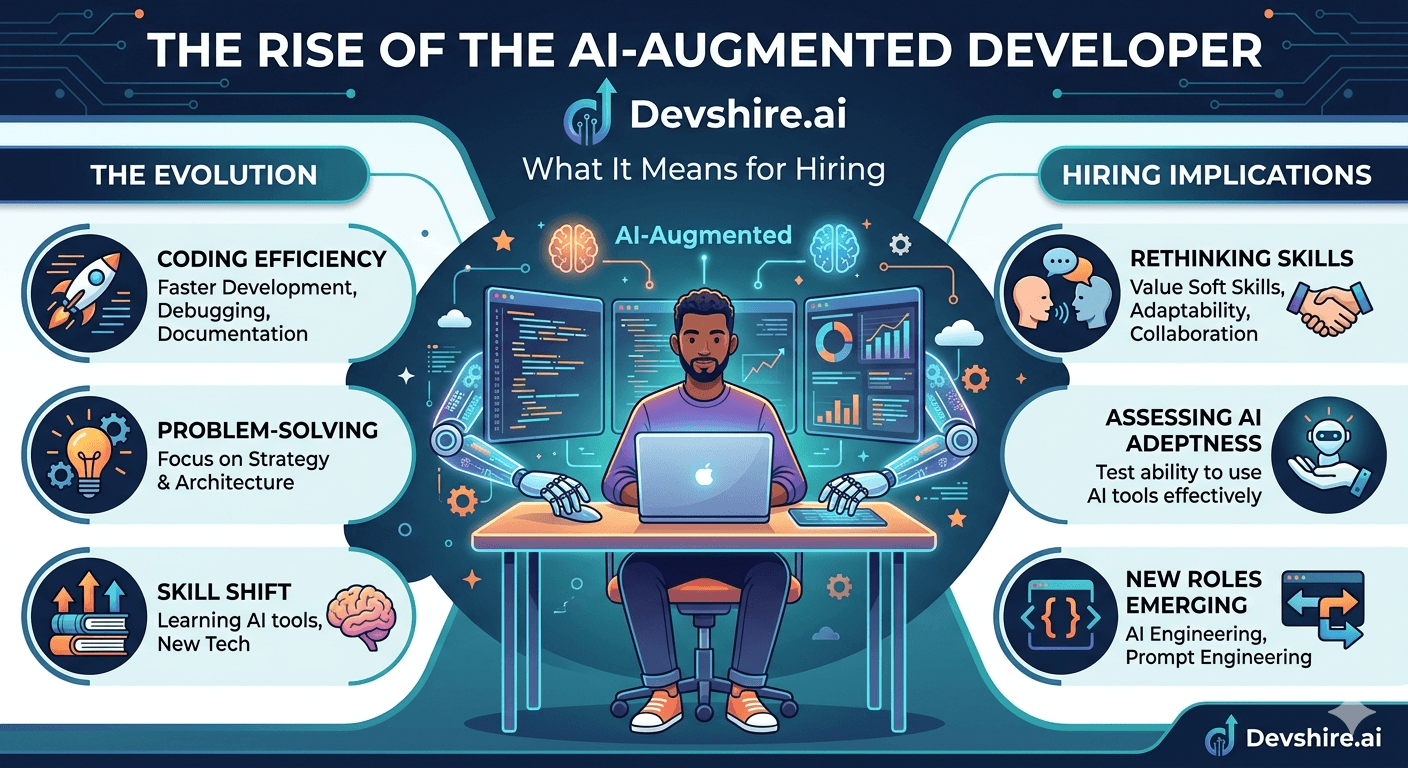
Two years ago, "AI-augmented developer" wasn't a job title anyone used. Now it's the fastest-growing hiring category in software engineering. The shift isn't just semantic. The role is genuinely different — different skills, different workflow, different output expectations, and a completely different hiring screen. If your team is still hiring developers the way you did in 2022, you're screening for the wrong things. And the candidates who are slipping past your filter are often the best ones available.
💡 TL;DR
The AI-augmented developer ships 2–3× faster than a traditional developer on comparable feature work, commands a 15–25% salary premium, and requires a fundamentally different hiring screen. The skills that matter are AI output validation, iterative prompting under uncertainty, and codebase review — not LeetCode scores or algorithm fluency. Teams that have updated their hiring process for this profile are closing in 8–12 days. Teams that haven't are still running 4–6 week searches for the wrong candidate.
What Actually Changed — And When
The AI-augmented developer isn't a new type of person. It's the same kind of developer that always existed — curious, pragmatic, fast to adopt new tools — who happened to encounter a set of AI coding tools powerful enough to fundamentally change their output rate. Cursor, Claude, Copilot, and similar tools hit a threshold around 2024 where using them daily produced genuinely measurable velocity gains rather than marginal ones.
What changed for hiring wasn't the supply of talented developers. It was the gap between the output of developers who adopted these tools seriously and those who didn't. That gap is now wide enough that it shows up in sprint velocity, in time-to-ship metrics, and in day rate comparisons. Hiring managers who noticed it first are the ones closing searches in under two weeks. [INTERNAL LINK: how to hire AI developers → /blog/hire-ai-developers-2026]
⚠️ Common advice that's wrong
Many hiring managers respond to this by adding "Copilot" or "Cursor" to their job requirements list and calling it done. That's not a screen — that's a checkbox. A developer who has Cursor installed and uses it occasionally is not an AI-augmented developer. The screen has to test how they use it, not whether they use it.
The AI-Augmented Developer Profile: What You're Actually Hiring For
Let's be precise about what this role looks like, because it's easy to conflate with adjacent profiles that are quite different.
Characteristic | AI-Augmented Developer | Traditional Developer | "Vibe Coder" |
|---|---|---|---|
Output velocity | 2–3× above traditional baseline | Baseline | High — but inconsistent quality |
AI tool use | Iterative, validated, critical | Occasional or none | Heavy but unvalidated |
Output validation | Reviews and critiques AI-generated code | Reviews all code | Minimal — ships what AI produces |
Debugging capability | Strong — uses AI to help but owns the diagnosis | Strong | Weak — struggles when AI can't fix it |
Architectural judgment | Present and applied | Present | Limited |
Production reliability | High | High | Low — production issues are common |
The vibe coder column is the hiring trap. Fast output in the interview, inconsistent quality in production. Your hiring screen needs to distinguish between the first and third columns — and the only way to do that is a live build task with code review, not a portfolio review or a GitHub history check.
The Hiring Screen That Finds AI-Augmented Developers
Standard developer hiring screens were designed for traditional developers. Algorithm quizzes, system design whiteboards, and portfolio reviews don't measure AI-augmented capability. Here's the screen that does. [INTERNAL LINK: three-layer developer screening framework → /blog/how-to-screen-ai-developers]
1️⃣ Layer 1 — Async AI workflow task (30 minutes)
Send a real bug from your backlog (anonymised). Ask the candidate to walk through how they'd approach it using their AI toolchain — in writing. You're not scoring the fix. You're reading their process: do they prompt iteratively, do they validate output, do they flag where they don't trust the model? Process quality tells you more than outcome quality at this stage.
2️⃣ Layer 2 — Live build task (45 minutes, screen share)
A constrained feature that would take a traditional developer 3–4 hours. You want to see them ship it in 45 minutes using AI tools. Watch how they prompt, where they pause, what they validate before moving on. Speed matters — but catching and correcting hallucinated output in real time matters more. The build task reveals both.
3️⃣ Layer 3 — AI-generated code review (20 minutes, live)
Give them 200 lines of AI-generated code with subtle bugs, a security gap, and some unnecessary complexity. Ask them to review it out loud. Strong candidates find the hallucinated variable, question the abstraction, and flag the injection risk. Weak candidates say "looks mostly fine." This layer is the single best predictor of production reliability in an AI-assisted team.
What to Pay an AI-Augmented Developer in 2026
AI-augmented developers command a premium — and it's justified. A developer shipping 2–3× faster on feature work is delivering 2–3× the output value for roughly 15–25% more in compensation. That maths is favourable, and most hiring managers who've run the numbers agree. [INTERNAL LINK: developer rates and costs in 2026 → /blog/cost-hire-developer-2026]
Role | Day Rate (Contract) | Salary Range (Full-Time, US) |
|---|---|---|
Senior AI-augmented full-stack | $700–$1,100/day | $145,000–$195,000 |
Mid AI-augmented full-stack | $500–$750/day | $110,000–$145,000 |
AI workflow / LLM engineer | $650–$1,000/day | $130,000–$180,000 |
Junior AI-augmented dev | $200–$380/day | $75,000–$105,000 |
Trusted by 500+ startups & agencies
"Hired in 2 hours. First sprint done in 3 days."
Michael L. · Marketing Director
"Way faster than any agency we've used."
Sophia M. · Content Strategist
"1 AI dev replaced our 3-person team cost."
Chris M. · Digital Marketing
Join 500+ teams building 3× faster with Devshire
1 AI-powered senior developer delivers the output of 3 traditional engineers — at 40% of the cost. Hire in under 24 hours.
Onboarding AI-Augmented Developers: The One Change That Matters
Traditional onboarding assumes a slow ramp. The AI-augmented developer should be shipping something meaningful within the first week — not a toy task, but a real one. If they're not shipping by day 7, you have a misalignment problem. Find out what it is immediately rather than assuming the ramp is normal.
The one additional onboarding element that most teams miss: explicit AI toolchain alignment on day one. Which models does your team use, what's the expected output quality bar, and where does AI-generated code go before it merges? State this explicitly. Don't assume a developer who uses Cursor well in isolation will adopt your team's AI standards without being told what they are.
The Bottom Line
The AI-augmented developer ships 2–3× faster than a traditional developer and commands a 15–25% salary premium — the productivity maths justify the premium for most hiring contexts.
Standard developer hiring screens (algorithm quizzes, system design whiteboards) don't measure AI-augmented capability. A live 45-minute build task and a code review task are the only screens that do.
The vibe coder — fast in interviews, unreliable in production — is the most common bad hire when teams update job titles without updating their screens. The code review layer catches this.
AI-augmented developer postings have grown over 200% since 2023. Teams with an updated hiring process are closing searches in 8–12 days. Teams without one are taking 4–6 weeks and often hiring the wrong profile.
Onboard with a real task in the first 3–5 days. Explicit AI toolchain alignment on day one prevents the quality drift that happens when each developer applies different AI standards to the same codebase.
Frequently Asked Questions
What is an AI-augmented developer?
An AI-augmented developer is a software engineer who has rebuilt their workflow around AI coding tools — using them iteratively and critically to generate, validate, and refine code significantly faster than traditional methods. They ship 2–3× faster than equivalent traditional developers on feature work, while maintaining production-grade quality standards through a disciplined output review process.
How do you hire an AI-augmented developer?
Run a three-layer screen: an async AI workflow task (how they approach a real problem using their toolchain), a live 45-minute build task (speed and output validation in real time), and a code review task (200 lines of AI-generated code with subtle bugs). Standard developer screens — algorithm quizzes and portfolio reviews — don't measure AI-augmented capability and will produce the wrong hire.
How much does an AI-augmented developer earn in 2026?
Senior AI-augmented full-stack developers earn $145,000–$195,000 salary in the US, or $700–$1,100/day on contract. Mid-level runs $110,000–$145,000 salary or $500–$750/day. The premium over traditional equivalents is 15–25%, which is justified by the 2–3× output velocity difference on comparable feature work.
What's the difference between an AI-augmented developer and a vibe coder?
An AI-augmented developer generates code quickly and then reviews, critiques, and validates it before it ships. A vibe coder generates code quickly and ships it with minimal review. The output rates look similar in an interview. The production reliability looks very different after two sprints. The code review layer of your hiring screen is specifically designed to catch this difference before you make the hire.
How long does it take to hire an AI-augmented developer?
Teams using specialised platforms like devshire.ai with pre-vetted candidates close in 8–12 days. Teams using general job boards typically take 4–6 weeks — partly because the candidate pool is harder to filter, and partly because traditional screening processes don't efficiently identify the right profile. The process gap, not the talent gap, accounts for most of the time difference.
Should I convert my existing developers into AI-augmented developers instead of hiring?
Yes — for the developers who are willing and able to adapt. Run an internal AI toolchain training sprint, set clear expectations about the workflow standards you want, and give developers 4–6 weeks to demonstrate adoption. Some will take to it immediately. Some won't adapt. Knowing which is which is valuable information regardless of what you decide about external hiring.







Devshire Team
San Francisco · Responds in <2 hours
Hire your first AI developer — this week
Book a free 30-minute call. We'll match you with the right developer for your project and get you started within 24 hours.
<24h
Time to hire
3×
Faster builds
40%
Cost saved