
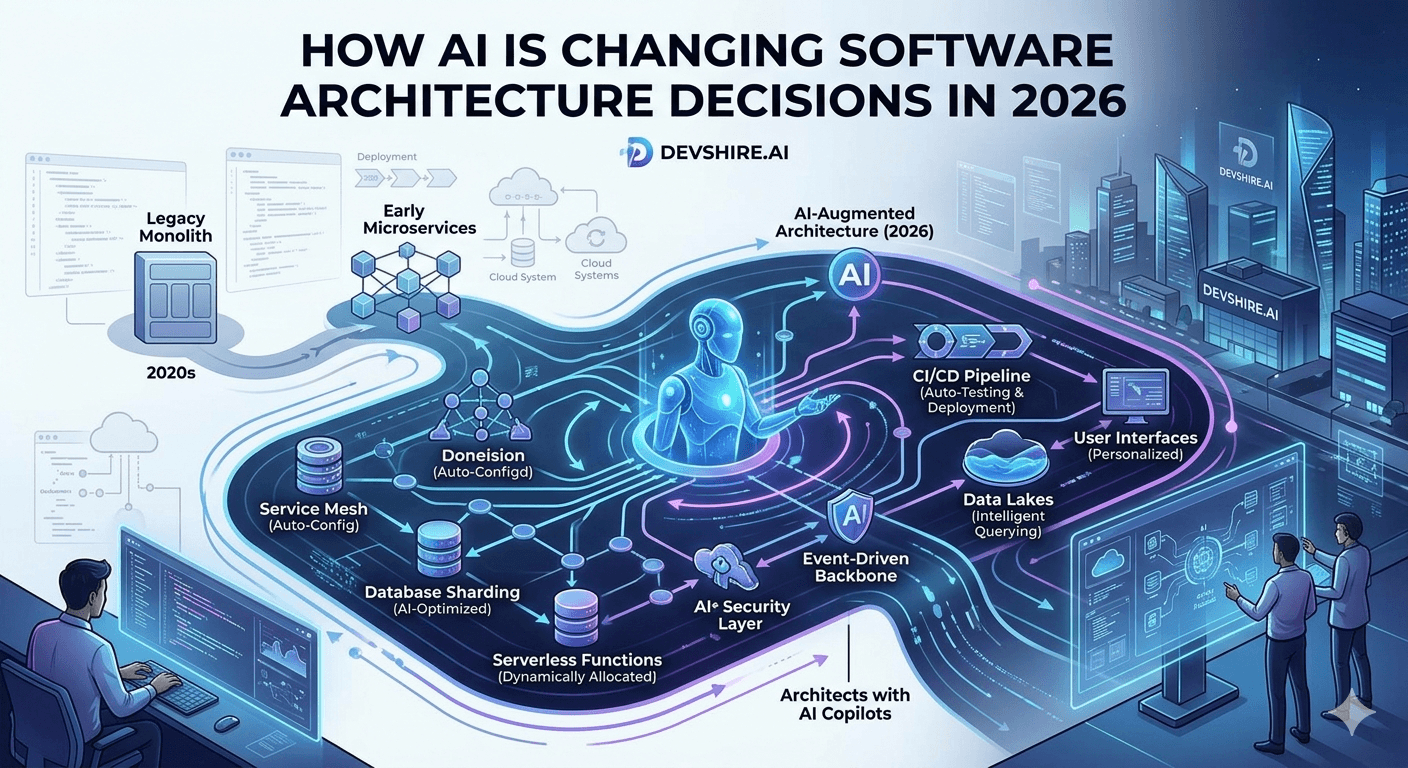
The conversation about AI and software development has been dominated by tools — Cursor, Copilot, Claude, which IDE is fastest. That's the surface layer. The deeper shift is architectural. AI is changing the decisions engineers make about how systems are structured, how data flows, how errors are handled, and what "reliable" even means when part of your stack is non-deterministic by design. If your architecture mental models are from 2022, some of them are already wrong.
💡 TL;DR
AI is changing software architecture in five concrete ways: non-determinism is now a first-class design concern, context windows are replacing traditional session management, evaluation pipelines are becoming as important as test suites, retrieval-augmented generation is reshaping how applications manage knowledge, and the boundary between application logic and model behaviour is blurring in ways that require new architectural patterns. Each change has implications for how you structure your codebase today — not in some future state.
Non-Determinism Is Now a First-Class Design Concern
Traditional software architecture assumes determinism. Given the same inputs, a function returns the same outputs. You can test it. You can cache it. You can reason about it. AI model calls break this assumption completely. The same prompt can return different outputs on different calls. That's not a bug — it's how the technology works. But it means your architecture has to account for it explicitly, not as an edge case.
In practice, this means: retry logic and fallback paths for model calls are as important as error handling for database queries. Output validation layers — checking that model responses conform to expected schemas — are non-negotiable for production systems. And caching strategies for LLM outputs require careful thought about when staleness is acceptable versus when fresh generation is required.
⚠️ Common advice that's wrong
A lot of early LLM integration tutorials treat model API calls like any other HTTP request: call it, handle the response, move on. That approach works in demos. It breaks in production when the model returns an unexpected format, hallucinates a field, or produces a response that's technically valid but logically wrong for your use case. Production AI architecture requires validation at every model boundary.
Context Windows Are Replacing Session Management
Traditional multi-step applications manage state in sessions, databases, and caches. AI-native applications manage state in a different way: the context window. What you pass to the model on each call determines what it knows and how it behaves. That's a fundamentally different state management paradigm — and it requires architectural decisions that don't have direct equivalents in traditional software design.
The emerging patterns: context window management libraries that handle token budgeting automatically, retrieval systems that inject relevant context rather than passing everything, and conversation history management that prunes and summarises rather than growing indefinitely. These patterns are becoming standard infrastructure in AI-native applications — and understanding them is becoming a baseline competency for AI engineering roles.
Traditional Pattern | AI-Native Equivalent | Key Difference |
|---|---|---|
Session state | Context window management | Token budget constraints, not memory limits |
Database query | Retrieval-augmented generation (RAG) | Semantic similarity, not exact key lookup |
Unit test | Evaluation pipeline with ground truth | Probabilistic correctness, not binary pass/fail |
Function with typed return | Structured output with validation layer | Model can return unexpected schemas |
Synchronous API call | Streaming with partial response handling | Latency profile is different — stream early |
Evaluation Pipelines: The Test Suite Equivalent for AI Systems
You can't test an LLM-based feature the same way you test a deterministic function. But you can build an evaluation pipeline — a system that runs your model against a set of representative inputs with expected outputs and measures how often the model gets it right. In 2026, evaluation pipelines are as important to production AI systems as test suites are to traditional software. Teams building AI features without them are flying blind.
The practical architecture: a curated dataset of representative inputs and expected outputs, a scoring function for each output (exact match, semantic similarity, human evaluation rubric, or a second model as judge), and a CI/CD integration that runs evals on every model or prompt change. This isn't research infrastructure — it's production engineering. And it requires dedicated time to build and maintain. [INTERNAL LINK: AI tools for developers in 2026 → /blog/ai-tools-developers-2026]
RAG Architecture: The New Standard for Knowledge-Intensive Applications
Retrieval-augmented generation (RAG) has moved from a research technique to a standard production pattern in 18 months. Any application that needs to answer questions about a specific knowledge base — company documents, product data, support history, legal texts — is now almost certainly using RAG rather than fine-tuning or prompt stuffing.
The reason is practical: RAG keeps the knowledge base updateable without retraining, gives you source attribution, and manages the context window problem by retrieving only relevant chunks rather than passing everything. The architecture decisions in a RAG system — chunking strategy, embedding model choice, retrieval mechanism, context assembly — are now a standard part of AI engineering conversations. Senior developers who can make these decisions fluently are in high demand. [INTERNAL LINK: building AI features into SaaS → /blog/add-ai-features-saas]
Trusted by 500+ startups & agencies
"Hired in 2 hours. First sprint done in 3 days."
Michael L. · Marketing Director
"Way faster than any agency we've used."
Sophia M. · Content Strategist
"1 AI dev replaced our 3-person team cost."
Chris M. · Digital Marketing
Join 500+ teams building 3× faster with Devshire
1 AI-powered senior developer delivers the output of 3 traditional engineers — at 40% of the cost. Hire in under 24 hours.
The Blurring Boundary Between Application Logic and Model Behaviour
In traditional software, the application logic lives entirely in your codebase. You can read it, test it, version it. In AI-native applications, some of the logic lives in the model — in the prompt, in the model weights, in the fine-tuning. That logic is harder to inspect, harder to version, and harder to debug when it goes wrong.
This blurring boundary is one of the most underappreciated architectural challenges in 2026. The teams handling it well have developed explicit practices: prompt versioning in version control alongside code, model behaviour tests that run against prompt changes, and clear documentation of which decisions are in code versus which are in model behaviour. Teams that haven't thought about this are accumulating invisible technical debt that surfaces unpredictably in production.
What Hasn't Changed — And Why That Matters
Actually — I want to push back on one thing here before wrapping up. The fundamentals of good software architecture haven't changed: separation of concerns, clear interfaces between components, observable systems, and designing for failure. These principles apply to AI components exactly as they apply to everything else. The mistake is treating AI integration as architecturally special in ways that justify skipping those fundamentals.
The teams building the most reliable AI-native systems are the ones applying rigorous traditional software engineering practices to their AI components — not treating them as magic boxes exempt from the usual standards. Non-determinism is new. The need for clear interfaces, error handling, and observability isn't.
The Bottom Line
Non-determinism is now a first-class design concern. Production AI architecture requires output validation layers and fallback paths at every model boundary — not as edge case handling, but as standard practice.
Context window management is the AI-native equivalent of session management. Token budgeting, retrieval injection, and history summarisation are becoming standard infrastructure patterns.
Evaluation pipelines are the test suite equivalent for AI systems. Teams shipping LLM-based features without them are building without a quality baseline.
RAG is now a standard production pattern for knowledge-intensive applications. The architecture decisions in a RAG system — chunking, embedding, retrieval — are baseline AI engineering competencies in 2026.
Prompt versioning alongside code, model behaviour tests, and documentation of what lives in code versus model behaviour are the practices that prevent invisible AI technical debt.
The fundamentals of good software architecture still apply to AI components. Non-determinism is new. Separation of concerns, observable systems, and designing for failure are not.
Frequently Asked Questions
How is AI changing software architecture in 2026?
Five concrete changes: non-determinism is now a first-class design concern requiring validation layers and fallback paths; context windows are replacing traditional session management; evaluation pipelines are becoming as important as test suites; RAG is the standard pattern for knowledge-intensive features; and the boundary between application logic and model behaviour is blurring in ways that require new versioning and documentation practices.
What is a RAG architecture and why does it matter?
RAG (retrieval-augmented generation) is an architecture pattern where relevant information is retrieved from a knowledge base and injected into the model's context at query time, rather than fine-tuning the model on that knowledge. It's become the standard pattern for knowledge-intensive AI applications because it keeps knowledge updatable without retraining, provides source attribution, and manages context window constraints efficiently.
How do you handle non-determinism in AI-powered applications?
Treat model calls like calls to an unreliable external service: add retry logic, validate output schemas before processing, build fallback paths for unexpected responses, and design your application logic to handle model failures gracefully. Output validation layers — checking that model responses conform to expected structure and content ranges — are non-negotiable for production AI systems.
What is an evaluation pipeline for AI systems?
An evaluation pipeline runs your AI feature against a curated dataset of representative inputs with expected outputs, measuring how often the model produces correct or acceptable responses. It's the AI-native equivalent of a test suite — and it's how you catch quality regressions when you change a prompt, switch models, or update your retrieval logic. Without evals, you have no baseline to measure AI behaviour changes against.
How should I version prompts in an AI-native application?
Store prompts in your version control system alongside code — not in a database, not in environment variables, not in a spreadsheet. Treat prompt changes with the same review process as code changes. Run your evaluation pipeline against prompt changes before merging. Document what each prompt version was designed to do and what changed between versions. Prompt drift without version control is one of the most common sources of unpredictable AI behaviour in production.
What software architecture skills are most important for AI engineering in 2026?
Context window management and token budgeting, RAG system design (chunking strategy, embedding models, retrieval mechanisms), evaluation pipeline architecture, structured output handling with validation layers, and streaming response patterns. These are the AI-specific architectural skills that complement traditional software engineering fundamentals — and that most senior developers are actively building in 2026.







Devshire Team
San Francisco · Responds in <2 hours
Hire your first AI developer — this week
Book a free 30-minute call. We'll match you with the right developer for your project and get you started within 24 hours.
<24h
Time to hire
3×
Faster builds
40%
Cost saved