
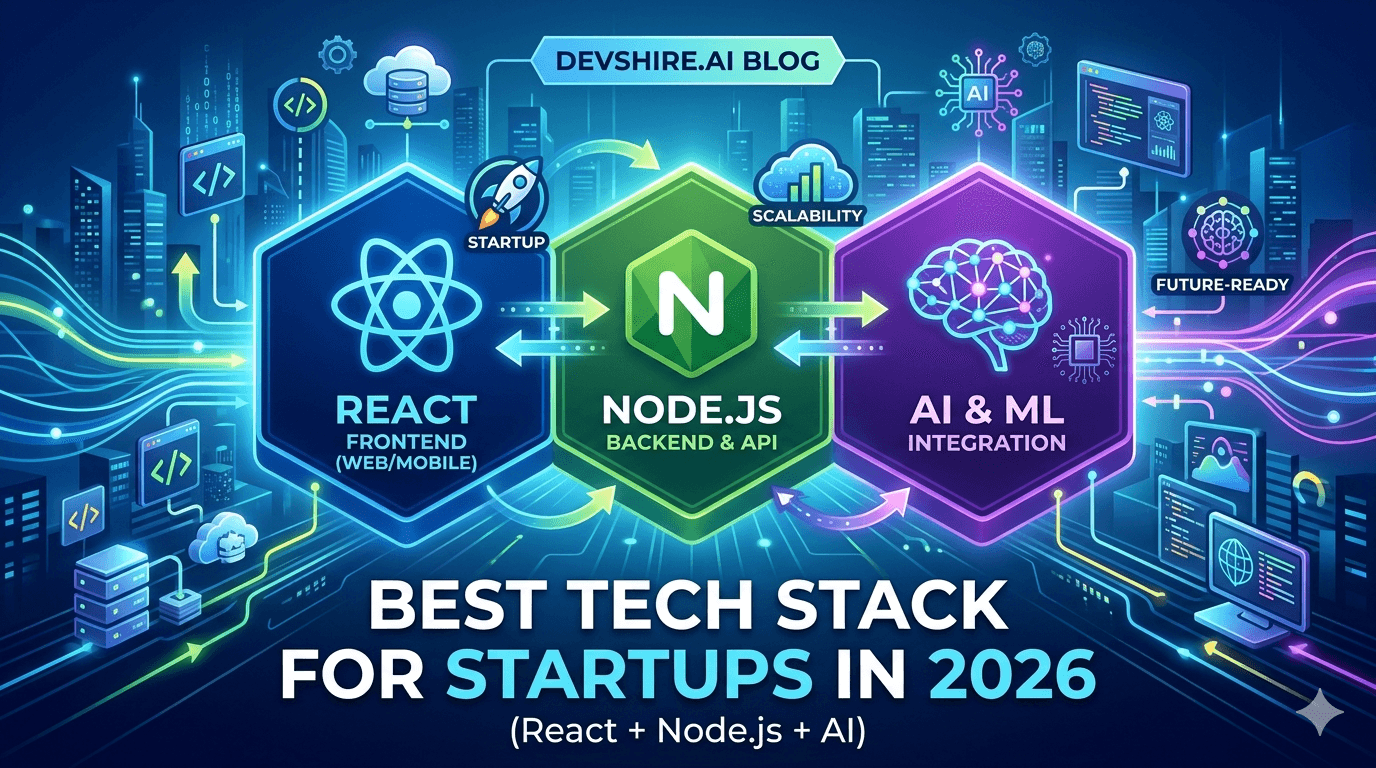
Most startup tech stack debates are decided in the wrong order. Founders ask what is trending, what investors recognise, or what the last YC batch used. The right question is simpler: what lets a 2 to 4 person team ship a production product in 90 days and iterate without rebuilding? In 2026, that answer has converged. React on the frontend, Node.js or Python on the backend, PostgreSQL for persistence, and an AI toolchain — Cursor, Claude, ChatGPT — woven into the development workflow from day one.
💡 TL;DR
The best tech stack for startups in 2026 is React plus Node.js plus PostgreSQL plus an AI development layer. This lets a 2-developer team ship what a 6-person team shipped in 2021. The AI layer — Cursor, Copilot, Claude API, and v0 by Vercel — is not optional anymore. It is the difference between hitting your MVP timeline and missing it by 8 weeks. A 2-person AI-native team on this stack shipped a full B2B SaaS product from zero to first paying customer in 67 days in Q3 2025.
The 2026 Startup Stack — Every Layer With a Reason
Here is the recommended stack with the specific reason each layer earns its place. Based on what we see working across 100+ early-stage engineering teams that have hired through devshire.ai in the last 18 months.
Layer | Technology | Why It Wins for Startups | Main Alternative |
|---|---|---|---|
Frontend | React + Next.js | Largest talent pool, AI tools generate excellent React, SSR built in | Vue.js — smaller talent pool |
Backend API | Node.js Fastify or Express | Same language as frontend, massive ecosystem, AI-native | Python FastAPI — better for AI-heavy backends |
Database | PostgreSQL | Proven, flexible, excellent ORM support, handles most SaaS workloads | MySQL — viable but weaker JSON support |
ORM | Prisma (Node.js) or SQLAlchemy (Python) | AI tools generate excellent Prisma schemas, fully type-safe | Drizzle — lighter but less AI-assisted tooling |
Auth | Clerk or Auth.js | Pre-built OAuth, MFA, session management in hours not weeks | Custom auth — never for an MVP |
Hosting | Vercel plus Railway or Fly.io | Zero-config deploys, git-push workflow, auto-scale | AWS — too much config overhead for pre-PMF |
AI Layer | Cursor + Claude API + ChatGPT + v0 | 2 to 3x development speed — required for competitive output | No AI layer — not viable in 2026 |
The AI Development Layer — Why It Is No Longer Optional
In 2023, AI tools were a productivity bonus. In 2026, they are the baseline. A startup without an AI development layer operates at 2022 speed — which means 2 to 3x slower than every competitor in their category. Here is what the AI layer actually looks like in a functioning 2026 startup team.
⚡ Cursor AI — primary development environment
Every developer uses Cursor as their IDE, not as a plugin. Multi-file context awareness means a single prompt scaffolds a full feature — React component, API route, database schema, and test — across all relevant files at once. Teams that switched from VS Code plus Copilot to Cursor as primary IDE report 30 to 50% faster feature cycles on comparable work.
🤖 Claude API — product AI features and code review
The Claude API does two jobs in a startup stack: powering AI features built into the product (content generation, classification, document analysis), and running an automated PR review bot that checks for AI-generated bug patterns. The review bot takes 2 days to build and prevents dozens of production issues per month.
🎨 v0 by Vercel — UI component generation
v0 generates complete, production-quality React components from a text prompt. A founder describing a dashboard layout gets a functional Tailwind CSS React component in 3 minutes. This removes the blank-canvas problem for frontend work and lets developers focus on integration rather than scaffolding from scratch.
💬 ChatGPT — architecture planning and API scaffolding
ChatGPT is the strongest tool for architecture planning, trade-off discussions, and API integration scaffolding. Fifteen minutes of ChatGPT architecture planning prevents 4 hours of wrong-direction building. This use case — planning before coding — is the one that shows up most consistently as high-ROI in developer workflow data.
Node.js vs Python Backend — The Actual Decision Logic
This is the most common stack debate in 2026 early-stage teams. The answer depends on one question: is AI your feature or your tool?
Use Node.js when your team is primarily JavaScript developers, you are building standard SaaS with real-time features, and AI integrations call third-party APIs rather than running local models. One language across the full stack is a real advantage for a 2-person team — fewer context switches, shared libraries, simpler deployments.
Use Python FastAPI when your product has significant AI or ML components beyond API calls — LangChain pipelines, vector embeddings, custom model inference, data processing at volume. Python is the language of the AI ecosystem in 2026. If AI is your core product rather than just a feature, Python is the right backend choice regardless of what your frontend developers prefer.
💡 The hybrid worth knowing about
Several high-growth startups in our network run Node.js for the main product API and a separate Python microservice for AI-heavy workloads. This is architecturally more complex but solves the language mismatch cleanly. Only worth the added complexity from team size 5 or more. Under that, commit to one language and move fast.
3 Stack Choices That Will Cost You 4 to 12 Weeks
These are the decisions that look reasonable at the time and cost startup teams a quarter of runway. Every one is based on a real situation we have seen in the past 18 months.
❌ Custom authentication from scratch
Custom auth takes 2 to 4 weeks to build correctly — password reset flows, session management, OAuth providers, MFA, rate limiting. Clerk or Auth.js covers all of this in hours. The only reason to build custom auth is a compliance requirement that no off-the-shelf solution meets. For most startups, that reason does not exist at MVP stage.
❌ Full AWS setup before product-market fit
Spending 3 weeks configuring VPCs, IAM roles, RDS instances, and load balancers is optimising for a scale problem you do not have. Vercel plus Railway gets you to production in 2 hours with git-push deploys. Migrate to AWS when infrastructure cost on managed platforms exceeds $3,000 per month — not before.
❌ Microservices architecture from day one
Microservices solve problems that do not exist at pre-seed and create problems that do — distributed tracing, network latency, independent deployment complexity. A modular monolith is the right architecture for the first 18 months. Plan for decomposition. Do not execute it until you have a concrete scaling signal.
Trusted by 500+ startups & agencies
"Hired in 2 hours. First sprint done in 3 days."
Michael L. · Marketing Director
"Way faster than any agency we've used."
Sophia M. · Content Strategist
"1 AI dev replaced our 3-person team cost."
Chris M. · Digital Marketing
Join 500+ teams building 3× faster with Devshire
1 AI-powered senior developer delivers the output of 3 traditional engineers — at 40% of the cost. Hire in under 24 hours.
67 Days to First Paying Customer — What the Stack Made Possible
A 2-person SaaS team — one frontend-leaning, one backend-leaning, both AI-native — hired through devshire.ai in Q3 2025. They were building a B2B SaaS product in the compliance space. Stack: Next.js, Node.js Fastify, PostgreSQL with Prisma, Clerk, Railway, Cursor as primary IDE, Claude API for document analysis.
In 90 days they shipped: full authentication with role-based access, a document upload and analysis pipeline using Claude API, Stripe billing integration, an admin dashboard generated with v0 and customised, and a public marketing page. Total cost for both developers over 90 days: $108,000. First paying customer: day 67. That timeline was not achievable without the AI development layer. The same scope with a traditional team would have taken 5 to 6 months minimum.
When to Evolve the Stack — Signals Not Timelines
The best tech stack for startups in 2026 is not permanent. But evolve based on measured signals — not hunches or advice from engineers who built at Google scale.
🔄 Move from Railway or Fly.io to AWS when
Monthly infrastructure cost on managed platforms exceeds $3,000, or you need compliance features — SOC 2, HIPAA, custom data residency — that managed providers cannot meet. Not before. The engineering time saved by staying on managed platforms pays for itself many times over versus premature AWS migration.
🔄 Add Redis caching when
Specific queries are taking over 500ms in production and you have confirmed the bottleneck is database read latency rather than query structure. Do not add caching infrastructure speculatively — add it when you have a measured problem and a specific query to fix.
🔄 Split to microservices when
A specific service has independent scaling requirements, or a module has grown large enough that a dedicated team owns it end-to-end and needs independent deployment cycles. A growing monolith is not a signal. A monolith with genuinely independent subsystems owned by separate teams is.
The Bottom Line
The best tech stack for startups in 2026: React plus Next.js, Node.js Fastify or Python FastAPI, PostgreSQL with Prisma, Clerk for auth, Vercel plus Railway for hosting.
The AI development layer — Cursor, Claude API, ChatGPT, v0 — is not optional. A 2-developer AI-native team on this stack shipped from zero to first paying customer in 67 days.
Use Node.js when AI is a feature. Use Python FastAPI when AI is your core product. Run a hybrid from team size 5 upward if needed.
Custom auth, premature AWS setup, and day-one microservices each cost 4 to 12 weeks of build time. All three are avoidable.
Evolve the stack on measured signals — query latency over 500ms, infrastructure cost over $3,000 per month, or concrete compliance requirements. Not before.
AI tools cost $30 to $60 per developer per month. They are the highest-ROI line item in a startup engineering budget by a significant margin.
Frequently Asked Questions
What is the best tech stack for a startup in 2026?
React plus Next.js for frontend, Node.js Fastify or Python FastAPI for backend, PostgreSQL with Prisma for data, Clerk for auth, Vercel plus Railway for hosting, and an AI toolchain covering Cursor, Claude API, and ChatGPT. This combination has the widest AI tooling support, the largest developer talent pool, and the lowest time-to-production for new features across the early-stage teams we work with.
Should a startup use Node.js or Python for their backend in 2026?
Node.js for standard SaaS products where the team is JavaScript-first and AI integrations call third-party APIs. Python FastAPI for products where AI is core — LangChain pipelines, vector search, custom model inference. A hybrid approach with Node.js for the main API and Python for an AI microservice works well from team size 5 upward but adds complexity below that threshold.
Is React still the right frontend framework for startups in 2026?
Yes — for most startups. React has the largest developer talent pool, the strongest AI tooling support (Cursor generates excellent React, v0 by Vercel outputs React components), and a mature ecosystem. Vue.js is a credible alternative but the talent pool is smaller. Svelte is interesting but ecosystem maturity lags React significantly for production SaaS products.
When should a startup move from managed hosting to AWS?
When monthly infrastructure costs on Vercel and Railway exceed $3,000, or when compliance requirements that managed providers cannot meet arise. Early AWS setup is one of the most common ways startup teams lose 3 to 5 weeks of product development time before having any users to serve. Managed platforms are the right call until the cost or compliance signal arrives.
Do AI coding tools actually make a difference for startup development speed?
Yes — measurably. Teams using Cursor, Claude, and ChatGPT as part of their daily workflow ship 2 to 3x faster on feature work. A 2-developer AI-native team can match the output of a 5 to 6 person traditional team on standard SaaS features. The tools cost $30 to $60 per developer per month — the ROI is immediate from the first sprint.
Build Your 2026 Startup Stack With AI-Native Developers
Devshire.ai matches pre-vetted React, Node.js, and Python developers who already run Cursor, Claude, and Copilot in their daily workflow. No ramp time on AI tools. No wrong stack choices. Shortlist in 48 to 72 hours — freelance and full-time options available.
Find Your Startup Developer ->
AI-toolchain vetted · React + Node.js + Python · Shortlist in 48 hrs · Median hire in 11 days
About devshire.ai — devshire.ai matches AI-native developers with early-stage startups. Every developer is pre-screened on live AI toolchain use including Cursor, Copilot, and Claude API. Start hiring ->
Related reading: How to Hire AI Developers in 2026 · How Much Does It Cost to Hire a Developer in 2026? · From Idea to Launch: Building Your First Startup App With AI Tools · Browse Pre-Vetted Startup Developers







Devshire Team
San Francisco · Responds in <2 hours
Hire your first AI developer — this week
Book a free 30-minute call. We'll match you with the right developer for your project and get you started within 24 hours.
<24h
Time to hire
3×
Faster builds
40%
Cost saved