
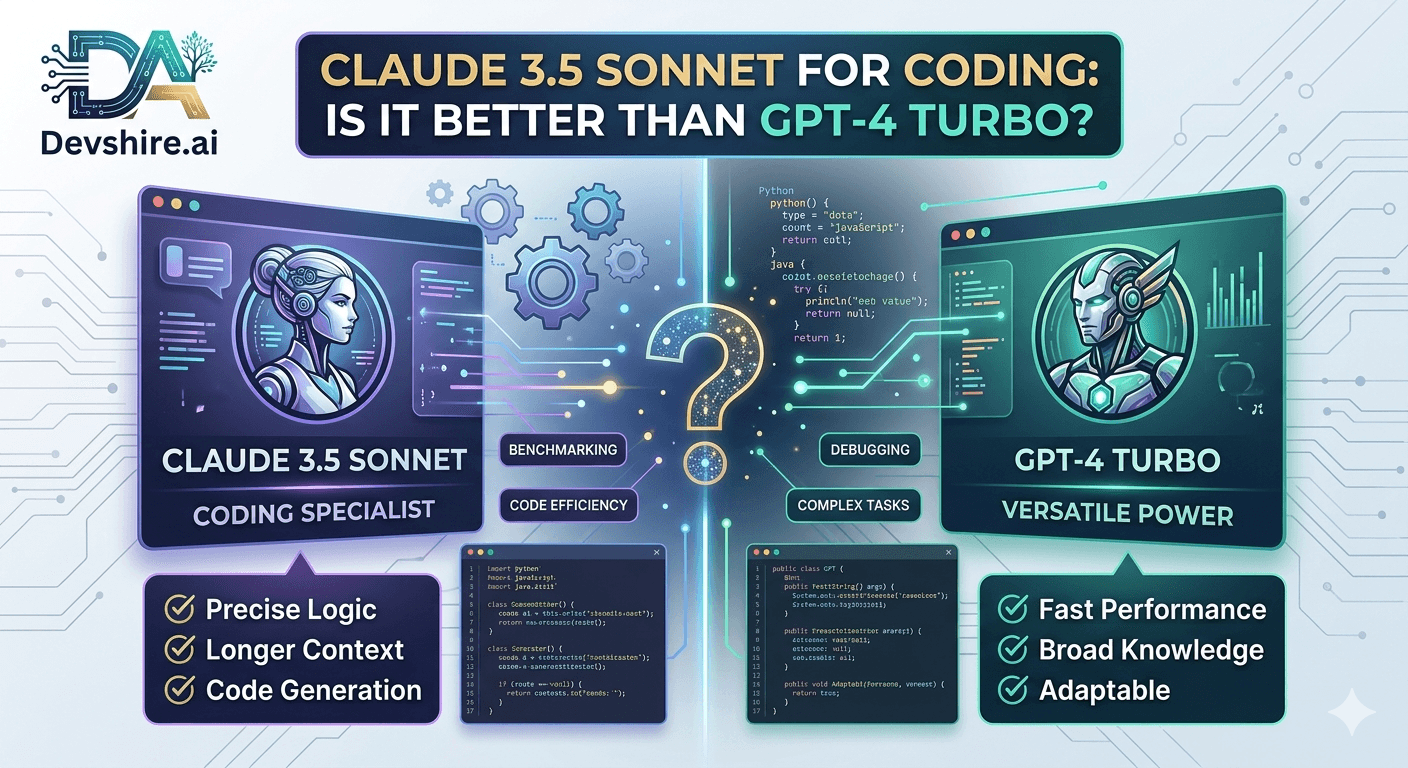
Benchmarks lie. Not on purpose — they just measure what's easy to measure, which isn't always what matters when you're 3 hours into a debugging session. Claude 3.5 Sonnet has been climbing developer preference surveys throughout 2025 and into 2026. The question worth answering isn't which model scores higher on HumanEval. It's which one makes your actual day-to-day coding better. Here's what that comparison actually looks like.
💡 TL;DR
Claude 3.5 Sonnet is the better coding model for most real-world tasks: debugging complex issues, refactoring large files, explaining code clearly, and maintaining instruction-following through long sessions. GPT-4 Turbo has the edge on broad general knowledge and tool-use integrations. For developers using Cursor or building with the API directly, Claude 3.5 Sonnet is the default choice in 2026 for most coding contexts.
What Actually Matters When Choosing a Coding Model
Most benchmark comparisons test code generation on isolated problems. That's useful — but it misses the three things that determine daily developer experience: instruction following over a long session, quality of explanations when you're debugging, and ability to understand existing code rather than just generate new code.
Capability | Claude 3.5 Sonnet | GPT-4 Turbo | Winner |
|---|---|---|---|
Instruction following (long sessions) | Excellent — rarely drifts from constraints | Good — occasionally ignores prior instructions | Claude |
Code explanation quality | Clear, concise, developer-friendly tone | Good but can be verbose | Claude |
Debugging complex issues | Strong systematic reasoning | Solid but less thorough on edge cases | Claude |
Code generation (greenfield) | Excellent | Excellent | Tie |
Tool use / function calling | Good | Slightly better for complex tool chains | GPT-4 |
Context window usage | 200k tokens — handles large codebases | 128k tokens | Claude |
Where Claude 3.5 Sonnet Genuinely Pulls Ahead
The biggest day-to-day advantage is instruction following across a long session. Ask Claude to "always use TypeScript strict mode" or "never add console.log statements" and it holds that constraint for the rest of the conversation. GPT-4 Turbo drifts more — not always, not dramatically, but enough to be annoying when you're trying to maintain consistent code style across a long session.
The second is debugging quality. When you paste in a 200-line function and say "something's wrong with the state update logic," Claude will systematically walk through the code and identify the issue with more precision. GPT-4 Turbo tends toward broader suggestions that are sometimes correct but require more iteration to land on the actual problem.
Where GPT-4 Turbo Still Has the Edge
GPT-4 Turbo is better for complex, chained tool use — especially if you're building agents that call multiple functions in sequence. OpenAI has invested heavily in function calling reliability and it shows. Claude's tool use is good but not quite at the same level for complex multi-step agentic pipelines.
GPT-4 also has a broader general knowledge base that occasionally matters for obscure library-specific questions. And its integration with the broader OpenAI ecosystem (Assistants API, fine-tuning, integrations) gives it practical advantages if you're already inside that stack.
Which Model Should You Default To for Coding in 2026?
If you're using Cursor: Claude 3.5 Sonnet. It's available as a model selection in Cursor and consistently outperforms GPT-4 on the tasks Cursor is primarily used for — refactoring, multi-file editing, debugging. The 200k context window also handles larger codebases more comfortably.
If you're building agents or complex tool-use pipelines: start with GPT-4 Turbo. The more mature function calling reliability is worth it for that use case specifically. You can always switch to Claude for the generation-heavy parts of the pipeline.
Trusted by 500+ startups & agencies
"Hired in 2 hours. First sprint done in 3 days."
Michael L. · Marketing Director
"Way faster than any agency we've used."
Sophia M. · Content Strategist
"1 AI dev replaced our 3-person team cost."
Chris M. · Digital Marketing
Join 500+ teams building 3× faster with Devshire
1 AI-powered senior developer delivers the output of 3 traditional engineers — at 40% of the cost. Hire in under 24 hours.
The Bottom Line
Claude 3.5 Sonnet outperforms GPT-4 Turbo on instruction following, debugging quality, and code explanation clarity in real daily use — not just benchmarks.
GPT-4 Turbo has a meaningful edge on complex multi-step tool use and function calling — relevant if you're building agentic pipelines.
Claude's 200k token context window handles large codebases significantly better than GPT-4 Turbo's 128k limit.
For developers using Cursor, Claude 3.5 Sonnet is the recommended default model for most coding tasks in 2026.
Both models perform equally well on greenfield code generation — the differentiation shows up in longer, more complex sessions and debugging tasks.
Frequently Asked Questions
Is Claude 3.5 Sonnet better than GPT-4 Turbo for coding?
For most daily coding tasks — debugging, refactoring, code explanation, and long sessions with specific constraints — yes. Claude 3.5 Sonnet has better instruction following and more systematic debugging reasoning. GPT-4 Turbo has a slight edge on complex multi-step tool use and function calling. The right answer depends on your specific use case.
Which model should I use in Cursor AI for coding?
Claude 3.5 Sonnet is the recommended default for Cursor in 2026. It handles multi-file editing and debugging with strong context awareness, and the 200k token window manages larger codebases better than GPT-4 Turbo's 128k limit. Switch to GPT-4o for tasks that specifically require complex tool chaining.
What's the context window difference between Claude 3.5 Sonnet and GPT-4 Turbo?
Claude 3.5 Sonnet supports a 200k token context window. GPT-4 Turbo supports 128k tokens. For most coding sessions this doesn't matter — but for large codebases, long debugging sessions, or working with multiple large files simultaneously, the Claude advantage is real.
Does Claude 3.5 Sonnet hallucinate code less than GPT-4?
Both models hallucinate — the question is frequency and how obvious it is. Claude tends to hallucinate less confidently on code it doesn't know, meaning it's more likely to say it's unsure rather than generate plausible-looking wrong code. GPT-4 can be more confidently wrong. In practice, review AI-generated code regardless of which model you're using.
Which model is better for building AI agents and complex tool-use pipelines?
GPT-4 Turbo has more mature and reliable function calling, which gives it a practical edge for complex multi-step agentic pipelines. Claude's tool use has improved significantly and is solid for most use cases — but if function calling reliability is critical to your application, GPT-4 Turbo is the safer default in 2026.
How do I access Claude 3.5 Sonnet for coding?
You can access Claude 3.5 Sonnet via the Anthropic API (model string: claude-sonnet-4-6), through Cursor AI's model selection, through the Claude.ai interface, and through various IDE integrations. For API-based usage, the Anthropic documentation at docs.claude.com covers integration details and pricing.







Devshire Team
San Francisco · Responds in <2 hours
Hire your first AI developer — this week
Book a free 30-minute call. We'll match you with the right developer for your project and get you started within 24 hours.
<24h
Time to hire
3×
Faster builds
40%
Cost saved