
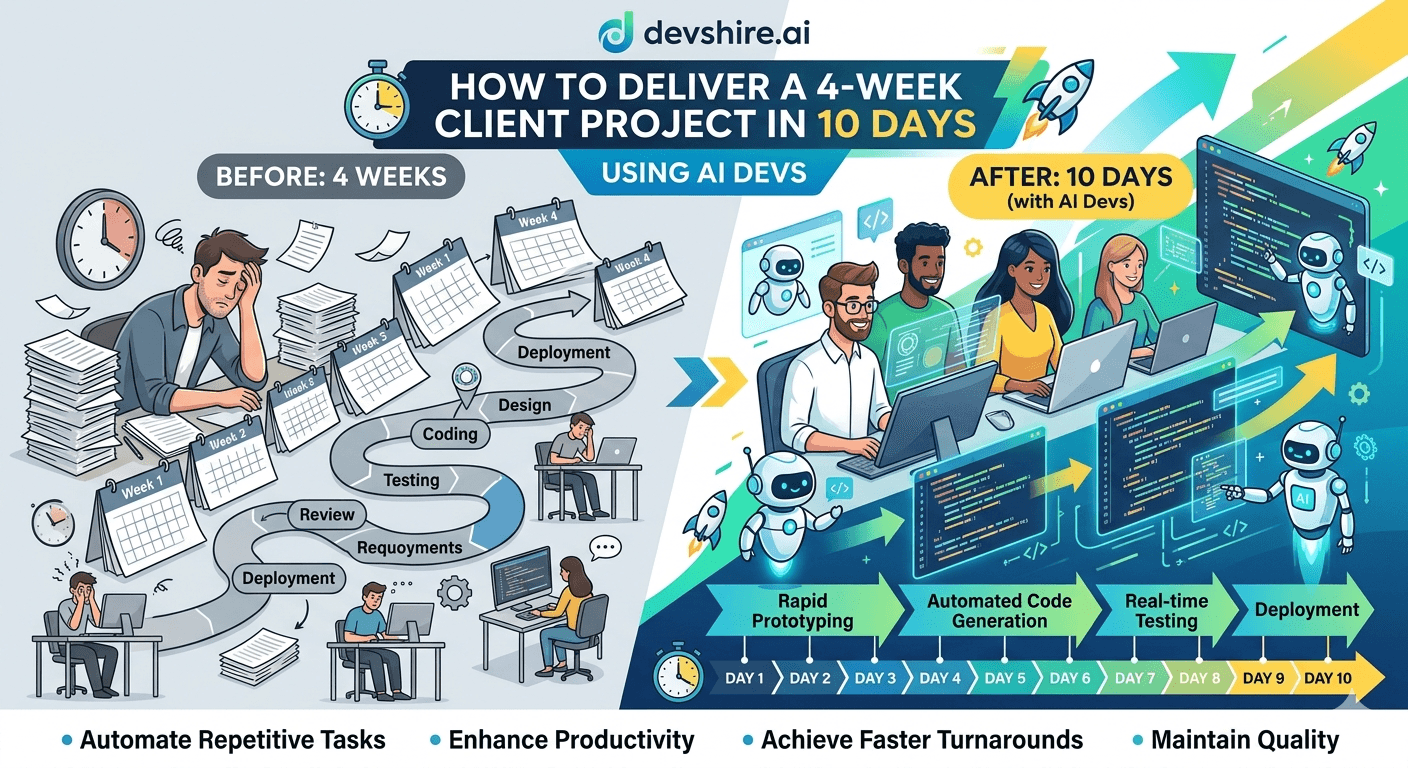
The client gave you four weeks. You told them you'd aim for three. But with your AI-assisted developer on it, you shipped in ten days. That kind of delivery speed isn't luck — it's a process. And it's repeatable. The gap between a 4-week project and a 10-day delivery isn't just about having faster developers. It's about removing all the non-development friction that bloats every project timeline. Here's the exact playbook.
💡 TL;DR
Delivering a 4-week project in 10 days requires three things: a fully resolved brief before day one, a developer who builds with AI-native tools, and a review cycle that runs in parallel rather than sequentially. Most projects waste 40–50% of their timeline on back-and-forth that should have happened before the first line of code was written. Eliminate that friction and the timeline collapses — in the best way.
Where the 4 Weeks Actually Go (It's Not the Coding)
Most people assume a 4-week project is 4 weeks of development. It's not. In a typical client project, actual development accounts for maybe 30–40% of the calendar time. The rest goes to brief clarification, back-and-forth on designs, waiting for client approvals, and sequential review cycles.
An AI-assisted developer can cut the development portion by 50–60%. But if you don't fix the other 60% of the timeline, you still end up at 4 weeks. The whole process needs to be rebuilt for speed — not just the coding part.
Project Phase | Traditional Timeline | AI-Optimised Timeline | How the Time Is Saved |
|---|---|---|---|
Brief resolution | 3–5 days | Day 0 (pre-start) | Brief template completed before kick-off |
Initial build | 10–14 days | 3–5 days | AI-assisted developer, clear scope |
Client review round 1 | 3–5 days | 1 day (async video + written feedback) | Async review format with deadline |
Revisions | 4–7 days | 1–2 days | AI-assisted, pre-scoped revision list |
QA and handoff | 5–7 days | 2–3 days | Parallel QA during revisions |
Day 0: The Brief That Makes Everything Else Fast
The biggest time sink in any client project isn't the development — it's the questions that come up mid-build because the brief wasn't resolved upfront. Every ambiguity in the brief becomes a back-and-forth email chain during the sprint. And each of those chains adds a day.
For a 10-day delivery, the brief must be fully resolved before the developer writes a single line. That means all design decisions made, all API access granted, all third-party credentials shared, and all "we'll figure that out later" items explicitly deferred to a phase two or removed from scope.
📦 The pre-start brief checklist
Before day one: final designs or wireframes locked, all API keys and third-party access shared, tech stack confirmed, acceptance criteria written for every deliverable, and out-of-scope items explicitly listed. If any of these are missing on day one, push the start date — not the deadline.
Parallel Review: The One Process Change That Saves the Most Time
Most projects run sequentially: developer builds → client reviews → developer revises → client approves → QA → handoff. Each phase waits for the previous one to end. That sequential structure alone accounts for 1–2 weeks of calendar time on a typical project.
For a 10-day delivery, QA starts on day 5 in parallel with the build. Client review happens on day 6 while QA is still running. Revisions are scoped and prioritised on day 7 before review is even complete. You're not rushing — you're just removing the waiting.
In practice, this means your project manager (or you) needs to be actively co-ordinating across developer, QA, and client simultaneously from mid-sprint. That's more demanding than sequential management. But it's the process that gets you to day 10.
How to Get Client Feedback in 24 Hours, Not 5 Days
Client review rounds are one of the biggest time drains in any agency project. The client has competing priorities. Feedback trickles in over four days. Half of it contradicts the other half. By the time you have a complete picture, a week is gone.
🎯 Send a 5-minute Loom walkthrough, not a live demo request
Async video walkthroughs get faster responses than "can we jump on a call to show you the build?" Loom lets the client watch on their schedule, pause and re-watch, and leave timestamped comments. Set a 24-hour feedback deadline — not as pressure, but as a project norm agreed upfront.
📋 Give them a structured feedback form, not a blank email
"What do you think?" gets rambling feedback. A structured form with three questions — what works, what needs to change, and what's a nice-to-have vs a must-have — gets actionable feedback. The distinction between must-have and nice-to-have alone saves you from revising things that don't matter.
Trusted by 500+ startups & agencies
"Hired in 2 hours. First sprint done in 3 days."
Michael L. · Marketing Director
"Way faster than any agency we've used."
Sophia M. · Content Strategist
"1 AI dev replaced our 3-person team cost."
Chris M. · Digital Marketing
Join 500+ teams building 3× faster with Devshire
1 AI-powered senior developer delivers the output of 3 traditional engineers — at 40% of the cost. Hire in under 24 hours.
The Bottom Line
The coding is only 30–40% of a typical project timeline. Fixing the other 60% — brief friction, sequential reviews, waiting for approvals — is where the 10-day delivery comes from.
Resolve the brief fully before day one. Every ambiguity that enters the sprint adds a back-and-forth email chain that costs at least a day.
AI-assisted developers cut the initial build phase from 10–14 days to 3–5 days on comparable feature work — but only if the scope is locked before they start.
Run QA in parallel with the build from day 5. Sequential process structure adds 1–2 weeks to most projects for no reason other than habit.
Use async video walkthroughs (Loom) for client review with a 24-hour feedback deadline. Live demos take 3–5 days to schedule and produce slower, less specific feedback.
A structured feedback form (what works / what changes / must-have vs nice-to-have) cuts revision scope by 30–40% compared to open-ended feedback requests.
Frequently Asked Questions
How can you realistically deliver a 4-week project in 10 days?
By fixing the non-development time sinks that inflate most project timelines. Development with AI-assisted developers is 50–60% faster. But the bigger gains come from resolving the brief before day one, running QA in parallel with the build, and using async review formats with 24-hour feedback deadlines. The calendar time collapses when you remove sequential waiting.
What's the biggest risk of fast delivery for client projects?
Scope creep mid-sprint. When clients see fast progress, they add things. The fix is a clear change order process agreed before the project starts, and a project manager (or you) actively protecting scope during the sprint. Speed only compounds if the scope stays stable.
How do I get clients to give feedback faster during the review stage?
Send a 5-minute Loom walkthrough instead of requesting a live demo call. Include a structured feedback form with three specific questions. Set a 24-hour feedback deadline as a project norm established at kickoff — not as a last-minute request. Clients respond faster when the format is easy and the expectation is clear.
Does faster delivery mean worse quality?
Not if your review process is tight. AI-assisted developers generate code faster, but QA still runs the same checks. The difference is that QA runs in parallel — starting on day 5 while the developer is still building, not sequentially after the build ends. Speed and quality are compatible when the process is right.
What needs to be in place before the project can start for a 10-day delivery?
Final designs or wireframes locked, all API keys and third-party access shared, tech stack confirmed, acceptance criteria written for every deliverable, and out-of-scope items explicitly listed. If anything on that list is missing on day one, push the start date. Starting with ambiguity guarantees a longer timeline than starting a day later with clarity.
Can every client project be delivered in 10 days?
No. Complex integrations, large feature sets, and projects with multiple stakeholders have natural time floors. The 10-day target works for bounded, well-scoped builds — single features, internal tools, MVPs with 3–5 screens. Larger projects compress significantly with this process, but not to 10 days. Set the right target before you promise the timeline.







Devshire Team
San Francisco · Responds in <2 hours
Hire your first AI developer — this week
Book a free 30-minute call. We'll match you with the right developer for your project and get you started within 24 hours.
<24h
Time to hire
3×
Faster builds
40%
Cost saved