
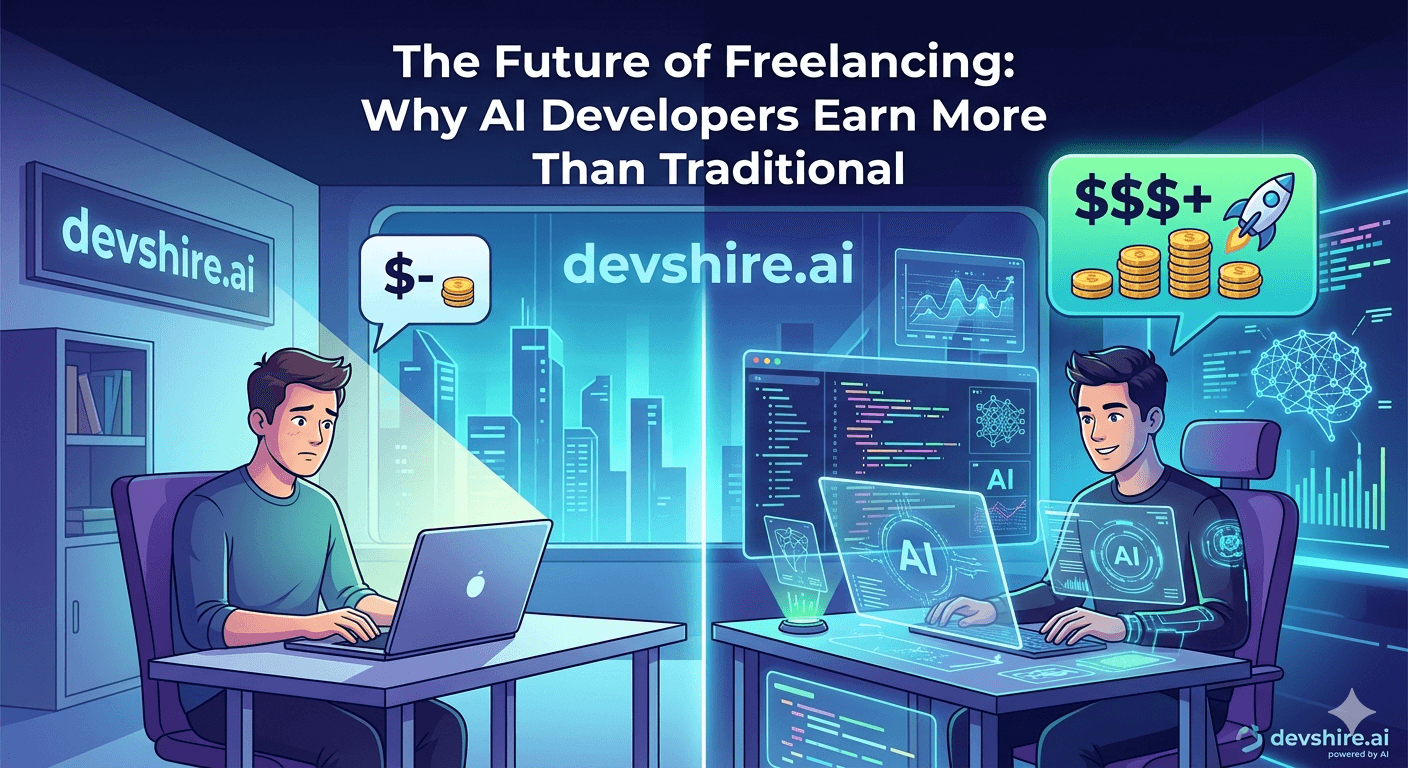
Two freelance developers. Same city, same experience level, same kind of clients. One is billing $65/hour and turning down work because she's at capacity. The other is billing $95/hour, taking fewer projects, and still earning more. The difference isn't specialisation, portfolio, or reputation. It's that one of them rebuilt her workflow around AI tools 18 months ago and the other hasn't. This is the freelancing income gap that's opening up right now — quietly, without much fanfare — and it's widening every quarter.
💡 TL;DR
AI developers are out-earning traditional freelancers by 20–40% for equivalent work in 2026. The premium comes from three compounding advantages: faster delivery (which justifies higher day rates), lower per-project cost to clients (which makes the higher rate easier to sell), and access to a narrower, higher-value market segment that specifically seeks AI-native developers. Freelancers who make the switch to AI-native workflows consistently report hitting their previous annual revenue in 7–8 months instead of 12.
The Income Gap Is Real — Here's the Data
Freelance developer rate surveys have consistently shown a widening gap between AI-augmented and traditional developers since 2024. According to Toptal's 2025 Freelance Developer Rate Report, developers who self-identify as AI-native bill at a median of 28% more than equivalent traditional developers across comparable skill levels and geographies. [EXTERNAL LINK: Toptal Freelance Developer Rate Report 2025 → freelance developer rate benchmarks by skill type]
But the headline rate differential understates the real income gap. Because AI developers ship faster, they also complete more projects per year. A traditional freelancer billing $75/hour who takes 6 weeks to complete a project earns less total revenue than an AI developer billing $95/hour who completes the same scope in 3.5 weeks — even accounting for time between projects. The gap isn't just in rate. It's in throughput.
Metric | Traditional Freelancer | AI-Augmented Freelancer |
|---|---|---|
Median day rate (senior full-stack) | $500–$700 | $700–$1,100 |
Average project duration (comparable scope) | 4–6 weeks | 2–3.5 weeks |
Projects completable per year | 7–9 | 12–16 |
Estimated annual revenue (senior level) | $95,000–$140,000 | $160,000–$240,000 |
Client retention rate | Average | Higher — speed creates loyalty |
Why Clients Willingly Pay More for AI Developers
This is the part that surprises most traditional freelancers: clients aren't grudgingly paying the premium. Most are happy to. The reason is simple maths from their side of the table.
A traditional freelancer charging $700/day takes 25 days to complete a project. Total cost: $17,500. An AI developer charging $950/day takes 12 days to complete the same project. Total cost: $11,400. The AI developer costs 36% less per project despite billing 36% more per day. That's a genuinely easy conversation to have with a client who cares about project cost rather than day rate — which is almost every client.
The pitch isn't "I'm more expensive." The pitch is "this project will cost you less and ship three weeks earlier." That's a completely different conversation, and it almost always wins. [INTERNAL LINK: how to price development projects with AI → /blog/price-development-projects-ai-developers]
📌 Real-World Example
A freelance developer in Berlin switched to an AI-native workflow in early 2024. Before the switch: billing €650/day, averaging 5-week projects. After: billing €900/day, averaging 2.5-week projects. Same client base, same type of work. Annual revenue went from €110,000 to €195,000 without adding a single new client type or expanding into new markets. The workflow change did it.
The Positioning Shift That Makes the Rate Stick
Raising your rate as a freelancer is usually a slow, awkward process. You worry about losing clients. You hedge. You raise it 10% and see what happens. The AI developer positioning shift is different — it's not a rate increase, it's a repositioning. And repositioning changes the conversation entirely.
The move: stop selling developer hours and start selling project outcomes with a speed guarantee. "I deliver comparable feature work 40–60% faster than a traditional developer, with the same QA process" is a value proposition that justifies a higher number before the client even asks about rate. You're not asking them to pay more for the same thing — you're showing them a better deal.
🎯 Before the repositioning
"I'm a full-stack developer with 6 years of experience. I specialise in React and Node. My rate is $700/day." This positions you as an interchangeable commodity. The client's next move is to compare you to the next developer on the list.
🚀 After the repositioning
"I deliver React and Node projects 40–60% faster than a traditional developer, using an AI-native workflow with the same QA bar. Most clients find the total project cost is lower despite my day rate." This positions you in a different category. The client's next move is to ask how that's possible — which is the conversation you want to have.
What the AI-Native Freelance Workflow Actually Looks Like
Not gonna lie — the transition takes a few weeks to feel natural. But the workflow itself isn't complicated. Here's what it looks like day-to-day for a freelance developer who has made the shift.
🛠️ Core toolstack
Cursor AI as the primary IDE, Claude 3.5 Sonnet as the default model for complex tasks and code review, GitHub Copilot as a secondary autocomplete layer for some developers. Most AI-native freelancers spend around $50–$80/month on tooling — which pays back in the first day of additional revenue per month. [INTERNAL LINK: best AI coding tools for developers → /blog/best-ai-coding-assistant-2026]
📋 Brief-first discipline
AI-native freelancers invest more time upfront resolving the brief before building starts. A fully resolved brief on day zero means Cursor's Composer feature works with clear context — which is where the speed multiplier actually comes from. Vague briefs produce slow AI-assisted development, not fast. The discipline is pre-build clarity, not just better tooling.
🔍 Output validation as a non-negotiable step
Every AI-generated module gets reviewed before it merges. Not because the developer doesn't trust the model — but because catching a hallucinated variable before the client sees it is the professional standard. This review step is what separates an AI-native freelancer from a vibe coder. It adds 15–20% to build time and prevents 100% of the client calls about production bugs that weren't caught in review.
Trusted by 500+ startups & agencies
"Hired in 2 hours. First sprint done in 3 days."
Michael L. · Marketing Director
"Way faster than any agency we've used."
Sophia M. · Content Strategist
"1 AI dev replaced our 3-person team cost."
Chris M. · Digital Marketing
Join 500+ teams building 3× faster with Devshire
1 AI-powered senior developer delivers the output of 3 traditional engineers — at 40% of the cost. Hire in under 24 hours.
Where AI-Native Freelancers Are Finding High-Value Clients
The highest-paying clients for AI-native freelancers aren't on Upwork or Fiverr. They're on platforms that specifically vet for AI development capability, in niche developer communities where AI-native workflows are the norm, and through direct referrals from clients who've already experienced the speed difference. [INTERNAL LINK: best platforms to hire AI developers online → /blog/best-platforms-hire-ai-developer-online]
Platforms like devshire.ai pre-screen for AI toolchain proficiency before surfacing candidates to clients — which means the clients coming through are specifically looking for what you offer, at the rates it commands. General freelance platforms work too, but you'll spend more time filtering clients who are price-shopping rather than value-shopping. The audience quality difference is significant.
Fair warning: switching to an AI-native positioning on a general platform without an updated portfolio and a specific case study with timeline data won't work. The positioning shift requires proof — not just a claim. Build one strong before-and-after case study showing scope, timeline, and quality outcome, and that single document will do more work than any profile update.
The Specialisation Premium on Top of the AI Premium
AI-native developers who also specialise in a specific domain or stack earn more still. An AI-native freelancer specialising in LLM integrations for SaaS products, or in AI workflow automation for e-commerce operations, is accessing a narrower market with less competition and higher willingness to pay. The generalist AI developer premium is 20–40% over traditional. The specialist AI developer premium is 40–70% or more.
The specialisation doesn't have to be deep ML engineering. It can be: AI-native development for fintech products, Python backend with LLM integration for SaaS companies, or React frontends for AI-powered tools. Domain specificity plus AI-native workflow is the highest-earning combination in freelance development right now. [INTERNAL LINK: vetted AI developers for hire → /blog/vetted-ai-developers-for-hire]
What Goes Wrong When Freelancers Try to Make the Switch
Three failure patterns come up consistently when freelancers try to transition to AI-native positioning and don't quite get there.
⚡ Failure 1: Claiming the positioning without the workflow
Updating your LinkedIn to say "AI-native developer" without actually rebuilding your workflow is the fastest way to damage your reputation. One project where you don't deliver at the speed you promised, and the client tells everyone. The positioning has to follow the capability — not precede it.
🐛 Failure 2: Skipping the output validation step
Developers who get excited about AI speed and skip review are the ones getting one-star reviews for production bugs. The validation step is not optional — it's the professional standard that justifies the premium rate. Fast and unreliable is worse than slow and reliable in client retention terms.
🔧 Failure 3: Competing on rate instead of value
Some freelancers make the switch to AI tools and then lower their rate because they feel guilty charging more when the work takes less time. This is the same mistake agencies make — and it has the same fix. You're not charging for time. You're charging for outcome and reliability. Hold the rate. Justify it with the timeline and quality case study. The guilt goes away when the invoice gets paid.
The Bottom Line
AI-native freelancers are out-earning traditional equivalents by 20–40% on day rate — and by significantly more on annual revenue, because higher throughput compounds across the year.
Clients pay the premium willingly because the total project cost is often lower despite the higher day rate. A 3.5-week project at $950/day costs less than a 6-week project at $700/day. That's the pitch.
The positioning shift — from selling hours to selling outcomes with a speed guarantee — is what makes the higher rate stick. Without the repositioning, a rate increase is just a rate increase.
The AI-native freelance workflow requires brief-first discipline, a validated output review step, and a core toolstack costing $50–$80/month that pays back in the first day of additional revenue per month.
Specialisation on top of AI-native workflow produces the highest earning potential: 40–70%+ premium over traditional developers for domain-specific AI development work.
Never claim the AI-native positioning before rebuilding the workflow. The positioning must follow the capability — one project that doesn't deliver on the speed promise does more damage than the premium is worth.
Frequently Asked Questions
Why do AI developers earn more than traditional freelancers?
Three compounding reasons: they deliver faster (which justifies a higher day rate), the total project cost to clients is often lower despite the higher rate (which makes it easy to sell), and they access a narrower, higher-value market segment specifically seeking AI-native capability. The income gap isn't just in day rate — it's in annual throughput. Completing 14 projects a year instead of 8 at a higher per-project rate produces a dramatically different annual income.
How much more do AI freelance developers earn compared to traditional developers?
AI-native freelancers command a 20–40% day rate premium over traditional equivalents at the same experience level. On annual revenue, the gap is wider — AI developers completing 12–16 projects per year versus 7–9 for traditional developers, at a higher per-project rate, typically produce 60–80% more annual revenue at the senior level. Senior AI-augmented freelancers in the US are billing $700–$1,100/day in 2026.
How do I transition from a traditional to an AI-native freelance workflow?
Start with the tooling: Cursor AI as your primary IDE, Claude 3.5 Sonnet as your default model for complex tasks. Spend 2–3 weeks rebuilding your workflow around these tools on a real project — not a side project, a paid one. Then build one case study documenting scope, timeline, and quality outcome. That case study is your proof of positioning. Raise your rate only after you have that proof — not before.
How do I convince clients to pay a higher rate for AI-assisted development?
Don't lead with the rate — lead with the total project cost comparison. Show that your 12-day project at $950/day costs $11,400 versus a traditional developer's 25-day project at $700/day costing $17,500. The premium disappears and becomes a discount when framed correctly. One specific case study with real timeline data closes this conversation faster than any amount of explanation.
Do I need to tell clients I use AI tools?
You don't need to lead with it, but don't hide it if asked. Frame it as a process efficiency: your AI-native workflow lets you deliver at higher speed with the same QA standard. Most clients care about outcomes and timeline — not which tools you use. If a client objects to AI tool use, that's usually a quality concern you can address by explaining your output validation process, not a fundamental objection to the value you're delivering.
What's the best platform for AI-native freelancers to find high-value clients?
Specialist platforms that pre-screen for AI development capability — like devshire.ai — deliver clients who are specifically looking for AI-native developers at the rates they command. General platforms like Upwork work but require more filtering to find clients who are value-shopping rather than price-shopping. Developer communities (LangChain Discord, HumanLoop Slack) and direct referrals from past clients are the other two high-value channels.
Is the AI freelance developer premium sustainable long-term?
The premium will compress as AI-native development becomes the norm rather than the exception — but that compression is likely 3–5 years out, not imminent. Right now, the gap between adapted and unadapted developers is wide enough that the premium is real and defensible. The freelancers who will maintain premium positioning long-term are those adding domain specialisation on top of AI-native workflow — that combination creates a more durable competitive position than AI tools alone.







Devshire Team
San Francisco · Responds in <2 hours
Hire your first AI developer — this week
Book a free 30-minute call. We'll match you with the right developer for your project and get you started within 24 hours.
<24h
Time to hire
3×
Faster builds
40%
Cost saved