
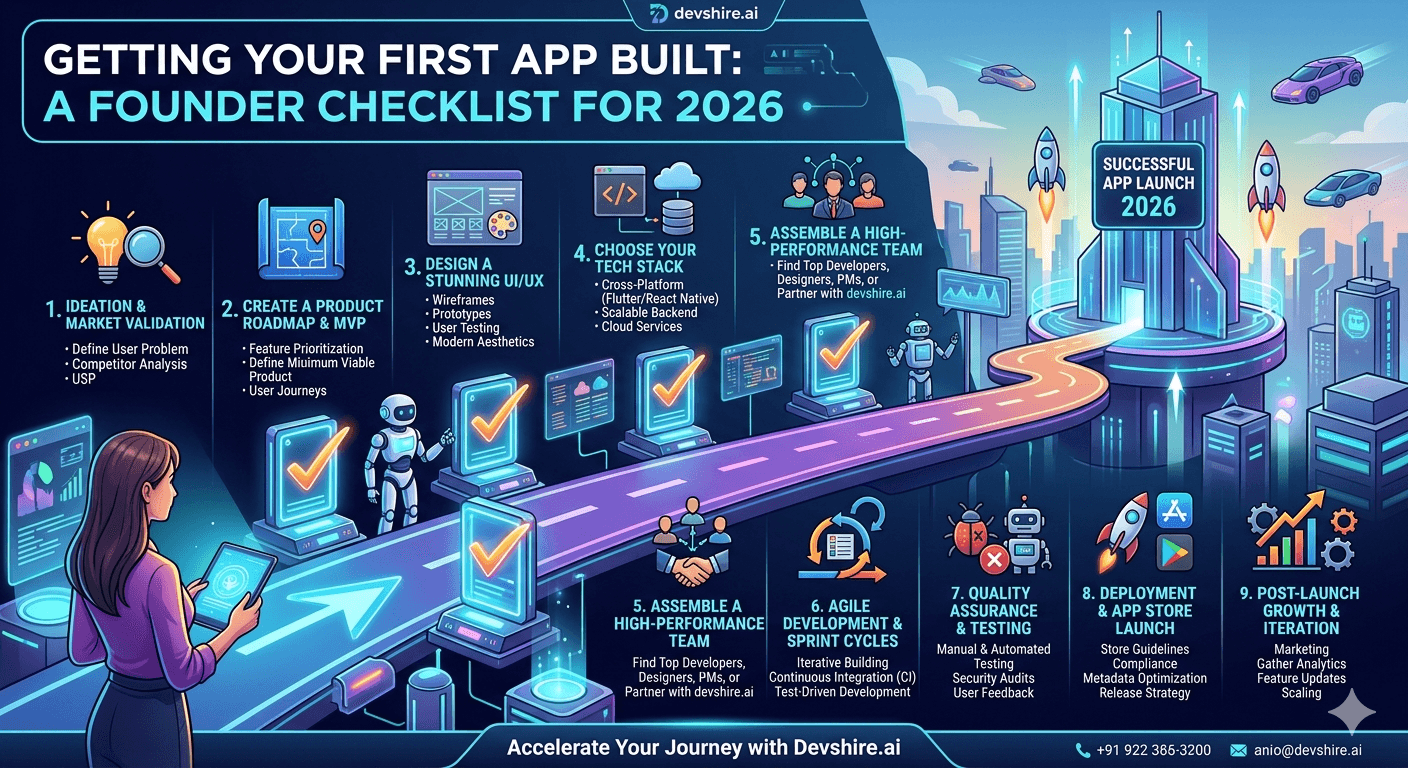
Most first-time founders don't fail to ship because their idea is bad. They fail because they start building before they've answered three or four questions that seem obvious in retrospect. The developer gets hired. The work begins. And then — six weeks in — you realise the brief was too vague, the scope was too wide, and you've spent $15,000 building something that doesn't quite solve the problem you started with. This checklist exists to stop that from happening to you.
💡 TL;DR
Before you hire a developer and start building, you need: a validated problem (not just an idea), a one-page product brief with defined scope, a clear success criterion for the first version, and a realistic budget that includes a 20–25% contingency. Most first apps that fail to ship do so because of unclear scope and underfunded contingency — not because the developer was bad or the idea was wrong.
Before You Hire Anyone: The Pre-Build Checklist
This is the stage most first-time founders rush through. Don't. Every hour you spend here saves three hours in the build.
✅ Validate the problem before validating the solution
Talk to at least 10 potential users about the problem before writing a line of spec. Not about your app — about their problem. You're looking for: do they have the problem, how are they solving it now, and how painful is it? If fewer than 7 of 10 say it's a real problem they'd pay to solve, the idea needs rethinking before the build starts.
✅ Define your MVP scope in one page
The minimum viable product should do one thing well for one type of user. Not three things for three user types. Write a one-page brief: what the app does, who uses it, what a successful first version looks like, and what's explicitly out of scope for v1. If the out-of-scope list is shorter than the in-scope list, you're building too much.
✅ Set a clear success criterion for v1
"The app works" is not a success criterion. "10 beta users can complete the core workflow without asking for help" is. Define this before you start so both you and your developer know what done looks like. Without this, scope creep is inevitable — there's always one more thing the app "needs" before it's ready.
✅ Budget with a 20–25% contingency
Whatever your developer quotes, add 20–25% for integration surprises, scope clarifications, and the inevitable third-party API that behaves differently than documented. Most first-time founders budget for the quote and run out of runway at 80% done. Don't be that founder.
The Hiring Checklist: Before Your Developer Writes a Line of Code
✅ Run a paid trial task before committing
Give your shortlisted developer a real, scoped task from your actual backlog — 4–6 hours of work, paid at their rate. Evaluate: did they ask good clarifying questions? Did they deliver on time? Did the output match the brief? A small paid test is the best predictor of a longer engagement you'll find.
✅ Agree the full scope in writing before work starts
A written scope document — deliverables, exclusions, revision rounds, timeline, and payment milestones — protects both you and your developer. Verbal agreements about scope always diverge over time. "I thought that was included" is the most expensive sentence in early-stage product development.
✅ Set up a project management tool from day one
Linear, Jira, or even a well-structured Notion board. Every task lives there. Nothing is managed over WhatsApp or email threads. This isn't bureaucracy — it's the only way to track what was promised, what's in progress, and what's done without spending half your week asking for updates.
During the Build: The Weekly Rhythm
Cadence | What Happens | Who Does It |
|---|---|---|
Weekly | 30-min check-in: what shipped, what's in progress, what's blocked | You + developer |
Every sprint end | Demo of what was built — not a status update, a working demo | Developer shows, you test |
Any time scope changes | Written change order before work starts on the new item | You initiate, developer confirms |
Monthly | Budget review — actual spend vs projected, contingency remaining | You track this — don't wait for surprises |
After You Ship: The Post-Launch Checklist
Shipping v1 is not the finish line. It's the starting gun. Here's what needs to happen in the two weeks after your first version goes live.
🚀 Get your first 10 users on it within 48 hours
Not a waitlist. Not "coming soon." Real users completing the core workflow. Watching someone use your app for the first time will tell you more in 20 minutes than three months of building in isolation. Schedule user calls immediately after launch — not in two weeks.
🐛 Track bugs separately from feature requests
Post-launch feedback will be a mix of bugs (things that are broken) and feature requests (things people want added). Fix bugs first, always. Feature requests go on a prioritised backlog for v2 planning. Treating every piece of feedback as equally urgent is how you end up with a developer fixing six things simultaneously and nothing shipping cleanly.
Trusted by 500+ startups & agencies
"Hired in 2 hours. First sprint done in 3 days."
Michael L. · Marketing Director
"Way faster than any agency we've used."
Sophia M. · Content Strategist
"1 AI dev replaced our 3-person team cost."
Chris M. · Digital Marketing
Join 500+ teams building 3× faster with Devshire
1 AI-powered senior developer delivers the output of 3 traditional engineers — at 40% of the cost. Hire in under 24 hours.
The Bottom Line
Validate the problem with at least 10 user conversations before writing a spec — not the solution, the problem.
Define your MVP as one thing done well for one user type. If the out-of-scope list is shorter than the in-scope list, you're building too much.
Budget with 20–25% contingency. Most first apps that stall do so because the founder ran out of budget at 80% done, not because the developer was bad.
Run a paid trial task before committing to any developer. 4–6 hours of real work at their rate is the best predictor of a longer engagement.
Use a project management tool from day one. Nothing is managed over WhatsApp or email threads — every task lives in the board.
Get real users on your app within 48 hours of launch. Watching someone use v1 teaches you more than months of building in isolation.
Frequently Asked Questions
What should a first-time founder do before getting an app built?
Validate the problem (not just the idea) with at least 10 potential user conversations, define a one-page MVP scope with an explicit out-of-scope list, set a clear success criterion for v1, and budget with a 20–25% contingency on top of any developer quote. These four steps prevent most of the expensive mistakes first-time founders make during the build.
How much should a first app cost to build in 2026?
A well-scoped MVP with 3–5 core screens and basic user auth typically runs $8,000–$15,000 with an AI-assisted developer, or $15,000–$30,000 with a traditional developer or small agency. Add 20–25% contingency to whatever you're quoted. Costs vary significantly by complexity, location, and whether you're using a freelancer, agency, or platform like devshire.ai.
How long does it take to build a first app?
A well-scoped MVP with an AI-assisted developer typically takes 3–6 weeks from brief to shipped v1. Traditional developers take 6–12 weeks for comparable scope. Timeline is directly proportional to how clearly the brief is defined — vague scope adds weeks, not days. A fully resolved brief before day one is the single biggest timeline accelerator available.
Should I hire a freelancer or an agency to build my first app?
For a first MVP, a senior freelancer or a small specialist agency (2–4 people) typically outperforms a large agency on both cost and communication clarity. Large agencies add project management overhead that slows down small builds. Freelancers require more founder oversight but are faster to start and more cost-effective for bounded scope work. Platforms like devshire.ai give you pre-vetted options in both categories.
What's the biggest mistake first-time founders make when building their first app?
Building too much in v1. Every feature you add to the first version multiplies the build time, the testing surface, and the budget required. The question isn't "what should the app have?" — it's "what's the absolute minimum that lets a user experience the core value?" Everything else is v2. Most first apps that fail to ship were killed by scope, not by bad execution.
How do I make sure I don't run out of money before the app is finished?
Three things: define scope tightly before agreeing a price, add 20–25% contingency to your budget before work starts, and track actual spend against projected spend weekly — not monthly. Scope creep and underfunded contingency are the two budget killers. Both are preventable with upfront discipline and weekly tracking during the build.







Devshire Team
San Francisco · Responds in <2 hours
Hire your first AI developer — this week
Book a free 30-minute call. We'll match you with the right developer for your project and get you started within 24 hours.
<24h
Time to hire
3×
Faster builds
40%
Cost saved