
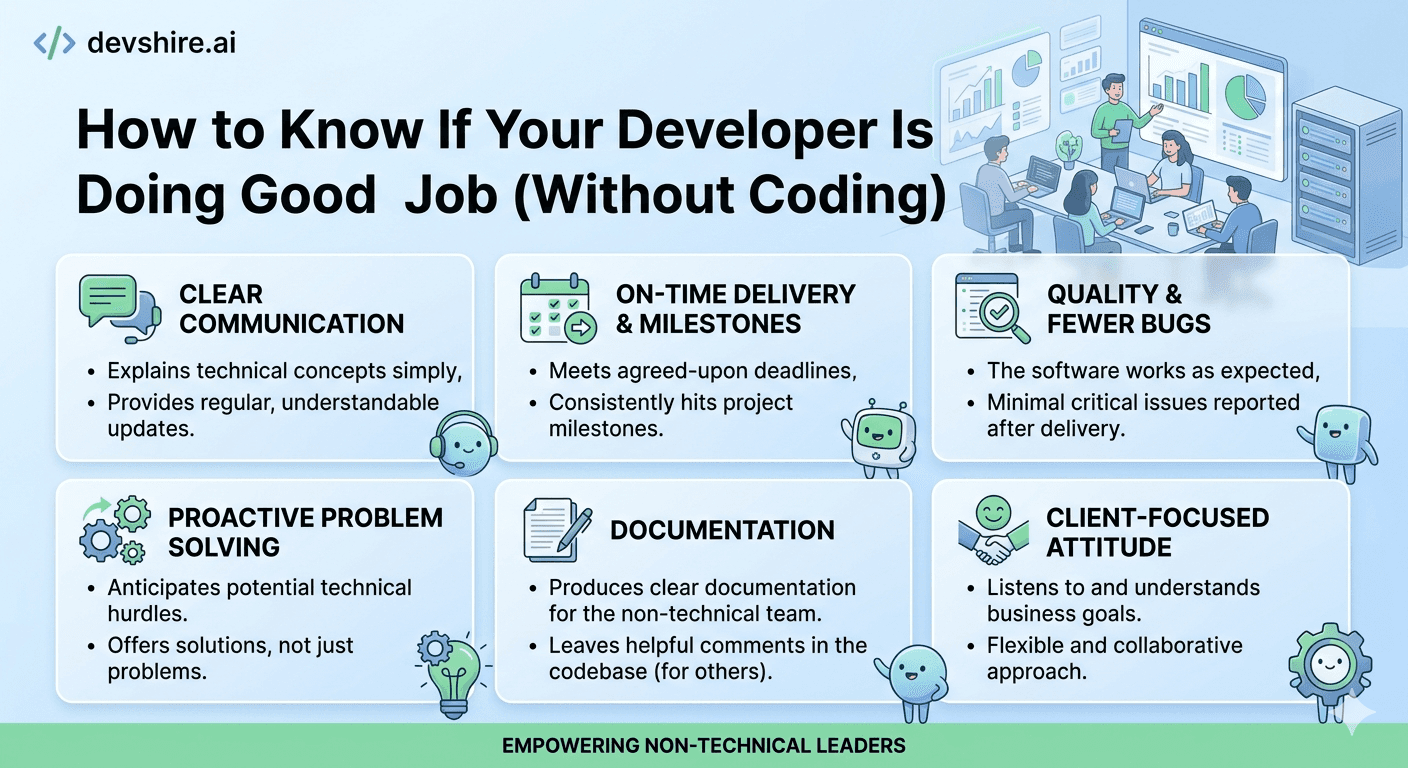
Three months in. Your developer is busy — or at least they look busy. Things are getting built — or at least something is being committed to GitHub. But you genuinely have no idea if what's happening is good, average, or quietly on fire. This is one of the most common and most uncomfortable positions a non-technical founder ends up in. The good news: you don't need to read code to evaluate developer performance. You need to track the right signals.
💡 TL;DR
Developer performance for non-technical founders comes down to four measurable signals: delivery against commitments, estimate accuracy, bug rate after shipping, and communication quality. You don't need to read code to track any of these. A developer who consistently ships what they committed, estimates within 20–30% accuracy, produces low post-ship bug counts, and communicates blockers early is a strong developer — regardless of what the code looks like internally.
The Four Signals That Tell You Everything
Most non-technical founders either over-rely on gut feel or try to evaluate code they can't read. Neither works. Here are the four signals that give you an accurate picture of developer performance without any technical knowledge required.
Signal | What to Measure | Good Benchmark | Warning Sign |
|---|---|---|---|
Delivery vs commitment | Did what was promised in the sprint ship? | 80%+ of committed tickets ship on time | Consistent slippage with vague reasons |
Estimate accuracy | Did the two-day task take two days? | Within 30% of estimate consistently | Estimates that double or triple regularly |
Post-ship bug rate | How many bugs appear after each release? | Fewer than 2–3 significant bugs per sprint | Regular production issues after shipping |
Communication quality | Do blockers surface early or after deadlines? | Blockers flagged same day they appear | Surprises at deadline, not before |
Signal 1: Delivery Against Commitments
This is the most important signal. At the start of every sprint, your developer commits to a set of tickets. At the end, you count how many shipped. That's it. No technical knowledge required.
A developer shipping 80%+ of committed work consistently is performing well on velocity. Consistent slippage — especially when accompanied by vague explanations rather than specific reasons — is a real performance signal. One slow sprint is normal. Three in a row is a pattern worth addressing directly.
The key distinction: "The API integration was more complex than scoped because the third-party documentation was wrong" is a legitimate explanation. "Things were just complicated this week" is not. Ask for the specific reason every time something doesn't ship on time.
Signal 2: Estimate Accuracy Over Time
Estimate accuracy is one of the most honest indicators of developer experience and self-awareness. A senior developer who regularly builds similar things will estimate within 20–30% of actual time. A developer who consistently underestimates by 100–200% either lacks experience with the task type or isn't being honest with themselves — or you — about complexity.
Track this over time, not per task. One bad estimate is normal — complexity surprises happen. A consistent pattern of underestimation tells you something real: either the developer is optimistic to avoid difficult conversations, or they're genuinely not experienced enough in the area to scope it accurately. Both matter, and they require different responses.
Signal 3: Communication Quality — The Easiest One to Miss
Here's the one most non-technical founders overlook: how early does your developer flag problems? A developer who tells you on Friday afternoon that the feature won't be ready for Monday's demo is a developer who knew earlier and didn't say so. That's not a communication style preference — it's a professional responsibility gap.
Strong developers surface blockers the day they encounter them. Not because they're covering themselves, but because they understand that your timeline planning depends on that information. A developer who consistently surfaces blockers early, even when it means delivering bad news, is more valuable than one who always sounds optimistic until they don't.
📌 How to make early communication the norm
Set the expectation explicitly on day one: "If you hit a blocker that might affect a deadline, I need to know the same day — not on deadline day. I'd rather adjust the plan early than be surprised late." Most developers will follow this norm once it's stated clearly. Developers who still don't are showing you something about how they work under pressure.
Trusted by 500+ startups & agencies
"Hired in 2 hours. First sprint done in 3 days."
Michael L. · Marketing Director
"Way faster than any agency we've used."
Sophia M. · Content Strategist
"1 AI dev replaced our 3-person team cost."
Chris M. · Digital Marketing
Join 500+ teams building 3× faster with Devshire
1 AI-powered senior developer delivers the output of 3 traditional engineers — at 40% of the cost. Hire in under 24 hours.
Using AI to Evaluate Code Quality Without Reading Code
You don't need to read code fluently to get a sense of code quality. Paste a function or module into Claude and ask: "Explain what this does, flag anything that seems unnecessarily complex, and note any obvious issues." You'll get a plain-language summary that tells you whether the code is straightforward or riddled with complexity that shouldn't be there.
This isn't about auditing your developer or catching them out. It's about building enough context to have an informed conversation. "I was looking at the authentication module and Claude flagged some complexity around the session handling — can you walk me through why it's structured that way?" is a legitimate, useful question. Good developers will welcome it. Developers with something to hide won't.
What to Do When the Signals Are Bad
If multiple signals are consistently negative over two to three sprints, you have a performance problem — not a communication problem. Here's how to handle it without guessing.
⚡ First: have a direct conversation with specific data
"Over the last three sprints, 40% of committed work hasn't shipped on time. Here are the specific tickets. What's causing this?" Data-driven conversations are harder to deflect than vague concerns. You want a specific explanation and a specific plan, not reassurance.
🔍 Second: get a technical second opinion if needed
If you're concerned about code quality and your direct conversation didn't resolve it, pay for a 2-hour code review from a senior developer you find separately. $200–$400 for an independent technical opinion on your codebase is cheap insurance. Platforms like devshire.ai can connect you with vetted senior developers for exactly this kind of review.
The Bottom Line
Track four signals: delivery vs commitments, estimate accuracy, post-ship bug rate, and communication quality. None require reading code.
A developer shipping 80%+ of committed work consistently is performing well on velocity — the benchmark most non-technical founders never set explicitly.
Estimate accuracy within 30% consistently is the sign of an experienced developer. Regular 100–200% underestimates signal either inexperience or a pattern of optimistic communication to avoid difficult conversations.
Blockers surfaced the day they appear are a green flag. Surprises at deadline are a red flag. Set this expectation explicitly on day one.
Use Claude or ChatGPT to get plain-language code explanations — not to audit your developer, but to build enough context for real conversations about the work.
If signals are consistently negative over 2–3 sprints, get an independent technical review before making any major decisions. $200–$400 for a senior developer's opinion is cheap relative to the cost of a wrong call.
Frequently Asked Questions
How can a non-technical founder evaluate a developer's performance?
Track four signals without reading any code: delivery against sprint commitments, estimate accuracy over time, post-ship bug rate, and how early blockers are flagged. A developer who consistently delivers what they committed, estimates within 30%, produces low post-ship bug counts, and surfaces problems early is a strong performer regardless of internal code quality.
How do I know if my developer is writing good code?
Use AI tools to get plain-language explanations. Paste code into Claude and ask it to explain what it does, flag unnecessary complexity, and note any obvious issues. This doesn't replace a proper technical review but gives you enough context to ask informed questions. For a definitive answer, pay for 2 hours with a senior developer to review the codebase — it's worth the investment.
What's a good sprint delivery rate for a developer?
80%+ of committed tickets shipping on time consistently is a strong benchmark. Some slippage is normal — unexpected complexity happens. The pattern matters more than any single sprint. Consistent slippage below 60–70% with vague explanations is a performance signal worth addressing directly with specific data.
How do I know if my developer's time estimates are accurate?
Track estimate vs actual time across multiple tasks over several sprints. A developer consistently within 30% of their estimates is experienced and self-aware. Consistent underestimation by 100%+ (a two-day task taking four or five days regularly) signals either genuine scope uncertainty they're not communicating, or a pattern of optimistic estimates to avoid difficult timeline conversations.
What should I do if I think my developer isn't performing well?
Have a direct conversation with specific data first: three sprints of delivery data, specific tickets that slipped, specific examples of late blocker communication. Give the developer the chance to explain and propose a fix. If the conversation doesn't produce a credible plan and things don't improve within one sprint, get an independent technical opinion from a senior developer before making any further decisions.
Is it normal for developers to miss sprint deadlines sometimes?
Yes — occasional slippage is normal and expected. Complexity surprises happen, requirements clarify mid-build, and integrations behave unexpectedly. The concern is a consistent pattern, not isolated incidents. If a developer is missing more than 20–30% of committed work regularly with vague explanations, that's a pattern worth addressing. One bad sprint is not.







Devshire Team
San Francisco · Responds in <2 hours
Hire your first AI developer — this week
Book a free 30-minute call. We'll match you with the right developer for your project and get you started within 24 hours.
<24h
Time to hire
3×
Faster builds
40%
Cost saved