
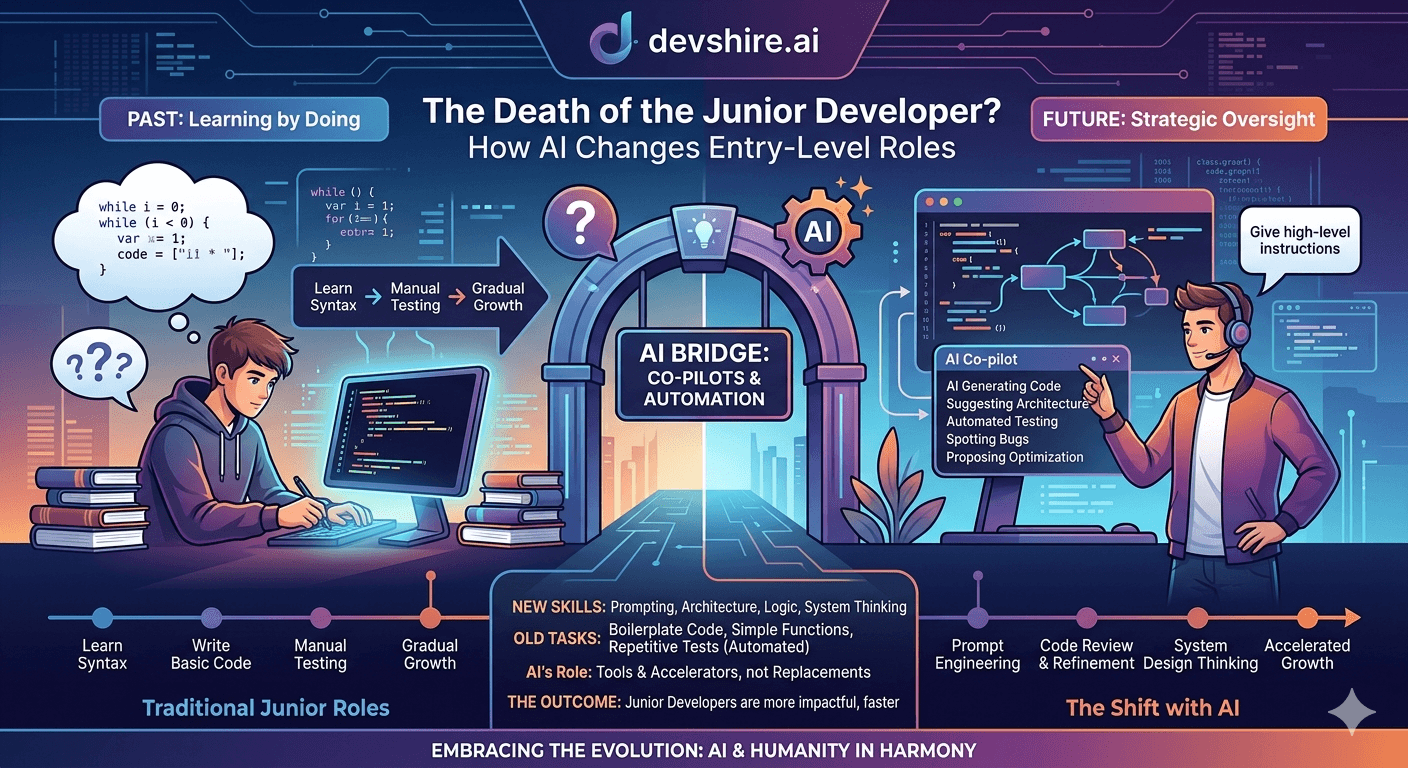
The hiring data is real and it's worth confronting directly. Entry-level developer job postings dropped by roughly 25% between 2023 and 2025 on major job boards. Bootcamp graduates are reporting longer job searches than their cohorts from three years ago. And teams that previously hired two junior developers for every senior are now hiring one senior and using AI tooling to cover the difference. So is the junior developer role disappearing? Not exactly — but it is transforming faster than any previous shift in the industry, and the developers who are thriving at entry level in 2026 look very different from those who are struggling. The difference isn't talent. It's whether they understand what the job now is.
💡 TL;DR
AI hasn't killed the junior developer role — it's replaced the lowest-value parts of it (boilerplate code, basic CRUD, copy-paste debugging) and raised the floor for what teams expect entry-level developers to contribute. Junior devs who thrive in 2026 are AI-native from day one, contribute real output in their first two weeks, and understand output validation well enough to catch model errors. Those who expect to learn on the job without AI tools are finding it very hard to get hired.
What AI Actually Replaced in Entry-Level Developer Work
Let's be specific about this. The "junior developer role" was never one thing — it was a bundle of tasks with varying skill requirements. AI has displaced the low-skill-ceiling tasks efficiently. The higher-judgment tasks remain and are, if anything, more important than before.
Task Type | AI displacement level | What's changed |
|---|---|---|
Boilerplate and scaffolding code | High | AI generates it in seconds — no longer a learning vehicle |
Basic CRUD endpoints | High | Copilot or Cursor generates these with a comment prompt |
Documentation writing | High | AI generates docs from code directly |
Copy-paste debugging from Stack Overflow | High | LLMs are better at this than Stack Overflow in most cases |
Writing unit tests for simple functions | Moderate | AI generates them but validation still requires judgment |
Understanding system architecture | Low | AI assists understanding but judgment remains human |
Debugging complex production issues | Low | AI can help but context and reasoning are critical |
Code review and output validation | Low | Increasingly important — catching AI errors is a core skill |
Here's the uncomfortable truth: the tasks that made junior developer roles accessible — the repetitive, low-judgment work that let new developers contribute while learning — are largely the ones AI displaced first. The learning scaffolding that existed naturally in those roles is gone or shrinking.
What Teams Actually Want From Junior Developers Now
The expectations have shifted significantly. Teams that hired junior developers in 2021 to write boilerplate and handle ticket backlogs now expect junior developers to operate more like AI-augmented mid-level developers — contributing real feature output from week two, not month six.
⚡ Ship something real in the first two weeks
The old 30-60-90 day ramp for junior developers is being compressed. Teams using AI tooling expect any developer — including juniors — to ship a real, if small, feature in the first two weeks. AI tools make this feasible even for developers still learning the codebase. Junior developers who can do this are kept; those who can't are a liability.
🔍 Validate AI output, not just generate it
The most in-demand junior developer skill in 2026 is understanding when AI-generated code is wrong. Any developer can prompt Cursor and get a code block. Far fewer can read that code block critically, identify the hallucinated variable, spot the edge case the model missed, and understand why the abstraction is unnecessary. This judgment is what separates deployable output from rework.
🔗 Understand the system, not just the task
When AI handles the mechanical code generation, the developer's primary contribution shifts to system understanding: why this design, what are the tradeoffs, how does this interact with the adjacent service, what breaks at scale? Junior developers who invest in deep system understanding — architecture, data flows, failure modes — become valuable faster than those who focus only on syntax and tooling.
⚠️ The trap to avoid
Junior developers who use AI as a crutch — accepting output without understanding it, copy-pasting solutions they can't explain, and producing high-volume low-quality PRs — are training themselves out of the job. AI-generated output without understanding creates a floor that looks productive in week 2 and collapses in week 8 when something breaks and needs real debugging. Teams notice fast.
How to Be Hireable as a Junior Developer in 2026
The path isn't complicated, but it requires a different focus than the standard bootcamp playbook. Here's what actually differentiates hireable junior developers in the current market.
🛠️ Build AI-native projects, not tutorial projects
Your portfolio needs to show that you ship real things using current tooling. A to-do app built in 2023 without AI assistance tells teams very little about how you'll work in their environment. Build something that demonstrates AI-augmented output: a tool where you used Cursor for scaffolding, validated the output, and shipped it to production. Document the process, not just the result.
🧠 Invest in fundamentals, not framework breadth
Knowing five JavaScript frameworks at a shallow level isn't a differentiator — AI can scaffold in any framework in minutes. Deep understanding of how JavaScript actually works, how async/await executes, why memory management matters, and how systems fail under load — this knowledge makes you effective at directing and validating AI output in ways shallow framework knowledge doesn't.
📋 Be explicit about AI tool use in your portfolio
Don't hide that you used Cursor or Claude to build something. Describe how you used it: what you prompted for, what you caught that was wrong, what you had to rewrite, and why. This demonstrates exactly the output validation judgment that teams are looking for. Hiding AI tool use looks dishonest. Showing how you use it well looks competent.
[INTERNAL LINK: AI tools developers use in 2026 → devshire.ai/blog/ai-tools-developers-2026]
What Companies Should Do Differently When Hiring Junior Developers
This isn't only a developer problem. Companies that apply 2021 hiring and onboarding playbooks to 2026 junior developers are creating problems on both sides.
🎯 Screen for AI-native workflow, not just coding ability
A junior developer who can pass a LeetCode medium doesn't tell you whether they can ship in your AI-augmented environment. Add a 30-minute live task that requires AI tool use: ask them to build a small feature using their AI toolchain while you watch. The signal you're looking for is how they prompt, whether they validate output, and whether they catch obvious errors before moving on.
🚀 Compress onboarding, don't extend it
AI-augmented junior developers can contribute meaningfully in week one with the right setup. Give them a real, small, scoped task on day three. If they can't produce something reviewable by end of week two, investigate immediately — it's either a hiring mismatch or an onboarding failure. Don't wait until the 90-day review to discover this.
🔄 Build code review infrastructure before hiring juniors
Junior developers using AI tools produce high-volume, inconsistent-quality output. This is manageable with strong PR review processes — and a liability without them. If you don't have a defined code review process that specifically checks for AI-generated code quality issues, don't hire junior AI-augmented developers yet. The speed advantage disappears in bugfix cycles if review is weak.
[INTERNAL LINK: hiring and onboarding AI developers → devshire.ai/blog/hire-ai-developers-2026]
Trusted by 500+ startups & agencies
"Hired in 2 hours. First sprint done in 3 days."
Michael L. · Marketing Director
"Way faster than any agency we've used."
Sophia M. · Content Strategist
"1 AI dev replaced our 3-person team cost."
Chris M. · Digital Marketing
Join 500+ teams building 3× faster with Devshire
1 AI-powered senior developer delivers the output of 3 traditional engineers — at 40% of the cost. Hire in under 24 hours.
The Bottom Line
Junior developer job postings declined roughly 25% between 2023 and 2025. The tasks AI displaced first were the ones that made entry-level roles accessible — boilerplate, CRUD, copy-paste debugging.
The role hasn't died — but the expectation has shifted dramatically. Junior developers are expected to ship real output in their first two weeks, not their first two months.
The highest-value junior developer skill in 2026 is output validation: knowing when AI-generated code is wrong and why. Any developer can prompt for code; not many can read it critically.
Junior developers who use AI as a crutch — accepting output they don't understand — will hit a wall when debugging real production issues. Deep fundamentals matter more, not less, when AI handles surface-level code generation.
Portfolio projects should show AI-native workflow, not hide it. Document how you used AI tools, what you caught, and what you rewrote. This demonstrates output validation, which is the signal companies want.
Companies hiring junior developers need to screen for AI-native workflow and compress onboarding. The 30-60-90 day ramp is outdated. If a junior developer can't contribute something reviewable in week two, investigate immediately.
Frequently Asked Questions
Is it harder to get a junior developer job in 2026 because of AI?
Yes — for traditional junior developer roles doing repetitive low-judgment work. Job postings for entry-level positions doing boilerplate, basic CRUD, and documentation have declined significantly. But junior developer roles that require AI-native workflow, output validation judgment, and the ability to ship real features quickly are in demand. The market isn't shrinking; it's shifting. Developers with AI-native skills and strong fundamentals are still getting hired quickly.
What should junior developers learn to stay relevant in 2026?
Two priorities: first, build AI tooling (Cursor, GitHub Copilot, Claude) into your daily workflow until it's the default, not occasional. Second, invest in fundamentals — how JavaScript actually executes, system design basics, database query optimisation, security principles. Fundamentals matter more when AI handles surface-level code generation because the remaining human value is in understanding and judgment, not in typing.
Are companies still hiring junior developers in 2026?
Yes, but fewer, and with higher baseline expectations. Teams that previously hired junior developers for rote work now expect entry-level hires to contribute real feature output within two weeks using AI tooling. The bar has risen. Junior developers who are genuinely AI-native — who can ship, validate AI output, and catch model errors — are competitive. Those without this profile are finding the market significantly harder than cohorts from 2022–2023.
Will AI completely replace junior developers?
The displacement of specific tasks, not the entire role. AI has taken over the lowest-judgment parts of junior developer work — boilerplate generation, documentation, basic debugging lookups. The parts that remain require human judgment: architecture understanding, output validation, debugging complex production issues, and contributing to system design decisions. Developers who build these skills remain employable; those who only had the displaced skills are struggling.
How should junior developers use AI tools without becoming dependent on them?
The key discipline: never accept AI output you can't explain. When Cursor generates a function, read every line and be able to articulate what it does and why. Rewrite sections you don't understand rather than shipping them. Use AI to go faster on code you understand, not to generate code you'd otherwise have to learn. This distinction produces developers who grow faster, not developers who plateau at "can generate code" and hit a wall when something breaks.
What does a strong junior developer portfolio look like in 2026?
Projects that demonstrate AI-native workflow and output validation. Describe how you built each project: what you prompted AI for, what you caught that was wrong, what you rewrote and why. Show something shipped to production — not just a GitHub repo. Include evidence of debugging and iteration, not just the working final state. The signal hiring teams want is judgment and output quality, not just the ability to generate code.
Do coding bootcamps still prepare developers for the job market in 2026?
Bootcamps that have updated their curriculum to teach AI-native development — integrating Cursor, teaching output validation, and focusing on system understanding over framework breadth — are producing competitive graduates. Those still running 2021 curricula focused on JavaScript fundamentals and React without AI tooling integration are producing graduates who are underprepared for current hiring expectations. Research what AI tooling content a bootcamp includes before enrolling.
Hire Junior AI-Augmented Developers — Pre-Screened and Ready to Ship
devshire.ai matches product teams with junior and mid-level developers who are genuinely AI-native — screened for output validation skills, not just tool familiarity. Get a shortlist in 48–72 hours.
Start Your Search at devshire.ai →
No upfront cost · Shortlist in 48–72 hrs · Freelance & full-time · Stack-matched candidates
About devshire.ai — devshire.ai matches AI-powered engineering talent with product teams. Every developer has passed a live AI proficiency screen covering tool use, output validation, and codebase review. Typical time-to-hire: 8–12 days. Start hiring →
Related reading: Hire AI Developers in 2026: Skip the Wasted Weeks · AI Tools for Developers in 2026 · AI vs Traditional Developer: What's the Real Difference? · Best AI Coding Assistant in 2026 · Prompt Engineering for Developers







Devshire Team
San Francisco · Responds in <2 hours
Hire your first AI developer — this week
Book a free 30-minute call. We'll match you with the right developer for your project and get you started within 24 hours.
<24h
Time to hire
3×
Faster builds
40%
Cost saved