
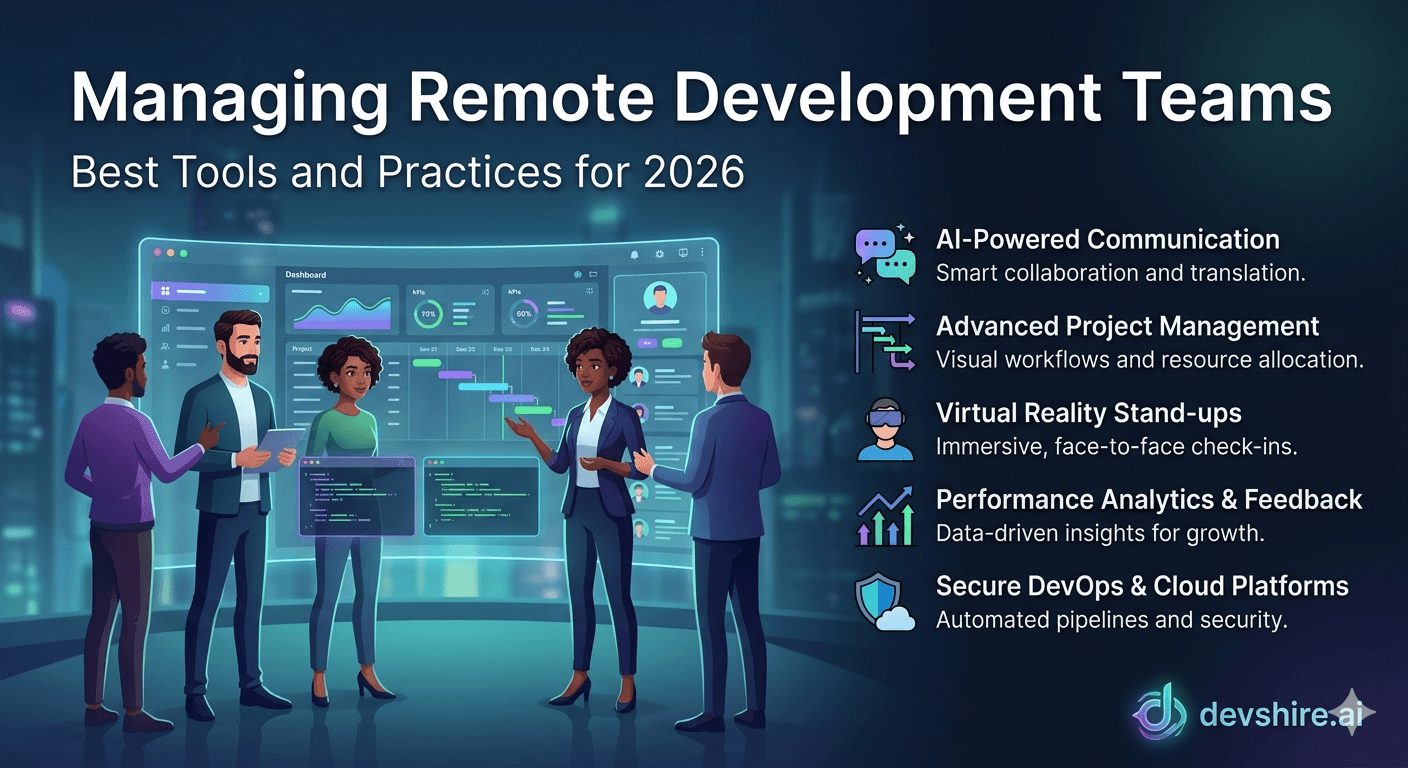
You promoted your best developer to team lead. Three months later, the team is shipping slower than before, standups are a mess, and two developers in different time zones barely talk to each other. This is the remote dev team management failure pattern — and it happens when you apply office management thinking to a distributed, async, AI-assisted team. The tools and practices that work in 2026 look different. Here's what they actually are.
💡 TL;DR
Managing remote dev teams well comes down to three things: async-first communication, a shared task system with clear output expectations, and a code review culture that specifically handles AI-generated output. Teams that nail all three ship 30–40% more per sprint than equivalent teams that don't. The tools matter less than the habits. But picking the wrong tools makes the right habits almost impossible to build.
Async-First Isn't a Preference — It's the Architecture
Most remote teams say they're async-first. What they actually mean is "we have Slack and we don't do daily standups." That's not async-first. Async-first means every decision, update, and blocker is captured in writing before it becomes a meeting. It means your developers can ship an entire sprint without a single synchronous conversation if they need to.
Why does this matter for managing remote dev teams specifically? Because developers do their best work in deep focus blocks — not between Slack pings. The more real-time interruptions you create, the more you're destroying the conditions that produce good code.
⚠️ Common advice that's wrong
Many remote work guides tell you to over-communicate and check in frequently to replace the "water cooler" effect. For remote dev teams, this is actively harmful. Frequent check-ins fragment focus time. The developers who ship the most are the ones with the fewest interruptions — not the most engaged Slack presences.
The Tools Stack That Actually Works for Remote Dev Teams in 2026
Let's be specific about what to use and what to skip. There are dozens of remote team tools — most of them add overhead without adding clarity.
Function | Tool | Why It Works |
|---|---|---|
Task management | Linear or Jira | Structured tickets with clear acceptance criteria — not just task names |
Async communication | Slack with strict channel discipline | Works when you enforce async norms — breaks when you treat it like a phone |
Code review | GitHub PRs + Reviewpad or CodeRabbit | AI-assisted review catches AI-generated bugs specifically |
Documentation | Notion or Confluence | Only works if someone actually maintains it — assign ownership |
Video async updates | Loom | Better than written for walkthroughs — worse for searchable decisions |
Sprint planning | Linear + async pre-read doc | Distribute the doc 24 hours before any live session — decisions land faster |
Managing AI-Assisted Developers Remotely: The Extra Layer You Need
Remote teams using AI-assisted developers need one additional management layer that most guides don't mention: a shared standard for AI output validation. Without it, you'll have developers shipping AI-generated code at different quality thresholds — and the inconsistency will hit you in production.
🔄 Set a team-wide AI review checklist
Every PR that contains AI-generated code goes through the same checklist: logic correctness, edge case handling, security gaps, and unnecessary complexity. This isn't about distrust — it's about consistent standards. The checklist should live in your repo wiki and get referenced in every PR template.
📦 Weekly async code review round-up
Once a week, one developer shares a 5-minute Loom walking through the most interesting piece of AI-generated code from that sprint — whether it worked well or badly. This builds shared pattern recognition across the team faster than any training session.
Three Remote Dev Team Failures — and the Fix for Each
These three problems account for most of the velocity loss in remote dev teams. If your team is shipping slower than it should be, one of these is probably the cause.
⚡ Problem 1: Developers are blocked and not saying so
Remote developers, especially junior ones, sit on blockers for hours rather than interrupt. Fix: add a "blocked" status to every ticket, and make a standing rule that any ticket in blocked status for more than 2 hours gets a message in the team channel. The act of labelling it forces the conversation.
🐛 Problem 2: PRs sit unreviewed for days
In remote teams, code reviews drift without explicit ownership. Assign a rotating review lead for each sprint — one person whose job is to make sure PRs don't age past 24 hours without a first review. This single change cuts the average PR-to-merge time by 40–60% in most teams.
🔧 Problem 3: Sprint goals are clear in planning, forgotten by day 3
Write the sprint goal in one sentence and pin it in the team channel for the entire sprint. Not the task list — the outcome. "Ship the document parsing pipeline to staging by Friday." That one sentence aligns every daily decision without a standup.
Trusted by 500+ startups & agencies
"Hired in 2 hours. First sprint done in 3 days."
Michael L. · Marketing Director
"Way faster than any agency we've used."
Sophia M. · Content Strategist
"1 AI dev replaced our 3-person team cost."
Chris M. · Digital Marketing
Join 500+ teams building 3× faster with Devshire
1 AI-powered senior developer delivers the output of 3 traditional engineers — at 40% of the cost. Hire in under 24 hours.
The Bottom Line
Async-first means every decision and blocker is captured in writing before it becomes a meeting — not just "we have Slack."
Add a rotating review lead each sprint to own PR turnaround time. Teams that do this cut average PR-to-merge time by 40–60%.
Remote teams using AI-assisted developers need a shared AI output review checklist — without it, quality thresholds drift across the team.
Pin the sprint goal as a single sentence in the team channel for the full sprint. It replaces the daily standup for alignment purposes.
Any ticket blocked for more than 2 hours should trigger a team channel message. The label forces the conversation that unblocks the developer.
Tools matter less than habits — but choosing tools that enforce async behaviour makes the right habits far easier to build.
Frequently Asked Questions
What are the best tools for managing remote development teams in 2026?
Linear or Jira for task management, Slack with strict channel discipline for async communication, GitHub PRs with an AI-assisted review tool (CodeRabbit or Reviewpad) for code review, and Notion for documentation. The tools matter less than the norms you build around them. A bad workflow in a good tool is still a bad workflow.
How do you keep remote developers productive without micromanaging?
Set clear output expectations per sprint — not activity expectations. "Ship these three tickets by Friday" is a good target. "Be online between 10am and 4pm" is micromanagement. Track output and blockers, not hours and Slack presence. Developers who are trusted to manage their own time consistently outperform those who aren't.
How do you handle code review for AI-generated code on a remote team?
Add an AI-specific checklist to your PR template: logic correctness, edge case handling, security gaps, and unnecessary complexity. Assign a rotating review lead each sprint who owns PR turnaround time. Weekly async code review walkthroughs (5-minute Looms) build shared quality standards faster than any written policy.
How many standups should a remote dev team have per week?
Honestly, fewer than most teams think. One async written standup per day (a brief message with what you shipped, what you're working on, and any blockers) replaces most live standups. Reserve synchronous video calls for sprint planning and retrospectives — not daily check-ins. Deep focus time is more valuable than daily alignment rituals.
What's the biggest mistake managers make with remote dev teams?
Treating remote work like office work with a video call instead of a meeting room. Remote dev team management requires a fundamentally different approach: more written communication, fewer real-time interruptions, explicit ownership of every shared responsibility, and output-based tracking instead of activity-based tracking.
How do you build team culture on a fully remote dev team?
Shared technical standards, visible progress, and genuine recognition of good work matter more than virtual socials. A weekly async code walkthrough where developers share interesting problems they solved does more for culture than a Friday quiz. Engineers bond over craft — give them a channel and a format for sharing it.







Devshire Team
San Francisco · Responds in <2 hours
Hire your first AI developer — this week
Book a free 30-minute call. We'll match you with the right developer for your project and get you started within 24 hours.
<24h
Time to hire
3×
Faster builds
40%
Cost saved