
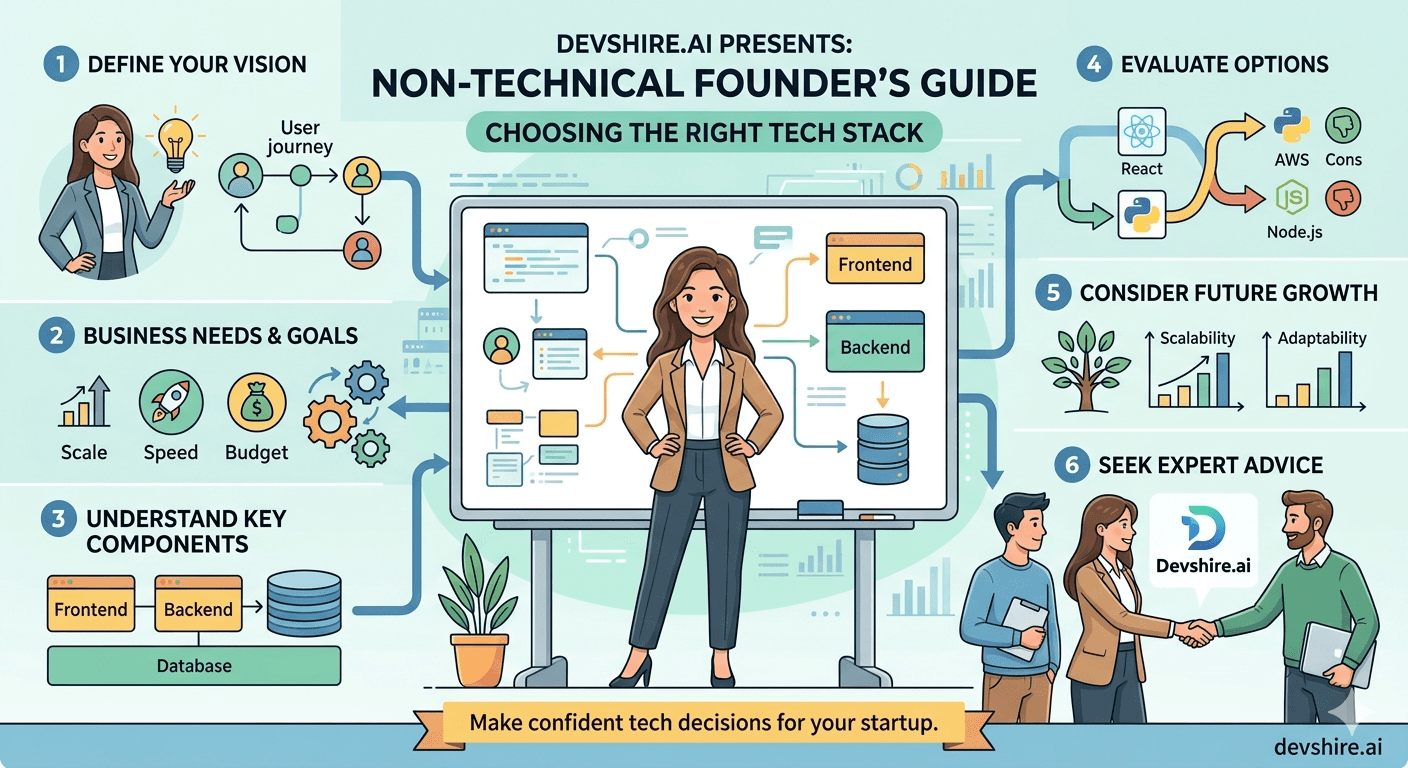
Your developer asked you what tech stack you want. You said "whatever you think is best" — and now you're three months in, three developers have looked at the codebase, and two of them said it was the wrong choice for your use case. This is one of the most expensive early-stage mistakes a non-technical founder can make. Not because picking the wrong stack is fatal — it usually isn't. But because deferring the decision entirely, without any framework for evaluating it, means you can't push back when it matters.
💡 TL;DR
As a non-technical founder, you don't need to pick the tech stack yourself — but you need to ask the right questions before agreeing to one. The three questions that matter: Is this stack widely used enough that you can hire for it? Does your developer have real production experience with it? And does it match your product type — web app, mobile, data-heavy, AI-powered? Stack decisions made in week one affect hiring, cost, and speed for the next 3–5 years.
Why the Tech Stack Decision Actually Matters to You as a Founder
Most non-technical founders treat the tech stack as a purely technical decision and hand it off entirely. That's a mistake — not because you should be making it, but because you should be influencing it. The stack your developer chooses today will determine how easy it is to hire the next developer, how fast you can ship new features, and how much technical debt you accumulate in year two.
Here's the thing: your developer is optimising for what they know and what they're comfortable building in. That's not wrong. But their comfort doesn't always align with your business needs. A developer who loves building in Rust might propose it for a simple SaaS product that would be faster to ship and easier to hire for in Python. You need enough framework to push back on that — not override it, but question it.
⚠️ Common advice that's wrong
Many startup guides tell non-technical founders to just use whatever their first developer recommends and not worry about it. That works fine when the developer choice is permanent. When developers change — and at early stage, they often do — a niche or unusual stack dramatically narrows your hiring pool and increases onboarding time. Stack decisions compound.
The Three Questions to Ask Before Approving Any Stack
You don't need to understand the technical merits of React vs Vue or Python vs Node. But you do need honest answers to these three questions before signing off on any stack decision.
1️⃣ Is this stack widely used enough to hire for?
Ask your developer: "If you left tomorrow, how easy would it be to find another developer for this stack?" If the answer is "quite niche" or involves a lot of hedging, that's a real business risk. For most SaaS products, the mainstream stacks — React or Next.js on the frontend, Python or Node on the backend — exist precisely because the talent pool is deep. Exotic choices have a cost.
2️⃣ Do you have real production experience with this stack?
A developer who has built a side project in a framework and a developer who has shipped production code to thousands of users in it are very different hires. Ask specifically: "Have you shipped something to production users in this stack? What went wrong and how did you fix it?" Enthusiasm for a new technology is not the same as the scar tissue that makes someone reliable in it.
3️⃣ Does this stack match my product type?
Different product types have natural stack fits. Standard SaaS web app: Next.js + Python or Node backend. Data-heavy analytics product: Python backend, possibly with Pandas or Polars. Mobile app: React Native or Flutter for cross-platform. AI-powered product: Python backend with FastAPI and direct LLM API integration. Ask your developer why the proposed stack fits your specific product — not just why it's a good stack in general.
The Non-Technical Founder Stack Cheat Sheet
You don't need to understand how these stacks work. You just need to know which ones are widely used, well-supported, and appropriate for your product type.
Product Type | Common Stack | Hiring Pool | AI Tool Support |
|---|---|---|---|
Standard SaaS web app | Next.js + Python (FastAPI) or Node.js | Very large | Excellent |
E-commerce / marketplace | Next.js + Node or Shopify/custom | Large | Excellent |
Mobile app (iOS + Android) | React Native or Flutter | Medium-large | Good |
AI-powered product | Python (FastAPI) + React or Next.js | Large and growing | Best-in-class |
Data-heavy analytics tool | Python backend + React frontend | Medium | Excellent for Python |
Internal tools / admin | Any mainstream stack — or no-code (Retool) | Very large | Good |
Red Flags in Stack Proposals From Developers
Most developer stack proposals are fine. But a few patterns are worth pushing back on as a non-technical founder.
First: a proposed stack you can't find any job postings for. If you search "[stack name] developer" on LinkedIn and get fewer than 500 results, that's a niche choice with hiring consequences. Ask why it's necessary over a more mainstream alternative.
Second: a microservices architecture for an early-stage product with fewer than 1,000 users. Microservices add complexity that slows down early-stage development and requires more senior expertise to manage. Most early products should start as a monolith and only split when the scale actually demands it. This is a real pattern — developers sometimes propose architecturally interesting solutions that are wrong for your current stage.
Third: a proposed stack the developer has never shipped to production. Enthusiasm is fine. Production experience is better. Ask the question directly.
Trusted by 500+ startups & agencies
"Hired in 2 hours. First sprint done in 3 days."
Michael L. · Marketing Director
"Way faster than any agency we've used."
Sophia M. · Content Strategist
"1 AI dev replaced our 3-person team cost."
Chris M. · Digital Marketing
Join 500+ teams building 3× faster with Devshire
1 AI-powered senior developer delivers the output of 3 traditional engineers — at 40% of the cost. Hire in under 24 hours.
How to Use AI to Evaluate Stack Proposals Without Technical Knowledge
Here's a practical move that most non-technical founders haven't tried: when a developer proposes a stack, paste the proposal into Claude or ChatGPT and ask: "Evaluate this tech stack choice for a [your product type] at early stage. What are the trade-offs, what are the risks, and what are the mainstream alternatives?"
You'll get a plain-language summary of the trade-offs that gives you enough context to ask better questions. You're not using AI to override your developer's judgment — you're using it to build enough understanding to have a real conversation. That conversation will produce a better outcome than nodding along and hoping for the best.
The Bottom Line
You don't need to pick the tech stack yourself — but you do need to ask three questions before approving one: Is it hireable? Does your developer have production experience with it? Does it match your product type?
Mainstream stacks (Next.js, Python/FastAPI, Node.js, React Native) exist because the talent pool is deep. Exotic choices narrow your future hiring options significantly.
A microservices architecture at early stage is almost always wrong for a product with under 1,000 users. Ask why a simpler monolith isn't sufficient.
For AI-powered products, Python with FastAPI is the de facto standard backend in 2026 — it has the best library support, the deepest LLM integration ecosystem, and the largest hiring pool for AI-focused developers.
Use Claude or ChatGPT to evaluate stack proposals in plain language — not to override your developer, but to build enough context to ask better questions.
Stack decisions made in week one affect hiring, cost, and velocity for the next 3–5 years. Treat them with the weight they deserve, even if you can't evaluate them technically.
Frequently Asked Questions
How should a non-technical founder choose a tech stack?
Ask your developer for a recommendation, then evaluate it against three questions: Is the stack widely used enough to hire for? Does your developer have real production experience with it? Does it fit your product type? You don't need to understand the technical merits — you need to make sure the choice serves your business needs, not just your developer's preferences.
What tech stack is best for a SaaS startup in 2026?
For most SaaS web applications: Next.js on the frontend with Python (FastAPI) or Node.js on the backend. This combination has the largest developer hiring pool, the best AI tooling support, and strong community resources. For AI-powered SaaS specifically, Python backend with FastAPI and direct LLM API integration is the clear standard in 2026.
Should I let my developer choose the tech stack?
Yes — but don't defer entirely. Your developer should lead the technical recommendation, and you should ask the three questions above before approving it. The most important one: "If you left tomorrow, how easy would it be to hire for this stack?" That question protects your business continuity regardless of what happens with any individual developer.
What happens if we pick the wrong tech stack early on?
It's rarely fatal, but it's expensive. Rebuilding in a different stack typically costs 2–4 months of development time and significantly more if the codebase is large. The more common impact is hiring difficulty — a niche or unusual stack narrows the pool of developers who can work on your product. Catching a poor stack choice at 3 months is much cheaper than at 18 months.
Is it ever worth using a no-code or low-code platform instead of a custom stack?
Yes — for internal tools, simple workflows, and product validation before committing to a full custom build. Retool, Bubble, and similar platforms can get you to a working tool in days rather than weeks. The trade-off is scalability and customisation ceilings. Use no-code to validate, then build custom when you know what you're actually building and why.
What tech stack should I avoid as an early-stage startup?
Avoid highly specialised or emerging stacks with small talent pools unless there's a compelling technical reason specific to your product. Avoid microservices architecture before you have scale that demands it. And be cautious about any stack where your developer is learning on the job — enthusiasm for a new technology is not the same as production experience with it.







Devshire Team
San Francisco · Responds in <2 hours
Hire your first AI developer — this week
Book a free 30-minute call. We'll match you with the right developer for your project and get you started within 24 hours.
<24h
Time to hire
3×
Faster builds
40%
Cost saved