
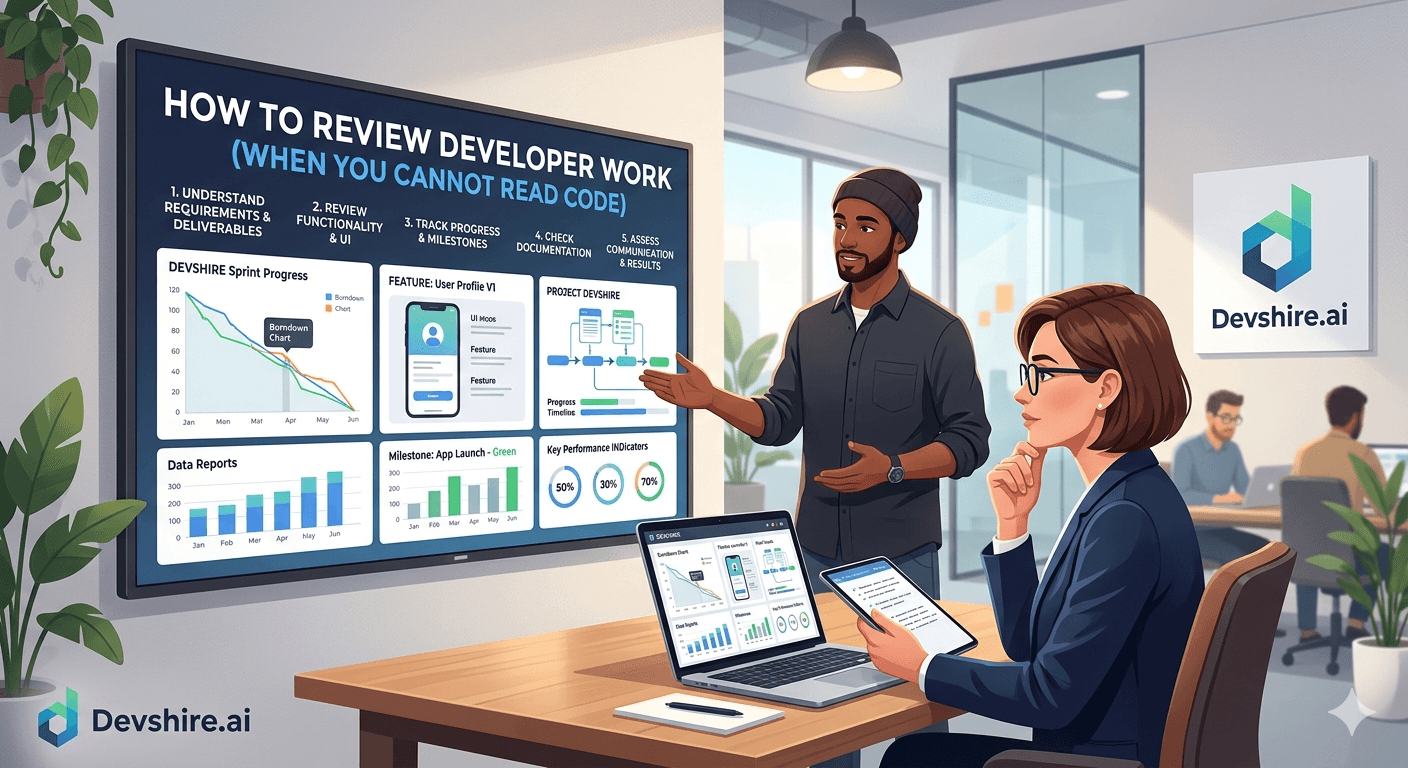
Your developer just finished a sprint. They say it's done. You look at the pull request — 847 lines changed across 12 files — and you have no idea what any of it means. So you approve it. Because what else are you going to do? This is the most common and most dangerous position a non-technical founder ends up in. Approving work you can't evaluate isn't a process — it's a prayer. Here's how to actually review developer work without being able to read the code.
💡 TL;DR
Non-technical founder code review has three layers: functional review (does it work?), spec review (does it match what was agreed?), and AI-assisted code review (does Claude flag anything worth asking about?). You won't catch everything — but this three-layer approach catches the issues that matter most: broken functionality, scope drift, and obvious quality problems. It takes 30–45 minutes per sprint and gives you real oversight without technical expertise.
The Three-Layer Review Process for Non-Technical Founders
You can't do the same review a senior developer does. But you can do a meaningful review that catches the things that matter most to you as a founder — and that's what the three-layer process is built for.
1️⃣ Layer 1 — Functional review: Does it actually work?
Use the feature yourself. Go through the exact user flow described in the spec. Does it do what it's supposed to do? Does anything break or behave unexpectedly? This sounds obvious, but a lot of non-technical founders skip it and rely on the developer's "it works" — which is not the same as you testing it yourself. Spend 15–20 minutes doing the actual user journey before approving anything.
2️⃣ Layer 2 — Spec review: Does it match what was agreed?
Pull up the original spec or acceptance criteria and go through it line by line against the delivered feature. Not the code — the feature behaviour. Does the upload limit work as specified? Does the error message appear when it should? Does the edge case you listed in the spec get handled correctly? A 15-minute spec-against-behaviour check catches scope drift before it compounds.
3️⃣ Layer 3 — AI-assisted code review: Does Claude flag anything?
Copy the most significant changed files from the pull request and paste them into Claude. Ask: "Explain what this code does, flag any obvious issues, security gaps, or unnecessary complexity, and tell me what questions a non-technical founder should ask about it." You'll get a 200–400 word summary that gives you specific questions to raise with your developer before approving the merge.
Edge Case Testing: The Part Most Founders Skip
Developers test the happy path. They make sure the feature works when everything goes right. Edge cases — what happens when things go wrong — are where production bugs live. As the person who knows the user scenarios best, you're actually well-positioned to test these.
Feature Type | Edge Cases to Test Manually |
|---|---|
File upload | Wrong file type, file too large, empty file, very slow connection |
User form / input | Empty fields, special characters, very long text, duplicate submissions |
Payment flow | Declined card, network timeout, double-click submit, back button after payment |
User authentication | Wrong password, expired session, simultaneous logins, password reset edge cases |
Data display | Empty state (no data), very large data set, missing fields |
How to Give Useful Feedback Without Technical Knowledge
The feedback that helps developers fix things is specific and behavioural, not evaluative. "This is buggy" is not useful. "When I upload a PDF over 5MB, the spinner shows for 10 seconds and then disappears without any error message" is useful. Describe what you did, what you expected, and what actually happened. That's the complete feedback format.
For AI-flagged code issues, frame them as questions rather than accusations: "Claude flagged that the session handling in the auth module looks complex — can you walk me through why it's structured that way and whether there's a simpler approach?" That's a legitimate, useful question that a good developer will welcome. It's not a challenge — it's engagement.
When to Bring in a Technical Second Opinion
Your three-layer review has limits. If you're consistently seeing issues flagged by the AI layer that your developer dismisses without clear explanation, or if post-ship bug rates are high despite passing your review, it may be time for a proper technical review. A 2-hour senior developer review of your codebase costs $200–$400 and gives you an independent technical opinion that no amount of AI-assisted review can fully replace. Do it once every 3–6 months on any active codebase — not just when you suspect a problem.
Trusted by 500+ startups & agencies
"Hired in 2 hours. First sprint done in 3 days."
Michael L. · Marketing Director
"Way faster than any agency we've used."
Sophia M. · Content Strategist
"1 AI dev replaced our 3-person team cost."
Chris M. · Digital Marketing
Join 500+ teams building 3× faster with Devshire
1 AI-powered senior developer delivers the output of 3 traditional engineers — at 40% of the cost. Hire in under 24 hours.
The Bottom Line
Non-technical founder code review has three layers: functional (does it work?), spec (does it match the brief?), and AI-assisted (does Claude flag anything worth asking?). All three together take 30–45 minutes per sprint.
Test the feature yourself before approving it. "It works" from your developer is not the same as you completing the user journey and finding what breaks.
Edge case testing — wrong file types, empty fields, duplicate submissions — is where production bugs live. You're better positioned to test these than most developers assume.
Useful feedback is specific and behavioural: what you did, what you expected, what actually happened. Avoid evaluative feedback like "this doesn't feel right."
Get an independent senior developer review every 3–6 months on any active codebase. $200–$400 is cheap insurance against accumulated technical debt you can't see from the outside.
Frequently Asked Questions
How can a non-technical founder review developer work?
Use the three-layer approach: functional review (test the feature yourself), spec review (check behaviour against the original brief), and AI-assisted code review (paste changed files into Claude and ask it to flag issues). This takes 30–45 minutes per sprint and gives you real oversight without technical expertise.
What should I actually test when reviewing a new feature?
Test the complete user journey described in the spec, all edge cases you can think of (wrong inputs, empty states, error scenarios), and any explicit acceptance criteria in the brief. Developers test happy paths. You should test the edges — because you know the user scenarios better than the developer does.
How do I give useful feedback to a developer when I don't understand the code?
Describe what you did, what you expected, and what actually happened. That's it. "When I upload a PDF over 5MB, the spinner shows for 10 seconds and then disappears without an error message" is perfectly useful feedback. Technical knowledge isn't required to describe broken behaviour — you just need to be specific about the steps and the outcome.
Can AI tools replace a proper code review by a senior developer?
No — AI tools can flag obvious issues and give you context for better questions, but they don't replace a senior developer's judgment. AI-assisted review is the right tool for ongoing sprint oversight when you don't have a technical co-founder. A proper senior developer review (every 3–6 months) is still the most reliable way to catch accumulated technical debt and architectural issues.
How often should I review my developer's work?
Every sprint — not just at milestones. A 30–45 minute three-layer review at the end of each sprint catches issues while they're small. Reviewing only at major milestones means problems compound for weeks before they're visible. Weekly functional testing and end-of-sprint spec checks cost you an hour a week and prevent the kind of drift that produces a three-month rework.
What do I do if Claude flags a serious code issue?
Don't panic and don't accuse — ask a specific question. "Claude flagged a potential SQL injection risk in the search function — can you walk me through how user input is being sanitised there?" Your developer will either explain why it's handled correctly (you learn something) or acknowledge the gap and fix it (you caught something important). Either way, the question was worth asking.







Devshire Team
San Francisco · Responds in <2 hours
Hire your first AI developer — this week
Book a free 30-minute call. We'll match you with the right developer for your project and get you started within 24 hours.
<24h
Time to hire
3×
Faster builds
40%
Cost saved