
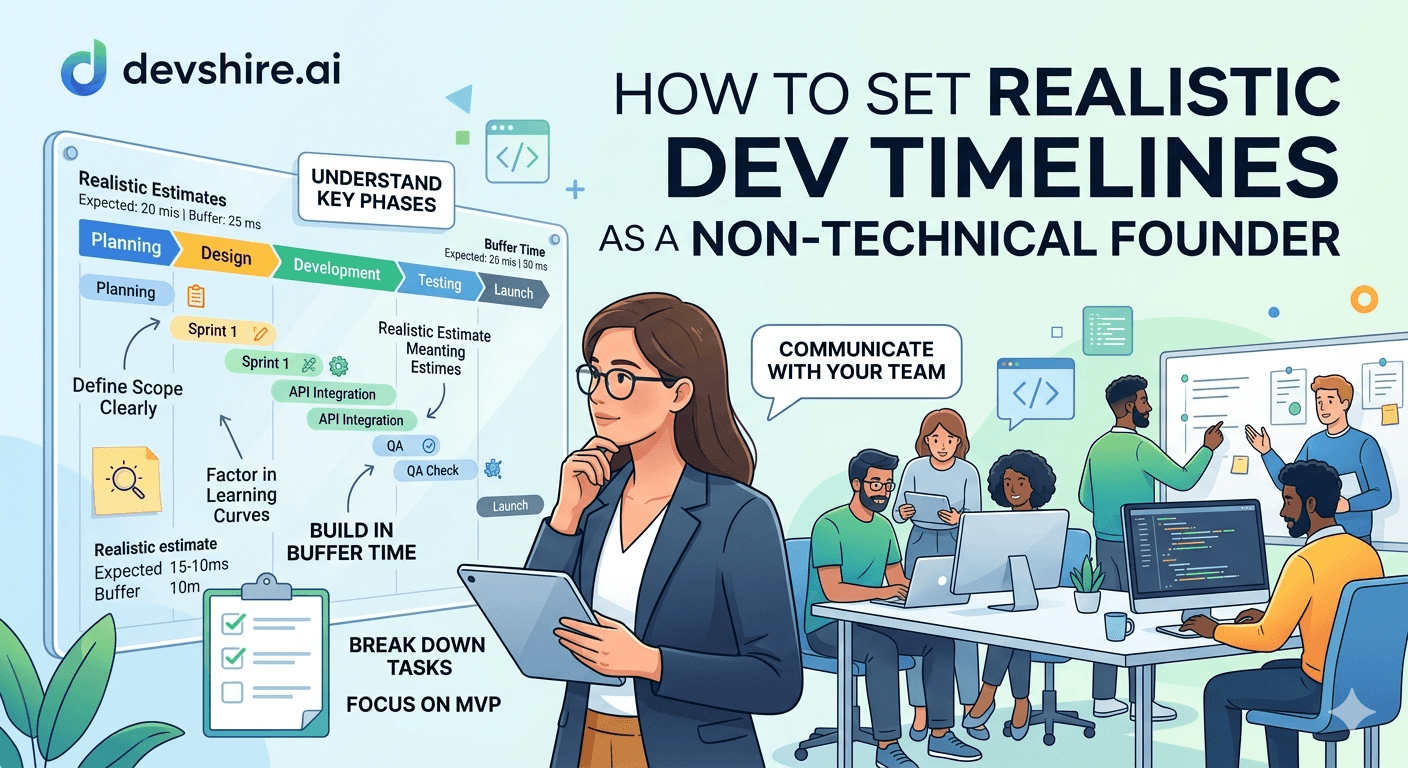
Your developer said two weeks. It's been five. And the explanation involves phrases like "unexpected complexity" and "integration issues" — which sound legitimate but you have no way to evaluate. This is the dev timeline problem that almost every non-technical founder hits. And it's almost never the developer being dishonest. It's almost always a combination of vague scope, optimistic estimates, and a founder who didn't know what questions to ask upfront. Here's how to fix all three before the next project starts.
💡 TL;DR
Realistic dev timelines start with a fully resolved brief and a developer who gives range estimates, not point estimates. Add 30–40% buffer to any estimate for integration and edge case work, and set explicit checkpoints at 25%, 50%, and 75% completion. The most expensive timeline failures aren't caused by bad developers — they're caused by unclear scope that produces accurate estimates for the wrong thing.
Why Dev Timelines Slip — The Real Reasons
Most non-technical founders assume timeline slippage means the developer is slow or disorganised. Sometimes that's true. But the majority of timeline failures come from three structural problems that start before the first line of code.
⚡ Reason 1: The scope was underspecified
A developer estimates based on what they understand the task to be. If the brief is vague, their estimate is for their interpretation — which may differ significantly from your actual requirements. The estimate is accurate; it's just accurate for the wrong thing. The fix is resolving the brief completely before asking for an estimate.
🐛 Reason 2: Integration work was underestimated
Most developers estimate the build time accurately. What they consistently underestimate is integration time — connecting their new feature to existing code, third-party APIs, and databases. Integration problems don't show up until you try to connect everything, and third-party APIs almost always behave differently than their documentation suggests. This is not incompetence — it's the nature of integration work. Budget 20–30% of total timeline for it explicitly.
🔧 Reason 3: Scope grew during the build
You added things. Or your developer built a better version than the minimum required. Or requirements clarified during the build and revealed they were more complex than they appeared. Any of these extends the timeline. The fix is a formal change order process — every scope addition, however small, gets documented and repriced before work starts on it.
How to Get Better Estimates From Your Developer
The estimate quality you get is directly proportional to the brief quality you provide. But there are also specific questions you can ask to improve estimate accuracy regardless of how detailed your brief is.
Instead of asking... | Ask this instead | Why it's better |
|---|---|---|
"How long will this take?" | "Give me a range — best case and worst case." | Forces acknowledgment of uncertainty |
"Can we do it in two weeks?" | Don't ask this | Leading question — gets a yes, not a real estimate |
"What's your estimate?" | "What are the main unknowns in this estimate?" | Surfaces the risks before they become surprises |
"Is this straightforward?" | "What's the hardest part of this build?" | Gets you the integration risk, not a reassurance |
The Buffer Rules Non-Technical Founders Always Need
Any estimate from any developer — no matter how senior, no matter how well-specified the brief — should have buffer added by you before it becomes a commitment to a stakeholder. Here's the rule of thumb that holds up across most early-stage product builds.
For new features with integration to existing code: add 30–40% to the estimate. For standalone new builds with no existing codebase dependency: add 20–25%. For anything involving a third-party API you haven't integrated before: add 40–50%. These aren't pessimism — they're the difference between setting a realistic expectation and breaking a promise.
📌 Real-World Example
A B2B SaaS founder was told by her developer that an email notification system would take 5 days. She added her 40% buffer (new feature + third-party email API integration) and told her client it would take 7 days. It took 6.5 days — the SendGrid API rate limiting behaved differently in production than in the sandbox. She delivered on time. Her client was happy. The 40% buffer is why.
How to Use Checkpoints to Catch Slippage Early
Don't wait until the deadline to find out the project is behind. Set three explicit checkpoints for any build over one week: 25% complete, 50% complete, and 75% complete. At each checkpoint, ask your developer one question: "Based on what you know now, does the original estimate still hold?"
Most developers won't volunteer that an estimate needs revision until the deadline passes. The checkpoint question makes it safe and expected to surface that information early — when you can still adjust the plan, not after it's too late. A developer who says "I think we're 20% behind at the 50% mark" is giving you something far more valuable than a developer who says nothing until day 14 of a 10-day build.
Trusted by 500+ startups & agencies
"Hired in 2 hours. First sprint done in 3 days."
Michael L. · Marketing Director
"Way faster than any agency we've used."
Sophia M. · Content Strategist
"1 AI dev replaced our 3-person team cost."
Chris M. · Digital Marketing
Join 500+ teams building 3× faster with Devshire
1 AI-powered senior developer delivers the output of 3 traditional engineers — at 40% of the cost. Hire in under 24 hours.
How AI-Assisted Developers Change the Timeline Equation
With AI-assisted developers, baseline build time for most features drops by 40–60%. A feature that would take a traditional developer 10 days might take an AI-augmented developer 4–6 days. That's real and worth accounting for when hiring.
But — and this matters — the integration and edge case work doesn't compress at the same rate. Third-party APIs still misbehave. Existing codebases still have hidden dependencies. The buffer rules above still apply. The timeline gets shorter overall, but the non-coding portions stay roughly the same. Don't let fast AI-assisted development lead you to remove the buffer — apply it to the reduced estimate, not the original one.
The Bottom Line
Most timeline slippage comes from underspecified scope, underestimated integration work, and scope growth during the build — not from developer incompetence.
Ask for a range estimate (best case / worst case), not a point estimate. "5–8 days" is more honest and more useful than "5 days."
Add 30–40% buffer to any estimate involving integration with existing code or new third-party APIs before committing that timeline to anyone external.
Set explicit checkpoints at 25%, 50%, and 75% of any build over one week. The question at each checkpoint: "Does the original estimate still hold?"
AI-assisted developers compress build time by 40–60% — but integration work compresses at a slower rate. Apply your buffer to the reduced estimate, not the original.
Never ask "can we do it in two weeks?" — that's a leading question. Ask "what's the range, and what are the main unknowns?" You'll get a much more useful answer.
Frequently Asked Questions
How should a non-technical founder set realistic dev timelines?
Start with a fully resolved brief before asking for an estimate. Ask for a range (best case / worst case), not a single number. Add 30–40% buffer for builds involving integration with existing code or new third-party APIs. Set three explicit checkpoints during the build to catch slippage before the deadline. All four steps together produce timelines you can actually commit to externally.
Why do developer estimates always seem to be wrong?
Estimates are usually accurate for the task as understood — but vague briefs mean the task is understood differently by the developer and the founder. Integration work is consistently underestimated because third-party dependencies behave unexpectedly. And scope almost always grows during a build. These three patterns explain most timeline slippage. They're all preventable with better upfront process.
How much buffer should I add to a developer's estimate?
For new features with integration to existing code: 30–40%. For standalone new builds: 20–25%. For anything involving a new third-party API: 40–50%. These buffers account for integration surprises, scope clarifications, and the edge cases that almost always surface during a real build. Apply the buffer to the estimate before committing any date to a stakeholder.
What should I do when a developer tells me a project will take longer than expected?
Ask for the specific reason, not a general explanation. "Integration issues" is not useful. "The Stripe webhook handling is more complex than expected because the event types for subscription updates differ between the test and live environments" is useful. The specific reason tells you whether the extension is legitimate and whether it could have been anticipated earlier — which informs how you scope the next sprint.
How do AI-assisted developers affect project timelines?
AI-assisted developers typically cut core build time by 40–60% on most feature work. A 10-day traditional build might take 4–6 days with an AI-augmented developer. However, integration work, third-party API behaviour, and edge case resolution compress at a slower rate. Still apply 20–40% buffer to AI-assisted estimates — the compression is real, but the non-coding complexity remains.
How do I protect a deadline when my developer falls behind?
Catch it early — which is what the 25/50/75% checkpoints are for. If you discover slippage at the 50% mark, you have time to descope, add capacity, or adjust the external commitment. If you discover it at 90%, you have almost no options. Early detection gives you choices. Late detection gives you damage control. The checkpoints are the difference between the two.







Devshire Team
San Francisco · Responds in <2 hours
Hire your first AI developer — this week
Book a free 30-minute call. We'll match you with the right developer for your project and get you started within 24 hours.
<24h
Time to hire
3×
Faster builds
40%
Cost saved