
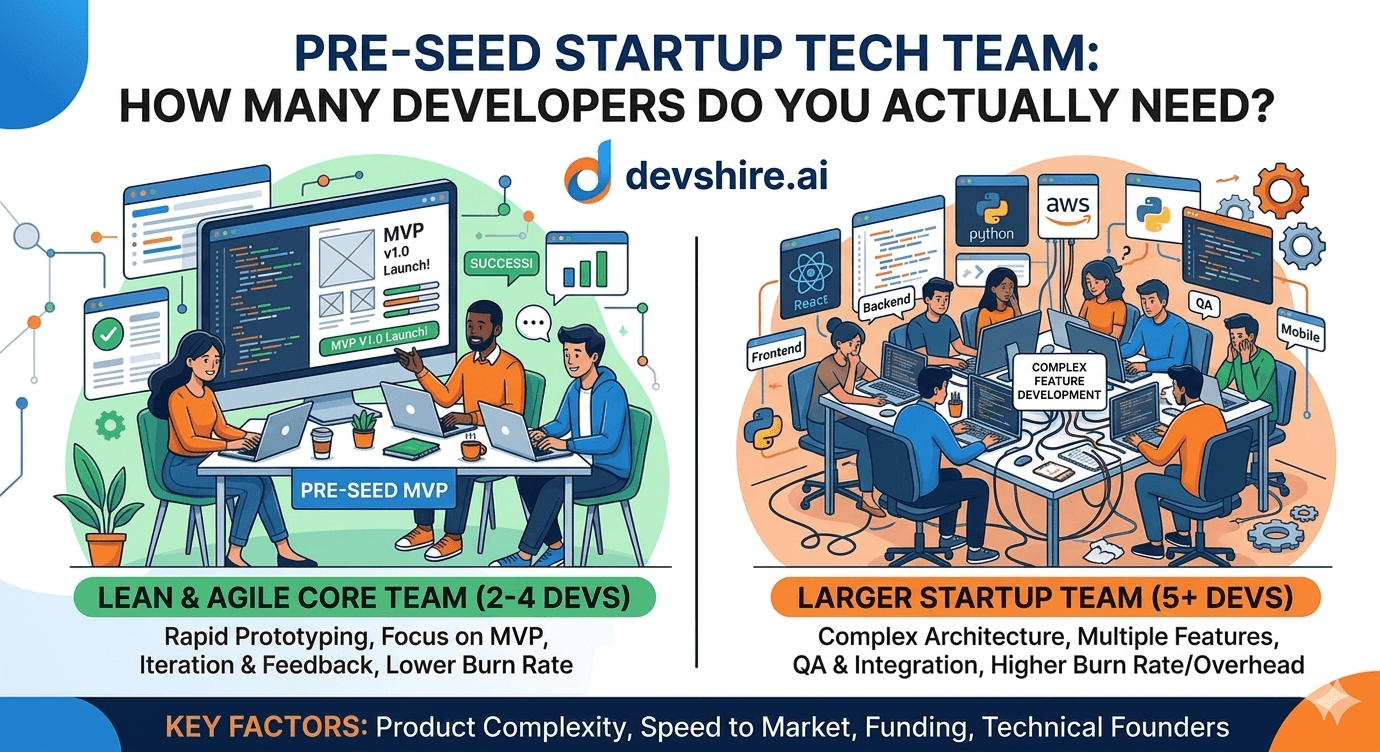
Most pre-seed founders either hire too many developers too early or delay hiring because they are not sure what they actually need. Both mistakes are expensive. Over-hiring at pre-seed burns runway before you have product-market fit. Under-hiring means you miss the window to ship before a better-funded competitor does. In 2026, AI tools have changed the correct answer to the headcount question more than any other single factor in the past 5 years. Here is what the right startup tech team size actually looks like.
💡 TL;DR
A pre-seed startup needs 1 to 2 AI-native developers to ship an MVP in 2026. Not 4 to 6. The AI toolchain — Cursor, Copilot, Claude, ChatGPT — multiplies output by 2 to 3x, which means the pre-AI answer of 3 to 4 developers is now solved by 1 to 2 AI-native ones. The right structure depends on whether you have a technical co-founder. With one: 1 additional AI-native developer. Without one: 2 AI-native developers. Anything more than 3 developers before product-market fit is almost always over-hiring.
Startup Tech Team Size by Stage — The 2026 Reality
Before AI tools, the standard advice was 3 to 5 engineers to build and launch an MVP. That advice was written for a 2019 development environment. In 2026, the correct numbers are significantly lower.
Stage | Pre-AI Team (2020) | AI-Native Team (2026) | What Changed |
|---|---|---|---|
Idea to MVP | 3 to 5 developers | 1 to 2 AI-native developers | Cursor + v0 + Claude replaces 2 devs of output |
MVP to first 100 users | 4 to 6 developers | 2 to 3 AI-native developers | AI output review process handles quality at speed |
100 to 1,000 users | 5 to 8 developers | 3 to 5 AI-native developers | Platform work still needs headcount but less than before |
Series A | 10 to 20 developers | 6 to 12 AI-native developers | Coordination overhead starts to limit multiplier |
The biggest change is at the pre-seed stage. Where founders used to need 3 to 5 developers to build an MVP, they now need 1 to 2 AI-native developers who use Cursor, Claude, and Copilot as standard tools. The output is the same or better. The cost is 60 to 70% lower.
With a Technical Co-Founder vs Without — Different Team Structures
The right team structure depends first on whether you have a technical co-founder — not on your funding amount or product complexity.
✅ If you have a technical co-founder
Your technical co-founder handles architecture decisions, code review standards, and the highest-complexity work. You need 1 AI-native developer alongside them who handles feature development velocity. Together, 2 people with the right AI toolchain can ship a full SaaS MVP in 8 to 12 weeks. Do not hire a third developer until you have a specific bottleneck the two of them cannot clear.
✅ If you do not have a technical co-founder
You need 2 AI-native developers — one who can own architecture and technical direction (effectively acting as your interim CTO), and one who drives feature velocity. The senior one should be a contractor at first, not an employee. Committing to a full-time CTO equivalent before product-market fit is a runway risk. A senior AI-native developer through devshire.ai can fill this role on a 3 to 6 month contract and transition to full-time if the product proves out.
What Each Developer on the Pre-Seed Team Actually Does
Vague role descriptions create hiring mismatches. Here is what each developer on a 2-person AI-native pre-seed team actually owns day-to-day.
👤 Developer 1 — Technical Lead (Senior AI-Native)
Owns: architecture decisions, data model design, infrastructure setup, code review standards, security review, AI toolchain configuration. Uses: ChatGPT for architecture planning, Claude for security and logic review, Cursor for complex feature builds. Day rate: $700 to $1,000. This is not an optional role — without someone in this seat, technical debt accumulates at a rate that kills pre-seed startups in months 4 to 6.
👤 Developer 2 — Feature Developer (Mid to Senior AI-Native)
Owns: feature velocity — building components, API endpoints, database schemas, test suites. Uses: Cursor as primary IDE, v0 for UI generation, Copilot for autocomplete, Claude for pre-PR review. Day rate: $400 to $700. This developer should be shipping a completed, deployable feature every 1 to 3 days on an MVP-stage product. If that is not happening, the AI toolchain setup or the task scoping is wrong.
📌 Real-World Scenario
A 2-person pre-seed fintech startup hired through devshire.ai in Q4 2025. One senior AI-native full-stack developer at $850 per day as technical lead, one mid-level AI-native developer at $550 per day for feature work. In 10 weeks they shipped: multi-tenant account structure, Plaid banking integration, transaction categorisation using Claude API, Stripe subscription billing, and a React dashboard. Total development cost for 10 weeks: $140,000. First paying customer: week 9.
When Not to Hire a Developer Yet
Not every pre-seed startup needs a developer on day one. This might be worth pushing back on slightly, because the reflex to start building immediately is strong — but it is sometimes the wrong move.
If you have not yet had 10 conversations with potential customers and confirmed they experience the problem you think you are solving, hiring a developer is premature. You might build the wrong thing. The sunk cost of paying a developer for 8 weeks on a product direction you abandon because of a customer conversation is real.
The right trigger to hire is: you have validated the problem with real customers, you have a defined MVP scope that is small enough to ship in 8 to 12 weeks, and you have enough runway to cover 3 months of developer cost without it threatening survival. Before all three are true, you are probably not ready to hire.
Trusted by 500+ startups & agencies
"Hired in 2 hours. First sprint done in 3 days."
Michael L. · Marketing Director
"Way faster than any agency we've used."
Sophia M. · Content Strategist
"1 AI dev replaced our 3-person team cost."
Chris M. · Digital Marketing
Join 500+ teams building 3× faster with Devshire
1 AI-powered senior developer delivers the output of 3 traditional engineers — at 40% of the cost. Hire in under 24 hours.
Signs You Are Over-Hiring on Engineering
Pre-seed over-hiring on engineering is one of the most common and most expensive startup mistakes. Here are the early warning signs.
🚩 More than 3 developers before your first 10 paying customers
If you have 4 or more developers and fewer than 10 paying customers, you are almost certainly building features nobody has asked for. Engineering headcount beyond 3 should be driven by specific customer demand — features customers are paying for or blocking deals on — not by founder intuition about what the product needs.
🚩 Hiring specialised roles too early
A pre-seed startup hiring a dedicated DevOps engineer, a dedicated QA engineer, or a dedicated data engineer before Series A is almost always over-specialising. An AI-native full-stack developer with Cursor handles infrastructure setup, automated testing, and basic data pipeline work. Specialisation is the right call at the stage where the work volume genuinely exceeds what a full-stack developer can manage — not before.
🚩 Developer-to-revenue ratio that cannot reach break-even
If your developer costs require $50,000+ MRR to break even and you are at $2,000 MRR, you have a burn problem that will not solve itself with more hiring. Cut headcount to 2 AI-native developers, focus on the features your current customers are paying for, and rebuild from there. More developers do not fix a product-market fit problem.
The Bottom Line
A pre-seed startup needs 1 to 2 AI-native developers to ship an MVP in 2026 — not 3 to 5. The AI toolchain multiplies output by 2 to 3x, changing the correct headcount answer significantly.
With a technical co-founder: hire 1 additional AI-native developer for feature velocity. Without one: hire 2 — a senior technical lead and a mid-to-senior feature developer.
The technical lead role at $700 to $1,000 per day is not optional. Without it, technical debt accumulates fast enough to kill most pre-seed startups in months 4 to 6.
The right trigger to hire a developer: problem validated with 10+ customer conversations, MVP scope defined, and 3 months of developer cost covered without threatening runway.
More than 3 developers before 10 paying customers is almost always over-hiring. Specialised roles before Series A are almost always premature.
A 2-person AI-native pre-seed team on the right stack shipped a fintech MVP with Plaid integration, Claude API features, Stripe billing, and first paying customer in 9 weeks.
Frequently Asked Questions
How many developers does a pre-seed startup need in 2026?
1 to 2 AI-native developers to ship an MVP. With a technical co-founder, 1 additional developer handles feature velocity. Without a technical co-founder, 2 developers — a senior technical lead and a mid-to-senior feature developer. Anything more than 3 before product-market fit is almost always over-hiring in 2026.
Should a pre-seed startup hire a CTO?
Not immediately. A full-time CTO commitment before product-market fit is a significant runway risk. The better approach: hire a senior AI-native developer on a 3 to 6 month contract who can fill the technical direction role, prove the product, and transition to a full-time CTO role if the product proves out. This costs 30 to 40% less than a full-time CTO hire and carries far less downside if the direction changes.
When should a startup hire its first developer?
After validating the problem with at least 10 real customer conversations, defining a specific MVP scope that can ship in 8 to 12 weeks, and confirming enough runway to cover 3 months of developer cost. Hiring before problem validation risks building the wrong thing for 8 weeks at $400 to $800 per day. The sunk cost of that mistake frequently exceeds the cost of 2 more weeks of customer validation.
What is the difference between an AI-native developer and a traditional developer for startup hiring?
An AI-native developer uses Cursor, Copilot, Claude, and ChatGPT as their primary authoring environment — not occasionally. They ship 2 to 3x more output per day on standard feature work. For a pre-seed startup where headcount directly determines runway, the difference between 2 AI-native developers and 4 traditional developers is $40,000 to $70,000 in saved runway on a 90-day engagement — with the same or better output.
Build Your Pre-Seed Tech Team With AI-Native Developers
Devshire.ai specialises in matching pre-seed startups with the exact 1 to 2 AI-native developers they need. Every developer is pre-vetted on live AI toolchain proficiency — Cursor, Copilot, Claude, and ChatGPT. Shortlist in 48 to 72 hours. Contract or full-time options. No over-hiring pressure.
Build Your Pre-Seed Tech Team ->
Pre-vetted AI-native devs · Technical lead roles available · Shortlist in 48 hrs · Contract and full-time
About devshire.ai — devshire.ai matches pre-seed and early-stage startups with pre-vetted AI-native developers. Every candidate is screened on live AI toolchain use. Start hiring ->
Related reading: How to Hire AI Developers in 2026 · Startup CTO for Hire vs AI-Powered Dev Team · How Much Does It Cost to Hire a Developer in 2026? · Browse Pre-Vetted Startup Developers







Devshire Team
San Francisco · Responds in <2 hours
Hire your first AI developer — this week
Book a free 30-minute call. We'll match you with the right developer for your project and get you started within 24 hours.
<24h
Time to hire
3×
Faster builds
40%
Cost saved