
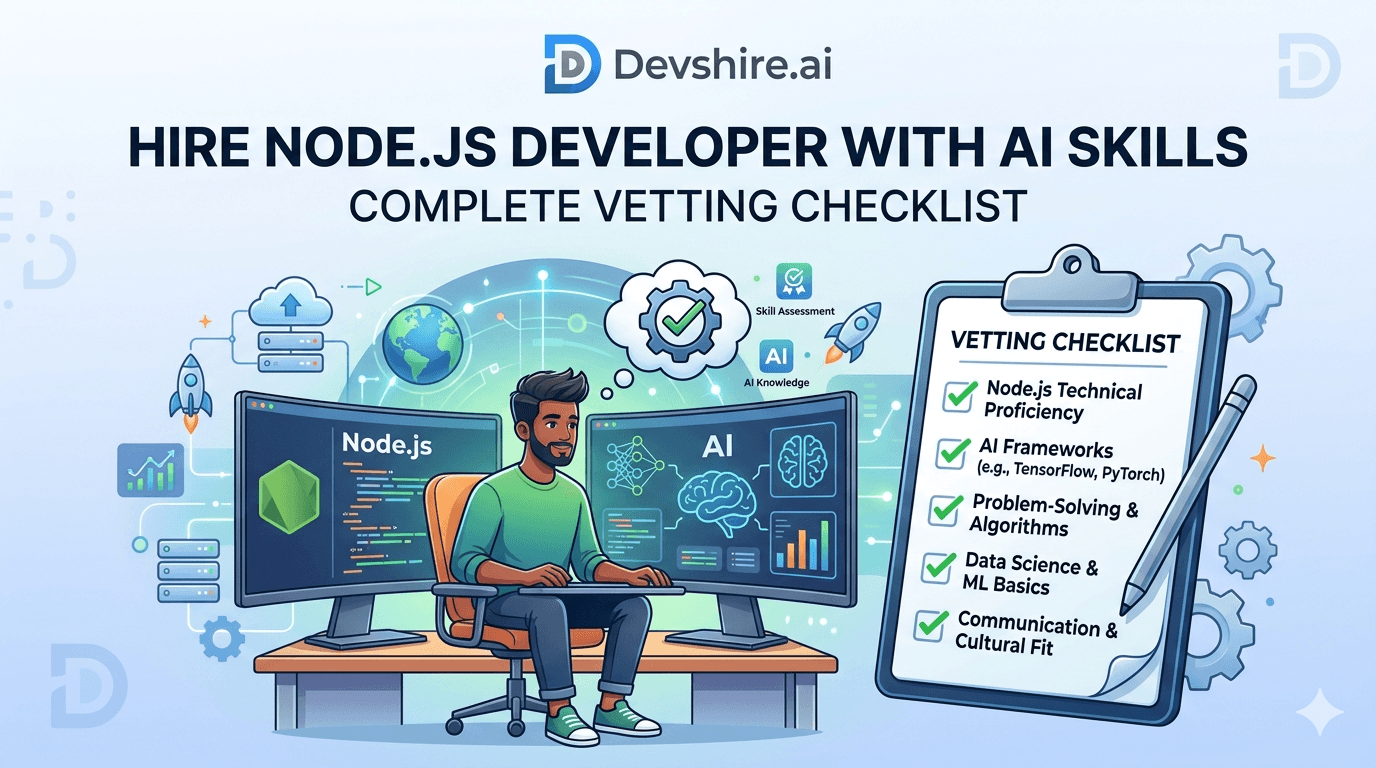
Most platforms that claim to offer vetted AI developers for hire are vetting for the wrong thing. They run a general coding screen, maybe a system design round, check English communication quality, and call it done. That process would have been adequate in 2022. In 2026, it misses the entire question that matters: can this developer build fast with AI tools while catching the specific errors those tools introduce? That is a different screen. Most platforms have not built it yet.
💡 TL;DR
A proper vetting process for AI developers covers four things: live AI toolchain proficiency, output validation habits, codebase review of AI-generated code, and async communication quality. Most platform vetting covers one of these four. Devshire.ai covers all four. The gap between a properly vetted AI developer and one who passed a generic coding screen shows up in your codebase by week 2 — and it almost always shows up as AI-generated bugs that passed PR review because nobody was trained to look for them.
What Most Vetting Processes Actually Test
Let us be direct. Here is what the major platforms actually put candidates through when they claim vetting for AI developers.
Platform | What They Actually Test | AI Toolchain Test? | Output Validation Test? |
|---|---|---|---|
Toptal | Algorithm screen, live coding, communication | No | No |
Arc.dev | Technical interview, coding challenge, soft skills | No | No |
Upwork | Portfolio, reviews, optional skills test | No | No |
Hired | Skills assessment, interview coaching | No | No |
Devshire.ai | Live AI build, output validation, code review, async comms | Yes | Yes |
None of the major general platforms test for AI toolchain proficiency or output validation. They test for general engineering quality — which is a necessary but insufficient screen for AI developer hiring in 2026.
The 4-Layer Vetting Framework That Actually Works
Here is the complete framework we use at devshire.ai. Every developer in our network passes all four layers before appearing in a client shortlist. Each layer tests something the others cannot.
1️⃣ Layer 1 — Stack and Background Validation (30 min async)
Written submission covering: primary stack and frameworks, AI tools used daily and which tasks each handles, recent projects built with AI assistance, and one specific example of catching an AI tool error in production. We reject any submission that is vague on tool specifics. Listing Copilot without describing workflow use is an automatic flag.
2️⃣ Layer 2 — Live AI Toolchain Build (45 min, real-time)
A constrained feature build with AI tools on and visible. The task is designed to take a traditional developer 3 to 4 hours. We want to see it done in 45 minutes. We are scoring: prompting approach (iterative vs one-shot), output validation speed, whether they catch the specific AI failure pattern embedded in the task spec, and code quality of the final output.
3️⃣ Layer 3 — AI-Generated Code Review (20 min, live)
We give candidates 180 to 250 lines of code generated by Cursor, Copilot, or ChatGPT — depending on their declared stack. The code contains 3 planted issues: one obvious, one subtle, one requiring framework-specific knowledge. Senior candidates find all three in under 15 minutes. Mid-level candidates find two reliably. Any candidate who finds fewer than two fails this layer regardless of Layer 2 performance.
4️⃣ Layer 4 — Async Communication Quality (48 hrs)
We send a written technical brief — the kind a client would send on day one — and ask for a written implementation plan. We are not scoring the plan for perfection. We are scoring: clarity, structure, whether they ask the right clarifying questions, and whether their written communication reflects the same technical quality as their spoken answers. A developer with poor async written communication is a liability in any remote team, regardless of coding output.
What the Screen Catches That Interviews Miss
These are the four developer types that pass traditional screens and fail ours. Every one of them would have been hired without the AI-specific layers.
🚩 The Vibe Coder
Exceptional at generating code with Cursor or ChatGPT. Cannot explain what the generated code does. Cannot debug it when it fails. Cannot adapt it to a slightly different context. Passes Layer 2 with flying colours. Fails Layer 3 immediately because they cannot review code they did not generate. Easy to catch once you run the code review layer.
🚩 The CV Stuffer
Lists Copilot, Cursor, Claude, Gemini, and Codex on their profile. Uses exactly one of them occasionally for autocomplete. Fails Layer 1 immediately when asked to describe workflow use for each tool. These candidates are extremely common in 2026 — AI tool keyword stuffing on profiles is epidemic.
🚩 The Strong Traditional Developer
Genuinely excellent engineer. Rarely uses AI tools. Completes the Layer 2 build task in 90 minutes instead of 45. That is not fast enough for an AI-native role. They pass Layer 3 with the strongest review of any candidate type. We flag these as strong traditional developer candidates and recommend them for roles where AI tool use is not the primary requirement.
🚩 The Async Communication Risk
Passes Layers 1 through 3 with strong scores. Layer 4 reveals vague, disorganised written communication. In a remote-first team, this developer cannot operate autonomously. Every task needs clarification calls. Every PR needs back-and-forth to understand intent. The developer is technically strong but structurally a bottleneck in any async environment.
How We Score AI Tool Proficiency — Not Just Yes or No
Vetting for AI toolchain proficiency is not a binary pass/fail. We score candidates across a spectrum, and the score profile determines which role types they are matched to.
Score Level | What It Means | Right Role Type |
|---|---|---|
AI-Native (Level 4) | AI tools are the primary authoring environment. Output validation is a trained habit. Layer 3 pass rate: 90%+. | Senior roles, autonomous work, fast-moving teams |
AI-Proficient (Level 3) | Regular AI tool use with solid validation habits. Occasionally over-trusts output on unfamiliar patterns. | Mid-senior roles with review process in place |
AI-Assisted (Level 2) | Uses AI tools for boilerplate and explanation. Not for primary authoring. Slower but fewer validation errors. | Feature work with strong review lead |
AI-Adjacent (Level 1) | Occasional AI tool use. No systematic validation habit. Traditional developer with AI awareness. | Traditional roles only — not AI developer hiring |
Most clients who come to devshire.ai need Level 3 or 4. We do not shortlist Level 1 or 2 candidates for AI developer roles regardless of general engineering quality. The gap between Level 2 and Level 3 in terms of daily output on AI-augmented work is significant enough to matter.
Trusted by 500+ startups & agencies
"Hired in 2 hours. First sprint done in 3 days."
Michael L. · Marketing Director
"Way faster than any agency we've used."
Sophia M. · Content Strategist
"1 AI dev replaced our 3-person team cost."
Chris M. · Digital Marketing
Join 500+ teams building 3× faster with Devshire
1 AI-powered senior developer delivers the output of 3 traditional engineers — at 40% of the cost. Hire in under 24 hours.
Build Your Own Vetting Process — If You Prefer to Self-Source
If you are hiring directly rather than through a platform, here is how to adapt this framework for your own hiring process. It takes about 3 hours to set up once. Then it runs on every candidate with minimal additional effort.
📋 Step 1 — Write your Layer 1 async questionnaire
Four questions: (1) Which AI tools do you use daily and for what specific tasks? (2) Describe a recent feature you built with AI assistance — which parts did the model get right, which parts did you override? (3) Describe the most recent AI tool error you caught before it shipped. (4) What is your code review checklist for AI-generated code? Send as async before any call.
🏗️ Step 2 — Build your live task spec
Write a feature spec that should take 3 to 4 hours for a traditional developer. This is your 45-minute AI build task. Include one known AI failure pattern in the spec requirements — for example, an async operation that requires error handling that Copilot typically skips. Calibrate difficulty by running it yourself with AI tools first.
🔍 Step 3 — Generate your code review sample
Use ChatGPT or Cursor to generate 180 to 200 lines of code in your stack. Then plant 3 bugs: one syntax-level, one logic-level, one framework-specific. Document the bugs in your answer key. Run this on every candidate as Layer 3. The answer key lets you score any reviewer on the team — not just technical leads.
✉️ Step 4 — Write your async brief for Layer 4
Write a 200-word technical brief describing a feature requirement — the kind you would actually send to an onboarding developer. Ask candidates to respond with an implementation plan in writing. Score on: clarity, structure, quality of clarifying questions, and accuracy of technical approach.
The Bottom Line
No major hiring platform in 2026 includes AI toolchain proficiency or output validation in their vetting screen. Devshire.ai is the exception. Every other platform requires you to add this layer yourself.
The four developer types that pass traditional screens and fail AI-specific vetting: vibe coders, CV stuffers, strong traditional developers miscategorised as AI-native, and async communication risks.
Proper AI developer vetting covers four layers: stack and background validation, live AI toolchain build, AI-generated code review, and async communication quality. All four are necessary. No single layer is sufficient alone.
AI tool proficiency is a spectrum from AI-adjacent to AI-native. Match the proficiency level to the role autonomy requirement — not just to the job title.
You can build this vetting process yourself in about 3 hours. It runs on every candidate with minimal marginal effort and is more predictive of output quality than any traditional screen.
The gap between properly vetted AI developers and those who passed a general coding screen shows up in production by week 2 — almost always as AI-generated bugs that slipped through PR review.
Frequently Asked Questions
What does a proper vetting process for AI developers include?
Four layers: a written async background assessment covering actual AI tool workflow, a 45-minute live build task with AI tools on and visible, a 20-minute code review of AI-generated code with planted bugs, and an async written communication assessment. Most platforms run one of these four. All four are necessary to reliably predict output quality in a real codebase.
How do I know if an AI developer is genuinely vetted versus just claiming to be?
Ask the platform or agency to describe their vetting process in specific detail. If they cannot name the specific AI tools they test for, the specific failure patterns they include in the code review, and the scoring criteria for the live build task, they are not running a real AI-specific vetting process. General coding screens do not qualify.
Why do algorithm tests fail to vet AI developers properly?
Algorithm tests measure a specific type of problem-solving skill that has almost no relationship to AI-augmented software development. An AI-native developer uses Cursor and Claude to scaffold features, validate output, and review code at speed. None of those skills are tested by reversing a linked list or finding the longest palindromic substring. The test measures the wrong thing entirely.
What is the difference between an AI-native and an AI-proficient developer?
An AI-native developer uses AI tools as the primary authoring environment — Cursor or Copilot is open for every task, not just hard ones. Output validation is an ingrained habit. They can catch model failures immediately. An AI-proficient developer uses AI tools regularly and well but occasionally over-trusts output on unfamiliar patterns. Both are strong hires. AI-native developers are the right fit for fully autonomous, fast-moving roles. AI-proficient developers work well in environments with a senior review lead in place.
Vetted AI Developers for Hire — All 4 Layers Completed
Every developer in the devshire.ai network has passed all four vetting layers — live AI build, output validation, AI-generated code review, and async communication assessment. No CV stuffers. No vibe coders. No traditional developers miscategorised as AI-native. Shortlist in 48 to 72 hours. Median hire in 11 days.
Browse Vetted AI Developers ->
4-layer AI vetting · Shortlist in 48 hrs · Freelance & full-time · Median hire in 11 days
About devshire.ai — devshire.ai is the only platform that vets AI developers on live toolchain proficiency, output validation, AI-generated code review, and async communication. Start hiring ->
Related reading: How to Hire AI Developers in 2026 · Best Platforms to Hire AI Developers Online · GitHub Copilot vs Cursor AI · Browse the Vetted Developer Network







Devshire Team
San Francisco · Responds in <2 hours
Hire your first AI developer — this week
Book a free 30-minute call. We'll match you with the right developer for your project and get you started within 24 hours.
<24h
Time to hire
3×
Faster builds
40%
Cost saved