
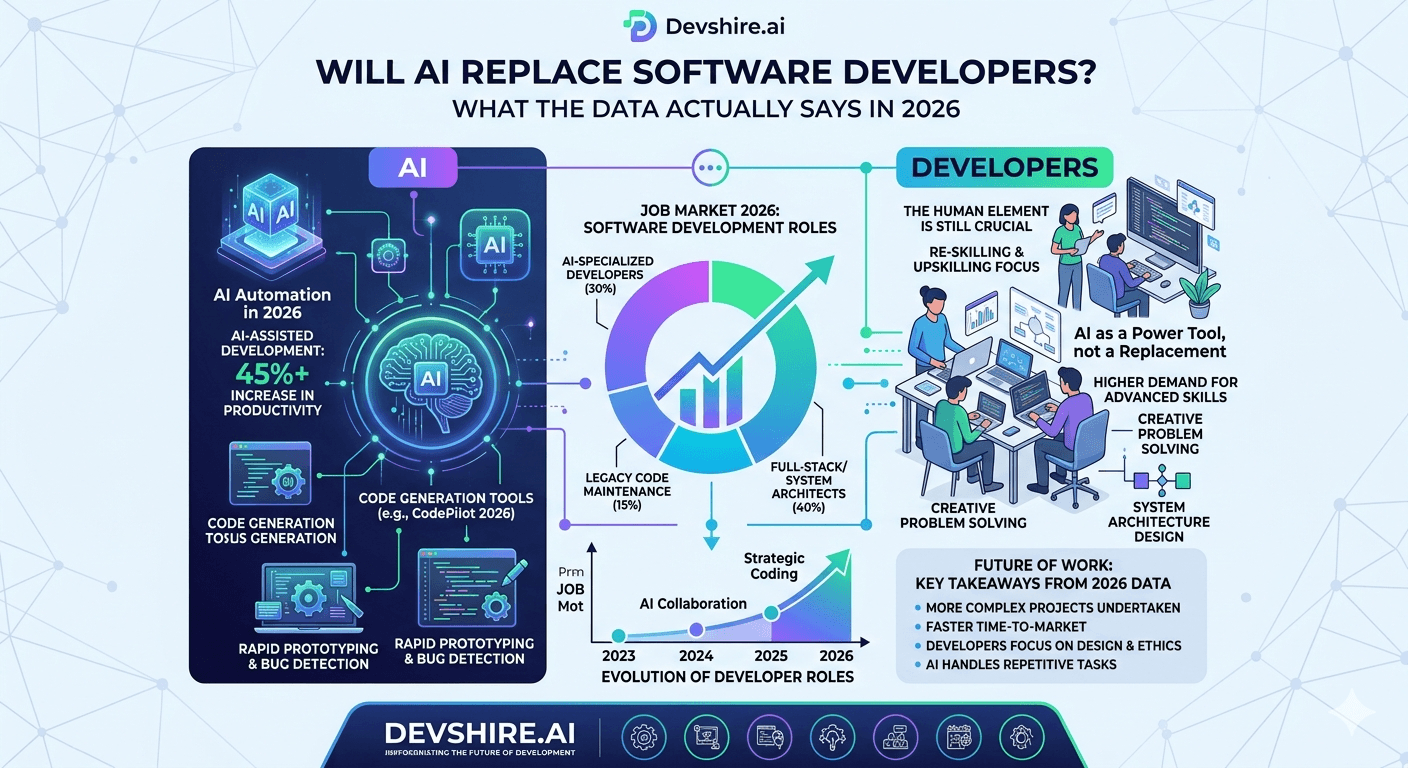
Every six months, a new wave of headlines announces that AI is about to make software developers obsolete. Every six months, the developer job market proves that prediction wrong — while quietly shifting underneath in ways that matter. The real story in 2026 isn't "AI replaces developers." It's more interesting than that. And if you're hiring, building a career, or running a dev team, the nuanced version is the one worth understanding.
💡 TL;DR
AI is not replacing software developers — it's replacing specific developer tasks and reshaping which skills are worth paying for. Demand for developers who can build effectively with AI tools is growing. Demand for developers who can only do what AI can do faster is shrinking. The split isn't between junior and senior — it's between those who've adapted their workflow and those who haven't. According to the Stack Overflow 2025 Developer Survey, 76% of developers now use AI tools regularly, but only 31% say AI has reduced their overall workload. The other 45% are shipping more, not less.
What the Data Actually Shows in 2026
Let's start with what we can measure. Developer job postings in the US are down roughly 18% from their 2022 peak — but that decline started before AI tools became mainstream, and most analysts attribute it primarily to post-pandemic correction and rising interest rates rather than AI displacement. [EXTERNAL LINK: Stack Overflow Developer Survey 2025 → developer employment and AI tool usage statistics]
At the same time, postings specifically requesting "AI-augmented" or "AI-native" development skills have grown by over 200% since 2023. The market isn't shrinking uniformly. It's bifurcating. Strong demand for one type of developer. Softer demand for another.
Developer Type | Job Market Trend (2024–2026) | Salary Trend |
|---|---|---|
AI-augmented full-stack developer | Growing — 200%+ increase in postings | +15–25% premium over traditional equivalent |
Traditional full-stack developer | Flat to declining — depends on specialisation | Flat — no meaningful growth |
Junior developer (no AI skills) | Declining — AI handles the lowest-complexity tasks | Downward pressure on rates |
LLM / AI workflow engineer | Strong growth — specialised and in demand | $120k–$180k+ salary range in 2026 |
Senior architect / tech lead | Stable to growing — AI increases their leverage | Stable with upward pressure |
What AI Is Actually Replacing — And What It Isn't
This drives me crazy about the replacement debate: it conflates tasks with jobs. AI is replacing specific tasks within developer roles — not the roles themselves. The distinction matters enormously.
AI handles well right now: boilerplate generation, unit test scaffolding, documentation drafts, simple CRUD features, and translating well-specified requirements into working code. These are real tasks that used to take developer time. They take less time now.
AI handles poorly right now: ambiguous requirements, system architecture decisions, debugging across complex interdependent systems, security-critical code review, stakeholder communication, and any task requiring business context that isn't in the codebase. These capabilities aren't improving at the same rate. And they represent the majority of what senior developers actually do.
⚠️ Common advice that's wrong
Most AI-replacement arguments treat coding as the primary developer skill. It isn't. Problem decomposition, architectural judgment, stakeholder translation, and knowing when not to build something are the skills that make senior developers valuable. AI doesn't have those. It has coding. And coding is only part of the job.
The Real Junior Developer Question
Here's where the replacement concern has the most validity. Entry-level developer roles are under genuine pressure. If AI can handle the work that used to justify hiring a junior developer — simple features, bug fixes, boilerplate, documentation — then the traditional junior-to-senior career pipeline changes shape.
But "changes shape" isn't the same as "disappears." What we're seeing instead is a bifurcation at the junior level too: juniors who use AI tools to ship at mid-level speed are getting hired and promoted faster than ever. Juniors who don't are struggling to compete. The floor has risen. The ceiling hasn't changed.
In practice, this means the most important thing a junior developer can do in 2026 is not learn another framework. It's develop a mature AI-assisted workflow — knowing which tools to reach for, how to validate output, and when to override the model. That skill is now more differentiating than any specific language or library knowledge. [INTERNAL LINK: AI-augmented developer vs traditional developer → /blog/full-stack-developer-for-hire-ai-vs-traditional]
What Hiring Teams Are Actually Doing Right Now
We've matched over 200 AI-powered engineering teams through devshire.ai since 2024. Here's what the hiring patterns actually look like — not the think-piece version, but what's happening in real decisions.
Most teams are not reducing headcount because of AI. They're holding headcount flat while shipping significantly more. A team that used to ship 8 features per sprint is shipping 12–15. The developers didn't get replaced — they got a productivity multiplier. The question those teams are asking now isn't "how do we hire fewer developers" — it's "how do we find developers who can actually use AI tools at this level?"
The teams that are reducing headcount are almost exclusively doing so in roles that were already at risk: junior developers doing purely mechanical work, developers whose entire job was writing code from spec with no architectural involvement. Those roles are genuinely under pressure. But they represent a minority of total developer employment.
Trusted by 500+ startups & agencies
"Hired in 2 hours. First sprint done in 3 days."
Michael L. · Marketing Director
"Way faster than any agency we've used."
Sophia M. · Content Strategist
"1 AI dev replaced our 3-person team cost."
Chris M. · Digital Marketing
Join 500+ teams building 3× faster with Devshire
1 AI-powered senior developer delivers the output of 3 traditional engineers — at 40% of the cost. Hire in under 24 hours.
The Adaptation Split: 2026's Real Dividing Line
If I had to draw one line in the developer market right now, it wouldn't be junior vs senior. It wouldn't be generalist vs specialist. It would be adapted vs unadapted.
Adapted developers have rebuilt their workflow around AI tools. They prompt iteratively, validate output critically, and use AI to handle the mechanical parts of their job so they can focus on the judgment calls. They're shipping 2–3× faster than they were two years ago. They're getting hired and promoted at above-average rates. They're in demand.
Unadapted developers are doing the same job the same way they did it in 2022. They're slower relative to the market. Their output-per-dollar is lower. And companies are noticing — not by firing them, but by not replacing them when they leave, and by preferring adapted candidates when they hire. [INTERNAL LINK: hire AI-augmented developers → /blog/hire-ai-developers-2026]
The Bottom Line
AI is not replacing software developers — it's replacing specific tasks within developer roles, primarily the lowest-complexity coding work. Developer demand is bifurcating, not collapsing.
Job postings for AI-augmented developers have grown over 200% since 2023. Traditional developer postings are flat to declining. The split is real and widening.
Junior developer roles are under the most pressure — but juniors using AI tools to ship at mid-level speed are getting hired and promoted faster than any other cohort.
The skills AI can't replicate — architectural judgment, ambiguous problem decomposition, stakeholder translation, security-critical review — are exactly the skills senior developers are paid for. Demand for those is stable or growing.
The real dividing line in 2026 is adapted vs unadapted developers, not junior vs senior. Workflow adaptation is now more differentiating than any specific technical skill.
Most teams are holding headcount flat and shipping more — not cutting developers and relying on AI. The productivity multiplier is going to output, not to headcount reduction.
Frequently Asked Questions
Will AI replace software developers in 2026?
No — but it is replacing specific tasks within developer roles, particularly the lowest-complexity coding work. Developer job demand is bifurcating: strong growth for AI-augmented developers, flat to declining for traditional developers doing work AI can now handle. The question isn't replacement — it's adaptation. Developers who've rebuilt their workflow around AI tools are in higher demand than ever.
Are junior developer jobs at risk from AI?
Entry-level roles are under more pressure than senior roles, because AI handles the task types that typically justified junior hires — simple features, bug fixes, boilerplate, documentation. But juniors using AI tools to ship at mid-level speed are getting hired and promoted faster than any previous cohort. The floor has risen. Adaptation is the deciding variable, not seniority level.
What developer skills are AI-proof in 2026?
Architectural judgment, ambiguous problem decomposition, security-critical code review, stakeholder communication, and knowing when not to build something. These are the skills that define senior developer value and that AI handles poorly. Developers who build depth in these areas while adopting AI tools for mechanical work are in the strongest market position.
How has AI affected developer salaries?
AI-augmented developers are commanding a 15–25% salary premium over traditional equivalents in 2026. Traditional developer salaries are flat. LLM and AI workflow engineers are at $120k–$180k+ in the US. The salary split tracks the demand split: adaptation to AI tools is now a meaningful salary differentiator, not just a nice-to-have.
Are companies reducing developer headcount because of AI?
Most companies are holding headcount flat and shipping more, rather than cutting developers. Teams that used to ship 8 features per sprint are shipping 12–15 with the same people. The productivity gain is going to output, not to headcount reduction — at least for now. Roles under genuine reduction pressure are narrowly scoped junior roles doing purely mechanical work with no architectural involvement.
Should I still learn to code in 2026 given how good AI is at coding?
Yes — but the reason has shifted. You learn to code not to generate code faster than AI (you won't), but to develop the judgment needed to direct, validate, and fix AI-generated code. Understanding code deeply is what separates an AI-augmented developer from a vibe coder. The former is in high demand. The latter ships fast and breaks things in production.
How do I future-proof my developer career against AI disruption?
Rebuild your workflow around AI tools now, not later. Develop depth in the skills AI handles poorly — architecture, security, ambiguous problem decomposition. Build a portfolio of shipped projects, not just code samples. And stay current: the AI tooling landscape is moving fast enough that a developer who was current 18 months ago may already be behind. Continuous adaptation is the career strategy, not a one-time update.







Devshire Team
San Francisco · Responds in <2 hours
Hire your first AI developer — this week
Book a free 30-minute call. We'll match you with the right developer for your project and get you started within 24 hours.
<24h
Time to hire
3×
Faster builds
40%
Cost saved