
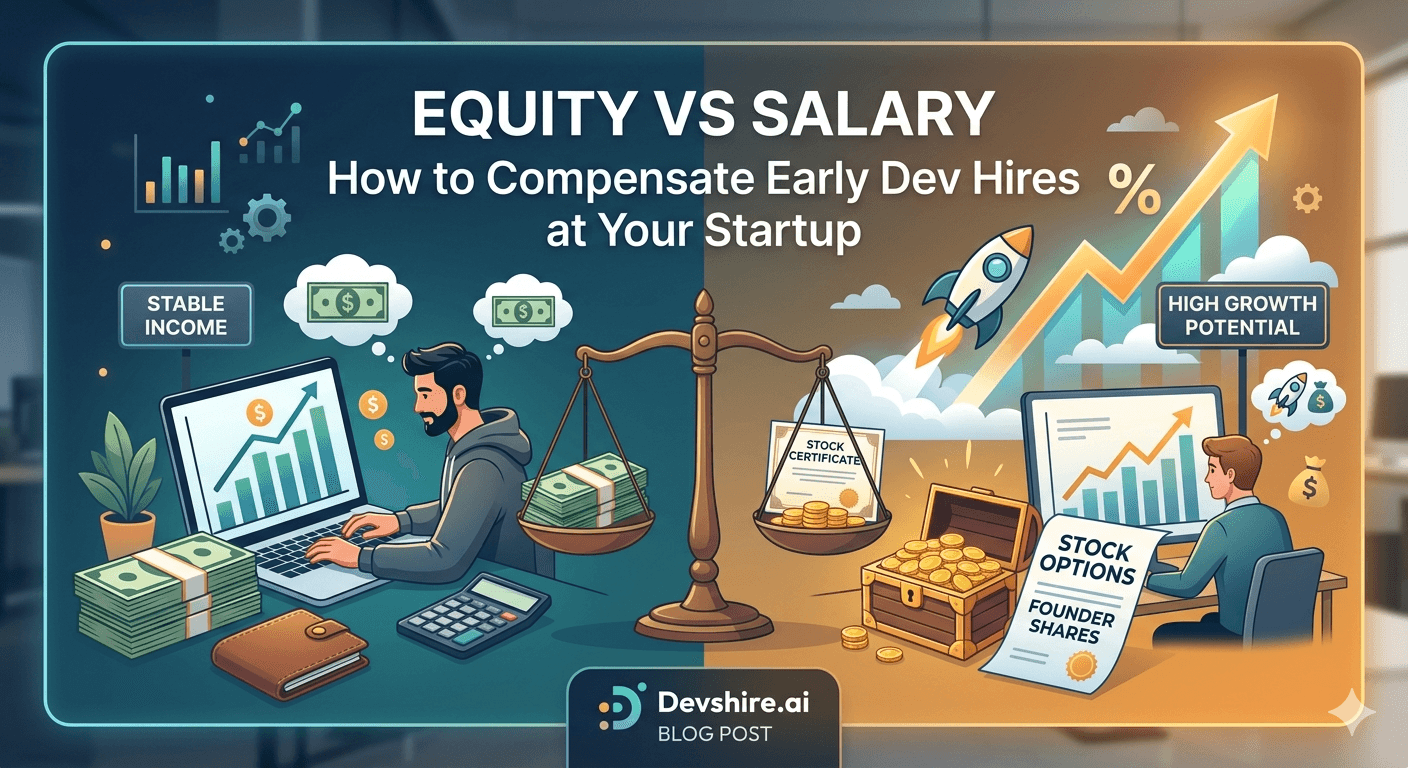
Your first developer hire will ask about equity. You'll either offer too much and dilute yourself badly, offer too little and lose the candidate, or avoid the question entirely and signal that you haven't thought about it. None of those outcomes are good. The equity vs salary question for early developer hires is one of the most consequential compensation decisions a founder makes — and it's almost always underprepared for.
💡 TL;DR
For a first technical hire (CTO-level or founding engineer), 1–5% equity with a 4-year vest and 1-year cliff is the standard range. For senior developer hires joining at Seed or Series A, 0.1–0.5% is typical. Cash salary for senior developers runs $130,000–$200,000/yr in the US, with offshore developers at 50–60% of that. The right answer for most early-stage startups: offer slightly-below-market salary plus meaningful equity rather than full market salary with token equity. Developers who take equity seriously are usually the ones who build as if they own something — because they do.
Stop Asking Equity vs Salary. Ask This Instead.
Most founders frame this as a binary: equity OR salary. That's not how compensation actually works. The real question is: what's the total value of this package to the developer, and does it match what they'd make elsewhere?
A senior developer evaluating your offer is running a mental calculation. They're comparing your offer against their outside options — which are many in 2026. If the expected value of your equity (probability of exit × their equity stake × exit multiple) plus your cash salary doesn't equal or exceed what they'd make at a funded startup or large tech company, they'll take the other offer.
In practice, this means you need to know three numbers before you make an offer: the market cash rate for this role in your region, the realistic equity range for this hire's seniority and your stage, and the expected value of your equity based on a realistic (not optimistic) outcome scenario. Get all three wrong and you'll either overpay or lose the candidate. Get them right and the conversation is straightforward.
Equity Benchmarks by Role and Stage
These are market-rate equity ranges based on Y Combinator's equity guidelines, Carta's compensation data, and AngelList's 2025 startup compensation survey. They assume standard 4-year vesting with a 1-year cliff.
Role | Pre-Seed | Seed | Series A | Series B+ |
|---|---|---|---|---|
Co-founder / CTO | 10–30% | 5–15% | N/A (too late) | N/A |
First engineer (founding) | 1–5% | 0.5–2% | 0.25–0.75% | 0.1–0.25% |
Senior developer (hire 2–5) | 0.5–1.5% | 0.1–0.5% | 0.05–0.15% | 0.01–0.05% |
Mid-level developer | 0.1–0.5% | 0.05–0.2% | 0.02–0.08% | 0.005–0.02% |
Junior developer | 0.05–0.2% | 0.01–0.05% | 0.005–0.02% | Options only, minimal |
Fair warning: these numbers move based on your traction. A pre-seed startup with $200K ARR can offer meaningfully different equity than a pre-seed startup with zero revenue. Adjust accordingly — and be honest with your developer about what the company is worth today.
Cash Salary Benchmarks for Developer Hires in 2026
These are full-time equivalent annual salary figures for developer roles at early-stage startups. They're not FAANG rates — those are 1.5–2× higher. These are competitive startup rates that attract strong candidates who want equity upside as part of their total compensation.
Role | US ($/yr) | UK (£/yr) | Eastern Europe ($/yr) | LatAm ($/yr) |
|---|---|---|---|---|
Senior Developer / Tech Lead | $150,000–$200,000 | £90,000–£130,000 | $60,000–$90,000 | $55,000–$85,000 |
Mid-Level Developer | $110,000–$150,000 | £65,000–£90,000 | $40,000–$65,000 | $38,000–$60,000 |
Junior Developer | $75,000–$110,000 | £40,000–£60,000 | $25,000–$40,000 | $22,000–$38,000 |
Founding Engineer (CTO-track) | $130,000–$180,000 | £80,000–£120,000 | $50,000–$80,000 | $45,000–$75,000 |
How to Structure the Equity Package — The Details That Matter
Offering the right equity percentage is half the job. The structure of how it vests and what happens in edge cases determines whether a developer views the equity as real value or theoretical noise.
Standard 4-year vest, 1-year cliff
This is the baseline. The developer earns no equity until completing 12 months (the cliff), then vests the remaining 75% monthly over 3 more years. This is standard, widely understood, and developers know what they're accepting. Don't deviate from this without a very good reason.
Option pool and strike price
Equity for early employees is usually in the form of stock options — the right to buy shares at today's price (the strike price) at a later date. The lower the strike price relative to the future value, the more valuable the options. Be transparent about the current 409A valuation and what the strike price will be. A developer who doesn't ask about this is either very junior or very trusting. A developer who does ask is engaging seriously with the compensation.
Acceleration clauses
Single-trigger acceleration (vesting accelerates if the company is acquired) and double-trigger acceleration (vesting accelerates if acquired AND the employee is terminated) are worth discussing with early hires. Acceleration clauses are more common in founding engineer packages than standard developer hires. They add complexity but matter a lot to developers who've seen acquisitions go badly for employees.
💡 The structure conversation most founders avoid
Tell your developer what a realistic exit looks like in numbers. "If we exit at $20M, your 0.5% is worth $100,000 pre-tax." That's a real, useful number. Vague statements about "significant upside" aren't. Developers who want equity as a real part of their compensation want the math. Give it to them. The ones who don't care about the math were never really interested in the equity anyway.
Trusted by 500+ startups & agencies
"Hired in 2 hours. First sprint done in 3 days."
Michael L. · Marketing Director
"Way faster than any agency we've used."
Sophia M. · Content Strategist
"1 AI dev replaced our 3-person team cost."
Chris M. · Digital Marketing
Join 500+ teams building 3× faster with Devshire
1 AI-powered senior developer delivers the output of 3 traditional engineers — at 40% of the cost. Hire in under 24 hours.
When to Lead With Equity vs When to Lead With Cash
The right emphasis depends on what the developer values and what your company can afford. Neither is universally correct.
Lead with equity when the developer has strong conviction in the market you're building in, you're pre-seed with limited cash, the developer has worked at startups before and understands equity upside, and the role is foundational — they'll be shaping the architecture, not just building features. In this case, slightly below market cash + meaningful equity is the compelling offer.
Lead with cash when the developer has dependents or financial obligations that make salary certainty critical, you're Series A or later with runway to pay market rates, the role is more execution than founding (implementing specs, not making decisions), or you're hiring a contractor or staff aug developer through a platform like Devshire.ai where equity typically isn't offered.
Actually — scratch the binary. The best early hires are usually motivated by both. Find out what matters to the specific person in front of you before defaulting to either extreme.
The Bottom Line
First founding engineer equity range: 1–5% at pre-seed, 0.5–2% at Seed. Standard senior developer hire: 0.1–0.5% at Seed, 0.05–0.15% at Series A. Always with a 4-year vest and 1-year cliff.
US senior developer full-time salary at a startup: $150,000–$200,000/yr. Eastern European equivalent: $60,000–$90,000/yr. These are competitive startup rates, not FAANG rates.
Tell developers exactly what their equity is worth in a realistic exit scenario. Vague upside language doesn't close candidates who take equity seriously. Real numbers do.
The equity vs salary decision is about the individual developer, not a formula. A developer with financial obligations needs cash certainty. One with runway savings and startup experience values equity more. Ask before assuming.
For contract or staff augmentation developers — through platforms like Devshire.ai — equity typically isn't part of the structure. You pay a competitive hourly rate and keep all equity for full-time team members who are genuinely building with you long-term.
The single most common early-stage mistake: offering token equity (0.01–0.05%) to founding engineers who are taking significant risk and responsibility. Either make the equity meaningful or make the salary market-rate. A mid-point that does neither of those things loses the best candidates to both better-paying companies and better-equitied startups.
Frequently Asked Questions
How much equity should I give my first developer hire?
For a founding engineer at pre-seed, 1–5% is the standard range depending on how early they join and how much risk they're taking. At Seed stage, 0.5–2% for an early engineer. These are with 4-year vesting and a 1-year cliff. Anything under 0.25% for a true founding engineer who's leaving a stable job is likely not competitive enough to close the candidate.
Should I offer equity or higher salary to attract developer talent?
It depends on the developer's situation. Ask directly: "What's more important to you right now — cash certainty or equity upside?" Most experienced startup developers will give you a straight answer. Pre-seed companies typically trade slightly below-market cash for meaningful equity. Series A companies usually pay closer to market rates with more modest equity. Neither formula is universal — the right answer is specific to each candidate.
What is a standard vesting schedule for startup developer equity?
The standard is 4-year vesting with a 1-year cliff. This means no equity vests until the developer completes 12 months, then 25% vests at the 1-year mark and the remaining 75% vests monthly over the following 3 years. This is so widely used in startup equity that deviating from it requires a clear explanation — developers will ask why.
Do contractor or freelance developers get equity?
Rarely, and usually not through standard staff augmentation arrangements. Contractors hired through platforms like Devshire.ai are compensated by hourly rate — the equity pool is reserved for full-time employees who are genuinely building the company long-term. If a contractor relationship evolves into a full-time founding role, equity can be structured at that point through a separate negotiation.
How do I explain equity value to a developer?
Give them real numbers, not percentages alone. Instead of "0.5% equity," say: "At our current valuation of $4M, 0.5% is worth $20,000 today. If we exit at $40M — which is a conservative outcome for our market — it's worth $200,000 pre-tax." Concrete scenarios are more compelling than percentage figures. Also explain the current strike price, what a liquidity event might look like, and how long the typical path is.
What happens to developer equity if the startup fails?
In most cases, unvested options expire and vested options become worthless if the company fails without an asset sale. Developers with experience at failed startups know this. Be honest about the risk — it builds trust, and the developers who understand and accept the risk are the ones who'll build with genuine ownership mentality. Overselling the exit upside to close a hire always backfires.
Need a Senior Developer Without the Equity Conversation?
Devshire.ai connects you with pre-vetted AI-powered developers on a staff augmentation model — competitive hourly rates, no equity required, start in under 24 hours. Save your equity pool for full-time founding team members. Test a Devshire developer free for 1 week.
Start Your Free 1-Week Trial →
Senior AI developers from $90/hr · No equity required · Hire in <24 hours · No minimum commitment
About Devshire.ai — Devshire.ai places AI-powered senior developers with startups on a staff augmentation basis — no equity, no full-time commitment, just high-output development from day one. Start hiring →
Related reading: How to Hire AI Developers in 2026 · How Much Does It Cost to Hire a Developer in 2026? · Developer Rates by Country in 2026 · How to Write a Dev Job Description That Attracts AI Talent · Staff Augmentation vs Managed Dev Team · Browse Pre-Vetted AI Developers →







Devshire Team
San Francisco · Responds in <2 hours
Hire your first AI developer — this week
Book a free 30-minute call. We'll match you with the right developer for your project and get you started within 24 hours.
<24h
Time to hire
3×
Faster builds
40%
Cost saved