
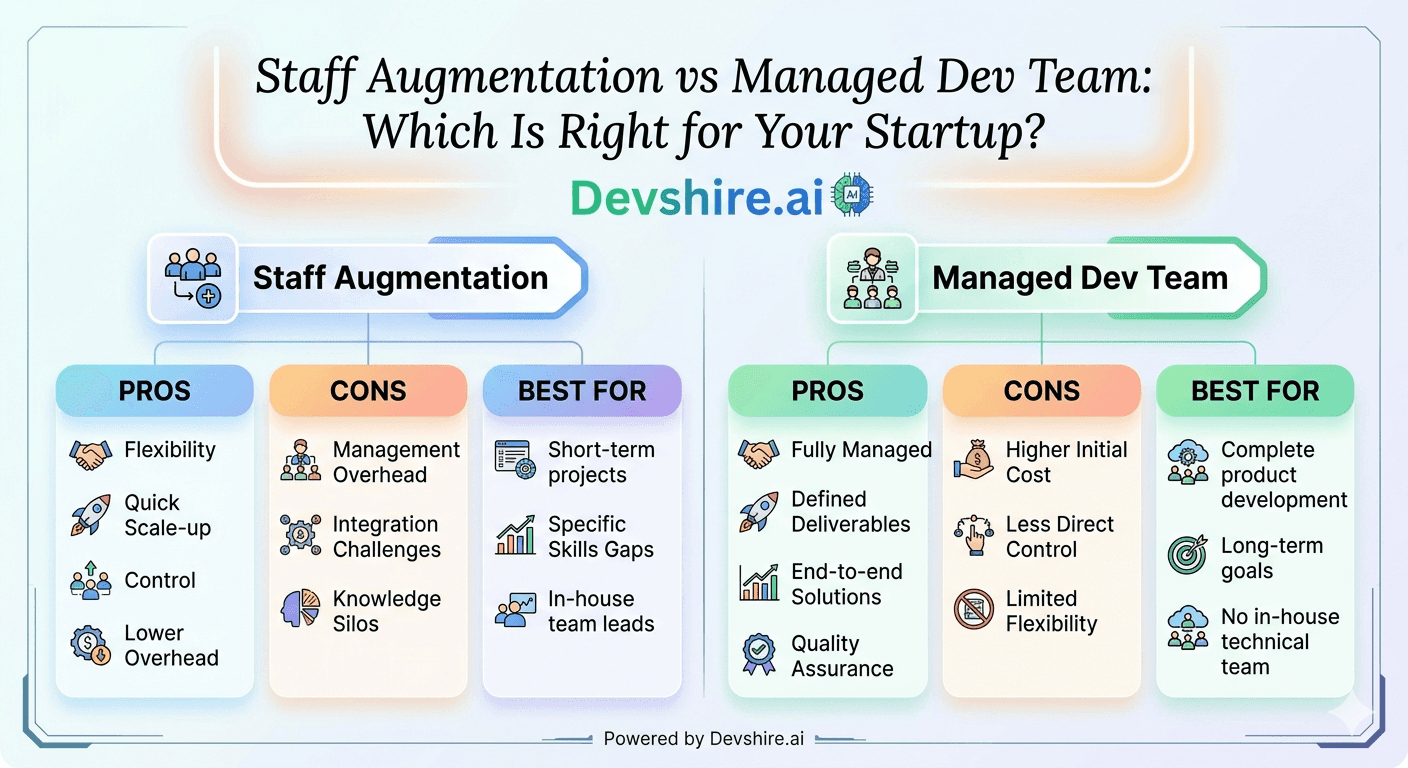
You need developers. You don't want to hire full-time yet. So the question becomes: do you bring in staff augmentation — individual developers who slot into your team — or do you hand the project to a managed dev team that owns delivery end-to-end? Both models work. Both fail for different reasons. The right answer depends on three things your team hasn't figured out yet: how defined the work is, how much control you need day-to-day, and what happens if output stalls.
💡 TL;DR
Staff augmentation gives you control and flexibility — you manage the developer directly, they work inside your team. A managed dev team gives you delivery accountability — they own the outcome, you review and approve. For startups under 10 people with a hands-on founder, staff augmentation through a platform like Devshire.ai wins almost every time. It costs $40–$140/hr depending on seniority, starts in under 24 hours, and you can swap or scale without a contract renegotiation. Managed teams make sense once your scope is fixed, your timeline is defined, and you have a product manager who can run the relationship.
What These Models Actually Mean in Practice
The terminology gets used interchangeably, which causes most of the confusion. Here's the real distinction, stripped of sales language.
Staff augmentation means you hire a developer — or several — who work as part of your team. They attend your standups, use your tools, report to your lead or founder, and work on whatever you assign them. You control the work. You manage the relationship. The developer is external but embedded.
A managed dev team means you contract a company or agency that owns a team of developers. You define what you want built. They decide how to build it, who builds it, and how the work is split. You review deliverables and give feedback. The team manages the rest.
In practice, this means staff augmentation gives you control and requires you to use it. A managed team gives you distance and requires you to trust the delivery. Neither model works if you pick the wrong one for your situation.
Side-by-Side: Staff Augmentation vs Managed Dev Team
Factor | Staff Augmentation | Managed Dev Team | Winner for Startups |
|---|---|---|---|
Control over work | Full — you direct daily tasks | Partial — you approve outputs | Staff Aug |
Speed to start | 24–48 hours (Devshire.ai) | 1–3 weeks (scoping + onboarding) | Staff Aug |
Cost structure | Hourly — pay only for hours used | Project fee or monthly retainer | Staff Aug |
Delivery accountability | You own the outcome | Agency owns the outcome | Managed (if scope is fixed) |
Flexibility | Scale up/down anytime | Contract changes = renegotiation | Staff Aug |
Requires from you | Active management, clear direction | Clear brief, review capacity | Depends |
Best for | Ongoing product work, iteration | Fixed-scope builds, defined deliverables | Depends on project |
Risk if wrong choice | Developer underused without direction | Expensive change orders, slow pivots | Staff Aug (lower risk floor) |
When Staff Augmentation Is the Right Call
Staff augmentation is the right model in four situations. Most early-stage startups fall into at least two of them.
✅ Your product is still evolving
If you're pre-product-market fit, the spec changes every two weeks. A managed team will charge you for every scope change. Staff augmentation lets you redirect work in real time — you tell the developer what matters this week, and they build it. No change order, no renegotiation, no delay.
✅ You have a founder or lead who can direct technical work
Staff augmentation fails when no one on your side can manage the developer. If you have a technical founder, a CTO, or a product manager who can run daily standups and review PRs, staff augmentation is dramatically more cost-effective than a managed team. You're paying for development hours, not project management overhead.
✅ You want a specific person on your team
Managed teams rotate developers. You often don't know who's working on your product from week to week. Staff augmentation gives you a named developer who knows your codebase, your decisions, and your patterns. That context compounds. A developer who's been on your product for 6 weeks is significantly more productive than a fresh one dropped in by a managed team.
✅ You want to try before you commit
Platforms like Devshire.ai offer a 1-week free trial. You test the developer in your actual codebase, on your actual work, before committing. Managed teams require weeks of scoping before a single line of code is written. Staff augmentation's trial-based model is the lowest-risk way to find a developer who genuinely fits.
When a Managed Dev Team Actually Makes Sense
Honestly — managed dev teams are the right choice in a narrower set of situations than most agencies will tell you. But those situations are real, and getting this wrong is expensive.
A managed team earns its place when the scope is fixed and documented, you have a product manager or project owner who can run a vendor relationship, the timeline is defined with clear milestones, and you genuinely don't want to manage individuals. A well-run e-commerce agency rebuilding a Shopify store, for example, is a legitimate managed team use case. The scope is clear. The deliverables are defined. There's no mid-project pivot coming.
But here's the thing most people skip. You might be thinking — but what about accountability? Managed teams own the outcome. That's true. But you still need someone on your side who can review that outcome intelligently. If you can't evaluate what they've shipped, you can't hold them accountable for it. The managed team model requires more internal capability than it appears to on the surface, not less.
Trusted by 500+ startups & agencies
"Hired in 2 hours. First sprint done in 3 days."
Michael L. · Marketing Director
"Way faster than any agency we've used."
Sophia M. · Content Strategist
"1 AI dev replaced our 3-person team cost."
Chris M. · Digital Marketing
Join 500+ teams building 3× faster with Devshire
1 AI-powered senior developer delivers the output of 3 traditional engineers — at 40% of the cost. Hire in under 24 hours.
The AI Developer Factor: Why Staff Aug Has Pulled Ahead in 2026
The calculus shifted in 2026. An AI-powered developer on a staff augmentation model now delivers what a 3-person managed team delivered two years ago. That changes the cost comparison completely.
A recruitment agency running outreach for 8 clients used Devshire.ai to place a single senior AI-powered developer on a 3-month staff aug engagement. That developer — using Cursor AI, Claude, and GitHub Copilot — shipped the equivalent of a 4-month managed team scope in 10 weeks, at roughly 40% of the cost. No project management overhead. No scope renegotiation. Direct communication with the founder daily.
The managed team model was built for a world where one developer = one developer's output. In 2026, one AI-powered developer = 2–3 developers' output. That math makes staff augmentation through an AI-first platform like Devshire the default choice for most startup and agency use cases.
💡 The hybrid worth knowing about
Some teams start with staff augmentation for the first 3 months — building the core product with a Devshire developer they manage directly — then hand off maintenance to a managed team once the codebase is stable and documented. This sequences the models correctly: control when you need it, delegation when the work is defined.
The Bottom Line
Staff augmentation gives you control, flexibility, and speed to start (24–48 hours via Devshire.ai). Managed dev teams give you delivery accountability and require less day-to-day management from your side.
For pre-PMF startups with a hands-on founder or CTO, staff augmentation wins in almost every scenario. You need to change direction too often for a managed team's structure to work.
A managed team is the right choice only when scope is fixed, timeline is defined, and you have someone internal who can run the vendor relationship intelligently.
AI-powered developers on a staff aug model now deliver 2–3× the output of traditional developers. This changes the cost comparison with managed teams significantly — you often need fewer developers, not a whole team.
The 1-week trial model at Devshire.ai eliminates the biggest risk in staff augmentation: choosing the wrong developer. Test before you commit, in your real codebase.
Managed teams rotate developers on your project. Staff augmentation gives you continuity — a developer who builds knowledge of your product over time. That compounding context is worth more than it sounds.
Frequently Asked Questions
What is the difference between staff augmentation and a managed dev team?
Staff augmentation means hiring external developers who work inside your team under your direction. You manage the work and the person. A managed dev team means contracting an agency or company that owns delivery — you define what you want, they decide how to build it and who builds it. The key distinction is control: staff augmentation puts it with you, managed teams take it on themselves.
Which is cheaper — staff augmentation or a managed dev team?
Staff augmentation is almost always cheaper per hour of development work. Managed teams bundle project management, communication overhead, and margin into their fees. You're paying for those things whether you need them or not. Staff augmentation through platforms like Devshire.ai starts at $40/hr for junior developers and $90–$140/hr for senior, with no project management overhead unless you add it.
Is staff augmentation right for a startup with no technical founder?
It depends on whether you can add that capability. If you have no one who can direct technical work or review code, staff augmentation becomes difficult — the developer needs direction and quality oversight. In that case, either hire a part-time fractional CTO to manage the developer, or consider a managed team for a fixed-scope first build. A fractional CTO plus a Devshire developer is often cheaper than a managed team and gives you more control.
How quickly can I start with staff augmentation?
Through Devshire.ai, you can have a vetted, AI-powered developer starting within 24–48 hours of posting your requirements. Managed dev teams typically require 1–3 weeks for scoping, contracts, and team onboarding before any development begins. For startups that need to move fast, the speed difference alone often makes the decision.
What happens if a staff augmentation developer isn't working out?
On platforms like Devshire.ai, you can swap the developer without penalty. The 1-week free trial period exists specifically to catch poor fits early — before you're committed. With a managed team, replacing a developer on your project typically requires a contract amendment and delays. Staff augmentation's flexibility is one of its most underrated advantages.
Can I use both models at the same time?
Yes, and some teams do this well. A common pattern: use staff augmentation for core product development where you need control and speed, and a managed team or agency for fixed-scope parallel workstreams — like a marketing site rebuild or a specific integration. Just make sure the two teams have a clear handoff protocol so nothing falls between the cracks.
Try Staff Augmentation the Right Way — Start With a Free Week
Devshire.ai matches you with pre-vetted AI-powered developers in under 24 hours. No managed team overhead. No long-term contracts. One senior AI developer who delivers what a 3-person team used to. Start with a 1-week free trial — test them in your real codebase before committing.
Start Your Free 1-Week Trial →
Pre-vetted AI developers · Starts at $40/hr · Hire in <24 hours · No minimum commitment
About Devshire.ai — Devshire.ai connects startups and agencies with AI-powered developers who use Cursor, Claude, and GitHub Copilot daily. Start in under 24 hours with a free 1-week trial. Start hiring →
Related reading: How to Hire AI Developers in 2026 · How to Write a Dev Job Description That Attracts AI Talent · Developer Rates by Country in 2026 · How to Onboard a Remote Developer in 48 Hours · Offshore Developer vs AI-Powered Developer: True Cost Comparison · Browse Pre-Vetted AI Developers →







Devshire Team
San Francisco · Responds in <2 hours
Hire your first AI developer — this week
Book a free 30-minute call. We'll match you with the right developer for your project and get you started within 24 hours.
<24h
Time to hire
3×
Faster builds
40%
Cost saved