
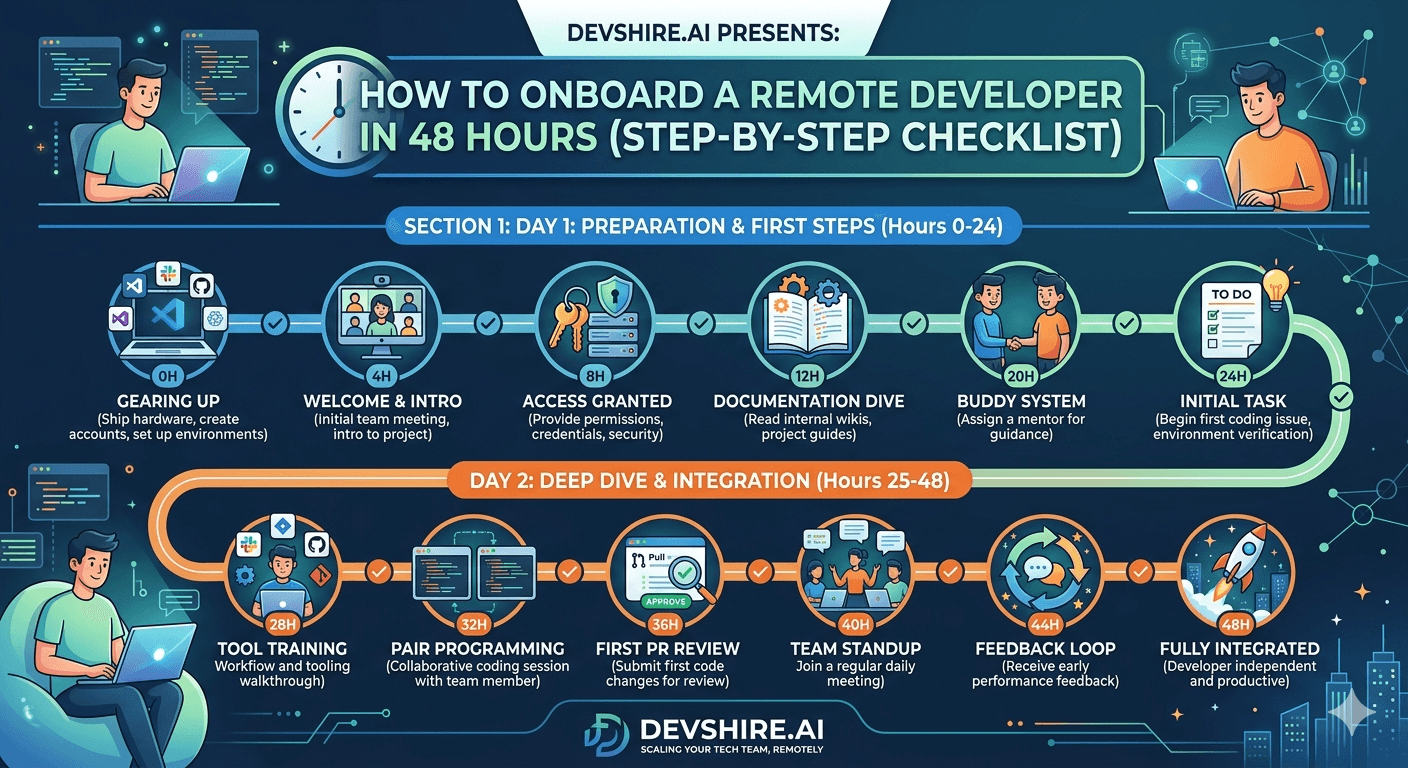
A developer who starts Monday and isn't productive by Wednesday is a hiring problem, not a developer problem. Most remote onboarding is done to the developer — a flood of Slack invites, a 40-page wiki nobody reads, and a vague instruction to "get familiar with the codebase." That approach produces a developer who's confused for two weeks and fully productive by week four. You can do it in 48 hours if the process is structured correctly.
💡 TL;DR
A remote developer can be fully productive within 48 hours if onboarding covers four things in order: access (all tools, accounts, and repo permissions set up before they start), context (a 1-page brief on the product, tech stack, and immediate priorities), a working local environment (they can run the app locally by end of Day 1), and a real first task (shipped and in review by end of Day 2). Most onboarding fails because it gives the developer information instead of giving them something to do. The fastest path to productivity is a small, real task with clear acceptance criteria on Day 1.
Before They Start: The Pre-Onboarding Checklist (Do This the Day Before)
The most common onboarding failure happens before the developer logs in for the first time. They spend Day 1 waiting for repo access, Slack invites that haven't arrived, and password resets. That's a full day lost — and it signals disorganisation that affects how the developer perceives the team for months.
Complete this checklist the afternoon before the developer starts. All of it. Every item that's missing on Day 1 costs 30–90 minutes of lost productivity and sends a silent message that your process isn't together.
☐ Repository access granted
Add them to GitHub/GitLab with the correct permissions before they start. Not read-only — they need to be able to create branches and open PRs from day one. If your repo requires VPN or SSO, have those credentials ready and tested on their email before Day 1 morning.
☐ Communication tools set up
Slack or Discord invite sent and accepted. Linear, Jira, or Notion access granted with the right workspace. If you use Loom for async video, invite them. Don't send eight tool invites at once on Day 1 morning — they'll miss half of them in the noise.
☐ Environment setup document written
A single document — maximum 2 pages — covering how to clone the repo, set up environment variables (.env.example is mandatory), install dependencies, and run the app locally. If this document doesn't exist, write it now. Time investment: 45 minutes. Time saved: 3–6 hours of developer confusion on Day 1.
☐ First task defined and documented
Write the first task before they start. Not "get familiar with the codebase" — that's not a task. A real first task has: a clear title, acceptance criteria (what done looks like), the relevant files or components to look at, and context on why this matters. Spend 20 minutes on this the day before. It changes everything about how their first week goes.
☐ 1-page product brief prepared
One page covering: what the product does and who uses it, the current state of the codebase (what's built, what's not), the tech stack and why those choices were made, and the top 3 priorities for the next 4 weeks. This is not a full PRD. It's a developer orientation document. Keep it to one page. If it's longer, cut it.
Day 1: Environment Running, Context Clear, First Task Started
Day 1 has three goals. The developer has a working local environment. They understand the product and immediate priorities. They've started — not finished, started — their first task. Everything else is secondary.
Morning (Hours 1–3)
Start with a 30-minute video call. Not a 2-hour onboarding session — 30 minutes. Cover the product in 5 minutes, the stack in 5 minutes, the way the team communicates in 5 minutes, and spend the remaining 15 minutes answering their questions. Then end the call and let them work.
Their job for the rest of the morning: get the app running locally using the environment setup document you prepared. Set a clear checkpoint — a message in Slack by 12pm confirming the app is running, or flagging where they got stuck. Most developers will have it running within 2 hours. If they don't, that's useful information about their setup skills.
Afternoon (Hours 4–8)
Point them to the first task you defined. Make yourself available for a 15-minute check-in mid-afternoon. The goal: by end of Day 1, they've read the task, understood the relevant code, and made a start — even if it's just a new branch with a couple of exploratory commits. No deliverable expected yet. Momentum is the deliverable.
Day 2: First PR Open, First Feedback Given, Working Rhythm Set
Day 2 is where most onboarding either locks in or falls apart. The developer should open their first pull request today — not a perfect PR, a real one. Something reviewable. This matters more than it sounds.
Opening a PR in the first 48 hours does five things: it forces the developer to understand your git workflow immediately, it gives you something concrete to review and give feedback on, it establishes the PR-as-communication norm from the start, it builds the developer's confidence that they're contributing, and it tells you whether their code style and quality are what you expected. All five of those things take weeks to establish if you don't do it in the first 48 hours.
⚡ The first PR doesn't need to be big
The best first tasks for Day 2 are small but real: fix a minor bug, add a missing validation, update a component to match a new design. The point isn't the feature — it's the workflow. A developer who opens a clean PR with a clear description on Day 2 will have that same habit for the rest of the engagement. One who takes 2 weeks to open their first PR has already set a different norm.
The Full 48-Hour Onboarding Checklist
Timing | Milestone | Owner | Done When |
|---|---|---|---|
Day Before | Repo access granted | You | Dev can clone and see code |
Day Before | All tool invites sent | You | Slack, Linear, Notion active |
Day Before | Env setup doc written | You | App runs in <60 mins from doc |
Day Before | First task defined | You | Task in Linear with acceptance criteria |
Day 1 AM | 30-min welcome call | Both | Product, stack, comms covered |
Day 1 AM | Local environment running | Developer | App loads at localhost |
Day 1 PM | First task started | Developer | Branch created, first commits made |
Day 1 PM | 15-min check-in call | Both | Blockers cleared, questions answered |
Day 2 AM | First PR open | Developer | PR with description, ready for review |
Day 2 PM | First code review done | You | Feedback given within 2 hrs of PR |
Day 2 PM | Second task assigned | You | Developer has clear next work |
Day 2 EOD | Async standup norm set | Both | Dev posts EOD update in Slack |
Trusted by 500+ startups & agencies
"Hired in 2 hours. First sprint done in 3 days."
Michael L. · Marketing Director
"Way faster than any agency we've used."
Sophia M. · Content Strategist
"1 AI dev replaced our 3-person team cost."
Chris M. · Digital Marketing
Join 500+ teams building 3× faster with Devshire
1 AI-powered senior developer delivers the output of 3 traditional engineers — at 40% of the cost. Hire in under 24 hours.
What Goes Wrong — And the Fix for Each
Three things derail 48-hour onboarding most often. All three are predictable. All three have a specific fix.
❌ The environment doesn't work
The developer follows the setup doc and something breaks — a missing environment variable, an outdated dependency, a platform-specific issue. This happens in roughly 40% of onboardings. Fix: have a second person test your environment setup doc on a clean machine before the developer starts. Or add a "Known Issues" section to the doc with the 3 most common setup problems and their solutions. This alone saves 2–4 hours on Day 1.
❌ The first task is too big
A first task that takes more than 1.5 days to complete means no PR in 48 hours, which means no feedback loop, which means the developer isn't sure if they're on the right track. Keep the first task to something completable in 6–10 hours. Save the big features for Week 2 when context has built up and the workflow is established.
❌ Feedback on the first PR takes too long
If the developer opens a PR on Day 2 morning and doesn't hear back for 24 hours, they don't know if they're doing it right. Commit to reviewing the first PR within 2 hours of it being opened. Even a brief review — "good approach, just fix X" — tells them the workflow is working. Slow code review in Week 1 sets a norm that's hard to change later.
The Bottom Line
Set up all access — repo, Slack, Linear, environment docs — the day before the developer starts. Every missing item on Day 1 costs 30–90 minutes of lost productivity and signals disorganisation.
The 48-hour milestone target: local environment running by end of Day 1, first PR open by end of Day 2. These two checkpoints tell you more about a developer than any interview question.
A first task should be completable in 6–10 hours — small, real, and with clear acceptance criteria. Not "get familiar with the codebase." That's not a task; it's a delay.
Review the first PR within 2 hours of it being opened. This single habit sets the entire tone of the working relationship. Slow first reviews create slow developers.
A 30-minute welcome call is better than a 2-hour onboarding session. Cover product, stack, and communication norms — then let them work. Information overload on Day 1 is a documented productivity killer.
Keep a living onboarding document. Every time something breaks or a question comes up during onboarding, add it to the doc. After 3–4 hires, your onboarding becomes nearly self-running.
Frequently Asked Questions
How do you onboard a remote developer quickly?
Pre-stage everything before Day 1: repo access, tool invites, environment setup docs, and a defined first task. On Day 1, run a 30-minute welcome call, then let them get the app running locally. On Day 2, have them open their first PR — even a small one. The feedback loop from real code review in the first 48 hours is more valuable than any amount of documentation reading or tool exploration.
What should a developer do in their first week?
By the end of Week 1, a developer should have: a working local environment, 2–3 PRs opened and reviewed, a clear understanding of the codebase architecture, and a grasp of the team's communication norms. If they're not at this point by Friday of Week 1, the onboarding process failed — not the developer. Review the checklist and identify what was missing.
What is the most important document for remote developer onboarding?
The environment setup document — the one that explains how to clone the repo, set up environment variables, install dependencies, and run the app locally. If a developer can't get the app running on their machine in under 60 minutes using this document, the document isn't good enough. Keep it under 2 pages and test it on a clean machine before every new hire.
How do you set expectations with a remote developer from day one?
Set expectations through structure, not just conversation. The clearest expectation-setter is the first task — if it has specific acceptance criteria, a defined timeline, and gets reviewed promptly when done, the developer understands the standard. Add an async standup norm (EOD update in Slack) from Day 1 and maintain it consistently. Norms set in the first week persist for months.
Should I use a platform to hire and onboard developers?
Platforms like Devshire.ai reduce onboarding time significantly because the developers are already vetted — you skip the "is this person competent?" uncertainty that slows down the first two weeks. The 1-week free trial structure also means the first week is explicitly a trial period, which focuses both sides on proving fit quickly rather than easing in slowly. Many Devshire clients have developers committing to real code within 24 hours of their start date.
What tools do I need to onboard a remote developer?
The minimum viable onboarding stack: GitHub or GitLab (code and PRs), Slack or Discord (communication), Linear or Jira (task management), and a shared Notion or Confluence doc for the environment setup guide and product brief. That's it. Adding more tools in Week 1 creates noise. Get the developer productive with the core four first, then introduce anything else once they have context.
Hire a Developer Who Hits the Ground Running in 24 Hours
Devshire.ai developers are pre-vetted, AI-powered, and experienced with fast-start remote onboarding. They've done this before — local environment up in hours, first PR open on Day 2. Start with a 1-week free trial. No contracts, no commitments, no slow starts.
Start Your Free 1-Week Trial →
Pre-vetted AI developers · Starts at $40/hr · First code committed in 24 hrs · No commitment
About Devshire.ai — Devshire.ai connects startups and agencies with AI-powered developers ready to ship from day one. Pre-vetted, AI-tool proficient, remote-native. Start hiring →
Related reading: How to Hire AI Developers in 2026 · How to Write a Dev Job Description That Attracts AI Talent · Staff Augmentation vs Managed Dev Team · Red Flags When Hiring a Freelance Developer · Managing Remote Development Teams: Best Tools and Practices · Browse Pre-Vetted AI Developers →







Devshire Team
San Francisco · Responds in <2 hours
Hire your first AI developer — this week
Book a free 30-minute call. We'll match you with the right developer for your project and get you started within 24 hours.
<24h
Time to hire
3×
Faster builds
40%
Cost saved