
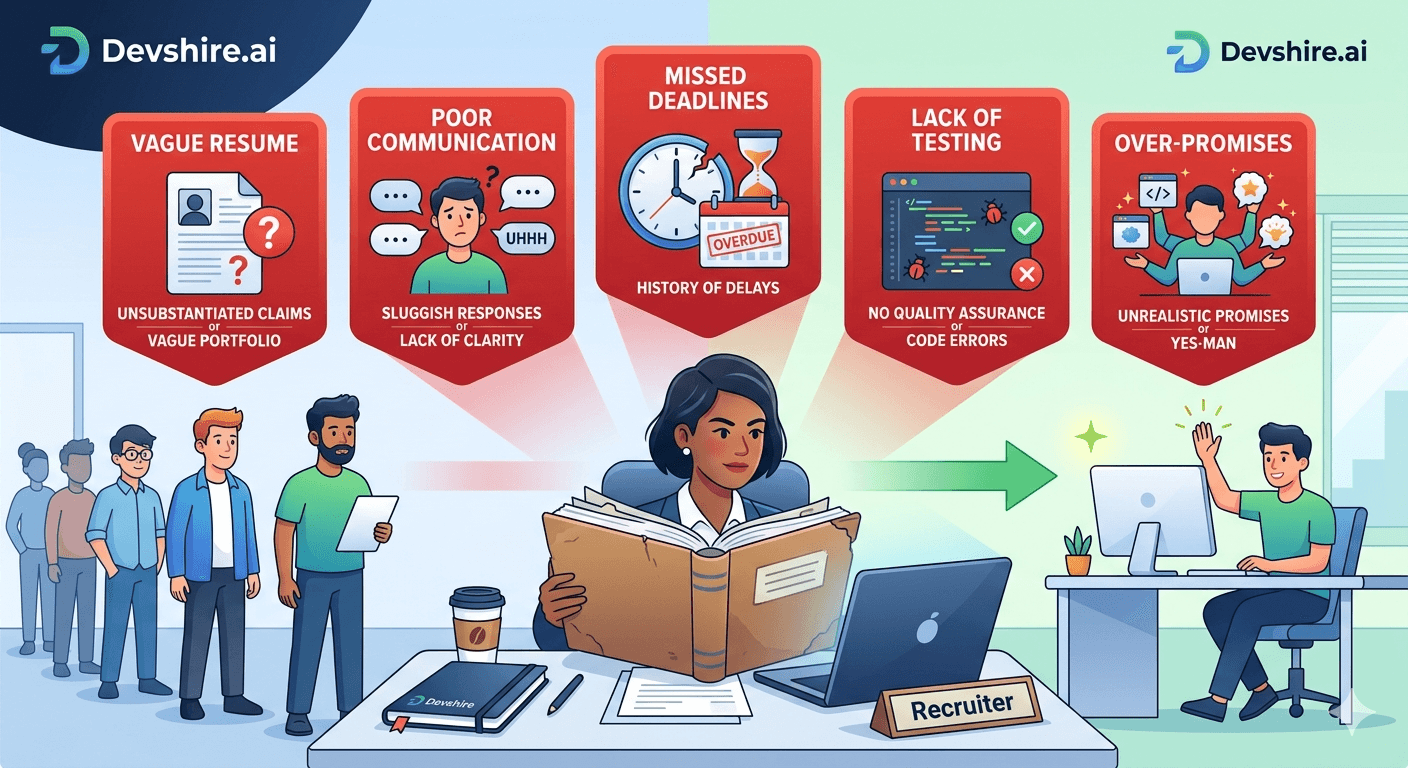
Most bad freelance developer hires are predictable. They leave signals in the first conversation — in how they respond to a brief, how they answer a scope question, how they describe their last client. The problem isn't that the signals are hidden. It's that most founders don't know what to look for until they've already wasted $15,000 and six weeks on the wrong developer. These are the patterns we've seen across 100+ developer placements at Devshire.ai. Some will save you a lot of money.
💡 TL;DR
The clearest red flags when hiring a freelance developer: they can't give a specific estimate for a scoped task, they have no live URLs in their portfolio, they're evasive about why they left their last client, they respond to your brief by immediately upselling scope, and they can't explain their code decisions in plain language. The single most reliable filter: ask for a paid 4–8 hour test task on a real piece of your project. A developer who's genuinely skilled will welcome this. One who isn't will push back or overpromise on what they'll deliver in that window.
Communication Red Flags That Predict Project Failure
Communication problems in the first week predict delivery problems in week four. These aren't personality issues — they're structural signals about how a developer operates under pressure.
🚩 They go quiet for 24–48 hours without warning
A developer who disappears for two days in the first week of contact — without a heads-up — will do the same when a bug is blocking your release. This isn't about being always-on. It's about communication discipline. Strong remote developers proactively flag when they'll be unavailable. Silence without context is a red flag at any stage of the relationship, but especially before the contract starts.
🚩 They can't explain technical decisions in plain English
Ask a developer why they chose PostgreSQL over MongoDB, or why they used a REST API instead of GraphQL, on their last project. A strong developer gives you a clear, simple answer — "we had relational data and needed ACID compliance, so Postgres was the obvious choice." A weak developer either gives you jargon that explains nothing or defers to what their last employer decided. You don't need to understand every technical choice, but you need to work with a developer who can explain them clearly.
🚩 Every message is a scope expansion
Some developers use every interaction as an opportunity to expand the project — "while I'm in there, I should also refactor X, build Y, and set up Z." Occasionally that's legitimate technical foresight. Usually it's a pattern that ends with a 40% cost overrun and a half-built product. A developer who can't stay inside a defined scope during the conversation will blow past it during the build. Ask them directly: "If I give you a fixed budget and scope, can you work within it?" and listen to what happens next.
Portfolio Red Flags That Most Founders Walk Past
These are the signals hiding in plain sight in most developer portfolios. They look like minor issues but predict significant problems.
What You See | What It Signals | How to Probe It |
|---|---|---|
All projects from 3+ years ago | May not be actively building | "What have you shipped in the last 6 months?" |
No live URLs, only screenshots | May not have shipped to production | "Can you send me a live link I can click?" |
"Contributed to" large projects | May have made minor fixes, not features | "What specific PRs did you merge and what did they change?" |
Only their own side projects | May struggle with client codebases | "Describe a time you joined an existing codebase. What was it like?" |
Identical tech stack across all projects | May struggle when your stack differs | "Have you worked in [your specific stack]? Show me an example." |
No mention of AI tools in 2026 | Traditional output velocity | "Which AI tools do you use daily? Show me your workflow." |
Proposal Red Flags That Hide in Plain Sight
The proposal stage is where most bad hires are preventable — and where most founders miss the signals because they're too focused on comparing prices.
🚩 Vague timeline: "2–4 weeks depending on requirements"
A developer who can't estimate a scoped task within a reasonable range hasn't scoped it seriously. "2–4 weeks" is a 100% variance range — it means they don't know. A developer with real experience estimates like this: "Based on what you've described, I'd put this at 12–14 business days, with the biggest uncertainty being the third-party API integration." Specificity is the signal. Vagueness is the red flag.
🚩 No questions about your project in the first message
A good developer reads your brief and immediately has clarifying questions: "What's the expected user load at launch?" or "Do you have a design system or are we building from scratch?" A developer who responds with a price and a timeline without asking anything doesn't understand your project. They're templating a response, not engaging with your problem. This pattern leads to scope misalignment within the first sprint.
🚩 They're unavailable to start for 3+ weeks
A developer who can't start for more than 3 weeks is either overcommitted or not treating your project as a priority. Either is a problem. Overcommitted developers deliver slower than estimated because your project always competes with the work they haven't finished yet. This is especially pronounced in fixed-price contracts where the developer has an incentive to delay your project to clear existing commitments first.
🚩 They push back hard on a paid trial
This is the most reliable filter. A developer who's genuinely skilled will agree to a paid 4–8 hour test task without hesitation — they know they'll impress you. A developer who's overpromising or has quality concerns will push back, offer excuses, or try to skip directly to a full contract. Push back on the pushback. Insist on the trial. It's the best $300–$600 you'll spend in the hiring process, and it filters out 80% of the red-flag developers who got this far.
Red Flags That Appear After You've Hired Them
Sometimes you miss the pre-hire signals. Here's what to watch for in the first two weeks — and how to address each before it becomes a project failure.
🚩 No code committed in the first 48 hours
A developer who hasn't made a commit — even exploratory — in the first two days isn't moving. This often signals they're overwhelmed by the codebase, stuck on environment setup (which you should have solved in onboarding), or working on other clients. Address this directly in a call, not over text. "I noticed you haven't pushed anything yet — where are you at?" You'll get real information fast.
🚩 PRs with no descriptions or context
A developer who opens a PR titled "fix" with no description of what changed or why isn't communicating — they're depositing code. This creates a review bottleneck where you have to ask questions about every PR before you can review it. Set the standard explicitly: every PR needs a one-paragraph description covering what changed and why. If you don't set this norm in Week 1, it won't exist in Week 8.
🚩 They always have a reason the deadline moved
One missed deadline with a legitimate reason is normal. A pattern of missed deadlines with a different excuse each time is a delivery problem, not a circumstance problem. The right response at the second miss: a direct conversation about whether the timeline was realistic and what specifically needs to change. The wrong response is to keep adjusting the deadline without addressing the pattern.
Trusted by 500+ startups & agencies
"Hired in 2 hours. First sprint done in 3 days."
Michael L. · Marketing Director
"Way faster than any agency we've used."
Sophia M. · Content Strategist
"1 AI dev replaced our 3-person team cost."
Chris M. · Digital Marketing
Join 500+ teams building 3× faster with Devshire
1 AI-powered senior developer delivers the output of 3 traditional engineers — at 40% of the cost. Hire in under 24 hours.
The Bottom Line
The clearest pre-hire red flag: they can't give a specific estimate for a scoped task. "2–4 weeks" means they haven't engaged with your project seriously.
Ask which AI tools they use daily. In 2026, a developer with no AI workflow is operating at 2022 speed — which affects your timeline and budget directly.
Always run a paid test task of 4–8 hours before committing. A qualified developer welcomes this. A developer who pushes back on a paid trial is telling you something important about their confidence in their own work.
Portfolio red flags: no live URLs, all projects 3+ years old, vague descriptions of personal contributions, and tutorial projects presented as original work.
The communication red flag that predicts project failure most reliably: going quiet for 24–48 hours without warning in the first week of contact.
Platforms like Devshire.ai pre-filter these red flags with technical vetting before you see a developer. The 1-week trial period is a structured version of the paid test task — everything you need to verify fit before committing to ongoing work.
Frequently Asked Questions
What are the biggest red flags when hiring a freelance developer?
The top five: inability to estimate a scoped task specifically, no live URLs in their portfolio, evasiveness about why they left their last client, immediate scope expansion in the first conversation, and pushback on a paid trial task. Any one of these is worth probing. Two or more together are a strong signal to move on to the next candidate.
How do you know if a freelance developer is actually good?
Three signals beyond the portfolio: they ask smart clarifying questions about your project immediately, they can explain their past technical decisions in plain language, and they're willing to do a paid test task without objection. A developer who does all three has the technical ability and communication skills to be a strong hire. The test task is non-negotiable — it's the only real-world signal in the process.
Should I always do a paid test before hiring a freelance developer?
Yes — with one exception. If you're hiring through a platform like Devshire.ai where technical vetting has already been done, the 1-week free trial serves the same purpose with less friction. In all other cases, a paid 4–8 hour test task is the single highest-ROI step in the hiring process. Pay the market rate for those hours. Never ask for free test work — it signals that you'll undervalue the developer's time throughout the engagement.
What should I do if a developer I've hired starts showing red flags?
Address the first sign directly, by video call, within 24 hours of noticing it. Don't handle performance issues over Slack — it creates defensiveness and ambiguity. Say specifically what you observed: "I noticed there have been no commits in 48 hours — what's blocking you?" Most early-engagement red flags are addressable if caught fast. The ones that persist after a direct conversation are not.
Is Upwork a good place to hire freelance developers?
Upwork has a large developer pool but high variance in quality and very limited AI-tool-specific vetting. The top-rated developers on Upwork are legitimately strong, but finding them requires significant evaluation time. For startups that need to move fast and don't have a technical co-founder to run the vetting process, pre-vetted platforms like Devshire.ai are significantly more efficient — you get a shortlist within 24 hours instead of spending 2–3 weeks evaluating 20+ profiles yourself.
What does a good freelance developer proposal look like?
A strong proposal includes: clarifying questions about your project (not just a price quote), a specific timeline estimate with the key uncertainty named, a relevant portfolio example with a live URL, a clear description of their working process and communication style, and either an invitation to a discovery call or a direct acknowledgment of your specific requirements. A proposal that could have been sent to any client with no changes is a template — and a red flag.
Hire Pre-Vetted Developers — Red Flags Already Filtered Out
Every developer on Devshire.ai has already been through technical vetting, portfolio review, and AI tool assessment. You skip the screening and get a shortlist of qualified, AI-powered developers in under 24 hours. Start with a 1-week free trial — the structured test that removes all remaining uncertainty.
Get Your Vetted Developer Shortlist →
Red flags pre-filtered · AI-tool vetted · Hire in <24 hours · Free 1-week trial
About Devshire.ai — Devshire.ai pre-vets every developer on portfolio quality, GitHub activity, AI tool proficiency, and communication skills before placing them with startups and agencies. Start hiring →
Related reading: How to Hire AI Developers in 2026 · How to Evaluate a Developer Portfolio When You Are Non-Technical · How to Write a Dev Job Description That Attracts AI Talent · How to Onboard a Remote Developer in 48 Hours · Offshore Developer vs AI-Powered Developer: True Cost Comparison · Browse Pre-Vetted AI Developers →







Devshire Team
San Francisco · Responds in <2 hours
Hire your first AI developer — this week
Book a free 30-minute call. We'll match you with the right developer for your project and get you started within 24 hours.
<24h
Time to hire
3×
Faster builds
40%
Cost saved