
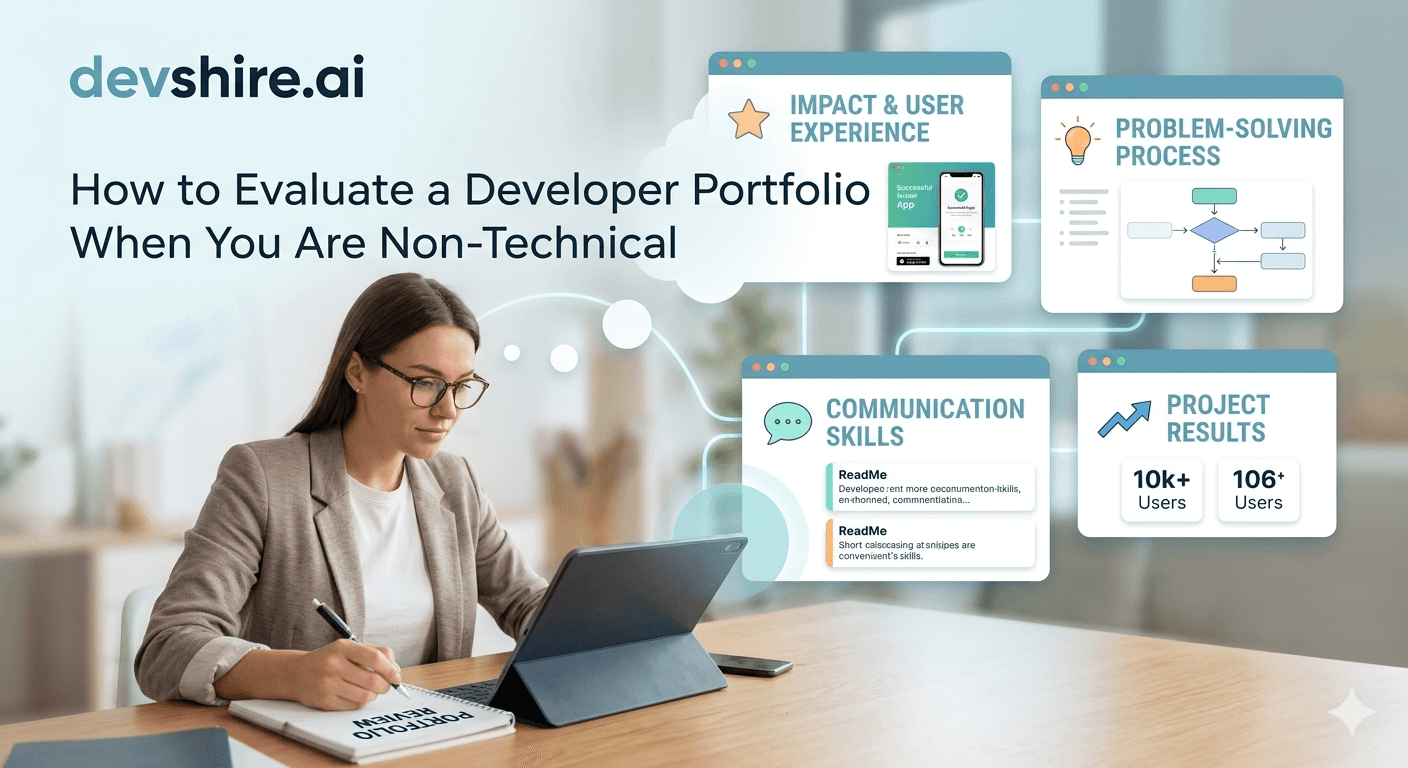
You're hiring a developer. They sent you a portfolio. It has GitHub links, a live app, and some screenshots. You have no idea what you're looking at — and you're making a decision that will cost $10,000–$50,000 and determine whether your product ships on time. This is one of the most common and most under-addressed problems in startup hiring. The good news: you don't need to read code to evaluate a developer portfolio well. You need to ask the right questions.
💡 TL;DR
Non-technical founders can evaluate a developer portfolio by focusing on three things: live, working products (not just screenshots), clear explanations of what the developer personally built vs what they inherited, and consistent activity patterns on GitHub that show real, ongoing work. Red flags include portfolios with only design mockups, no deployed live URLs, or projects where the developer can't explain their specific contribution. The best shortcut: use a pre-vetted platform like Devshire.ai where portfolio evaluation has already been done for you by a technical team.
The 5 Things a Non-Technical Founder Can Actually Evaluate
You don't need to understand the code. You need to understand the evidence that the code works, was shipped, and was actually written by this person. These five signals are visible to anyone.
🔍 1. Live URLs, not just screenshots
Click every link in the portfolio. Does it load? Does it work on mobile? A developer who builds production-quality applications always has live, functioning URLs. Screenshots are easy to fake. A deployed, working app is not. If every portfolio item is a screenshot or a Figma mockup, that's a red flag — not necessarily a deal-breaker, but worth probing in the interview.
🔍 2. Real users or real clients
A project with 200 actual users is a fundamentally different signal from a project the developer built for themselves over a weekend. Ask: "Is this live and being used?" and "How many users does it have?" A developer who has shipped something real — even a small SaaS tool with 50 paying customers — has navigated production bugs, user feedback, and real performance requirements. That experience doesn't show up in the code.
🔍 3. Their specific contribution
Ask every developer: "What did you personally build on this project?" The answer reveals everything. A strong developer will say: "I built the authentication system, the API layer, and the Stripe integration. The design was done by a contractor." A weak answer is vague — "I worked on the backend" with no specifics. If they can't describe their exact contribution, they either didn't do much of the work or they can't articulate technical decisions clearly, which is a problem either way.
🔍 4. GitHub activity pattern (not just commit count)
You don't need to read the code on GitHub. Look at the activity graph. Does it show consistent work over time, or a burst of activity right before they applied? Consistent work — commits spread across weeks and months — means this is a developer who ships continuously. A burst pattern suggests the portfolio was assembled specifically for job applications. Also check: do they have repositories with README files that explain what each project does? A developer who documents their work is a developer who communicates well.
🔍 5. The complexity of problems they've solved
You can evaluate complexity without reading code by asking: "What was the hardest technical problem you solved in this project?" A junior developer will say something like "setting up the database." A senior developer will say something like "we had a race condition in our payment processing that only appeared under concurrent load — I fixed it by implementing an idempotency key on the Stripe webhook handler." You don't need to understand every word. You need to assess whether the answer is specific, whether it demonstrates independent problem-solving, and whether it sounds like something they actually lived through.
Portfolio Red Flags That Non-Technical Founders Often Miss
These are the signals that look fine on the surface but indicate a problem underneath. Most non-technical founders walk past all of them.
What You See | What It Often Means | What to Do |
|---|---|---|
Only design screenshots, no live URLs | Developer may be a designer, not a builder | Ask for a live demo or test deployment |
"Contributed to" large open source projects | May have fixed one typo in a README | Ask what specific PRs they merged and what they changed |
All projects are from 2–3 years ago | May not be building actively anymore | Ask what they've shipped in the last 6 months |
Projects built entirely solo, no team context | May struggle with codebases they didn't create | Ask about a time they joined an existing codebase |
No mention of AI tools in 2026 | May be working at traditional speed | Ask which AI tools they use daily |
Tutorial projects presented as original work | Rebuilt a YouTube tutorial, not original code | Ask: "What would you add if you kept building this?" |
The 6 Questions to Ask in the Portfolio Review Call
You don't need a technical co-founder in the room. You need the right questions. These six will tell you what you need to know from any developer portfolio, regardless of your own technical background.
"Walk me through your favourite project in this portfolio. What problem were you solving and why did you build it?" — The quality of their thinking matters more than the technical answer. Can they explain a problem clearly?
"What did you personally build vs what was done by someone else?" — Non-negotiable. Every portfolio item needs this answered specifically.
"What's the hardest bug or technical problem you hit on this project? How did you fix it?" — Specificity here = real experience. Vagueness = inherited work or embellishment.
"Is this still live? How many users does it have?" — Grounds the portfolio in reality immediately.
"Which AI tools do you use in your daily development workflow?" — In 2026, the answer to this directly predicts their output velocity. A developer using Cursor AI and Claude will ship 2–3× faster than one who isn't.
"If you joined our project next week, what would your first two weeks look like?" — This shows whether they understand onboarding, can plan independently, and can think beyond just writing code.
The Honest Shortcut: Use a Pre-Vetted Platform
Here's the thing about portfolio evaluation: it's time-consuming even for technical people. For non-technical founders, it's a full-time job for a week. There's a legitimate shortcut that doesn't compromise on quality.
Platforms like Devshire.ai do the portfolio evaluation for you — by a technical team. Every developer on Devshire has already had their GitHub reviewed, their live projects tested, their AI tool proficiency assessed, and their communication style evaluated through a real technical interview. By the time a developer appears in your shortlist, the portfolio work is done.
A founder running a 4-person SaaS startup recently told us: "I spent 3 weeks evaluating developer portfolios and got it wrong twice. Then I used Devshire, got a shortlist in 48 hours, did one interview, and hired the right person in a day. I wish I'd started there."
That said — even with a pre-vetted platform, the six questions above are worth asking in the final interview. They're not about verification at that point. They're about understanding how this specific developer thinks and whether they'll communicate well with a non-technical founder.
Trusted by 500+ startups & agencies
"Hired in 2 hours. First sprint done in 3 days."
Michael L. · Marketing Director
"Way faster than any agency we've used."
Sophia M. · Content Strategist
"1 AI dev replaced our 3-person team cost."
Chris M. · Digital Marketing
Join 500+ teams building 3× faster with Devshire
1 AI-powered senior developer delivers the output of 3 traditional engineers — at 40% of the cost. Hire in under 24 hours.
The Bottom Line
You don't need to read code to evaluate a developer portfolio. Focus on live URLs, real users, specific contributions, GitHub activity patterns, and the quality of problem-solving explanations.
The single most revealing question: "What did you personally build on this project?" Vague answers are a red flag regardless of how impressive the portfolio looks.
Ask which AI tools they use. In 2026, a developer using Cursor AI and Claude daily ships 2–3× faster. This directly affects your timeline and budget.
Tutorial projects presented as original work is one of the most common portfolio deceptions. Ask: "What would you add if you kept building this?" — a developer who didn't write the code can't answer this well.
GitHub activity patterns matter more than commit counts. Consistent work over months beats a portfolio assembled in a burst right before the application.
The fastest legitimate shortcut: use a pre-vetted platform like Devshire.ai where portfolio review has already been done technically, then use the interview to evaluate communication and thinking style.
Frequently Asked Questions
How do I evaluate a developer's portfolio without technical knowledge?
Focus on five things you can assess without reading code: live, functioning URLs for every project; evidence of real users or clients; the developer's specific contribution to each project (not just team membership); consistent GitHub activity over time; and the quality of their verbal explanations when asked about hard problems they solved. These signals are visible to any founder regardless of technical background.
What should I look for in a developer's GitHub profile?
Look at the activity graph first — consistent commits spread across weeks and months beat a burst of activity right before the application. Then check whether their repositories have README files that explain what each project does and how to run it. A developer who documents their work communicates well. You don't need to read the actual code to extract these signals.
What are the biggest red flags in a developer portfolio?
The main red flags: only screenshots with no live URLs; all projects are 2+ years old with nothing recent; inability to name their specific contribution to each project; tutorial-based projects presented as original work; and no mention of AI tools in 2026. The most serious red flag is vagueness — a developer who can't describe specifically what they built and what problem it solved is either hiding something or hasn't built much.
Should I ask for a paid test project instead of reviewing a portfolio?
Yes, and most experienced developers will respect this. A short paid test — 4–8 hours of real work on a scoped mini-task from your actual project — tells you more than any portfolio review. It shows communication style, how they handle ambiguity, code quality, and speed. Platforms like Devshire.ai structure the first week as a trial specifically for this reason. Pay for the trial. It's the best $300–$600 you'll spend in the hiring process.
How important is it that a developer uses AI tools in 2026?
Very important if your goal is shipping fast. A developer using Cursor AI, GitHub Copilot, and Claude in their daily workflow delivers 2–3× the feature output of one who isn't. For a startup where development speed directly affects runway consumption, this multiplier is significant. Ask specifically which tools they use and how — not just whether they've heard of them.
Skip the Portfolio Review — Get Pre-Vetted AI Developers in 24 Hours
Devshire.ai evaluates every developer's portfolio, GitHub, and AI tool proficiency before you see them. You get a vetted shortlist in 24–48 hours, not a pile of portfolios to evaluate yourself. Start with a 1-week free trial. No commitment required.
Get Your Developer Shortlist →
Pre-vetted AI developers · Technical vetting done for you · Hire in <24 hours · Free 1-week trial
About Devshire.ai — Devshire.ai connects non-technical founders and startups with AI-powered developers, pre-vetted on GitHub activity, live projects, and AI tool proficiency. Start hiring →
Related reading: How to Hire AI Developers in 2026 · How to Write a Dev Job Description That Attracts AI Talent · How to Manage Developers When You Are Non-Technical · Red Flags When Hiring a Freelance Developer · How to Onboard a Remote Developer in 48 Hours · Browse Pre-Vetted AI Developers →







Devshire Team
San Francisco · Responds in <2 hours
Hire your first AI developer — this week
Book a free 30-minute call. We'll match you with the right developer for your project and get you started within 24 hours.
<24h
Time to hire
3×
Faster builds
40%
Cost saved