Every year brings a new round of "X language is dead" and "Y is the future" posts that say more about the author's preferences than the actual market. So let's ground this in something more useful: hiring demand, ecosystem momentum, the specific impact of AI tooling on each language's trajectory, and where the real engineering work is happening in 2026. The list isn't about what's theoretically best. It's about what companies are actually paying for, what AI developer tools support well, and where learning investment will compound over the next 18 months. Some of these picks will be unsurprising. A few will push back on conventional wisdom. All of them are grounded in market signals, not hype.
💡 TL;DR
Python, TypeScript, and Rust are the three languages with the strongest combined signals of hiring demand, AI tooling support, and ecosystem momentum heading into 2027. Python remains dominant for AI/ML work. TypeScript has effectively replaced JavaScript as the default for serious web development. Rust is the fastest-growing systems language. Go, Kotlin, and Swift hold strong in their domains. SQL is underrated and essential. Java isn't going anywhere in enterprise. PHP is declining but not dead.
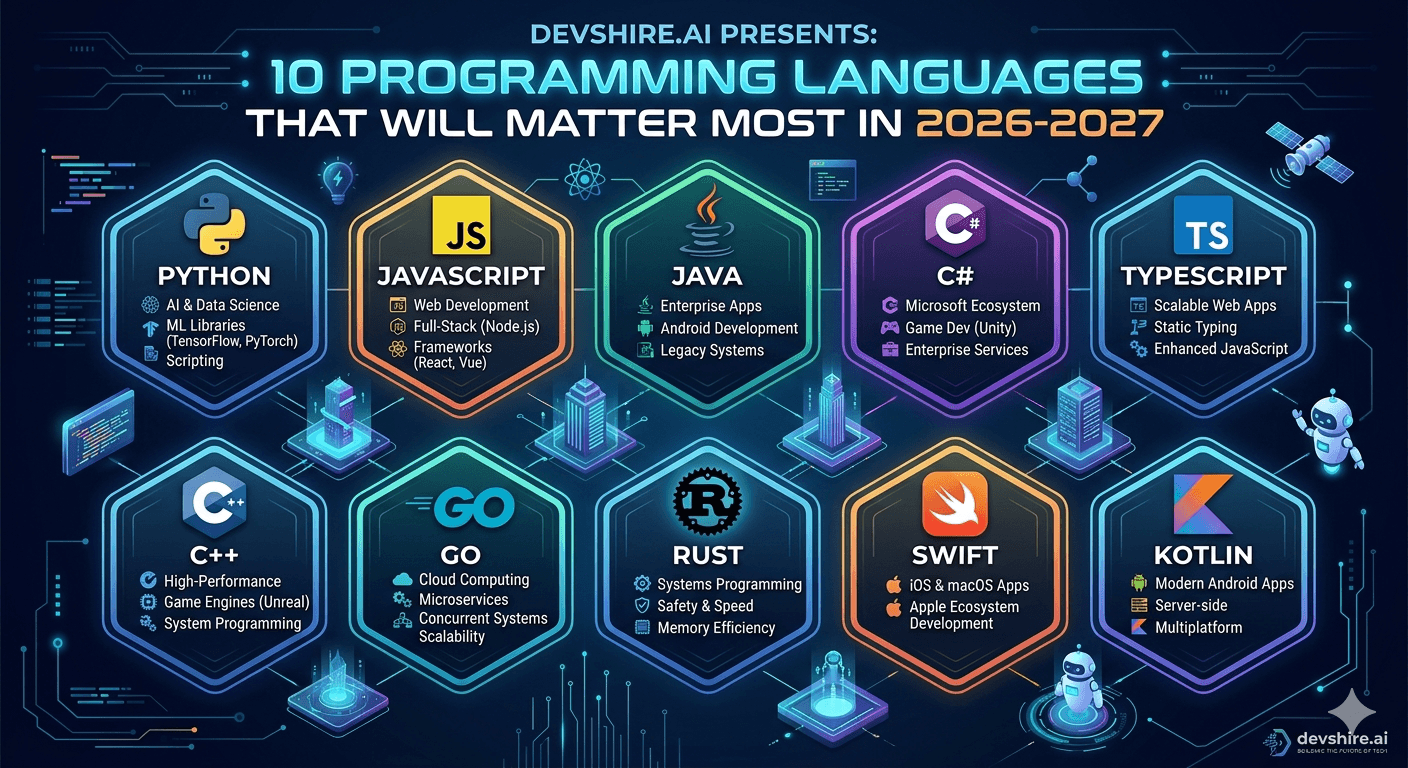
The 10 Languages and Why Each One Matters
Ranked by combined signal strength: hiring demand, ecosystem growth, AI tooling support, and forward momentum. This isn't a popularity contest — a language scoring well on all four signals is a better investment than one scoring high on only one.
🥇 1. Python
Python is the language of the AI era by a significant margin. Every major ML framework — PyTorch, TensorFlow, scikit-learn, LangChain, LlamaIndex — is Python-first. The language is also dominant in data engineering, scripting, and backend API work. AI tooling support for Python is the best of any language — Copilot, Cursor, and Claude all perform best on Python codebases. If you write one language well in 2026, make it Python. [INTERNAL LINK: hiring Python developers with AI skills → devshire.ai/blog/hire-python-developer-ai-tools]
🥈 2. TypeScript
TypeScript has effectively won the web development language debate. Major frameworks (Next.js, Remix, SvelteKit) default to TypeScript. Node.js projects at serious companies are TypeScript. The type system makes AI code generation significantly more reliable — models produce better TypeScript output than JavaScript because the types give them more context. New projects starting in plain JavaScript in 2026 are making a deliberate choice to avoid types, not a default one.
🥉 3. Rust
Rust is the fastest-growing systems language and the most in-demand for WebAssembly work. Linux kernel adoption (official support since 2022), widespread use in cloud infrastructure tooling (Cloudflare Workers, Fastly's Compute platform), and the browser-side Wasm use case make Rust's trajectory uniquely strong. It's harder to learn than most languages on this list — but the premium rates for Rust expertise reflect genuine scarcity of people who know it well.
4️⃣ 4. Go (Golang)
Go holds a strong position in backend infrastructure — API servers, CLI tools, DevOps tooling, and cloud-native services. Kubernetes, Docker, Terraform, and most major cloud tools are written in Go. The language's simplicity, fast compile times, and excellent concurrency model make it a natural fit for the microservices and cloud-native patterns that dominate backend engineering. Hiring demand is strong and relatively stable.
5️⃣ 5. SQL
SQL is chronically underrated in "languages to learn" lists because it's not a general-purpose language. That's a mistake. Every data role, every backend role that touches a database, and every analytics role requires SQL. The ability to write performant queries, understand query plans, and reason about indexing is a skill that AI tools don't replace — they assist but they regularly produce slow or incorrect queries that require human judgment to fix.
6️⃣ 6. Kotlin
Kotlin is the standard for Android development and increasingly for JVM backend work via Spring Boot and Ktor. The Google-endorsed Android default has strong hiring demand from the mobile development market. For developers on the JVM ecosystem, Kotlin is a significantly better experience than Java for new code while maintaining full Java interoperability. Hiring demand is strong and growing in mobile-heavy markets.
7️⃣ 7. Swift
Swift is the Apple ecosystem language — iOS, macOS, watchOS, and increasingly server-side via Swift on Server. If you're building iOS apps or targeting the Apple ecosystem, Swift is the only serious option. The Apple developer market is large and well-compensated. Hiring demand tracks Apple platform adoption closely, which means strong in consumer tech, weaker in enterprise and infrastructure.
8️⃣ 8. Java
Java is unfashionable in 2026 and very much employed. Enterprise software, Android legacy codebases, and large-scale backend systems at banks, insurance companies, and large enterprises run on Java. Spring Boot remains one of the most widely deployed backend frameworks. Nobody's excited about Java, but the career stability for Java developers in enterprise contexts is high. If you're already in Java, don't leave without a reason.
9️⃣ 9. C# (.NET)
C# and the .NET ecosystem have modernised significantly under Microsoft's cross-platform push. Azure-based enterprise development, game development via Unity, and Windows enterprise applications all run on C#. Microsoft's AI investments mean Copilot and Azure AI tooling is deeply integrated into the .NET ecosystem — arguably the best Microsoft-native AI developer experience of any language.
🔟 10. Ruby
Ruby (specifically Ruby on Rails) holds a specific niche: startup web development where developer happiness and convention-over-configuration matter. Rails is still the fastest path from idea to deployed web application for teams who know it. Hiring demand has narrowed significantly — fewer companies are choosing Rails for new projects — but the existing Ruby codebase ecosystem (particularly at Shopify-adjacent and Y Combinator alumni companies) ensures ongoing demand for experienced Rails developers.
Languages Losing Ground — And Why
It's worth being honest about which languages are declining and what's driving it. This isn't about the languages being bad — it's about demand signals.
Language | Trend | Primary reason |
|---|---|---|
PHP | Declining (slowly) | New projects rarely choose PHP; legacy maintenance persists |
Perl | Sharply declining | Legacy scripts only; no meaningful new project adoption |
JavaScript (plain) | Stable but shifting | TypeScript replacing it for new projects; JS still runs everywhere |
Scala | Declining in web, stable in data | Apache Spark + Scala still relevant; web adoption declined sharply |
CoffeeScript | Effectively dead | TypeScript made the value proposition obsolete |
How AI Tooling Changes Which Languages Are Worth Learning
AI code generation tools have changed one part of the language learning calculus: the cost of writing in a language you know less well has dropped. When Cursor or Copilot can scaffold TypeScript code from a Python developer's intent, the barrier to working across languages is lower than it was.
But there's a caveat. AI tools are best at the languages they've been trained on most — Python and TypeScript/JavaScript are by far the best supported. Rust, Go, and Kotlin are well-supported. Niche languages, proprietary DSLs, and legacy codebases in COBOL or older Fortran variants are significantly worse supported.
The practical implication: learning a well-AI-supported language multiplies the productivity benefit of AI tooling. A Python developer using Cursor gets more leverage than a Perl developer using the same tool, because the model's training data heavily favours Python. Language choice and AI tool choice are now interconnected decisions.
[INTERNAL LINK: best AI coding assistants in 2026 → devshire.ai/blog/best-ai-coding-assistant-2026]
The Bottom Line
Python, TypeScript, and Rust are the three languages with the strongest combined hiring demand, ecosystem momentum, and AI tooling support heading into 2027.
SQL belongs on any list of essential languages despite not being general-purpose. Every data, backend, and analytics role requires strong SQL skills that AI tools assist but don't replace.
Java and C# aren't exciting but they're stable. Enterprise hiring demand for both is significant and tends to be well-compensated.
AI tooling is best on Python and TypeScript by a wide margin. Language choice and AI tool choice are now connected — working in a well-supported language multiplies your AI tooling leverage.
Plain JavaScript is losing ground to TypeScript on new projects. The type system makes AI-generated code more reliable, which is a practical advantage beyond just static analysis.
Rust's trajectory is uniquely strong because it solves problems — memory safety, WebAssembly performance, systems-level concurrency — that no other language solves as well. The learning curve is real but the rate premium reflects genuine demand.
Trusted by 500+ startups & agencies
"Hired in 2 hours. First sprint done in 3 days."
Michael L. · Marketing Director
"Way faster than any agency we've used."
Sophia M. · Content Strategist
"1 AI dev replaced our 3-person team cost."
Chris M. · Digital Marketing
Join 500+ teams building 3× faster with Devshire
1 AI-powered senior developer delivers the output of 3 traditional engineers — at 40% of the cost. Hire in under 24 hours.
Frequently Asked Questions
What is the most in-demand programming language in 2026?
Python leads on absolute hiring demand, particularly for AI/ML and data engineering roles. TypeScript leads for web and full-stack development hiring. The gap between Python and TypeScript in total job postings has narrowed significantly as AI-related roles have expanded. If you can only learn one language for career purposes in 2026, Python provides the broadest applicability across AI, data, and backend roles.
Should I learn JavaScript or TypeScript in 2026?
TypeScript, without hesitation, for new learning. TypeScript is a strict superset of JavaScript — everything you learn in TypeScript applies to JavaScript — but the type system makes you significantly more productive with AI tools, catches errors earlier, and is the default for most serious new web projects. Starting with plain JavaScript and migrating to TypeScript later is a path many developers took; starting with TypeScript from the beginning is faster for new learners.
Is Rust worth learning in 2026?
Yes, if you're targeting systems programming, WebAssembly, or cloud infrastructure tooling. Rust's hiring demand is growing fast and the rate premium for strong Rust developers is among the highest of any language. The learning curve is genuinely steeper than most languages — budget 2–3 months to feel productive — but the scarcity of developers who know it well means the career return is strong for those who invest the time.
Is PHP still worth learning in 2026?
Only if you're maintaining an existing PHP codebase or specifically targeting the WordPress/Drupal ecosystem. New project adoption of PHP has declined significantly, and most teams starting fresh web projects are choosing Node.js, Python, or Ruby instead. That said, the sheer volume of existing PHP code — WordPress alone powers roughly 40% of websites — means PHP maintenance and development work isn't disappearing soon. It's a maintenance language, not a foundation language for new careers.
Which programming languages work best with AI coding tools like Copilot and Cursor?
Python and TypeScript/JavaScript are by far the best supported — these are the languages with the most training data in AI models, producing more accurate and context-aware suggestions. Go, Rust, Kotlin, and C# have good support. Java support is solid. Niche languages, older languages with less documentation, and proprietary DSLs are significantly worse supported. If maximising AI tool leverage is a priority, language choice matters.
Is Java still worth learning for a new developer in 2026?
Yes, with context. Java hiring demand in enterprise is significant and stable. Banks, insurance companies, large enterprise software vendors, and Android development all have substantial Java hiring. For developers targeting startups and early-stage companies, other languages have stronger adoption. For developers targeting enterprise employment with strong compensation and job stability, Java remains a solid career foundation — particularly if you also learn Spring Boot and modern Java (17+) patterns.
What programming language should I learn first in 2026?
Python for versatility, TypeScript for web focus. Python gives you access to AI/ML, data engineering, scripting, and backend API work — the broadest application surface of any language. TypeScript gives you full-stack web development, React/Next.js, and Node.js backend work. Both are well-supported by AI coding tools, which matters for how fast you learn and how productive you'll be in your first job. Start with whichever domain interests you most.
Find Developers Who Know the Stack You're Building On
devshire.ai matches product teams with developers pre-screened for the specific languages, frameworks, and AI tooling your project requires. Stack-specific shortlist in 48–72 hours. No guesswork.
Start Your Search at devshire.ai →
No upfront cost · Shortlist in 48–72 hrs · Freelance & full-time · Stack-matched candidates
About devshire.ai — devshire.ai matches AI-powered engineering talent with product teams that care about stack fit, not just keyword matching. Every developer has passed a live proficiency screen. Typical time-to-hire: 8–12 days. Start hiring →
Related reading: Hire Python Developers With AI Skills · Hire Node.js Developers With AI Skills · Best Tech Stack for Startups in 2026 · Best AI Coding Assistant in 2026 · AI Tools for Developers in 2026







Devshire Team
San Francisco · Responds in <2 hours
Hire your first AI developer — this week
Book a free 30-minute call. We'll match you with the right developer for your project and get you started within 24 hours.
<24h
Time to hire
3×
Faster builds
40%
Cost saved