
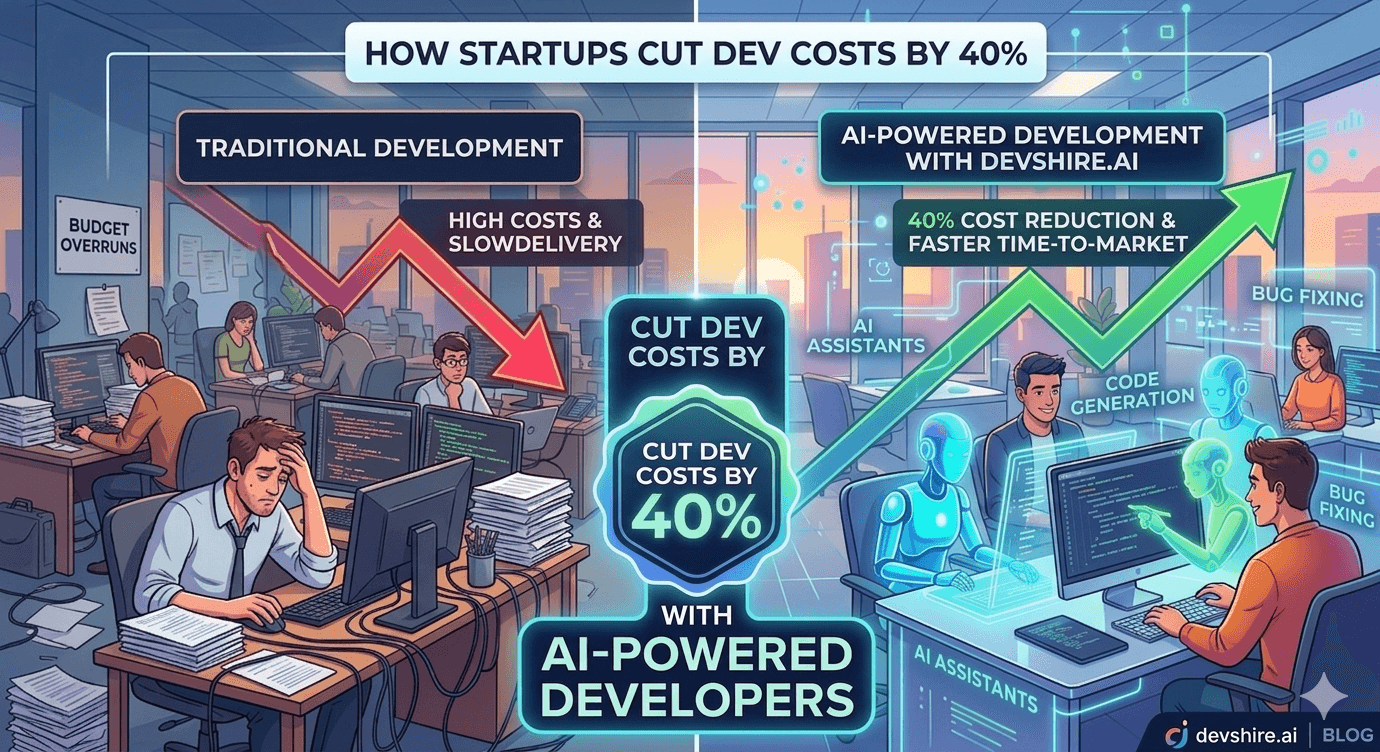
The average seed-stage startup in 2026 spends 55 to 70% of its runway on engineering. Most of that spend is not buying output — it is buying hours. An AI-augmented development team changes that ratio fundamentally. Not by cutting corners. By getting the same output from fewer people, faster. Startups that have made this shift are reporting 35 to 45% reductions in total developer spend on equivalent product scope. Here is how that maths works — and exactly how to replicate it.
💡 TL;DR
Startups reduce developer costs by 35 to 45% in 2026 by replacing 2 traditional developers with 1 AI-native developer plus an AI toolchain. The AI-native developer costs 20 to 30% more per day but ships 2 to 3x more output. On a 90-day engagement, total cost drops by $30,000 to $54,000 while output stays the same or increases. The specific tools driving this: Cursor AI, GitHub Copilot, Claude API, ChatGPT, and v0 by Vercel. None of them costs more than $60 per developer per month.
The Real Cost Comparison — Traditional vs AI-Native Dev Team
Let us put specific numbers on this. Both scenarios build the same product: a B2B SaaS MVP with authentication, a core feature set, billing integration, and an admin dashboard. 90-day timeline.
Cost Factor | Traditional Team (3 devs) | AI-Native Team (2 devs) | Difference |
|---|---|---|---|
Daily rate per developer | $500 average | $700 average | +$200/dev/day |
Total 90-day cost | $135,000 | $63,000 to $90,000 | Save $45,000 to $72,000 |
Features delivered | 35 to 50 | 60 to 100 | +40 to 100% more output |
AI toolchain cost | Not included | $120 to $180 total | Negligible |
Time to first deploy | Week 3 to 4 | Week 1 to 2 | 2 weeks faster |
The AI toolchain — Cursor, Copilot, Claude — costs $120 to $180 total for 2 developers over 90 days. That is a rounding error against the $45,000 to $72,000 in reduced developer cost. The cost reduction is not from AI tools being cheap. It is from needing fewer people to produce the same output.
Where the 40% Actually Comes From — 4 Specific Sources
The cost reduction is not evenly distributed across the development workflow. It concentrates in four specific areas. Understanding where the savings come from is what lets you replicate them reliably.
💰 Source 1 — Headcount reduction on feature work (biggest driver)
One AI-native developer using Cursor and Copilot ships 2 to 3x the feature output of a traditional developer on standard product work — React components, API endpoints, database schemas, test suites. This means you need 1 developer where you previously needed 2. On a $500 per day rate, that is $45,000 saved per developer per 90-day engagement. This single factor drives 60 to 70% of the total cost reduction.
💰 Source 2 — Faster onboarding (2 weeks vs 4 weeks)
An AI-native developer using Cursor with codebase indexing and Claude for architecture explanation reaches full productivity in 1 to 2 weeks. A traditional developer takes 3 to 4 weeks. At $700 per day, 2 weeks of productive onboarding saved per developer equals $7,000. Across multiple hires or contract rotations, this compounds significantly.
💰 Source 3 — Reduced rework from AI-assisted test coverage
AI-native developers use ChatGPT and Cursor to generate test suites as a standard part of the feature workflow — not as an afterthought. Better test coverage means fewer production bugs, fewer hotfix sprints, and fewer emergency developer hours at premium rates. Teams we work with report 30 to 50% reduction in unplanned hotfix work after switching to AI-native developers with enforced test generation habits.
💰 Source 4 — Lower hiring process cost (shorter search)
A 6-week hiring process on a general job board costs approximately $24,000 in opportunity cost — senior team time spent reviewing CVs, running interviews, and waiting. Through devshire.ai, the same search closes in 8 to 12 days. That is 4 weeks of search time saved per hire. At $800 per day engineering opportunity cost for the team running the search, that is $16,000 saved per hire.
The Specific Tools That Drive Each Saving
The cost reduction is tool-specific. Not all AI tools contribute equally. Here is what each one actually does to the cost structure.
Tool | Monthly Cost per Dev | Cost Saving It Drives | Rough ROI |
|---|---|---|---|
Cursor AI Pro | $20 | 2 to 3x feature speed — biggest single driver | 100 to 200x per month |
GitHub Copilot | $10 to $19 | 1.5 to 2x on boilerplate and autocomplete | 50 to 100x per month |
Claude API | Variable — $10 to $50 on usage | Review bot prevents production bugs, faster debugging | 30 to 80x per month |
ChatGPT Plus | $20 | Architecture planning prevents wrong-direction builds | 20 to 60x per month |
v0 by Vercel | Free to $20 | UI scaffolding — saves 2 to 4 hrs per component from scratch | 30 to 60x per month |
Total monthly AI toolchain cost per developer: $60 to $110. Against a $700 daily rate, these tools pay for themselves in under 2 hours of developer time per month. The ROI argument is closed before you even start.
The Wrong Way to Cut Dev Costs — And Why It Backfires
This drives me crazy. The first instinct for most founders trying to reduce developer costs is to hire cheaper. Lower day rates, junior developers, offshore without a process. That logic looks correct on the spreadsheet and collapses in practice.
A junior developer at $200 per day who produces inconsistent output, requires constant review, and introduces bugs that a senior developer would not — costs more per feature delivered than a senior AI-native developer at $700 per day who ships clean, tested code that rarely needs rework. The cost-per-output calculation, not the cost-per-day calculation, is the one that matters.
⚠️ Common advice that is wrong
Many startup advisors recommend hiring 3 junior developers instead of 1 senior AI-native developer to save money. The maths looks right until week 3 — when you discover that managing 3 junior developers requires a senior technical lead you do not have, the code review burden falls on your most expensive person, and the output quality still does not match 1 AI-native senior. The junior headcount strategy is a trap for most pre-seed teams.
Trusted by 500+ startups & agencies
"Hired in 2 hours. First sprint done in 3 days."
Michael L. · Marketing Director
"Way faster than any agency we've used."
Sophia M. · Content Strategist
"1 AI dev replaced our 3-person team cost."
Chris M. · Digital Marketing
Join 500+ teams building 3× faster with Devshire
1 AI-powered senior developer delivers the output of 3 traditional engineers — at 40% of the cost. Hire in under 24 hours.
A Real Startup That Cut Dev Costs by 43%
A 4-person pre-seed startup in HR tech came to us in November 2025. They had been running a team of 3 traditional developers at $480 to $550 per day each — $1,530 to $1,650 per day total for 3 people. Delivery was slow, the codebase had accumulated significant technical debt, and they had missed their Q3 launch target by 6 weeks.
We helped them restructure to 2 AI-native developers at $750 per day each — $1,500 total. Marginally cheaper per day. But within 6 weeks, feature velocity had doubled. The codebase was cleaner because Cursor with a review process was catching the patterns their old review process missed. And total monthly developer cost dropped from $99,000 to $57,000 — a 43% reduction on the same product scope. They shipped their MVP 4 weeks later.
How to Implement This at Your Startup — Specific Steps
You do not need to rebuild your team overnight. Here is a phased approach that works for most startups.
1️⃣ Step 1 — Add AI tools to your existing team first
Before restructuring headcount, add Cursor Pro and Claude API access to every developer on the team. Run a 2-week trial. Measure feature velocity before and after. Most teams see 30 to 50% improvement without changing headcount. This tells you whether your existing developers can operate as AI-native, or whether you need to hire for that skill.
2️⃣ Step 2 — Replace the next open role with an AI-native hire
When a developer leaves or a new role opens, fill it with an AI-native developer who has demonstrated toolchain proficiency through a live screen. Do not replace a traditional developer with another traditional developer if an AI-native hire is available at a comparable rate. Each replacement shifts the cost-per-feature ratio.
3️⃣ Step 3 — Set an AI output review standard before scaling
An AI-native team without a code review process for AI-generated output can ship bugs faster than a traditional team. Before adding AI-native headcount, write a one-page AI output review standard: which patterns to flag, which test coverage minimum to enforce, and what the PR checklist includes for AI-assisted code. This takes 30 minutes and prevents the most common failure mode.
The Bottom Line
Startups reduce developer costs by 35 to 45% in 2026 by replacing 2 to 3 traditional developers with 1 to 2 AI-native developers plus an AI toolchain. Output stays the same or increases.
The four sources of savings: headcount reduction on feature work (biggest), faster onboarding by 2 weeks per hire, reduced rework from AI-assisted test coverage, and lower hiring process cost.
The AI toolchain — Cursor, Copilot, Claude API, ChatGPT, v0 — costs $60 to $110 per developer per month. They pay for themselves in under 2 hours of developer time per month.
Hiring cheaper developers is the wrong way to cut costs. Cost-per-feature, not cost-per-day, is the correct metric. Junior developers at $200 per day frequently cost more per feature than AI-native seniors at $700.
A real startup restructured from 3 traditional developers at $1,530 per day to 2 AI-native developers at $1,500 per day and cut monthly developer cost by 43% while doubling feature velocity.
Implement in three steps: add AI tools to existing team first and measure, replace open roles with AI-native hires, set an AI output review standard before scaling headcount.
Frequently Asked Questions
How do startups reduce developer costs using AI in 2026?
By replacing 2 to 3 traditional developers with 1 to 2 AI-native developers who use Cursor, Copilot, Claude, and ChatGPT daily. The AI-native developer costs 20 to 30% more per day but ships 2 to 3x more output. The net cost reduction per feature delivered is 35 to 45% over a 90-day engagement, with total team spend dropping by $30,000 to $72,000 on comparable scope.
Is it cheaper to hire junior developers or AI-native developers for a startup?
AI-native developers are cheaper per feature delivered despite costing more per day. A junior developer at $200 per day producing inconsistent output with high review burden costs more per shipped feature than a senior AI-native developer at $700 per day producing clean, tested code. The cost-per-feature metric — not the day rate — is what matters for startup engineering budgets.
What AI tools reduce startup development costs the most?
Cursor AI Pro at $20 per month drives the largest single saving — 2 to 3x feature speed. GitHub Copilot adds 1.5 to 2x on boilerplate work. ChatGPT prevents wrong-direction builds through architecture planning. Claude API prevents production bugs through automated PR review. Total monthly cost for all four: $60 to $110 per developer. ROI is immediate from the first sprint.
How much can a startup save by using AI developers instead of traditional ones?
On a 90-day engagement for a typical SaaS MVP, replacing 3 traditional developers at $500 per day with 2 AI-native developers at $700 per day saves $30,000 to $54,000 in total developer cost while delivering 40 to 100% more features. The exact saving depends on the scope, the stack, and the quality of the AI toolchain adoption — but 35 to 45% is the consistent range we see.
Cut Your Startup Dev Costs With Pre-Vetted AI-Native Developers
Devshire.ai matches startups with AI-native developers who are pre-screened on live toolchain use — Cursor, Copilot, Claude API, and ChatGPT. Hire 1 developer who delivers what 2 traditional developers would, at 40% lower total cost. Shortlist in 48 to 72 hours.
Pre-vetted AI-native devs · 40% cost reduction · Shortlist in 48 hrs · Median hire in 11 days
About devshire.ai — devshire.ai helps startups build leaner, faster engineering teams with pre-vetted AI-native developers. Every candidate is screened on live AI toolchain use. Start hiring ->
Related reading: How Much Does It Cost to Hire a Developer in 2026? · Full-Stack Developer for Hire: AI vs Traditional ROI · Best Tech Stack for Startups in 2026 · Browse Pre-Vetted AI-Native Developers







Devshire Team
San Francisco · Responds in <2 hours
Hire your first AI developer — this week
Book a free 30-minute call. We'll match you with the right developer for your project and get you started within 24 hours.
<24h
Time to hire
3×
Faster builds
40%
Cost saved