
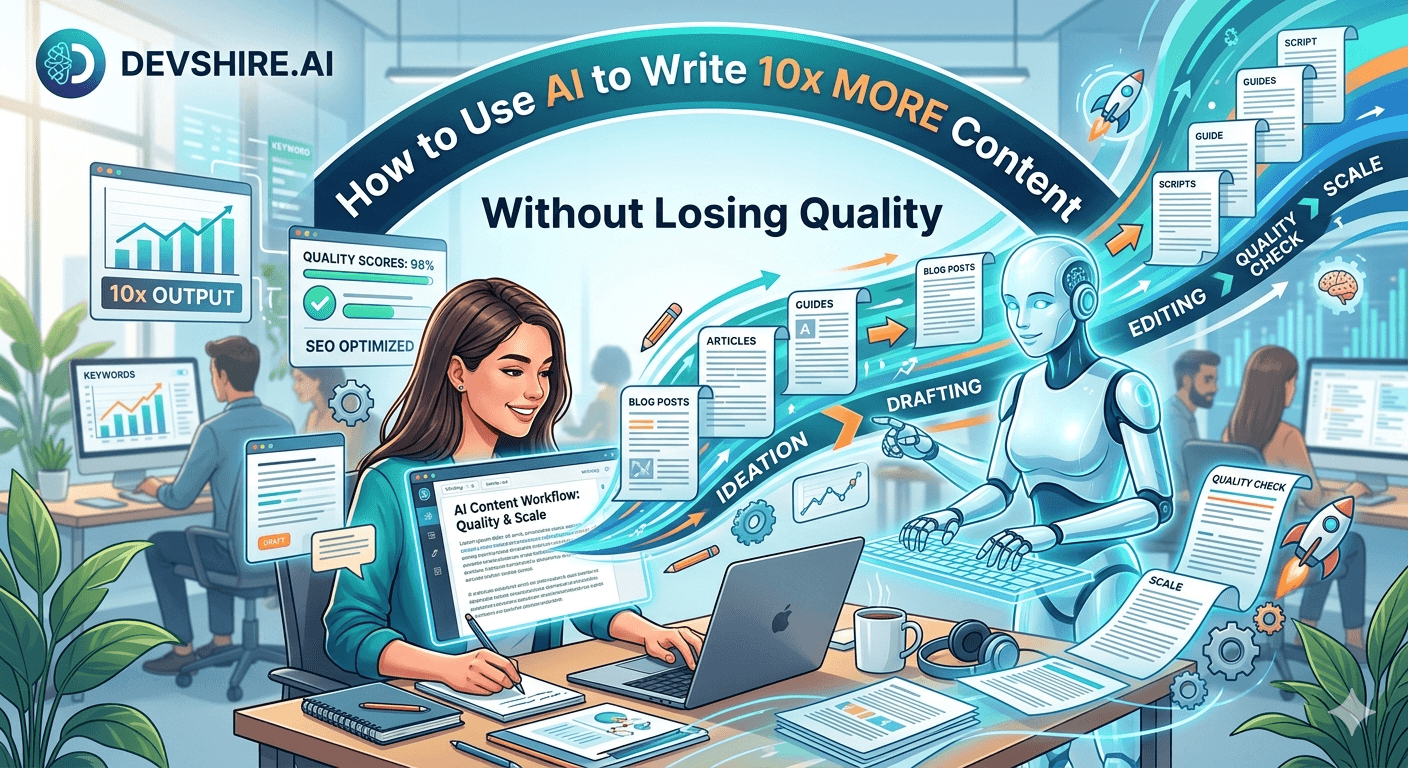
Most AI content looks like AI content. You can spot it in the first sentence — generic opener, three bullet points, a conclusion that says nothing. Teams that use AI to scale their content output and end up with that are doing it wrong. Not because AI can't write well. Because they haven't built a system around it. The teams that are actually publishing 3–5x more content without a corresponding drop in quality aren't just prompting better — they're designing a production workflow where AI handles the structural work and human expertise provides the signal that makes it worth reading. Here's exactly what that workflow looks like.
💡 TL;DR
AI can increase your content output 5–10x without quality loss — but only if you treat it as a production system, not a drafting shortcut. The system has three phases: a structured brief that loads the AI with your specific context, a generation pass that you edit rather than rewrite, and a quality gate that checks for thinness, accuracy, and voice before anything publishes. Teams that skip the brief phase produce generic content. Teams that skip the quality gate get indexed and penalised. Build all three phases.
Why Most AI Content Fails — and It's Not the Model's Fault
This drives me crazy. Teams try AI content, get back something generic, and conclude that AI can't write good content. That's the wrong conclusion. The output you get from AI is a direct reflection of the input you give it. Generic brief, generic output. Every time.
The problem isn't the model — it's the workflow. Most teams use AI the same way they'd use a search engine: type a question, get an answer, copy it. That produces commodity content that reads like it was written by a committee that's never actually done the work.
⚠️ The advice that's actually making things worse
A lot of AI content guides tell you to "just write a detailed prompt." That's necessary but not sufficient. A detailed prompt still produces generic content if it doesn't contain specific context — your audience's exact pain points, your product's real differentiators, examples from your actual experience. The model generates from what it was trained on. Your context is what makes the output different from every other piece on the topic.
The shift that changes everything: stop using AI to write content and start using it to produce a first draft that you edit. That distinction changes everything about the output.
The Content Brief: The Most Important Step Nobody Spends Enough Time On
Before any AI generation, you need a brief. Not a topic title — a fully loaded context document that tells the model everything it needs to produce something useful. Here's the structure that consistently produces better first drafts.
🎯 1. The specific audience and their problem
Don't write "content marketers." Write: "B2B SaaS content marketers at Series A companies who are publishing 4 posts/month and trying to scale to 15 without hiring more writers. They've tried AI tools once, got generic output, and gave up." That specificity shows up in the output.
💡 2. The specific angle (what makes this different)
Every topic has 50 existing articles. Tell the AI what your angle is that the others miss. "Most guides on AI content cover tool lists. This one covers the production workflow — the brief, generation, and quality gate system — which is what the tool-list guides skip."
🔑 3. Real examples and specific numbers
Give the AI real data to work with. "Teams using this workflow are publishing 15 posts/month with 2 people instead of 4." "The brief takes 20 minutes to write. The generation pass takes 15. The edit pass takes 45. Total: 80 minutes per post." These specifics are what turn a generic article into something that feels authoritative.
🚫 4. What not to say
Explicitly tell the AI what to avoid: banned phrases, wrong audience assumptions, common misconceptions in the niche. This is as important as telling it what to include. A list of banned phrases cuts generic AI language by about 60% in the first draft.
The 3-Pass Generation Workflow
One prompt, one output, publish — that's not a workflow. That's a shortcut. Real AI content production uses at least three passes.
1️⃣ Pass 1 — Structure generation (5 minutes)
Generate the outline first. Ask for the H2 headings, the angle of each section, and what each section needs to prove or show. Review this before generating the full draft. Changing the structure at outline stage takes 2 minutes. Restructuring a 2,500-word draft takes 45.
2️⃣ Pass 2 — Section-by-section generation (15 minutes)
Generate each H2 section separately, not the whole post at once. This keeps the context window focused and produces better output per section. For complex technical sections, give the model the relevant facts in the prompt — don't rely on it to recall specifics correctly.
3️⃣ Pass 3 — Human edit pass (45–60 minutes)
This is where the quality happens. You're not rewriting — you're adding. Add the specific example the AI couldn't have known. Add the caveat from your real experience. Cut the filler sentences (there will be some). The model gives you 70% of the draft. You add the 30% that makes it worth reading.
Total time: roughly 80 minutes per post, down from 4–6 hours of pure human writing. That's your productivity multiplier. Not zero time — 80 minutes. But 80 focused minutes that produce a publishable piece.
[INTERNAL LINK: AI tools for developers → devshire.ai/blog/ai-tools-developers-2026]
Keeping Your Voice Consistent at Scale
Here's the problem that shows up around post 20 when teams scale AI content: everything starts sounding the same. Or worse — it sounds like a different author wrote each piece. No throughline, no recognisable perspective.
Voice consistency at scale requires a voice document. Not a style guide — those are too abstract. A document with specific examples of how your brand writes, phrases you use, stances you take, and sentences you'd never write.
📝 Build a voice reference document
Pull 3–5 sentences from your best-performing past content. Put them in the prompt as examples of your voice. Then add 5–10 sentences you'd never write — the corporate-speak, the AI-generic phrases, the hedging language. This positive and negative example approach is more effective than any abstract style description.
🔄 Create a voice consistency check
Before publishing, run a final prompt: "Does this section sound like the examples in the voice doc, or does it sound like generic AI content? List any sentences that feel off." This takes 2 minutes and catches the most obvious voice drift before it goes live.
Trusted by 500+ startups & agencies
"Hired in 2 hours. First sprint done in 3 days."
Michael L. · Marketing Director
"Way faster than any agency we've used."
Sophia M. · Content Strategist
"1 AI dev replaced our 3-person team cost."
Chris M. · Digital Marketing
Join 500+ teams building 3× faster with Devshire
1 AI-powered senior developer delivers the output of 3 traditional engineers — at 40% of the cost. Hire in under 24 hours.
The Quality Gate: What to Check Before You Publish
Publishing thin AI content is worse than not publishing. Google has gotten better at identifying it, and readers bounce immediately. You need a quality gate — a checklist that every piece passes before it goes live.
Check | What to Look For | Fix If Failing |
|---|---|---|
Specificity | At least 3 specific numbers, examples, or named tools | Add from your actual experience or cited sources |
Original angle | At least one claim that isn't in the top-5 Google results | Add your real experience or a counter-intuitive take |
Accuracy | All factual claims verified | Check every statistic — models hallucinate numbers |
Voice | No three consecutive AI-sounding sentences | Edit or add a human-written sentence to break pattern |
Actionability | Reader can do something specific after reading | Add a concrete next step to any vague section |
The accuracy check is non-negotiable. AI models hallucinate statistics. They'll write "according to a 2024 Gartner report, 78% of marketers..." and that report doesn't exist. Check every factual claim before it publishes. One fabricated stat in a piece damages your credibility more than any SEO benefit is worth.
[EXTERNAL LINK: Google's guidance on helpful content → developers.google.com/search/docs/fundamentals/creating-helpful-content]
Scaling to 15+ Posts Per Month: The Operational Reality
Most content teams don't fail at generating more content. They fail at managing it. Here's the operational infrastructure you need before you try to publish 15 posts a month.
📋 A brief-to-publish tracker
Track every piece through five stages: brief → generated → human-edited → quality-checked → scheduled. Use Notion, Linear, or even a spreadsheet. Without a tracker, pieces get stuck in "almost done" limbo for weeks. A two-person content team publishing 15 posts/month typically has 8–10 pieces in flight at any time.
🗓️ Batched brief-writing sessions
Write 4–5 briefs in one sitting once a week. Brief writing requires the most human judgment — you need to know the audience, the angle, and the context. Batching it means you make those decisions once with a clear head, then the generation work flows from them all week. Context-switching between brief writing and editing is a hidden productivity killer.
[INTERNAL LINK: AI SEO tools → devshire.ai/blog/best-ai-seo-tools-saas-startups-2026]
The Bottom Line
AI content fails when the brief is weak. A fully loaded brief — specific audience, specific angle, real examples, banned phrases — is what separates generic output from useful drafts.
Use a 3-pass workflow: structure outline first, section-by-section generation second, human edit pass third. One-shot prompting produces commodity content.
Total time per post with this system: roughly 80 minutes vs 4–6 hours of pure writing. That's 5x output, not 10x — but at this quality level, 5x compounds significantly.
AI models hallucinate statistics. Check every factual claim before publishing. One fabricated stat damages your credibility more than any SEO benefit justifies.
Build a voice reference document with real examples from your best content and sentences you'd never write. Use it in every prompt.
A quality gate with 5 checks (specificity, original angle, accuracy, voice, actionability) prevents thin content from publishing. Skip it at your own risk.
Write 4–5 briefs in batched sessions once a week. Context-switching between brief writing and editing is a productivity killer you can eliminate with scheduling.
Frequently Asked Questions
Can AI actually write high-quality content at scale?
Yes — but only with the right workflow around it. AI handles structural work, covers well-trodden ground efficiently, and produces 70% of a publishable draft. The remaining 30% that makes content worth reading — specific examples, original angles, real experience signals — comes from human input in the brief and edit pass. Teams that treat AI as a replacement for thinking get generic content. Teams that treat it as a production accelerator get real scale.
How do I stop AI content from sounding like AI content?
Three things make the biggest difference: a voice reference document with real examples from your best writing and specific phrases to avoid; section-by-section generation (not one full-post prompt); and a human edit pass focused on adding specific examples and experience signals, not just cleaning language. Generic output almost always traces back to a generic brief. The more context you load in, the more specific the output.
What's the best AI tool for writing content at scale?
Claude and GPT-4o both produce strong long-form drafts with a good brief. Claude tends to produce more structured, nuanced output on complex topics. GPT-4o is faster for high-volume generation. Jasper and Copy.ai are purpose-built content tools with built-in workflows but less flexible prompting. Most teams doing serious content scale work directly with the API of their preferred model and build their own brief-to-generation workflow around it. [INTERNAL LINK: AI tools for developers → devshire.ai/blog/ai-tools-developers-2026]
How many blog posts can I publish per month with an AI content workflow?
A two-person team (one content strategist, one editor) using an AI production workflow can realistically publish 12–20 posts per month at full quality. A single person with a well-designed workflow can hit 8–12. The bottleneck is almost always the human quality pass — not the AI generation. The brief-to-publish time with this system is roughly 80 minutes per post.
Will Google penalise AI-generated content?
Google's official position is that it targets unhelpful content, not AI-generated content specifically. Thin, generic posts with no original insight get suppressed regardless of how they were written. Posts with genuine expertise, specific examples, and original perspective get indexed and ranked well regardless of whether AI assisted in writing them. The quality gate exists precisely to ensure your content passes the helpfulness test — not to hide AI involvement.
How do I maintain brand voice when using AI for content?
Build a voice reference document and include it in every prompt. It should contain 5–8 actual sentences from your best-performing content (positive examples of your voice), and 5–10 sentences you'd never write (negative examples). This approach works better than abstract style guides because the model learns from concrete examples. Run a voice check on every draft before the edit pass — ask the AI itself whether the draft matches the examples.
What's the biggest risk of scaling content with AI?
Publishing factually inaccurate content. AI models confidently produce statistics, study citations, and quotes that don't exist. A single fabricated stat that gets picked up and spread is a credibility problem that takes months to recover from. Build fact-checking into your quality gate as a non-skippable step. Every data point needs to trace back to a real source before it publishes. Everything else can be fixed. Fabricated facts are hard to walk back once they're indexed.
Build Content Systems That Actually Scale — With the Right Developer
devshire.ai matches SaaS teams with developers who can build AI-powered content workflows, automation pipelines, and publishing infrastructure — so your content team publishes more without the manual bottlenecks.
Find Your AI Developer at devshire.ai →
No upfront cost · Shortlist in 48–72 hrs · Freelance & full-time · Stack-matched candidates
About devshire.ai — devshire.ai connects product teams with developers who build real AI-powered systems. Every candidate passes a live proficiency screen. Typical time-to-hire: 8–12 days. Start hiring →
Related reading: Best AI SEO Tools for SaaS Startups in 2026 · How to Build a Programmatic SEO Strategy for a B2B SaaS Site · Prompt Engineering for Developers · Best AI Tools for Developers in 2026 · Claude AI for Developers







Devshire Team
San Francisco · Responds in <2 hours
Hire your first AI developer — this week
Book a free 30-minute call. We'll match you with the right developer for your project and get you started within 24 hours.
<24h
Time to hire
3×
Faster builds
40%
Cost saved