
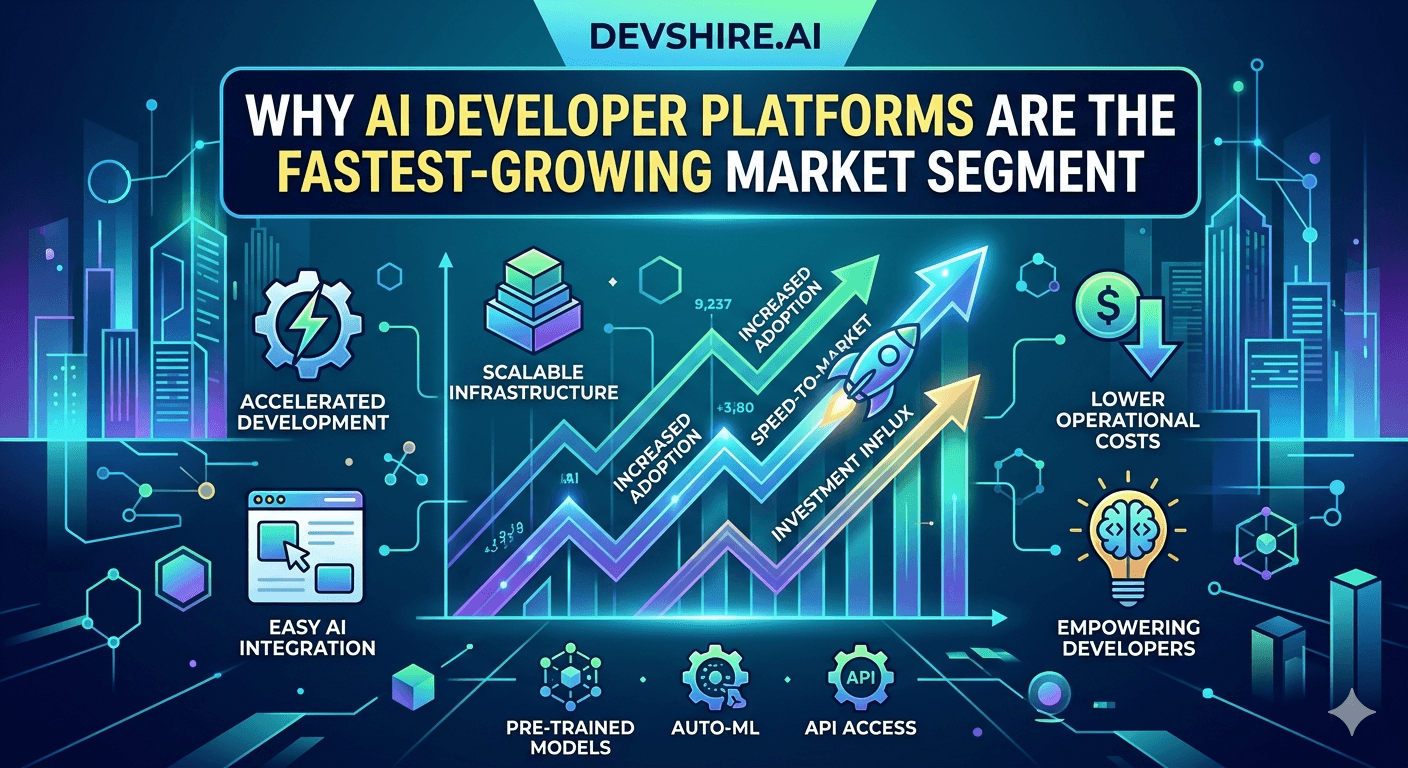
Eighteen months ago, "AI developer tools" was a novelty category. Today it's the fastest-growing segment in enterprise software, with investment and adoption outpacing cloud infrastructure, cybersecurity, and even the SaaS productivity tools that dominated the previous decade. GitHub Copilot crossed 1.3 million paid subscribers. Cursor went from zero to category-defining in under two years. And the market is nowhere near saturated — estimates from multiple research firms put AI developer tooling as a $25–40B market by 2028. But raw market size numbers don't tell you what to actually do with this information. Whether you're a developer choosing tools, a startup founder building on the stack, or a team leader making platform decisions — what matters is understanding why this segment is growing so fast and where it's heading.
💡 TL;DR
AI developer platforms are growing faster than any other software segment because they directly compress the highest cost in software development — developer time. Every percentage point of productivity improvement at developer salaries of $150–$300k/year has massive ROI. The category is bifurcating into code generation tools (Cursor, Copilot), AI infrastructure platforms (AWS Bedrock, Google Vertex, Azure AI), and LLM API providers (Anthropic, OpenAI). Teams making platform decisions now are setting their stack for 2–3 years.
Why This Segment Is Growing So Fast
The economics are the simplest explanation. Software developer salaries at senior level average $175–$225k in the US. A tool that makes developers 20% more productive is worth $35–$45k per developer per year in recovered salary value. At $500/year for a Copilot enterprise subscription, that's a 70–90x ROI on tooling spend. No other enterprise software category comes close to that cost-to-value ratio.
That ROI is why enterprise adoption moved from "pilot project" to "mandatory standard tooling" in 12–18 months at major tech companies. The growth isn't hype — it's economics working exactly as expected.
Segment | Key players | 2025 estimated market size | Growth rate |
|---|---|---|---|
AI-assisted coding tools | Cursor, GitHub Copilot, Tabnine | $4.5B | +85% YoY |
AI infrastructure / MLOps | AWS Bedrock, Google Vertex AI, Azure AI | $12B | +64% YoY |
LLM API providers | Anthropic, OpenAI, Mistral, Cohere | $8B | +112% YoY |
AI agent / workflow platforms | LangChain, CrewAI, n8n AI | $2.1B | +140% YoY |
The agent and workflow platform row is notable. It's smaller in absolute terms but growing fastest — and it's the segment where the next wave of productivity tooling is being built. Autonomous coding agents that can complete multi-file changes are still early but the adoption curve is steep.
The Three Platform Categories and What They're For
"AI developer platform" gets used to describe very different things. For teams making decisions, the category breakdown matters.
💻 Code generation and IDE-integrated tools
Cursor, GitHub Copilot, Tabnine, JetBrains AI. These live inside your development environment and accelerate the actual writing of code. This is the segment with the clearest ROI story and the fastest enterprise adoption. The competition here is primarily between Cursor (agentic, whole-file context) and Copilot (Microsoft ecosystem integration). [INTERNAL LINK: GitHub Copilot vs Cursor comparison → devshire.ai/blog/github-copilot-vs-cursor-ai]
🏗️ AI infrastructure and managed model platforms
AWS Bedrock, Google Vertex AI, Azure AI Services, Hugging Face Inference Endpoints. These platforms let teams build AI-powered product features without managing model infrastructure. They handle model hosting, scaling, and the API layer — so developers focus on building features, not operating GPU clusters. This is where the bulk of enterprise AI spending is going in 2026.
🔗 LLM API providers and foundation models
Anthropic (Claude), OpenAI (GPT-4 and o-series), Google (Gemini), Mistral, Cohere. These are the model layer underneath everything else. The competition here is on capability, context window size, cost per token, latency, and reliability. Teams building AI product features are making platform bets here that affect their product roadmap for 2–3 years. Switching costs are moderate but real.
🤖 AI agent and workflow orchestration platforms
LangChain, LlamaIndex, CrewAI, n8n AI, Temporal + AI. This category is the frontier — platforms for building multi-step AI workflows where agents take actions, use tools, and complete tasks that require multiple model calls and external system interactions. Still early in enterprise adoption but growing fastest by percentage. [INTERNAL LINK: AI workflow automation for dev teams → devshire.ai/blog/ai-workflow-automation-dev-team]
Making Smart Platform Decisions for Your Team
The worst outcome is picking a platform based on what's trending on developer Twitter instead of what matches your use case. Here's the framework that actually matters.
🎯 Separate the tool categories in your decision
Your IDE coding tool choice (Cursor vs Copilot) is independent of your model API choice (Anthropic vs OpenAI) and your infrastructure choice (AWS Bedrock vs Google Vertex). Many teams conflate these. Make each decision separately based on the specific requirements of that layer.
💰 Model cost per token at your expected volume
At low volume, the cheapest provider versus the best provider barely matters. At high volume — millions of API calls per month — cost-per-token becomes a significant line item. Model providers are pricing very differently in 2026. Run the numbers at your 12-month projected volume before committing to a provider architecture.
🔒 Data residency and compliance requirements
Enterprise customers increasingly require data residency guarantees — that their data doesn't leave a specific geography for processing. AWS Bedrock, Azure AI, and Google Vertex all offer regional deployment options. The raw LLM API providers (OpenAI, Anthropic) are adding enterprise agreements with data handling commitments. Know your compliance requirements before you're locked into a platform that doesn't meet them.
What This Market Growth Means for Hiring
The fastest-growing market segment is also creating the most acute talent shortage. Developers who understand AI infrastructure — how to build on Bedrock or Vertex, how to design agentic workflows, how to evaluate model tradeoffs for production use cases — are in a supply-constrained market where demand is growing faster than the talent pool.
At devshire.ai, the hardest-to-fill roles in 2026 are AI infrastructure engineers and agentic workflow developers — not because the work is technically impossible, but because so few developers have done it in production environments. The skills are learnable; the experience is scarce. Teams building on AI platforms need to either find the developers who have it or invest in growing the skills internally.
[INTERNAL LINK: hiring AI workflow engineers → devshire.ai/blog/vetted-ai-developers-for-hire]
Trusted by 500+ startups & agencies
"Hired in 2 hours. First sprint done in 3 days."
Michael L. · Marketing Director
"Way faster than any agency we've used."
Sophia M. · Content Strategist
"1 AI dev replaced our 3-person team cost."
Chris M. · Digital Marketing
Join 500+ teams building 3× faster with Devshire
1 AI-powered senior developer delivers the output of 3 traditional engineers — at 40% of the cost. Hire in under 24 hours.
The Bottom Line
AI developer tooling is growing faster than any other software segment because the ROI is clear: developer time is expensive, and tools that compress it pay back in months, not years.
The category breaks into four segments: IDE code generation tools, AI infrastructure platforms, LLM API providers, and agent/workflow orchestration platforms. Each serves a different use case and requires separate evaluation.
Agent and workflow orchestration is the fastest-growing sub-segment by percentage, though smallest in absolute size. This is where the next wave of productivity tooling is being built.
Platform decisions at the model API layer (Anthropic vs OpenAI vs Google) are 2–3 year commitments with moderate but real switching costs. Make them based on cost at volume, context window, reliability, and compliance requirements.
Data residency and enterprise compliance requirements are increasingly important in platform selection. Build this into your evaluation before you're locked in.
AI infrastructure engineers and agentic workflow developers are the most supply-constrained category in developer hiring in 2026. Demand is growing faster than the talent pool significantly.
Frequently Asked Questions
What are AI developer platforms?
AI developer platforms are tools and infrastructure that help developers build, deploy, and work with AI capabilities. This includes IDE-integrated code generation tools (Cursor, GitHub Copilot), managed AI infrastructure (AWS Bedrock, Google Vertex AI), LLM API providers (Anthropic, OpenAI), and agent/workflow orchestration frameworks (LangChain, CrewAI). The category covers both developer productivity tooling and AI application infrastructure.
Why are AI developer tools growing so fast in 2026?
The fundamental driver is economics. Senior developers cost $150–$300k/year. A tool that makes developers 20–30% more productive is worth $30–$90k per developer per year. Enterprise-grade AI coding tools cost $500–$2,000 per developer per year. The ROI is in the range of 50–100x on tooling investment. When the payback period is under a month, enterprise adoption moves fast — which is exactly what's happened.
Which AI developer platform should a startup choose in 2026?
For code generation: Cursor for agentic development on complex codebases, GitHub Copilot for teams already in the Microsoft/GitHub ecosystem. For LLM API: evaluate Claude (Anthropic) for complex reasoning and long context, GPT-4 (OpenAI) for broad capability and ecosystem integrations, Gemini (Google) for Google Cloud-integrated teams. For AI infrastructure: AWS Bedrock if you're on AWS, Google Vertex if you're on GCP, Azure AI if you're on Azure. Platform choices should follow your existing infrastructure commitments, not override them.
What's the difference between GitHub Copilot and Cursor?
GitHub Copilot is primarily an autocomplete and inline code suggestion tool — it predicts the next lines of code as you type and can generate function completions. Cursor is a full AI-integrated IDE (built on VS Code) that supports whole-file and multi-file context, agentic tasks where AI completes larger changes autonomously, and chat interfaces for architectural questions. Cursor is more powerful for complex development tasks; Copilot integrates more cleanly into existing GitHub and Microsoft workflows. [INTERNAL LINK: GitHub Copilot vs Cursor → devshire.ai/blog/github-copilot-vs-cursor-ai]
How do I choose between AWS Bedrock, Google Vertex AI, and Azure AI?
Follow your existing cloud platform. If your infrastructure is on AWS, Bedrock gives you the best integrated experience with other AWS services, IAM permissions, and VPC networking. Same logic applies to Google Vertex AI on GCP and Azure AI on Azure. The platform-specific integrations (data pipelines, networking, security) are harder to replicate cross-cloud than the model capabilities. Choose the AI platform that lives with your data and compute, not the one with the best marketing.
What developer skills are most valuable in the AI platform market?
The most supply-constrained skills in 2026: experience building on managed AI infrastructure (Bedrock, Vertex), designing and shipping agentic workflows in production, RAG (Retrieval-Augmented Generation) pipeline implementation, and LLM API integration with robust error handling and cost management. These skills are learnable from existing software engineering backgrounds but require hands-on project experience that most developers haven't yet accumulated.
Is the AI developer tools market sustainable or is it a bubble?
The productivity gains are real and measurable, which separates this from previous software bubbles. The ROI case for AI coding tools is demonstrable in actual output metrics, not future projections. The specific companies and platforms will consolidate — not every current player will survive. But the underlying market for tools that compress developer time has a durable demand foundation that doesn't depend on speculation about future capabilities.
Find Developers Who Know the AI Platform Stack
devshire.ai matches product teams with developers experienced in AI infrastructure, LLM integration, and agentic workflow development — the skills in highest demand and shortest supply. Shortlist in 48–72 hours.
Start Your Search at devshire.ai →
No upfront cost · Shortlist in 48–72 hrs · Freelance & full-time · Stack-matched candidates
About devshire.ai — devshire.ai matches AI-powered engineering talent with product teams. Every developer has passed a live AI proficiency screen. Typical time-to-hire: 8–12 days. Start hiring →
Related reading: GitHub Copilot vs Cursor: Which AI Coding Tool Wins? · Claude AI for Developers: What It Can Do · AI Workflow Automation for Dev Teams · Vetted AI Developers for Hire · Hire AI Developers in 2026







Devshire Team
San Francisco · Responds in <2 hours
Hire your first AI developer — this week
Book a free 30-minute call. We'll match you with the right developer for your project and get you started within 24 hours.
<24h
Time to hire
3×
Faster builds
40%
Cost saved