
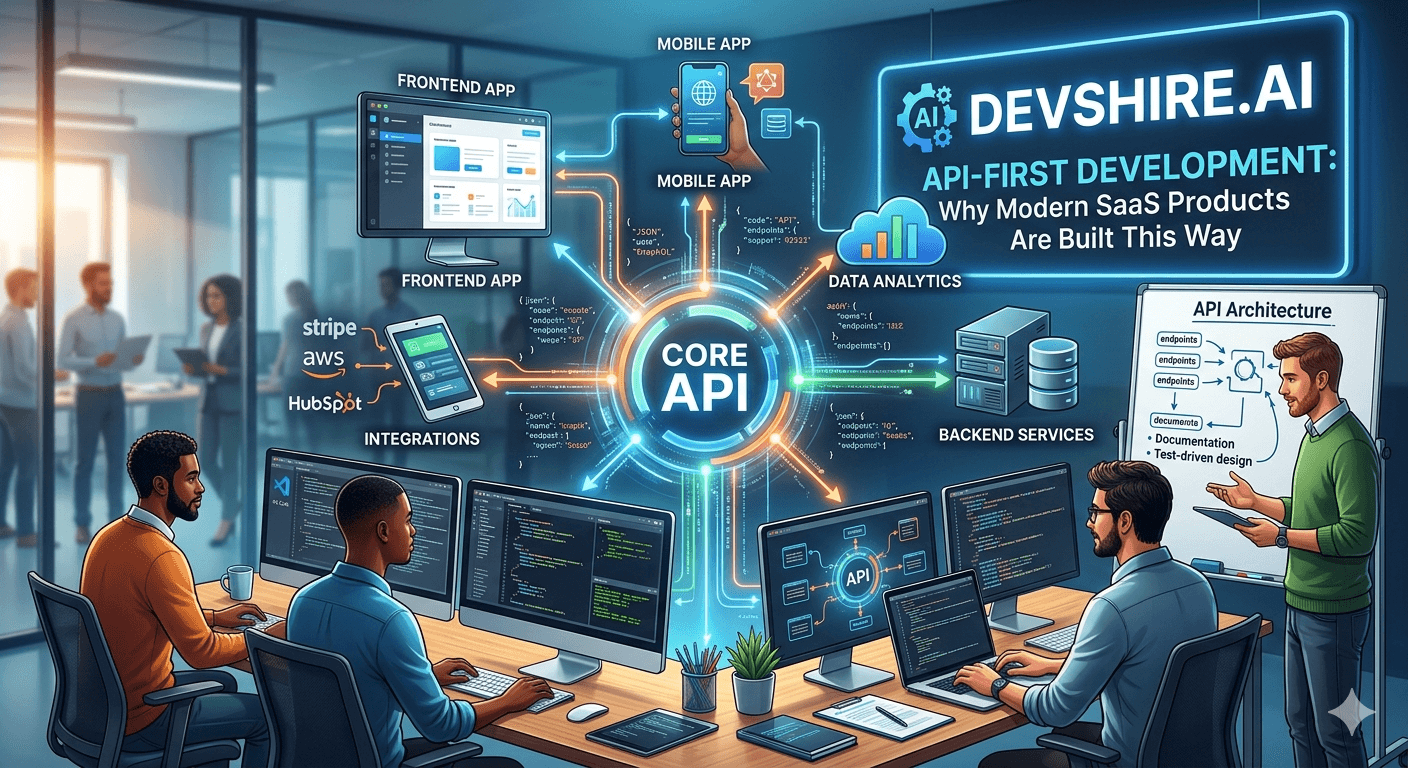
Stripe processed over $1 trillion in payments in 2023. Their product is not a dashboard. It's an API that a dashboard happens to sit on top of. Every feature Stripe's own frontend team builds, developers around the world can build too — because the API and the UI use exactly the same endpoints. That architectural decision, made in 2010, is why Stripe became the default payments layer for the internet instead of just another payments UI.
💡 TL;DR
API-first SaaS development means your API is designed and built before your frontend — not generated from it. The API is the product. The frontend is a client. This lets your SaaS serve web, mobile, third-party integrations, and developer customers from the same foundation. The practical payoff: API-first products ship integrations in days instead of months, attract developer users who drive organic growth, and scale to multiple surfaces without rebuilding core logic. The cost: it requires more upfront architecture discipline than a UI-first approach. But the teams that skip it typically rebuild from scratch by month 18.
API-First vs API-Later — The Architectural Fork That Matters
Most SaaS products are built UI-first. The frontend gets built, the backend routes exist to serve that specific UI, and then at some point — usually when a customer asks for an API, or when a mobile app is needed — the team tries to expose those routes as a public API. This always costs more than starting API-first would have. Because the routes weren't designed for general use. They have implicit state, UI-specific response shapes, and business logic tangled with presentation concerns.
Dimension | API-First Approach | UI-First Approach |
|---|---|---|
When API is designed | Before any UI is built | After UI is working, if ever |
Who designs the API | Backend engineers + product, for general use | Backend engineers, for specific UI needs |
Third-party integrations | Available from day one | Require rework of existing routes |
Mobile app timeline | Weeks — use existing API | Months — refactor routes first |
Developer customer access | Included in the core product | A separate project, usually delayed 12+ months |
Testing | API tested independently of UI | Backend and frontend coupled — harder to test in isolation |
The hidden cost of UI-first is the integration tax. Every time a customer asks "can I connect this to X?" — Zapier, Salesforce, their own internal tools — a UI-first product has to evaluate whether the route exists in a usable form. An API-first product just documents the endpoint.
Design the API Before You Write a Route
API-first SaaS development starts with API design as a product activity — not a technical one. The question isn't "what endpoints do we need to serve the UI?" It's "what operations does a developer need to perform on this system to accomplish everything our product can do?"
The design process that works:
Write the API reference first. Before any code. Document every resource, every endpoint, every request parameter, and every response shape in an OpenAPI (Swagger) spec. This forces you to think through the data model and resource relationships before implementation traps you.
User-test the API spec with a developer. Give the spec to a developer who doesn't know the product and ask them to build a simple integration against it. Every place they get confused or ask a question is a design problem in the API — not a documentation problem.
Design for idiomatic REST (or GraphQL if your data model warrants it). Resources are nouns. HTTP verbs are operations. Pagination is consistent. Error responses have consistent shapes with machine-readable error codes. Developers expect these conventions. Violating them creates friction that compounds across every integration.
Version from day one. Your first API is v1. Even if you never change it. Versioning at launch means customers can target a stable surface and you can ship v2 without breaking existing integrations. Adding versioning retroactively after you have API customers is a multi-month project.
[INTERNAL LINK: SaaS security best practices for APIs → saas-security-best-practices]
SDKs and Documentation — Where API-First Products Win or Lose
An API without excellent documentation is a locked door with a key that nobody can find. The documentation is not a nice-to-have addition to the API. For API-first SaaS development, it is the product experience for developer users.
What Good API Documentation Actually Contains
Look at Stripe's documentation and count how many code examples exist before you have to click anything. That density of examples is not accidental. Every endpoint has a request example and a response example in at least three languages. Every error code has an explanation and a suggested resolution. Every concept has a guide that explains the why, not just the how.
📄 Quickstart that works in under 10 minutes
A developer who can't make a successful API call within 10 minutes of starting will leave. Build the quickstart first. Test it with a real developer who's never seen the product. Time them. If they're not making their first successful call in 10 minutes, the quickstart needs work.
📄 Code examples in the languages your customers actually use
Node.js, Python, and cURL cover 80% of SaaS API customers. Add Ruby and PHP if your market warrants it. Auto-generated examples from your OpenAPI spec are a start — but hand-written examples that show real-world patterns, not just parameter names, are what developers actually rely on.
📄 Detailed error reference
Every error code your API returns should have a documentation page with the cause, the fix, and a code example of how to handle it. Most SaaS APIs document success cases and leave error handling to developers to figure out. This creates support tickets. A good error reference turns a 30-minute debugging session into a 2-minute fix.
Auto-Generate SDKs — Don't Build Them by Hand
Speakeasy and Stainless generate SDKs from OpenAPI specs automatically. A generated SDK in Node.js, Python, Ruby, and Go takes 2 hours to set up and maintains itself as your API evolves. Hand-rolling SDKs takes weeks and falls out of sync with the API within months. Generate them. Don't build them.
[EXTERNAL LINK: Speakeasy SDK generation → speakeasy.com]
Rate Limits, Auth, and the API Infrastructure You Need From Day One
You might be thinking — but we don't have API customers yet, why build this now? Here's why: retrofitting rate limiting, API key management, and usage tracking onto a live API that customers are already using is a breaking change. Get these right before your first API customer, not after your tenth.
🔑 API key authentication with scopes
Issue scoped API keys from day one. A key with read-only scope cannot write. A key scoped to a specific resource cannot access others. This is not over-engineering — it's the minimum security model that enterprise customers will ask about in their first security questionnaire. Building it in at launch is trivial. Retrofitting it is two weeks of breaking change management.
🔑 Rate limiting at the API gateway or middleware layer
Set rate limits before you have API customers — not in response to your first abuse incident. Standard SaaS API rate limits: 100 requests per minute per API key for standard endpoints, 10 per minute for expensive operations. Communicate limits in response headers: X-RateLimit-Limit, X-RateLimit-Remaining, X-RateLimit-Reset. Developers expect these headers and build their clients to respect them.
🔑 Usage tracking per API key
Log every API call with key ID, endpoint, response time, and status code. This data drives pricing decisions, identifies your highest-volume customers, spots abuse patterns, and provides the usage data that makes metered billing possible. The cost of not having it — when you want to add API-based pricing at month 12 — is building an instrumentation layer on a live system.
Trusted by 500+ startups & agencies
"Hired in 2 hours. First sprint done in 3 days."
Michael L. · Marketing Director
"Way faster than any agency we've used."
Sophia M. · Content Strategist
"1 AI dev replaced our 3-person team cost."
Chris M. · Digital Marketing
Join 500+ teams building 3× faster with Devshire
1 AI-powered senior developer delivers the output of 3 traditional engineers — at 40% of the cost. Hire in under 24 hours.
A Real Scenario: How API-First Compounds Over 18 Months
A 5-person team building a project management SaaS chose API-first at launch. Month 1: web UI and iOS app shared the same API with zero code duplication. Month 4: a customer requested a Zapier integration. It took 3 days — the Zapier connection used existing endpoints, not new routes. Month 8: two enterprise customers requested custom integrations with their internal tools. Both were self-serve via the public API with documented webhooks. Month 12: a developer marketplace launched, with third-party integrations built by the community. Month 18: the API tier represented 23% of revenue from customers who paid for programmatic access.
A comparable team that built UI-first: at month 8, the first enterprise integration request triggered a 6-week project to refactor backend routes into a usable public API. The Zapier integration launched at month 14. The developer marketplace was never built.
Honest limitation: API-first requires more upfront architecture discipline and documentation work. For a solo founder with a 6-week runway, UI-first to validate the concept first is a defensible choice. But plan the migration to API-first before you have your first API customer — not after.
[INTERNAL LINK: SaaS boilerplate vs custom build → saas-boilerplate-vs-custom-build]
The Bottom Line
API-first means designing the API as a product — before writing UI code — so that your frontend is just one client of the same API your customers use.
Write the OpenAPI spec before writing any routes. User-test it with a developer who doesn't know the product. Every confusion point is a design problem, not a documentation problem.
Version your API from day one — even if you never change v1. Retrofitting versioning after you have API customers is a multi-month breaking change project.
Set rate limits before your first API customer. Communicate them in response headers. The standard starting point is 100 requests per minute per API key for standard endpoints.
Generate SDKs from your OpenAPI spec using Speakeasy or Stainless. Don't build them by hand. Generated SDKs in four languages take 2 hours to set up and maintain themselves as the API evolves.
Log every API call from day one — key ID, endpoint, response time, status code. This data drives pricing decisions, catches abuse, and makes metered billing possible when you're ready for it.
Frequently Asked Questions
What is API-first SaaS development?
API-first SaaS development is the practice of designing and building your API before your frontend — and treating the API as the core product rather than as infrastructure to serve a specific UI. In an API-first product, every feature available in the web interface is also available through the API. The frontend is just one client consuming the same endpoints that customers, third-party integrations, and mobile apps use.
Why do modern SaaS companies use API-first development?
Because it compounds value over time in ways that UI-first cannot. API-first products can launch mobile apps without backend refactoring, support third-party integrations without custom engineering work, serve developer customers who pay for programmatic access, and expand into new distribution channels (Zapier, Make, native integrations) without rebuilding the core layer. Stripe, Twilio, and Notion are API-first companies. Their developer ecosystems are a significant competitive moat that UI-first products cannot replicate quickly.
What is the difference between API-first and API-led development?
The terms are often used interchangeably. API-first typically refers to the design philosophy — the API is designed before the implementation begins. API-led sometimes refers to an enterprise integration pattern where APIs are the primary integration layer between systems. For SaaS development, API-first is the relevant concept: design the API contract before writing routes, treat the API as the primary product interface, and build all other surfaces — web, mobile, integrations — as consumers of that API.
How do I start building an API-first SaaS product?
Start by writing the OpenAPI spec for your core resources and operations — before any code. Define your resource model (what are the things your API manages?), the operations on each resource (create, read, update, delete, plus any domain-specific actions), and the authentication model. Then user-test the spec with a developer external to the project. Build routes that implement the spec. Let the spec drive the implementation, not the other way around.
When should a SaaS startup not go API-first?
When validating whether the core product concept works before committing to architecture. A solo founder with 6 weeks to prove a concept can move faster UI-first. But the plan should include an explicit migration point to API-first — specifically, before the first customer requests an integration or before the team starts building a mobile app. Retrofitting API-first onto a live UI-first product costs 4–8 weeks of refactoring. That's much cheaper than the 18-month compounding cost of never doing it.
What authentication method should an API-first SaaS use?
Scoped API keys for machine-to-machine access. OAuth 2.0 for third-party integrations that need to act on behalf of a user. JWTs for your own frontend clients with short expiry and refresh token rotation. Many SaaS products support all three — API keys for developers and integrations, OAuth for Zapier and similar platforms, and JWTs for the web application. Start with scoped API keys and add OAuth when your first integration partner requires it.
How do I document an API-first SaaS product?
Start with a quickstart guide that gets a developer to their first successful API call in under 10 minutes. Then an endpoint reference generated from your OpenAPI spec with hand-written code examples in Node.js, Python, and cURL. Then concept guides that explain why, not just how — authentication, pagination, webhooks, error handling. Then a detailed error reference with causes and fixes for every error code your API returns. Stripe's documentation structure is the benchmark. Study it before writing your own.
What rate limits should an API-first SaaS start with?
A practical starting point: 100 requests per minute per API key for standard read and write endpoints, 10 per minute for expensive operations like bulk exports or AI-powered features, and 1,000 per hour as a secondary rolling limit. Return rate limit headers on every response: X-RateLimit-Limit, X-RateLimit-Remaining, and X-RateLimit-Reset. These let developers build compliant clients that back off gracefully rather than hammering your API until they get blocked.
Build Your SaaS API With a Developer Who's Done It Before
Devshire.ai matches SaaS teams with pre-vetted backend developers who understand API-first architecture — OpenAPI design, SDK generation, rate limiting, and the webhook infrastructure that enterprise customers expect. Shortlist in 48–72 hours.
API-first specialists · OpenAPI experienced · Shortlist in 48 hrs · Median hire in 11 days
Related reading: Stripe SaaS Integration Guide 2026 · SaaS Security Best Practices · Add AI Features to Your SaaS Without an ML Team
Stats source: [EXTERNAL LINK: Stripe 2023 annual payment volume → stripe.com/newsroom]
Related image: API-first architecture diagram — Postman API platform blog
Related video: "API Design Best Practices" — Arjun Full Stack YouTube channel (200K+ subscribers)







Devshire Team
San Francisco · Responds in <2 hours
Hire your first AI developer — this week
Book a free 30-minute call. We'll match you with the right developer for your project and get you started within 24 hours.
<24h
Time to hire
3×
Faster builds
40%
Cost saved