
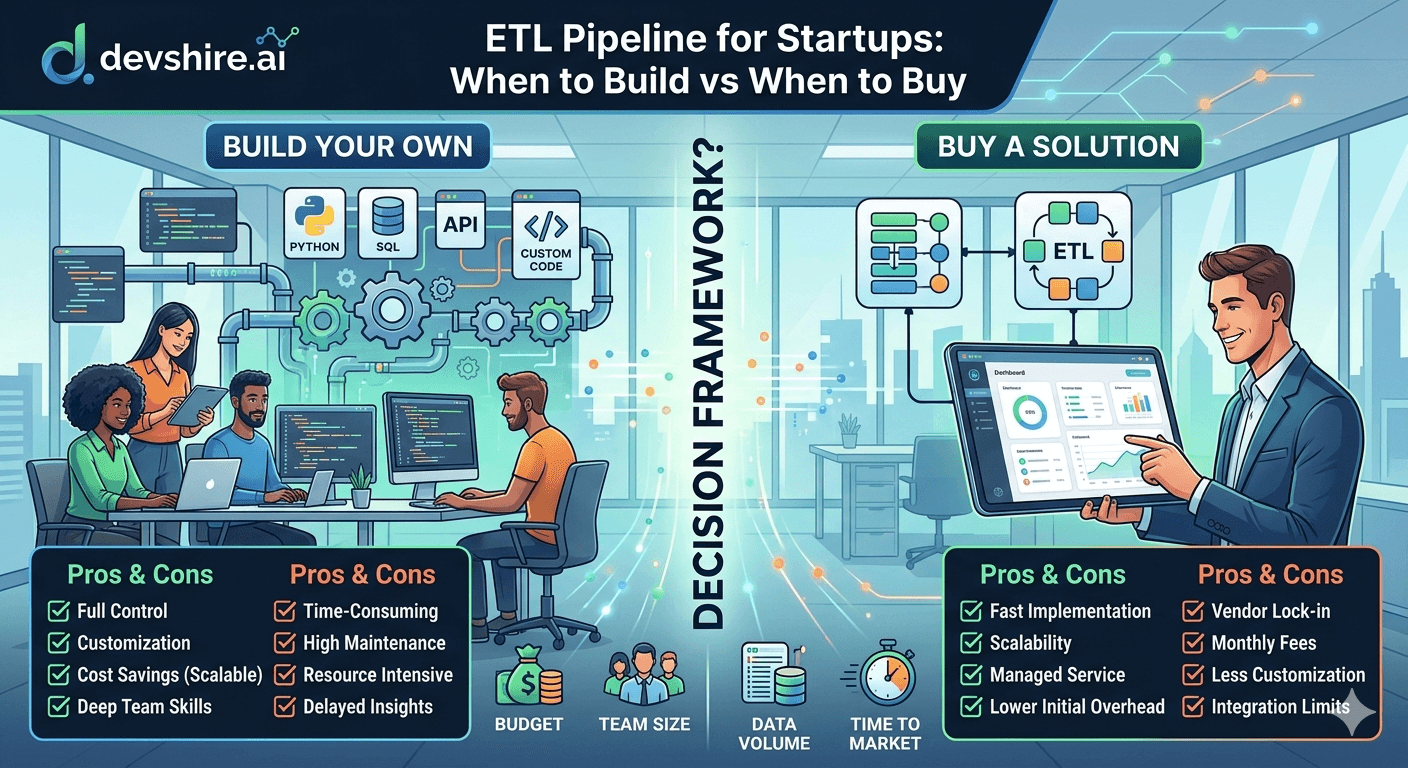
Someone on your team spent three weeks building a custom Stripe-to-Postgres sync. It worked great for four months. Then Stripe changed their API version. The sync broke silently on a Friday. By Monday morning, your revenue dashboard was showing data from three days ago and nobody had noticed. You fixed it Tuesday. That's the build-your-own ETL pipeline story at most early-stage startups. And it repeats. With every new data source you add, another custom connector to maintain, another failure mode to monitor, another engineer spending a Thursday debugging a webhook instead of shipping features. The build vs buy question for ETL pipelines is actually pretty clear — if you know what to look for.
💡 TL;DR
For third-party data sources (Stripe, Salesforce, HubSpot, Zendesk), buy an ETL tool — Fivetran, Airbyte, or Stitch. The cost of maintaining custom connectors is always higher than the subscription. Build custom pipelines only for internal data sources with unusual schemas that no connector covers. The break-even on DIY vs Fivetran typically hits at month 3 when your second connector breaks and an engineer spends two days fixing it instead of shipping.
What ETL Actually Means for a Startup (Skip the Textbook Definition)
ETL stands for Extract, Transform, Load. But in practice at a startup, it means one thing: getting data from wherever it lives — Stripe, your app database, your CRM, your support tool — into one place where your team can query it.
Most startups encounter ETL as a pain point before they have a name for it. The data analyst is copying Stripe exports into a Google Sheet. The developer wrote a cron job that syncs orders to Postgres every hour. The founder is manually downloading reports from HubSpot. All of this is ETL — just the slow, fragile, manual version.
⚠️ The hidden cost most teams miss
The most expensive part of a DIY ETL pipeline isn't the initial build — it's the ongoing maintenance. Every third-party API you sync against will change at least once a year. Stripe, Salesforce, HubSpot — they all release API version updates that break undocumented sync assumptions. When that happens, someone has to fix it. That someone is almost always an engineer who had other things to build that week.
Fivetran vs Airbyte vs Stitch: Which ETL Tool for Which Stage
There are three tools most startups end up evaluating. Here's the honest picture of each.
Tool | Best For | Pricing Model | Setup Time | Self-Hosted? |
|---|---|---|---|---|
Fivetran | Teams wanting zero maintenance, enterprise connectors | Per row synced (gets expensive at scale) | Hours | No |
Airbyte | Cost-conscious teams, open source flexibility | Free self-hosted; cloud from $200/mo | 1–2 days | Yes |
Stitch | Small teams, simple sources | From $100/mo flat | Hours | No |
Fivetran is the most reliable and the most expensive at scale. Airbyte is open-source and self-hostable — which means lower cost but you're maintaining the infrastructure. Stitch is the simplest to get started with but covers fewer connectors than Fivetran.
For most startups under $3M ARR, Airbyte self-hosted or Stitch is the right starting point. Fivetran is worth the premium once you have a data team that needs SLA guarantees on connector reliability.
When Building Your Own ETL Pipeline Actually Makes Sense
Here's the thing — I'm not saying never build custom pipelines. There are legitimate cases for it. But the trigger should be specific, not default.
✅ Build if: your internal database schema is too custom
Your app has a multi-tenant schema with per-customer tables, or a domain-specific data model that no off-the-shelf connector understands. In this case, a custom sync that knows your schema is often cleaner than contorting a generic connector to fit it.
✅ Build if: you need real-time streaming, not batch sync
Most ETL tools sync on a schedule — every 15 minutes, every hour. If you need true real-time data (under 5 seconds latency) for a feature like live dashboards or fraud detection, you're looking at a CDC (Change Data Capture) pipeline using Debezium or similar. That's a custom build, and it's justified for real-time requirements.
✅ Build if: no connector exists for your data source
Some niche industry platforms, proprietary internal systems, or legacy databases have no Fivetran or Airbyte connector. In that case, you're building one — but scope it carefully. Build only the fields you need, not a full API wrapper.
When to Buy — And Why the Math Almost Always Favours It
For any widely-used third-party platform — Stripe, Salesforce, HubSpot, Zendesk, Shopify, Intercom — buy the connector. Full stop. Here's the actual cost calculation.
💸 The real cost of a custom Stripe connector
Build time: 3–5 days of senior developer time at $700/day = $2,100–$3,500. First API change fix: 1–2 days per year = $700–$1,400. Second API change (Stripe releases 2–3 API versions per year): another $700–$1,400. Year-one total: $3,500–$6,300. Fivetran for the same Stripe connector: $300–$600/year at startup data volumes. The maths are not close.
🔧 Maintenance is the killer, not the build
Most teams underestimate how often connectors break. Stripe updates their API. HubSpot changes a property name. Salesforce adds new authentication requirements. Each change is a 2–4 hour debugging session for your engineer. Buy connectors for platforms with active API development — and that's almost every major SaaS platform.
[EXTERNAL LINK: Airbyte connector catalog → docs.airbyte.com/integrations]
Trusted by 500+ startups & agencies
"Hired in 2 hours. First sprint done in 3 days."
Michael L. · Marketing Director
"Way faster than any agency we've used."
Sophia M. · Content Strategist
"1 AI dev replaced our 3-person team cost."
Chris M. · Digital Marketing
Join 500+ teams building 3× faster with Devshire
1 AI-powered senior developer delivers the output of 3 traditional engineers — at 40% of the cost. Hire in under 24 hours.
Setting Up Your First ETL Pipeline: A Practical Walkthrough
Here's what a week-one ETL setup looks like for a typical SaaS startup using Airbyte Cloud and BigQuery as the destination.
1️⃣ Day 1 — Connect your sources
Set up connectors for your three most important sources: your production Postgres database (read replica, not primary — never point an ETL tool at your primary DB), Stripe for billing data, and your CRM if you have one. Configure sync frequency — hourly is usually enough. Daily is fine for early stage.
2️⃣ Day 2–3 — Configure your destination and test
Point everything at your BigQuery or Redshift dataset. Run your first sync and validate: do the row counts match what's in the source? Are timestamps correct? Are the schemas what you expected? Never assume a first sync is clean — check it.
3️⃣ Day 4–5 — Add monitoring and alerting
Set up failure alerts — either through Airbyte's built-in notifications or by monitoring sync job status via their API and alerting to Slack. A silent sync failure is the worst kind. Most broken ETL pipelines are only discovered when someone needs the data and it's three days stale.
[INTERNAL LINK: data warehouse guide → devshire.ai/blog/data-warehouse-startups-snowflake-bigquery-redshift]
Don't Forget the Transform Layer
ETL pipelines get data into your warehouse. But raw data from a Stripe sync is not clean, join-ready data. The Stripe invoices table has different IDs than your customers table. The field names are Stripe's names, not yours. The timestamps are in UTC but your business logic uses local time.
This is where dbt comes in. Build a transformation layer on top of your raw synced data that produces clean, business-logic-aware models your team can actually query. Without it, your warehouse is a pile of raw data that every analyst queries differently — and then argues about the results.
In practice, this means: one dbt model for customers that joins your user table with Stripe subscription data, one for revenue metrics, one for product usage. Run dbt after each sync cycle. Your dashboards query the dbt models, not the raw tables.
[INTERNAL LINK: customer analytics platform → devshire.ai/blog/customer-analytics-platform-saas]
The Bottom Line
For third-party platforms (Stripe, HubSpot, Salesforce), always buy a connector. The year-one cost of a custom Stripe connector is $3,500–$6,300 vs $300–$600 for Fivetran — the maths aren't close.
Build custom pipelines only for: internal databases with unusual schemas, real-time streaming requirements under 5 seconds, or data sources with no available connector.
Airbyte self-hosted is the best cost option for startups under $3M ARR. Fivetran is worth the premium once you need enterprise SLA guarantees.
Always sync from a read replica, never from your primary database. An ETL tool querying your production primary can cause real performance problems.
Set up failure alerts on day one. Silent sync failures are the most damaging — nobody notices until the data is days old and decisions have already been made on it.
Build a dbt transformation layer on top of raw synced data. Without it, analysts query raw tables differently and fight about the numbers.
The break-even point on DIY vs bought ETL typically hits at month 3, when your first connector breaks and an engineer spends two days fixing it.
Frequently Asked Questions
What is an ETL pipeline and why do startups need one?
An ETL pipeline extracts data from multiple sources (your app database, Stripe, your CRM, support tools), transforms it into a consistent format, and loads it into a central data store — typically a data warehouse. Startups need one when they need to run queries that span multiple data sources and a product analytics tool can't do it. Without a pipeline, data lives in silos and answering cross-source business questions requires hours of manual work.
Should I use Fivetran or Airbyte for my startup's data pipeline?
Airbyte (self-hosted) is the better choice for most startups under $3M ARR — it's open source, self-hostable, and significantly cheaper than Fivetran at early data volumes. Fivetran is worth the premium when you need guaranteed connector SLAs, enterprise data sources, and a team that doesn't want to manage any infrastructure. Both cover the major connectors most startups need: Stripe, Postgres, Salesforce, HubSpot.
How much does an ETL pipeline cost for a startup?
Airbyte self-hosted is free (you pay for the hosting, typically $50–$150/month on a small cloud instance). Airbyte Cloud starts around $200/month. Stitch starts at $100/month flat. Fivetran starts around $500–$1,000/month depending on data volume. Building custom connectors looks free until you factor in maintenance — a realistic year-one cost for a single custom connector to a major platform is $3,500–$6,300 in engineer time.
What's the difference between ETL and ELT?
ETL transforms data before loading it into the destination. ELT loads raw data first and transforms it inside the data warehouse using tools like dbt. For most modern startups, ELT is the right approach — load raw data into BigQuery or Redshift, then use dbt to build clean, tested transformation models on top of it. ELT is more flexible and scales better than pre-transform pipelines.
How often should my ETL pipeline sync data?
For most startup use cases, hourly syncs are sufficient for operational dashboards. Daily is fine for slower-moving data like CRM contacts. The main exception is billing data — if you're monitoring revenue metrics actively, a 15-minute Stripe sync gives you near-real-time revenue visibility. True real-time (under 5 seconds) requires a CDC pipeline like Debezium, which is a significantly more complex build.
What happens if my ETL pipeline breaks?
If you have alerts configured, you'll know within an hour. If you don't, you'll find out when someone pulls a report and the numbers look wrong — which could be days later. Always set up failure notifications for your sync jobs: Airbyte and Fivetran both support Slack and email alerts natively. A silent data pipeline failure is worse than a loud one because decisions get made on stale data before anyone notices.
Do I need a data engineer to set up an ETL pipeline?
A senior full-stack developer with some data infrastructure experience can set up Airbyte or Fivetran with a BigQuery destination in 1–3 days. The technical ceiling isn't that high for the initial setup. Where you need data engineering experience is in the transformation layer — building dbt models that correctly implement your business logic takes domain knowledge. Most startups get the pipeline running themselves and bring in a specialist for the dbt model design.
Need a Developer to Build Your Data Pipeline the Right Way?
devshire.ai matches startups with developers who have real experience building data infrastructure — ETL pipelines, dbt models, and data warehouse setup. Get a pre-vetted shortlist in 48–72 hours without the weeks of searching.
Find Your Data Developer at devshire.ai →
No upfront cost · Shortlist in 48–72 hrs · Freelance & full-time · Stack-matched candidates
About devshire.ai — devshire.ai connects startups with developers who've built real data pipelines and analytics infrastructure. Every candidate passes a live proficiency screen. Typical time-to-hire: 8–12 days. Start hiring →
Related reading: Data Warehouse for Startups: Snowflake vs BigQuery vs Redshift · Building a Customer Analytics Platform for SaaS · How to Add Mixpanel or Amplitude to Your App · SaaS Product Roadmap Planning · Automate Your Startup Backend with AI







Devshire Team
San Francisco · Responds in <2 hours
Hire your first AI developer — this week
Book a free 30-minute call. We'll match you with the right developer for your project and get you started within 24 hours.
<24h
Time to hire
3×
Faster builds
40%
Cost saved