
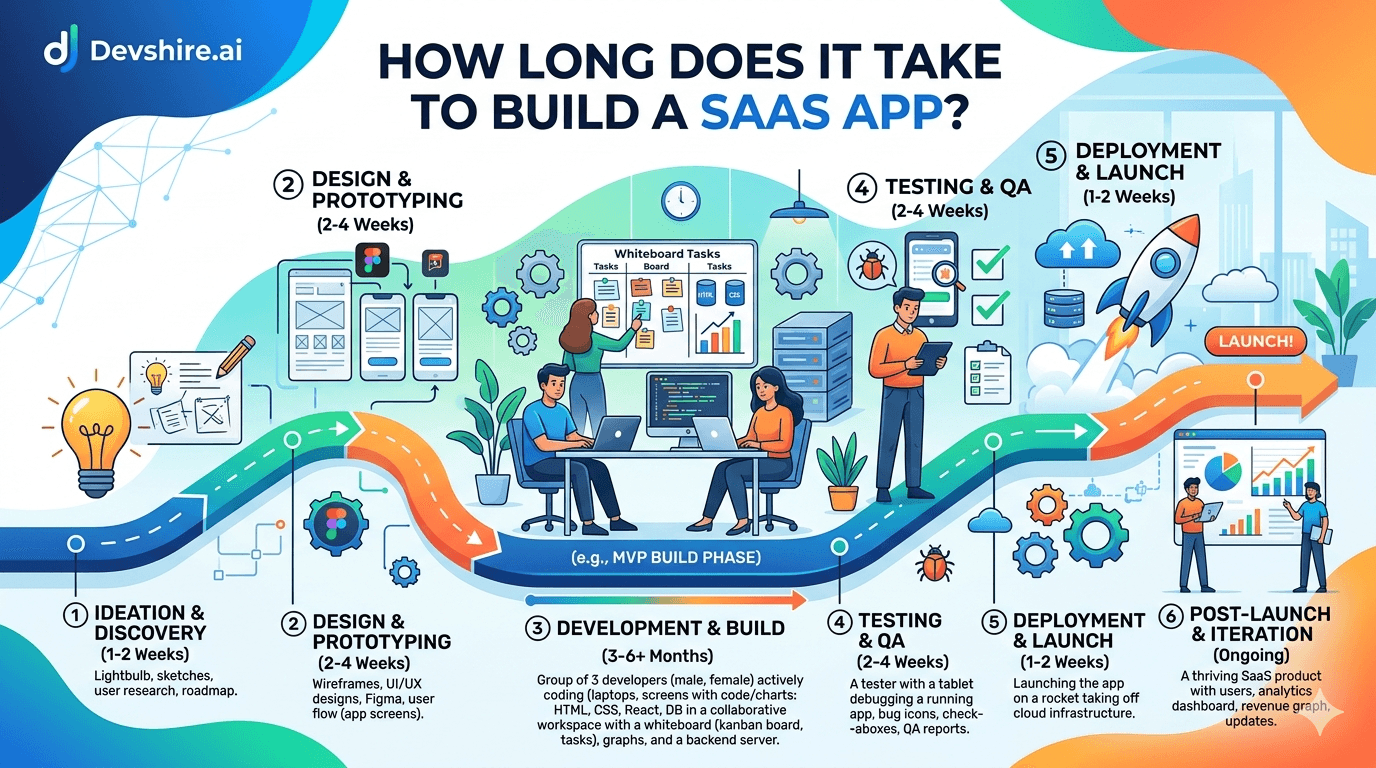
The honest answer is 3 to 9 months to a paying customer. But that range is almost useless without the context that determines where you fall in it. A solo developer building a simple B2B tool on a boilerplate with an AI-assisted workflow sits at the 3-month end. A 4-person team building a marketplace with real-time features, complex permissions, and custom billing sits at the 9-month end. The mistake most founders make is assuming they're in the first category when they're building something in the second.
💡 TL;DR
A simple SaaS MVP — auth, billing, one core workflow — takes 6–10 weeks with a 2-person team using a boilerplate. A medium-complexity SaaS — multi-tenant, integrations, dashboard — takes 3–5 months. A full-featured B2B SaaS with team management, API access, and compliance requirements takes 6–12 months. These timelines assume competent developers, no discovery phase, and 20% buffer for unplanned work. Add 30–50% if the team is building the core domain for the first time. Most timelines people quote are the optimistic case. These are the median.
What Actually Determines the Timeline — Not the Feature List
Founders focus on the feature list when estimating SaaS build time. Developers focus on the variables below the feature list. These are the real timeline drivers:
Variable | Fast End | Slow End | Timeline Impact |
|---|---|---|---|
Team AI toolchain | Cursor + Claude daily | No AI tools | 30–50% faster on standard features |
Foundation | Boilerplate (auth/billing pre-built) | Custom from scratch | 4–8 weeks saved |
Domain familiarity | Team has shipped this type of product | First time building this domain | Add 30–50% |
Spec clarity | Detailed spec, edge cases documented | Build-as-you-go product discovery | Add 2–6 weeks |
Third-party integrations | 0–1 integrations | 3+ integrations (Salesforce, HubSpot, etc.) | Each adds 1–3 weeks |
Compliance requirements | None at launch | SOC 2, HIPAA, GDPR from day one | Add 6–12 weeks |
The domain familiarity variable is the one teams underestimate most. Building a project management tool when you've built three project management tools moves fast. Building your first payments platform, your first healthcare records system, or your first real-time collaboration tool does not — regardless of how experienced the developers are.
Phase-by-Phase: Where the Time Actually Goes
Here's the phase breakdown for a medium-complexity SaaS — multi-tenant B2B with billing, team management, a core workflow, and a dashboard. Team of 2 developers, boilerplate foundation, no compliance requirements.
📅 Week 1–2: Foundation and infrastructure (2 weeks)
Boilerplate setup, environment configuration, CI/CD pipeline, database schema design, auth integration. If using a boilerplate, the auth and billing wrapper is live by end of week 1. The two weeks go to project structure, database design, and the deployment pipeline being reliable — not to features.
📅 Week 3–6: Core product feature (4 weeks)
The one thing users pay for. This gets the most developer time and the most product iteration. Whatever the core workflow is — the thing that delivers the product's value — it gets built, tested with real users, and iterated on during this phase. Everything else is secondary to shipping this.
📅 Week 7–9: Billing and team management (3 weeks)
Stripe subscription wiring, team invitation flow, role-based access control, billing portal. These are complex enough to warrant dedicated time and simple enough to underestimate. Most teams budget 1 week here and need 3. Plan for 3.
📅 Week 10–12: Dashboard, admin, and polish (3 weeks)
User dashboard, admin panel, email notifications, error states, empty states, mobile responsiveness. This phase always takes longer than expected because polish is unbounded — you can always make it better. Time-box it deliberately.
📅 Week 13–14: Beta, fixes, and launch prep (2 weeks)
Private beta with 10–20 users, bug fixing from real usage, performance issues discovered in production, security review, and launch checklist. This is the phase most timelines drop entirely. Don't. You will find things in beta that require more than 30 minutes to fix.
Total: 14 weeks, or roughly 3.5 months. That's the median for this product type with this team setup. Not the fast case. Not the slow case. The median.
SaaS Complexity Tiers — Matching Timeline to Product Type
Not all SaaS products are equal in complexity. Here's how to place your product in the right tier and what timeline to plan against.
Tier | Product Examples | Team of 1 | Team of 2 | Team of 3–4 |
|---|---|---|---|---|
Simple (single workflow, basic auth, flat billing) | Scheduling tool, simple form builder, basic analytics | 10–14 weeks | 6–10 weeks | 4–7 weeks |
Medium (multi-tenant, team management, dashboard) | Project management, CRM, reporting tool | 20–28 weeks | 12–18 weeks | 8–14 weeks |
Complex (real-time, marketplace, ML features) | Collaboration platform, two-sided marketplace, AI product | 40+ weeks | 24–36 weeks | 16–24 weeks |
Enterprise (compliance, SSO, audit logs, SLAs) | Healthcare SaaS, fintech, government tooling | Not viable solo | 36–52 weeks | 24–40 weeks |
These timelines include the 20% buffer for unplanned work. They assume experienced developers. They assume the spec is reasonably defined before development starts. Add 30–50% for any of: first-time domain, no spec, or developers without SaaS experience.
What AI Tools Do to the Timeline — Real Numbers
A 2-developer AI-native team using Cursor, Claude, and GPT-4o daily ships standard SaaS features 30–50% faster than the same team using traditional tooling. That's not a marketing claim — it's what we see consistently across teams that have hired through devshire.ai over the past 18 months.
Specifically: a React dashboard component that takes a traditional developer 4 hours takes an AI-native developer 90 minutes — because v0 generates the component structure in 3 minutes, the developer spends 30 minutes wiring it to the API, and 60 minutes on edge cases and polish. The 30 minutes of API wiring doesn't get faster. The 4 hours of scaffolding from scratch does — it effectively disappears.
In practice, this means a medium-complexity SaaS that a traditional 2-person team ships in 18 weeks, an AI-native 2-person team ships in 11–13 weeks. That's roughly 5–7 weeks of runway saved. At $8,000–$12,000 per developer-month, that's $40,000–$84,000 in development cost.
But here's the edge case AI tools don't help with: complex business logic, domain-specific rules, and architectural decisions. AI accelerates the implementation of decisions. It doesn't replace the decisions. The hardest parts of building a SaaS — the data model, the permission system, the billing edge cases — still require experienced developer judgment. Just less time executing them.
[INTERNAL LINK: best tech stack for startups 2026 → best-tech-stack-startup-2026]
[EXTERNAL LINK: GitHub Copilot developer productivity study → github.blog/2022-09-07-research-quantifying-github-copilots-impact-on-developer-productivity-and-happiness]
Trusted by 500+ startups & agencies
"Hired in 2 hours. First sprint done in 3 days."
Michael L. · Marketing Director
"Way faster than any agency we've used."
Sophia M. · Content Strategist
"1 AI dev replaced our 3-person team cost."
Chris M. · Digital Marketing
Join 500+ teams building 3× faster with Devshire
1 AI-powered senior developer delivers the output of 3 traditional engineers — at 40% of the cost. Hire in under 24 hours.
What Goes Wrong — The Delays That Kill Timelines
Most timeline slippage in SaaS development comes from the same five causes. Recognising them early is more valuable than any project management framework.
Scope creep from customer feedback during beta. Beta users ask for features. Some are right to build. Most should wait. Set a clear rule: no new features during the beta phase. Bug fixes and critical UX improvements only. New features go on the post-launch roadmap.
Third-party API surprises. Integrating with Salesforce, HubSpot, or any enterprise API takes 2–4x longer than the documentation suggests. Their sandbox environments have different behaviour than production. Rate limits are more restrictive than documented. Plan 3 weeks for any enterprise integration, not 3 days.
Underestimated email and notification systems. Transactional emails, billing notifications, and in-app alerts collectively take 2–3 weeks that nobody budgets for. They're not glamorous. They're also not optional — users who don't get billing failure notifications churn silently.
Authentication edge cases. Password reset flows, email verification, SSO integration, and session handling have more edge cases than they appear to. If using a provider like Clerk, most of this is handled. If building custom auth, add 2 extra weeks.
Production performance issues not caught in development. A query that's fast with 100 test records is slow with 50,000 real ones. Reserve the final 2 weeks of your timeline for performance profiling and optimisation under realistic data volumes. Don't find this in production with paying customers.
[INTERNAL LINK: SaaS product roadmap planning → saas-product-roadmap-planning]
The Bottom Line
A simple SaaS MVP takes 6–10 weeks with a 2-person AI-native team on a boilerplate. A medium-complexity multi-tenant SaaS takes 12–18 weeks. A complex product with real-time features or marketplace dynamics takes 24–36 weeks.
Add 30–50% to any estimate if the team is building this type of product for the first time. Domain familiarity is a larger timeline variable than team size.
AI tools — Cursor, Claude, v0 — cut standard feature implementation time by 30–50%. The remaining time on complex business logic and architecture decisions doesn't compress as much. Plan accordingly.
Each major third-party integration (Salesforce, HubSpot, enterprise APIs) adds 1–3 weeks. Budget 3 weeks per integration, not 3 days.
Reserve 2 weeks at the end of every timeline for beta user testing, bug fixes, and production performance issues. This phase is always needed. Most timelines don't include it.
Most timeline overruns come from one of five causes: scope creep during beta, third-party API surprises, underestimated notification systems, auth edge cases, and production performance issues. Name them upfront and plan for them.
Frequently Asked Questions
How long does it take to build a SaaS app from scratch?
From zero to paying customer: 6–10 weeks for a simple single-workflow SaaS with a 2-person AI-native team on a boilerplate. 12–18 weeks for a medium-complexity multi-tenant SaaS. 24–36 weeks for a complex product with real-time features, marketplace dynamics, or significant integrations. These are median timelines for experienced developers with a clear spec. Solo developers add 50–80% to each range. First-time domains add another 30–50%.
How much does it cost to build a SaaS app in 2026?
Developer cost is the primary variable. At North American senior developer rates of $100–$175/hour, a 12-week project with a 2-person team costs $96,000–$168,000. At global rates of $35–$75/hour for comparable experience, the same project costs $33,600–$72,000. Using a boilerplate saves 4–8 weeks of development at any rate. AI tooling saves an additional 30–50% on standard feature implementation time. The realistic range for a medium-complexity SaaS MVP is $35,000–$120,000 depending on team location and tooling.
What is the fastest way to build a SaaS app?
A SaaS boilerplate (Shipfast, Supastarter) plus a 2-person AI-native team using Cursor and Claude daily is the fastest stack for standard SaaS products. This combination reaches a first paying customer in 6–8 weeks for simple products. The boilerplate handles auth, billing, and email. The AI tools cut standard feature implementation time by 30–50%. The team focuses entirely on the core product workflow rather than splitting time with infrastructure.
How long does it take to build a SaaS app solo?
A solo developer building a simple SaaS with modern AI tools and a boilerplate can reach a basic MVP in 10–14 weeks. Medium-complexity SaaS solo takes 20–28 weeks. The primary risk isn't development speed — it's context switching. Solo developers who also handle customer support, marketing, and sales during development consistently take 40–60% longer than these estimates. Dedicated development time matters more than team size up to a point.
Does a SaaS MVP need all features from day one?
No — and most failed SaaS products built too many features too early. A functional MVP needs: the one core workflow that delivers the product's primary value, auth (registration, login, password reset), basic billing, and enough UI that users understand how to use it. Everything else is post-validation scope. Teams that define MVP as "everything we want to build eventually" never ship. Define MVP as "the minimum that could get a paying customer." Ship that. Learn. Expand.
How long does SaaS development take compared to a traditional web app?
SaaS development takes longer than a traditional web app of similar functional complexity because of the infrastructure layer: multi-tenant data isolation, subscription billing, team management, API access, admin tooling, and the email and notification systems that keep users engaged. A comparable feature set built as a traditional web app might take 8 weeks. The same feature set built as a multi-tenant SaaS product takes 12–16 weeks. The extra time is in the infrastructure, not the features.
How do I estimate how long it will take to build my SaaS?
Start with the complexity tier table: simple (6–10 weeks with a 2-person team), medium (12–18 weeks), complex (24–36 weeks). Then apply these adjustments: +30–50% for first-time domain, +2–3 weeks per major third-party integration, -30–50% for AI-native development workflow, +2 weeks for beta and launch prep if you haven't budgeted it, and a 20% buffer on the total for unplanned work. Get engineering input on any estimate before treating it as a commitment. Developer estimates that don't involve developers aren't estimates — they're wishes.
What slows down SaaS development the most?
In order of frequency: unclear or changing specifications (teams that re-discuss requirements mid-sprint lose 20–30% of their velocity), third-party API integration surprises (enterprise APIs consistently take 2–4x longer than documented), scope creep during beta (new feature requests before launch that get accepted), underestimated auth and billing edge cases, and production performance issues that were not testable at development data volumes. Fixing the specification problem alone — having a clear, agreed spec before sprint one — eliminates the most common source of timeline slippage.
Build Your SaaS on the Timeline It Deserves
Devshire.ai matches SaaS founders with pre-vetted developers who give honest estimates, use AI tooling daily, and have shipped products in your complexity tier before. No timeline surprises. Shortlist in 48–72 hours.
Honest estimates · AI-native workflow · Shortlist in 48 hrs · Median hire in 11 days
Related reading: SaaS Developer Hourly Rate 2026 · SaaS Boilerplate vs Custom Build · How to Build a SaaS Product Roadmap
Stats source: [EXTERNAL LINK: GitHub Copilot productivity impact research → github.blog]
Related image: SaaS development timeline Gantt chart — Linear.app project management tool
Related video: "How Long Does It REALLY Take to Build a SaaS?" — Indie Hackers YouTube channel (100K+ views)







Devshire Team
San Francisco · Responds in <2 hours
Hire your first AI developer — this week
Book a free 30-minute call. We'll match you with the right developer for your project and get you started within 24 hours.
<24h
Time to hire
3×
Faster builds
40%
Cost saved