
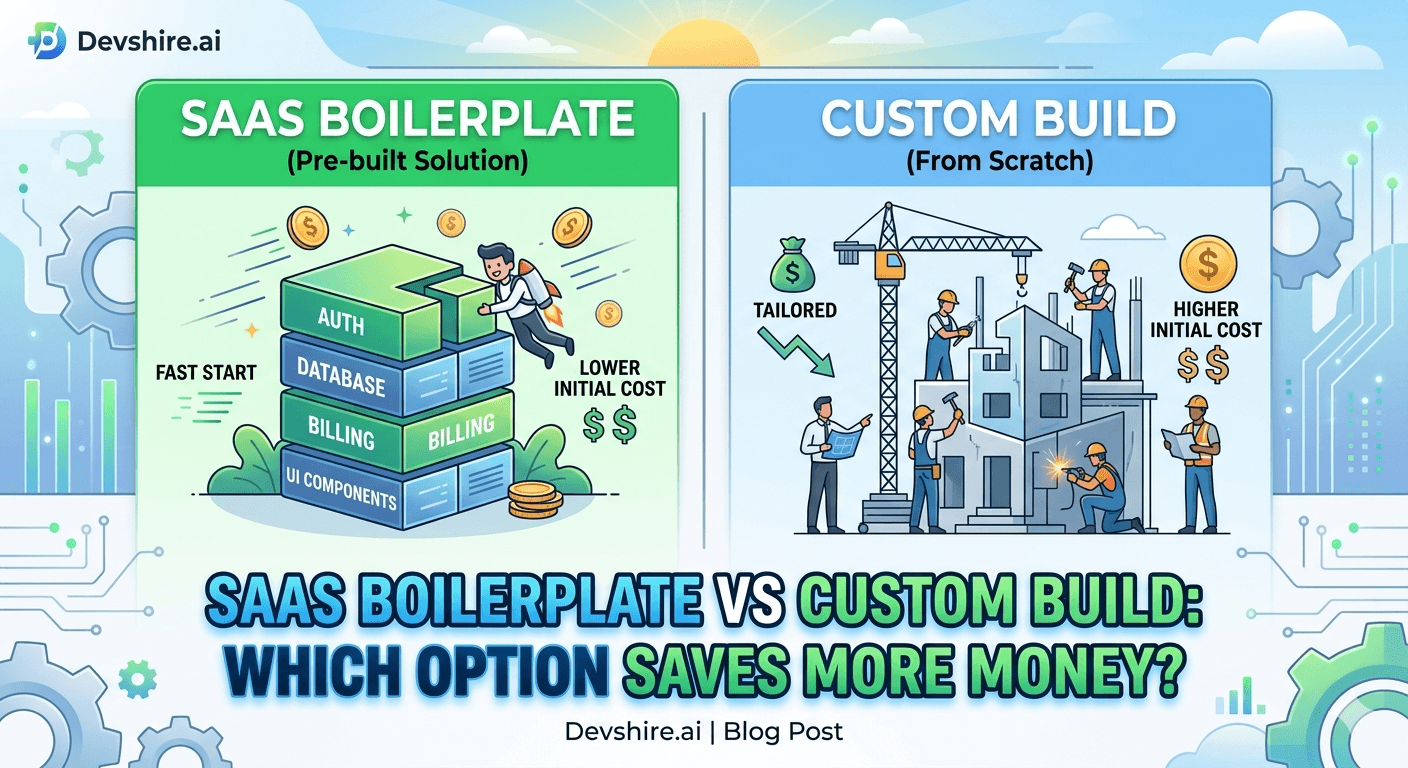
A founder quoted $18,000 for a custom SaaS build reached out last quarter. A comparable boilerplate starter — with auth, billing, database, and email pre-wired — costs $297 one time. The 60x price difference should make the decision obvious. It doesn't. Because the wrong choice isn't always the expensive one. Picking a boilerplate for a product with genuinely complex domain logic is how teams end up six months later fighting the very abstractions they paid to start with.
💡 TL;DR
If your SaaS needs auth, billing, email, and a basic dashboard — a boilerplate saves 4–8 weeks of dev time and $8,000–$25,000 in early-stage cost. If your core product logic is the infrastructure (marketplace, real-time platform, complex permissions), a boilerplate will fight you from week 3. The honest rule: boilerplates save money on the wrapper. Custom builds save money on the core. Know which one your product actually is before you decide.
The Real Cost Math — What Each Option Actually Costs
Let's put numbers on this instead of vague advice. These figures are based on what we see across early-stage SaaS teams hiring through devshire.ai in 2025–2026 — not theoretical estimates.
Cost Category | SaaS Boilerplate Path | Custom Build Path |
|---|---|---|
Upfront purchase or setup | $97–$497 one-time | $0 (but 3–6 weeks of dev time) |
Auth + billing wiring | 1–3 days | 2–4 weeks |
First feature ship | Week 2–3 | Week 5–8 |
Developer cost to MVP | $8,000–$18,000 | $22,000–$55,000 |
Customisation ceiling | Moderate — fights complex logic | Unlimited — you own everything |
Long-term maintenance | Dependency on boilerplate updates | Full control, no external deps |
The boilerplate saves $14,000–$37,000 on the MVP. That gap only closes if your custom build has a strong reason to exist — and most early-stage products don't, yet.
When Boilerplate Wins — and By How Much
Boilerplates are not shortcuts. They are pre-built foundations for the parts of SaaS that are the same across 90% of products. Auth, billing, user management, email, admin panel. These parts are solved problems. Building them yourself is not differentiation — it is reinvention.
A 3-person SaaS team building a project management tool for construction firms used Shipfast (a Next.js boilerplate at $299) as their foundation. Auth, Stripe billing, and email were live on day 3. They shipped their first paying customer at week 5. A comparable team building from scratch — same product spec — hit their first paying customer at week 13. That's 8 weeks of runway consumed on infrastructure that had nothing to do with construction project management.
✅ Your core value is in the domain logic, not the infrastructure
If users pay you for project management, analytics, or workflow automation — not for how you handle auth — a boilerplate is right. The infrastructure is undifferentiated.
✅ You need to reach your first 10 paying customers in under 90 days
Boilerplates compress MVP timelines by 4–8 weeks consistently. For pre-revenue teams, 8 weeks of runway is worth more than architectural purity.
✅ Your team is 1–3 developers
Small teams cannot afford to split attention between product work and infrastructure work simultaneously. Boilerplate handles the infrastructure so the team can focus entirely on what makes the product worth paying for.
When Custom Build Saves Money Long-Term
Here's where I'll push back on the boilerplate default: some products are the infrastructure. And for those, a boilerplate creates debt faster than it creates value.
A marketplace product — where the platform itself handles payments between buyers and sellers, complex permissioning, and real-time matching — will hit the ceiling of any boilerplate by month 2. The Stripe Connect integration alone is a specialised implementation that standard boilerplates don't cover well. The permissions system is domain-specific. The real-time features need architecture decisions the boilerplate doesn't make.
In these cases, the 4-week savings at the start becomes a 12-week refactor at month 3. The custom build was cheaper overall — it just didn't look that way at the beginning.
⚠️ Your platform model is the product
Marketplaces, multi-sided platforms, real-time collaboration tools — where the core experience IS the infrastructure. Boilerplates model single-sided SaaS. The abstraction mismatch creates friction on every feature.
⚠️ Complex permission systems from day one
Role-based access control that goes beyond admin/user/owner starts fighting most boilerplates by week 4. If your permissions model is genuinely complex — org hierarchies, resource-level permissions, conditional access — build it yourself correctly from the start.
⚠️ Enterprise-grade compliance from launch
If your target customers require SOC 2, HIPAA, or GDPR data residency from day one, verify what the boilerplate actually covers. Most don't handle audit logging, data retention policies, or regional data isolation. You'll build those anyway — just on top of a boilerplate that may or may not make them easier.
Actually — scratch the common advice that boilerplates are always faster. The speed advantage only holds if the boilerplate's architecture matches your product's architecture. When it doesn't, you spend more time fighting the boilerplate than building features.
The Leading SaaS Boilerplates in 2026 — Honestly Compared
These are the options teams actually choose, with honest trade-offs rather than feature comparison theater.
Boilerplate | Stack | Price | Best For | Honest Limitation |
|---|---|---|---|---|
Shipfast | Next.js, Stripe, MongoDB/Postgres, Resend | $299 one-time | Solo founders, first SaaS, speed to market | Opinionated structure can fight complex products |
Supastarter | Next.js or Nuxt, Supabase, Stripe | $249 one-time | Teams already on Supabase, B2B multi-tenant | Supabase-dependent — hard to migrate off |
SaaSUI | React, Next.js, Chakra UI | Free tier + $149 pro | UI-heavy products needing design system | Less opinionated backend — you wire more yourself |
Gravity | Node.js, React, Postgres | $399 one-time | Teams wanting clean architecture, not Next.js | Smaller community, less documentation |
Custom build | Your stack, your choices | $22,000–$55,000 dev cost | Complex domain logic, platform businesses | No shortcuts anywhere, longer MVP timeline |
[INTERNAL LINK: how to hire SaaS developers → hire-saas-developers]
Trusted by 500+ startups & agencies
"Hired in 2 hours. First sprint done in 3 days."
Michael L. · Marketing Director
"Way faster than any agency we've used."
Sophia M. · Content Strategist
"1 AI dev replaced our 3-person team cost."
Chris M. · Digital Marketing
Join 500+ teams building 3× faster with Devshire
1 AI-powered senior developer delivers the output of 3 traditional engineers — at 40% of the cost. Hire in under 24 hours.
The Hybrid That Most Guides Don't Mention
Most teams don't have to choose entirely between SaaS boilerplate vs custom build. The hybrid approach — which experienced teams use consistently — looks like this: use a boilerplate for the generic wrapper, but plan from day one which parts you'll replace.
Start with Shipfast for auth, billing, and email. On week one, identify the two or three features that are genuinely your product. Build those from scratch, with the architecture they actually need, while the boilerplate handles everything else. By month 3, the boilerplate parts fade into the background and your custom core drives the product. By month 6, you may rip out the boilerplate billing wrapper entirely and replace it with a custom implementation. That's fine — you validated the product first.
💡 What we've seen fail
Teams that treat the boilerplate as permanent architecture rather than a starting scaffold. Boilerplate code is not your codebase. It's scaffolding. The teams that succeed use it to get to revenue, then selectively replace the parts that don't fit their specific product. The teams that fail try to make the product fit the boilerplate forever.
[INTERNAL LINK: SaaS product roadmap planning → saas-product-roadmap-planning]
[EXTERNAL LINK: Shipfast boilerplate documentation → shipfa.st/docs]
The Bottom Line
A SaaS boilerplate saves $14,000–$37,000 in early-stage development cost and compresses MVP timelines by 4–8 weeks for standard SaaS products.
Custom builds win for platform businesses, marketplace models, and products where complex permissions or real-time architecture is the core product — not a feature on top of it.
Leading boilerplates like Shipfast ($299) and Supastarter ($249) cover auth, billing, email, and basic dashboard in days. The generic wrapper is solved. Focus dev time on what makes your product different.
The hybrid approach works best: use a boilerplate for the generic infrastructure, plan from day one which parts you'll eventually replace, and build your core product logic custom from the start.
Boilerplate code is scaffolding, not permanent architecture. Teams that fail treat it as the latter.
If your target customers need SOC 2 or HIPAA compliance from launch, verify what the boilerplate actually covers before committing — most don't handle audit logging or data residency out of the box.
Frequently Asked Questions
Is a SaaS boilerplate worth buying in 2026?
For most early-stage SaaS products, yes. A boilerplate costing $97–$497 replaces 4–8 weeks of development work on auth, billing, email, and basic infrastructure. If your core product is not the infrastructure — meaning users pay you for what the product does, not how it's built — a boilerplate is the financially sound choice. The savings on developer time alone far exceed the purchase price within the first sprint.
What is the main risk of using a SaaS boilerplate vs custom build?
The main risk is architectural mismatch. If your product has complex domain logic, unique permission models, or platform-level infrastructure requirements, the boilerplate's abstractions will fight you. You'll spend more time working around the boilerplate than building features. The risk isn't the boilerplate itself — it's choosing one when your product genuinely needs a custom foundation.
How much does it cost to build a SaaS from scratch vs using a boilerplate?
A custom build to MVP typically costs $22,000–$55,000 in developer time, depending on complexity and team rates. A boilerplate-based build typically costs $8,000–$18,000 to the same milestone, plus the boilerplate purchase at $97–$497. The gap of $14,000–$37,000 is real. It only closes if the custom build avoids a significant refactor that a mismatched boilerplate would have caused.
Can I use a boilerplate and still have a custom product?
Yes — and this is how most successful early-stage teams approach it. Use the boilerplate for generic infrastructure (auth, billing, email), and build your core domain logic custom from day one. The boilerplate handles the solved problems. Your custom code handles what makes the product worth paying for. By the time you have 100 paying customers, you'll know which boilerplate parts to replace based on real product requirements.
Which is the best SaaS boilerplate in 2026?
Shipfast is the most popular for Next.js-based SaaS products in 2026, at $299 one-time with strong community support. Supastarter is the better choice if you're building on Supabase with B2B multi-tenant requirements. Gravity suits teams that want clean Node.js architecture without Next.js constraints. The best boilerplate depends on your stack — not on feature count comparisons.
When should a startup build completely from scratch?
Build from scratch when the infrastructure IS your product. Marketplaces, multi-sided platforms, real-time collaboration tools, and highly regulated products (healthcare, fintech) with complex compliance requirements from day one. In these cases, a boilerplate's abstractions create more work than they save within the first few months. The custom build costs more at the start but avoids a painful architectural rework at month 3 or 4.
How long does it take to launch a SaaS using a boilerplate?
A focused 2-person team using a well-matched boilerplate can reach a functional product with paying customers in 4–6 weeks. The boilerplate handles auth, billing, and email in the first 2–3 days. Remaining time goes entirely to building the product's core value. Without a boilerplate, the same team typically reaches the same milestone in 10–14 weeks when building infrastructure and product simultaneously.
Are SaaS boilerplates good for enterprise products?
With caveats. Standard boilerplates handle basic multi-tenancy and role-based access, which works for many B2B products. But enterprise requirements like audit logging, SAML SSO, data residency, and SOC 2 audit trails are rarely covered out of the box. Verify what the boilerplate covers against your enterprise customer requirements before committing. Often, the gap means custom work anyway — just on top of someone else's foundation.
Not Sure Which Path Is Right for Your Product?
Devshire.ai matches early-stage SaaS founders with pre-vetted developers who've navigated the boilerplate vs custom build decision across dozens of products. Get an honest architecture assessment before you commit to either path.
No sales pitch · Architecture-first · Shortlist in 48 hrs · Median hire in 11 days
Related reading: Stripe SaaS Integration Guide 2026 · How Long Does It Take to Build a SaaS App? · SaaS Developer Hourly Rate in 2026
Related image: SaaS architecture comparison diagram — from Shipfast official documentation
Related video: "SaaS Boilerplate vs Building From Scratch" — Theo (t3.gg) YouTube channel (300K+ subscribers)







Devshire Team
San Francisco · Responds in <2 hours
Hire your first AI developer — this week
Book a free 30-minute call. We'll match you with the right developer for your project and get you started within 24 hours.
<24h
Time to hire
3×
Faster builds
40%
Cost saved