
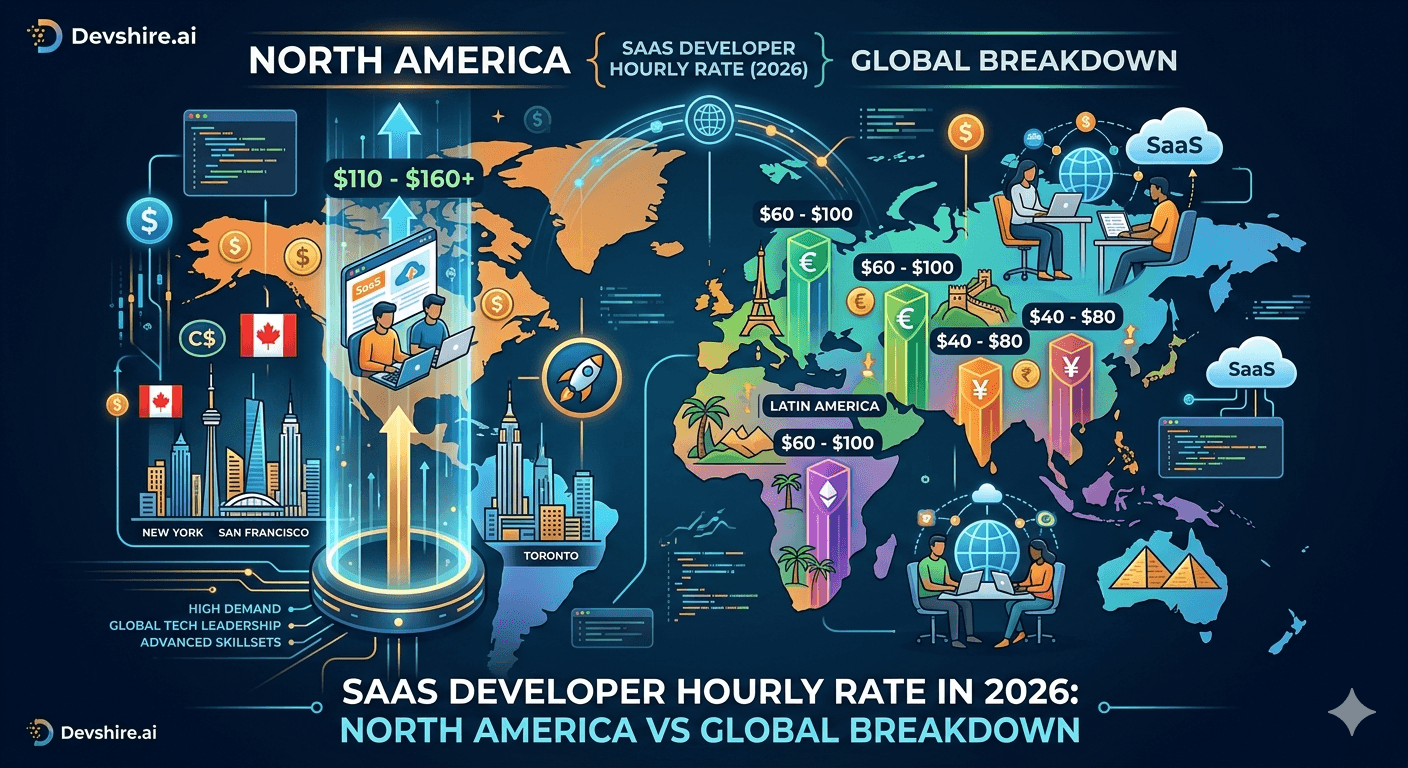
A senior SaaS developer in San Francisco costs $175/hour. The same experience level — React, Node.js, Stripe integration, multi-tenant architecture — costs $55–$75/hour in Eastern Europe and $35–$55/hour in South and Southeast Asia. That gap is real, documented, and widely used. What's less discussed is the narrowing. AI tooling has compressed output differences between markets more than rate differences. A developer in Krakow using Cursor and Claude daily ships comparable feature velocity to a San Francisco developer without AI tools — at one-third the cost.
💡 TL;DR
In 2026, senior SaaS developer rates range from $35–$55/hour (South/Southeast Asia), $50–$90/hour (Latin America), $55–$90/hour (Eastern Europe), $85–$140/hour (Western Europe), to $120–$175/hour (North America). AI tooling has compressed the output gap between markets more than the rate gap. An AI-native developer at $60/hour typically delivers higher value than a non-AI developer at $90/hour on standard SaaS features. Vet AI toolchain usage during interviews — it's now a genuine differentiator in developer productivity at every price point.
SaaS Developer Hourly Rates by Region — 2026 Data
These figures represent senior-level SaaS developers — 5+ years experience, React or Vue frontend competency, Node.js or Python backend, database design, and familiarity with SaaS infrastructure patterns. Junior and mid-level rates are typically 40–60% of these figures.
Region | Senior Rate Range | Mid-Level Range | Typical Engagement | Key Strengths |
|---|---|---|---|---|
North America (US/Canada) | $120–$175/hr | $80–$120/hr | Full-time hire or CTO-level contracts | Deepest SaaS-specific experience, same timezone, cultural alignment |
Western Europe (UK, Germany, Netherlands) | $85–$140/hr | $60–$90/hr | Agencies, contractors, EU-based product teams | Strong technical depth, good timezone overlap with US East |
Eastern Europe (Poland, Ukraine, Romania, Serbia) | $55–$90/hr | $35–$65/hr | Remote contractors, dedicated team members | Strong CS fundamentals, growing AI toolchain adoption, EU timezone |
Latin America (Argentina, Brazil, Colombia, Mexico) | $50–$85/hr | $30–$55/hr | US-timezone remote, agencies, contractors | Same or overlapping timezone with US, strong English, growing SaaS ecosystem |
South Asia (India, Pakistan, Sri Lanka) | $35–$60/hr | $20–$40/hr | Agencies, individual contractors, dedicated devs | Largest talent pool, widest rate range, strong Node.js and React supply |
Southeast Asia (Philippines, Vietnam, Indonesia) | $30–$55/hr | $18–$38/hr | Agencies, contractors, product teams | Strong English (Philippines), growing full-stack supply, US-compatible hours |
Staffing firm Toptal's 2025 compensation report placed the median rate for a senior freelance software engineer in North America at $149/hour — consistent with the range above. The global median for the same experience profile via international platforms sits at $62/hour.
[EXTERNAL LINK: Toptal developer rate guide → toptal.com/developers/hourly-rate]
What You Actually Get at Each Price Point
Rate comparison tables are only useful if they're honest about what changes as the rate changes. Here's the real breakdown — not aspirational, based on what we observe in developer performance across engagements.
💰 $30–$50/hour — High volume, inconsistent quality floor
At this range you find genuine talent — especially in South Asia and Southeast Asia — but you also find misrepresented experience levels. Vetting matters most here. Developers who are genuinely strong at this rate often move up quickly as their portfolio builds. Expect more management overhead, more code review, and a higher variance in output quality than mid-range. Best for well-specified tasks with clear acceptance criteria.
💰 $55–$85/hour — The value zone in 2026
Eastern Europe and Latin America at this rate regularly produce developers who match or exceed North American mid-level output. AI toolchain adoption is high in this cohort — Polish, Romanian, and Colombian developers consistently appear in AI-toolchain competency assessments in the top quartile. For most SaaS startups, this range delivers the best output-per-dollar, especially for product development work that requires architectural judgment alongside feature execution.
💰 $90–$140/hour — Reliable senior quality, some premium for timezone
Western European developers in this range typically bring strong computer science fundamentals, experience in complex system design, and reliable delivery. The premium over Eastern Europe is partly skill, partly timezone convenience for US teams, and partly the labour market in those regions. For lead developer or CTO-level technical work, this range is appropriate.
💰 $140–$175/hour — North American senior rate
Justified for: same-timezone embedded team members who attend standups, team leads who also manage other developers, developers with deep domain expertise in a regulated vertical (fintech, healthcare), or fractional CTOs. Not justified for standard feature development that a strong developer at $65/hour can execute with equivalent quality.
The AI Factor — Why Rate Alone Is the Wrong Metric in 2026
Here's the thing that rate comparison tables don't capture: effective output rate matters more than hourly rate when the productivity spread between AI-native and non-AI developers can reach 50% on standard SaaS work.
A developer at $60/hour using Cursor, Claude, and v0 daily ships standard React features at 1.5–2x the speed of a developer at $90/hour without AI tools. The effective cost per feature for the AI-native developer is $30–$40. For the non-AI developer, it's $90. The lower hourly rate developer delivers more features per dollar — despite costing less per hour.
In practice, this means two things:
Vet AI toolchain competency explicitly in every developer interview, regardless of region or rate. Ask to see their Cursor setup. Ask how they use Claude in their daily workflow. Ask for a recent project where AI tooling was part of the development process. Developers who can answer these specifically are genuinely AI-native. Developers who say "I use GitHub Copilot sometimes" probably aren't.
Don't assume North American rates buy proportionally more output in 2026. The tooling gap is narrower than the rate gap.
💡 The interview question that reveals AI-native developers
Ask: "Walk me through how you used AI tools on your last feature." An AI-native developer will describe a specific workflow — how they use Cursor's multi-file context, how they prompt Claude for structured output, how they use v0 for component scaffolding and then modify it. A developer who lists AI tools without being able to describe a specific workflow is not productively using them.
[INTERNAL LINK: how long to build a SaaS app → how-long-to-build-saas-app]
Freelance vs Agency vs Dedicated Developer — Rate and Trade-Off Comparison
The hiring model affects both rate and risk. Here's how the options compare for SaaS development specifically:
Model | Effective Rate | Best For | Watch Out For |
|---|---|---|---|
Independent freelancer | Quoted rate, no markup | Well-specified features, short to medium engagements | Availability gaps, single point of failure on key features |
Freelancer platform (Toptal, Upwork) | Quoted rate + platform margin (10–20%) | Vetting assistance, payment protection | Platform margin adds cost; top talent often moves off-platform |
Boutique agency | $80–$180/hr blended | Full project delivery, less management overhead | Senior rate billed, junior work delivered — verify who's actually on your project |
Dedicated remote developer (via matching service) | Developer rate, low overhead | Ongoing product work, team integration, context retention | Quality varies by matching service vetting rigour |
The boutique agency warning is worth emphasising. Most agencies bill at senior developer rates and staff projects with mid-level or junior developers once the contract is signed. The senior developer who closed the deal might spend 2 hours per week on your project. Ask explicitly who will be writing code day-to-day, and get their profiles before signing anything.
[INTERNAL LINK: how to hire a SaaS developer → hire-saas-developers]
Trusted by 500+ startups & agencies
"Hired in 2 hours. First sprint done in 3 days."
Michael L. · Marketing Director
"Way faster than any agency we've used."
Sophia M. · Content Strategist
"1 AI dev replaced our 3-person team cost."
Chris M. · Digital Marketing
Join 500+ teams building 3× faster with Devshire
1 AI-powered senior developer delivers the output of 3 traditional engineers — at 40% of the cost. Hire in under 24 hours.
Total Project Cost: Hourly Rate × Real Timeline
Hourly rate only matters in the context of the timeline it takes to ship. Here's the total cost math for building a medium-complexity SaaS (12–16 weeks, 2 developers) at different rate points:
Rate per Developer | Weekly Cost (2 devs, 40hrs) | 14-Week Total (2 devs) | 18-Week Total (if slips) |
|---|---|---|---|
$40/hr (South Asia mid) | $3,200 | $44,800 | $57,600 |
$65/hr (Eastern Europe senior) | $5,200 | $72,800 | $93,600 |
$85/hr (Latin America senior) | $6,800 | $95,200 | $122,400 |
$120/hr (North America mid) | $9,600 | $134,400 | $172,800 |
$160/hr (North America senior) | $12,800 | $179,200 | $230,400 |
The 18-week column is important. Most SaaS projects don't land at the optimistic estimate — the median slips 20–30% from plan. A project budgeted at $72,800 (2 Eastern European senior developers, 14 weeks) typically lands at $87,000–$95,000. A project budgeted at $134,400 (North American mid, 14 weeks) typically lands at $161,000–$175,000. The slip percentage is similar; the dollar impact is not.
[EXTERNAL LINK: Stack Overflow Developer Survey 2025 salary data → survey.stackoverflow.co/2025]
The Bottom Line
Senior SaaS developer rates in 2026: $35–$60/hr (South/Southeast Asia), $55–$90/hr (Eastern Europe), $50–$85/hr (Latin America), $85–$140/hr (Western Europe), $120–$175/hr (North America).
The effective value zone for most SaaS startups is $55–$85/hour — Eastern European and Latin American senior developers who combine strong fundamentals with growing AI toolchain adoption.
Vet AI toolchain competency explicitly. An AI-native developer at $60/hour can outship a non-AI developer at $90/hour on standard SaaS features. Ask candidates to walk through a specific recent workflow using Cursor or Claude — not just list the tools.
Agency blended rates of $80–$180/hour often mean junior developers executing at senior rates. Ask who writes code daily before signing. Get their profiles.
For a medium-complexity SaaS at Eastern European senior rates, budget $75,000–$95,000 for a 14–18 week build with a 2-developer team. Add 20% buffer for timeline slippage — the median project slips 20–30% from the original plan.
Frequently Asked Questions
What is the average SaaS developer hourly rate in 2026?
The global average for a senior SaaS developer in 2026 is approximately $75–$95/hour when weighted across all markets. North American rates anchor the high end at $120–$175/hour. South and Southeast Asian rates anchor the low end at $35–$60/hour. Eastern European and Latin American rates cluster at $55–$90/hour and represent the most common hiring choice for US-based startups seeking quality at a reasonable price point.
How much do SaaS developers charge per hour in North America?
Senior SaaS developers in North America charge $120–$175/hour as independent contractors. Mid-level developers charge $80–$120/hour. Junior developers charge $50–$80/hour. These rates are for freelance contractors — full-time employee total compensation (salary plus benefits plus equity) typically annualises at a rate equivalent to $85–$200/hour for the same experience levels, depending on company stage and location.
Is it worth hiring a cheaper offshore SaaS developer?
For well-specified product work with clear acceptance criteria, yes. Eastern European and Latin American senior developers at $55–$85/hour consistently deliver output comparable to North American developers at $120–$150/hour on standard SaaS features. The strongest argument against it is timezone overlap — if your team requires real-time collaboration throughout the day, the timezone gap adds friction. Latin American developers largely solve this for US-based teams. Eastern European developers have a 5–8 hour gap that most teams manage successfully with overlapping working hours.
How do I evaluate a SaaS developer before hiring?
Four-step process: technical interview with real SaaS architecture questions (how would you model multi-tenant data isolation, how would you handle webhook idempotency), AI toolchain walkthrough (ask them to describe a specific recent workflow using Cursor, Claude, or Copilot — not just list tools they know), a paid trial task (a small, well-defined feature in a test repository — 4–8 hours), and reference checks with previous SaaS clients. Skip any of these and the hire risk increases significantly.
What skills should a SaaS developer have to justify a senior rate?
At senior rate: React or Vue for frontend with Next.js or Nuxt experience, Node.js or Python backend with REST API design competency, PostgreSQL with schema design and query optimisation experience, Stripe subscription and webhook integration, multi-tenant architecture patterns, CI/CD pipeline setup and maintenance, and basic DevSecOps (environment variable management, security headers, rate limiting). Developers who claim senior rates without demonstrable experience in billing integration or multi-tenant patterns specifically are likely mid-level with senior-level ambition.
How do agency SaaS developer rates compare to freelance rates?
Agency blended rates typically run $80–$180/hour and are substantially higher than the equivalent individual freelancer rate for the same experience level. The premium covers project management, QA, backup developer coverage, and agency overhead. The risk is that the agency bills senior rates while staffing with mid-level or junior developers. Always ask for the specific developers who will work on your project, verify their experience, and get it in the contract that specific named individuals will execute the work.
How have SaaS developer rates changed in 2025–2026?
North American rates have held relatively flat compared to the 2021–2022 peak, when senior developer salaries reached historic highs following pandemic-era tech hiring. Global rates have compressed slightly as supply increased in Eastern Europe and Latin America. The more significant change is the AI productivity premium — developers who demonstrably use AI tooling daily command 10–20% premiums over comparable developers who don't, because the output difference justifies it for most product teams.
Should I hire a SaaS developer full-time or on an hourly basis?
For ongoing product development beyond 6 months, full-time or long-term contract is almost always more cost-effective than hourly. Full-time builds product context, reduces onboarding overhead, and creates ownership that hourly engagements don't. Hourly makes sense for: a specific feature or integration with a clear end point, a technical audit or architecture review, or early-stage validation before you're ready to commit to a hire. Most SaaS products benefit from at least one full-time developer embedded in the team within the first 6 months.
Find Pre-Vetted SaaS Developers at the Right Rate for Your Stage
Devshire.ai matches SaaS startups with pre-vetted developers across North America, Eastern Europe, and Latin America — screened on AI toolchain use, SaaS architecture patterns, and Stripe integration experience. Shortlist in 48–72 hours. Transparent rates, no agency markup.
No markup · AI-toolchain vetted · Global reach · Shortlist in 48 hrs · Median hire in 11 days
Related reading: How Long Does It Take to Build a SaaS App? · Best Tech Stack for Startups in 2026 · SaaS Boilerplate vs Custom Build
Stats source: [EXTERNAL LINK: Stack Overflow Developer Survey 2025 → survey.stackoverflow.co/2025]
Related image: Developer salary by region map — Stack Overflow Developer Survey 2025
Related video: "How Much Do Software Developers Make in 2026?" — Caleb Curry YouTube channel (600K+ subscribers)







Devshire Team
San Francisco · Responds in <2 hours
Hire your first AI developer — this week
Book a free 30-minute call. We'll match you with the right developer for your project and get you started within 24 hours.
<24h
Time to hire
3×
Faster builds
40%
Cost saved