
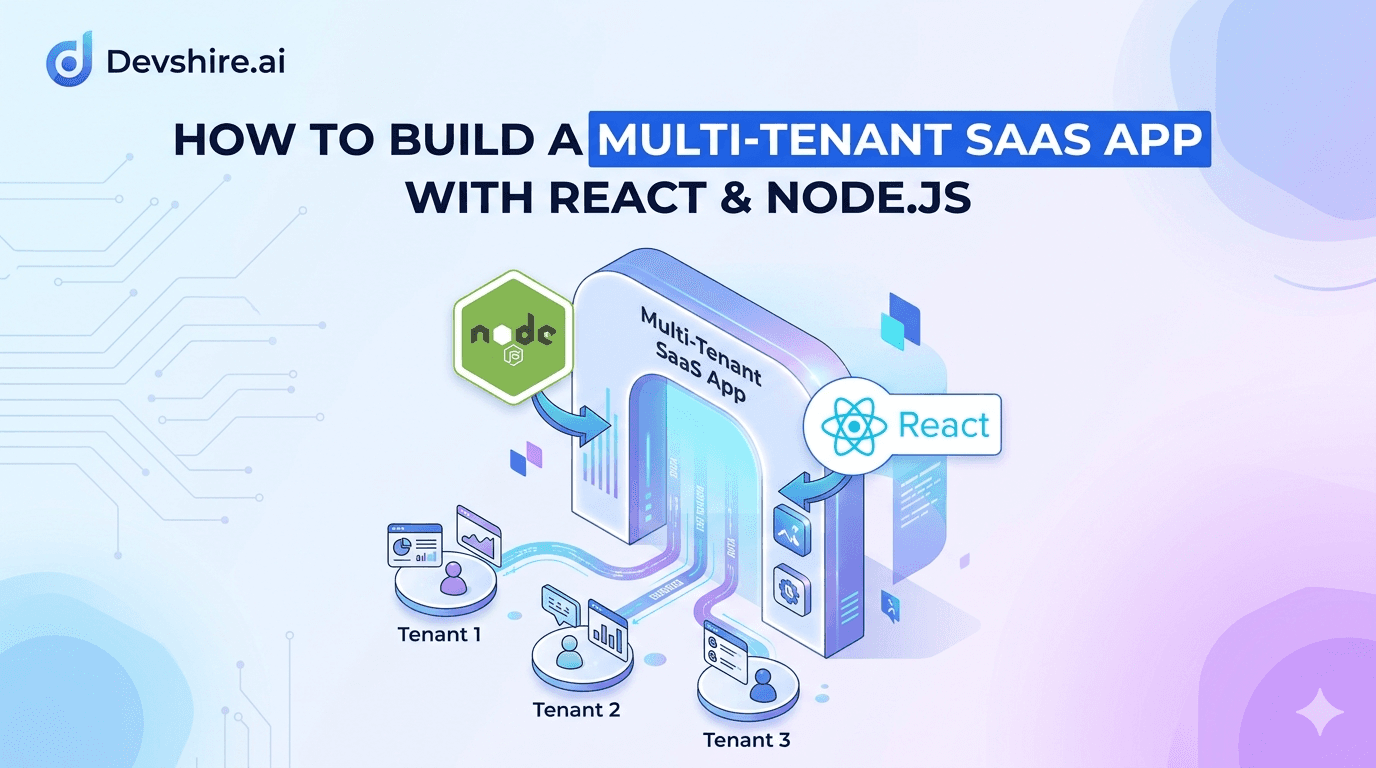
Multi-tenancy is the architectural decision that most SaaS founders get wrong — not because it is complicated, but because it is deceptively simple to implement badly. A single database with a tenant_id column on every table looks like multi-tenancy. It is not. Without row-level isolation, proper indexing on tenant_id, and middleware that enforces tenant context on every request, you have a single-tenant app with a column that creates a false sense of data isolation. Here is how to build it correctly the first time.
💡 TL;DR
The recommended multi-tenant architecture for a React plus Node.js SaaS in 2026 is shared database with row-level isolation enforced at the middleware layer. Schema-per-tenant is cleaner but operationally expensive above 100 tenants. Database-per-tenant only makes sense for enterprise-tier isolation requirements. The critical implementation details: tenant_id on every table, compound indexes on (tenant_id, primary_key), middleware that attaches tenant context before every route handler, and Prisma middleware that appends WHERE tenant_id = current_tenant to every query. AI tools — Cursor and ChatGPT — generate correct multi-tenant schemas and middleware with specific prompts.
3 Multi-Tenancy Patterns — Trade-offs in Plain English
There are three main approaches to multi-tenant data architecture. Each has a specific use case. Choosing the wrong one creates either an operational nightmare or an unnecessary rebuild later.
Pattern | How It Works | Best For | Main Downside |
|---|---|---|---|
Shared DB, row-level isolation | Single database, tenant_id on every table, enforced in middleware | Most SaaS products — 1 to 10,000 tenants | Data isolation is enforced in code — one bug leaks data across tenants |
Schema-per-tenant | Single database, separate schema namespace per tenant | Products needing strong isolation without full DB separation | PostgreSQL schema count ceiling, complex migrations |
Database-per-tenant | Separate PostgreSQL database per tenant | Enterprise tier with contractual data isolation requirements | Operationally expensive — $20 to $50 per tenant per month, complex backup |
For the vast majority of SaaS products, shared database with row-level isolation is the correct starting point. Schema-per-tenant is a reasonable step up for products with strict isolation requirements that do not yet need full database separation. Database-per-tenant should be reserved for enterprise tiers where contractual data isolation is a requirement — not offered by default.
The Data Model — What Every Table Needs
Implementing row-level isolation correctly requires three things on every table in your database. Miss any one and your isolation is incomplete.
1️⃣ tenant_id on every row
Every table that contains tenant-specific data needs a tenant_id foreign key referencing your tenants table. Not most tables — every table. The risk of missing tenant_id on a single table is a data leak where one tenant's query returns another tenant's records. Use ChatGPT to review your schema and flag any table missing tenant_id before writing any application code.
2️⃣ Compound index on (tenant_id, primary identifier)
A query like SELECT * FROM users WHERE tenant_id = $1 AND email = $2 runs at full table scan speed without an index on (tenant_id, email). Add a compound index on (tenant_id, [primary lookup field]) on every table. This is the most commonly missed performance step in multi-tenant implementations — teams add tenant_id but forget the compound index, then wonder why their query times degrade above 1,000 tenants.
3️⃣ NOT NULL constraint on tenant_id
tenant_id must be NOT NULL on every table. A nullable tenant_id means a record can exist without tenant association — which either causes query failures or, worse, returns results across all tenants when the tenant_id is null and the WHERE clause does not catch nulls correctly. Enforce NOT NULL at the schema level, not in application code.
The Tenant Context Middleware — The Most Critical Layer
Row-level isolation enforced only by individual queries is fragile. One developer writes a query without the tenant_id filter and data leaks. The correct approach is a middleware layer that attaches tenant context before every route handler and a Prisma extension that appends tenant filtering at the ORM level.
🔧 Step 1 — Tenant resolution middleware
Write a Fastify or Express middleware that runs before every route handler. It extracts the tenant identifier from the authenticated JWT token or subdomain, validates that the tenant exists and is active, and attaches the resolved tenant object to the request context. Any request that cannot resolve a valid tenant receives a 401 before the route handler runs.
🔧 Step 2 — Prisma client extension for automatic tenant filtering
Create a Prisma client extension that intercepts every findMany, findFirst, findUnique, create, update, and delete operation and automatically appends WHERE tenant_id = current_tenant_id to the query. This makes tenant isolation automatic rather than relying on individual developers to add it to every query. A single Cursor prompt generates this extension correctly for most standard Prisma schemas.
🔧 Step 3 — Integration test for tenant isolation
Write a test that creates two tenants, creates a resource in tenant A, and verifies that a request authenticated as tenant B cannot access it. This test should run in CI on every PR. If it fails, the PR does not merge. Use ChatGPT to generate the test scaffold — it handles the multi-tenant test setup pattern well with a specific prompt about the authentication and context structure.
Using Cursor and Claude to Build Multi-Tenant Architecture Faster
Multi-tenancy is a well-understood pattern, which makes it one of the areas where AI tools perform best. The implementations are predictable and the failure modes are well-documented — meaning Cursor and Claude generate correct code reliably when prompted specifically.
Task | Best Tool | Specific Prompt Pattern | Time Saved |
|---|---|---|---|
Schema design review for missing tenant_id | ChatGPT | Paste schema, ask to flag tables missing tenant_id and suggest compound indexes | 1 to 2 hours |
Prisma tenant isolation extension | Cursor | Describe the extension requirement with your exact model names and context object structure | 3 to 5 hours |
Tenant resolution middleware | Cursor | Specify JWT structure, tenant validation logic, and error response format | 2 to 3 hours |
Tenant isolation integration tests | ChatGPT | Describe auth context structure and ask for cross-tenant access test cases | 1 to 2 hours |
Cross-tenant data leak code review | Claude | Paste all route handlers, ask to identify queries missing tenant_id filter | 2 to 4 hours |
Trusted by 500+ startups & agencies
"Hired in 2 hours. First sprint done in 3 days."
Michael L. · Marketing Director
"Way faster than any agency we've used."
Sophia M. · Content Strategist
"1 AI dev replaced our 3-person team cost."
Chris M. · Digital Marketing
Join 500+ teams building 3× faster with Devshire
1 AI-powered senior developer delivers the output of 3 traditional engineers — at 40% of the cost. Hire in under 24 hours.
Tenant Onboarding Flow — What Happens When a New Tenant Signs Up
The tenant onboarding flow is the sequence of operations that run when a new customer creates an account. Getting this right is critical — it creates the root tenant record that all subsequent data isolation depends on.
📋 Step 1 — Create tenant record atomically with the owner user
The tenant and its first user (owner) must be created in a single database transaction. If the tenant is created but the user creation fails, you have an orphaned tenant with no owner. Use Prisma's transaction API to wrap both operations. If either fails, both roll back. Use Cursor to generate this transaction pattern — it handles Prisma transaction syntax correctly with a specific prompt.
📋 Step 2 — Generate tenant slug for subdomain routing
Multi-tenant SaaS products typically route tenant context via subdomain (tenant-name.yourapp.com) or via a path prefix (/app/tenant-name). Generate the slug from the company name provided at signup, enforce uniqueness, and handle conflicts with an incrementing suffix. This logic is simple but tedious — Cursor generates it correctly in under 5 minutes with a specific prompt about your naming rules.
📋 Step 3 — Seed default data for the new tenant
Most SaaS products have default configuration, role definitions, or template data that should exist for every new tenant. Create a tenant seeding function that runs after successful tenant creation. Keep it idempotent — safe to run multiple times on the same tenant without creating duplicates. This function becomes important when you add features that require new default data for existing tenants.
The Bottom Line
Shared database with row-level isolation is the correct architecture for most SaaS products. Schema-per-tenant is a reasonable step up. Database-per-tenant is for enterprise contractual requirements only.
Every tenant-specific table needs three things: NOT NULL tenant_id foreign key, compound index on (tenant_id, primary lookup field), and inclusion in the Prisma client extension that auto-appends tenant filtering.
Prisma client extension that auto-appends WHERE tenant_id to every operation is the correct isolation mechanism — not relying on individual developers to add it per query.
Write a cross-tenant access test that runs in CI on every PR. If it fails, the PR does not merge. This is the single most effective safeguard against data leaks in multi-tenant systems.
AI tools — Cursor for implementation, ChatGPT for schema review and test generation, Claude for cross-tenant leak detection in existing code — cut multi-tenant implementation time by 50 to 70%.
Tenant and owner user creation must be atomic in a single Prisma transaction. An orphaned tenant with no owner is a silent failure that creates data integrity problems downstream.
Frequently Asked Questions
What is the best multi-tenancy architecture for a SaaS app in 2026?
Shared database with row-level isolation enforced at the middleware and ORM level is the recommended starting point for most SaaS products. It scales efficiently from 1 to 10,000 tenants, is operationally simple, and supports fast feature development. Schema-per-tenant is appropriate when contractual isolation is required but full database separation is too expensive. Database-per-tenant should be reserved for enterprise tiers with specific contractual data isolation requirements.
How do I prevent data leaks between tenants in a shared database?
Three layers of protection: tenant_id NOT NULL on every table, a Prisma client extension that automatically appends WHERE tenant_id to every query, and a cross-tenant access integration test in CI that fails any PR that allows tenant B to access tenant A's data. Relying on individual developers to add tenant_id filtering to every query is not sufficient — the ORM-level extension is the correct safeguard.
How do I implement multi-tenancy in Node.js with Prisma?
Create a Prisma client extension that intercepts all read and write operations and appends tenant context automatically. Write Express or Fastify middleware that resolves the tenant from the JWT token or subdomain before every request and attaches it to the request context. The Prisma extension uses AsyncLocalStorage or a context object passed from the middleware. Use Cursor with a specific prompt about your JWT structure and Prisma model names to generate both components.
What database indexes are needed for a multi-tenant SaaS app?
Every tenant-scoped table needs a compound index on (tenant_id, [primary lookup field]) — for example, (tenant_id, email) on a users table, (tenant_id, slug) on a resources table. Without compound indexes, queries filtered by tenant_id and a secondary field require full table scans. This causes severe query degradation above 1,000 tenants. Add these indexes during schema design, not as a performance fix after the problem appears.
Hire Developers Who Build Multi-Tenant SaaS Right the First Time
Every developer in the devshire.ai network has been screened on multi-tenant architecture patterns, Prisma data isolation, and AI-assisted implementation with Cursor and Claude. No re-architects at month 4. No data leaks from missing tenant filters. Shortlist in 48 to 72 hours.
Find Your SaaS Architecture Developer ->
Multi-tenant expertise tested · Cursor + Prisma specialists · Shortlist in 48 hrs · Freelance and full-time
About devshire.ai — devshire.ai pre-vets developers on SaaS architecture patterns including multi-tenancy, Prisma, and React plus Node.js stacks. Start hiring ->
Related reading: Best Tech Stack for Startups in 2026 · Stripe Integration for SaaS: Complete Developer Guide 2026 · SaaS Security Best Practices Every Dev Team Must Implement · API-First Development: Why Modern SaaS Products Are Built This Way







Devshire Team
San Francisco · Responds in <2 hours
Hire your first AI developer — this week
Book a free 30-minute call. We'll match you with the right developer for your project and get you started within 24 hours.
<24h
Time to hire
3×
Faster builds
40%
Cost saved