
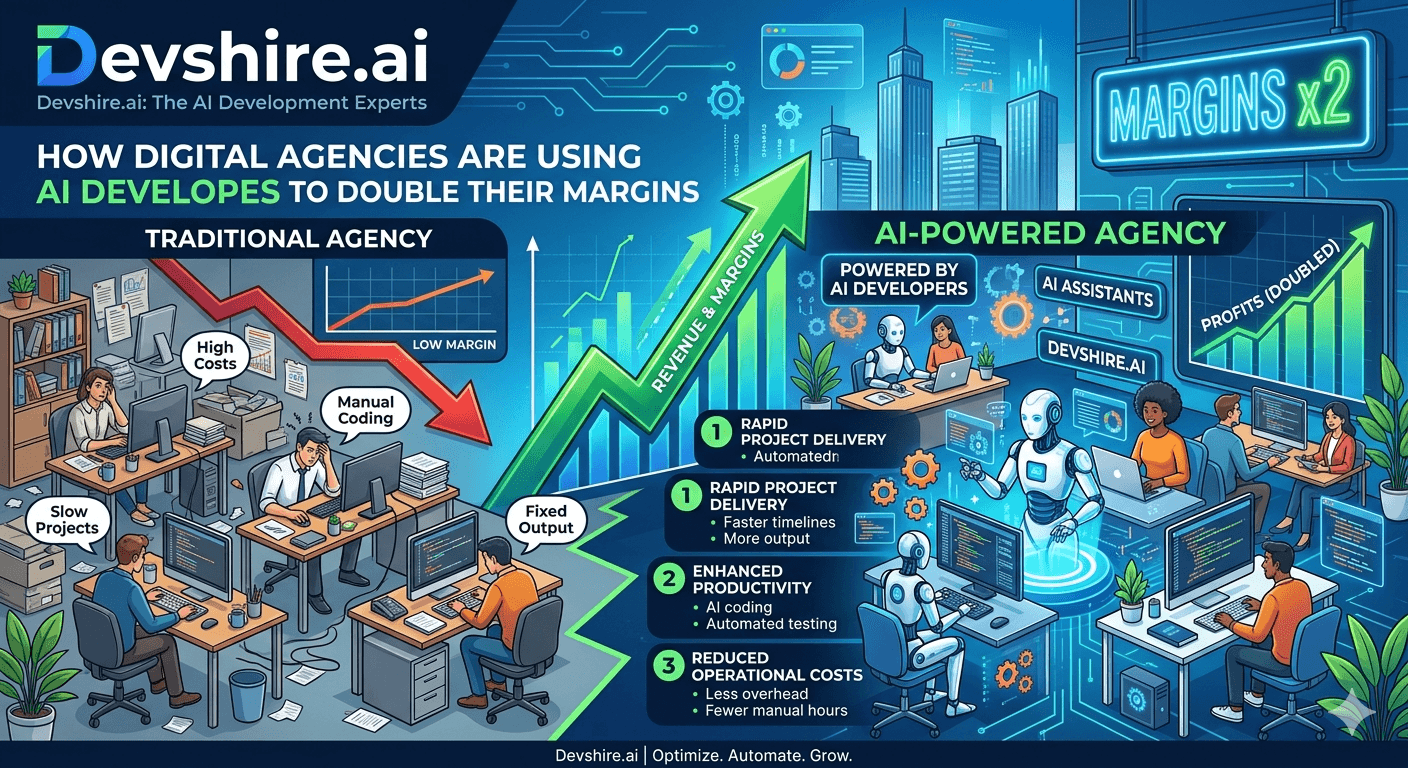
A 6-person digital agency in Austin doubled their net margin from 18% to 37% in one quarter. They didn't raise prices. They didn't fire anyone. They replaced two traditional developers with one AI-powered developer through Devshire.ai, restructured delivery around that developer's 3× output velocity, and kept billing clients the same rate. The math was that simple — and that uncomfortable for agencies still running the traditional headcount model.
💡 TL;DR
Digital agencies are doubling margins in 2026 by replacing traditional developers with AI-powered developers who ship 2–3× faster. The model: bill clients at traditional market rates ($100–$150/hr), pay Devshire.ai developers at $60–$110/hr, and absorb the difference as margin rather than passing it to clients. A single AI-powered senior developer replaces a 2–3 person traditional dev team on most agency project types. Agencies running this model are seeing 30–45% net margins vs the industry standard of 15–22%. The window to implement this before competitors do is closing fast.
The Margin Math: Why AI Developers Change Agency Economics
Traditional agency development economics look like this. You hire a senior developer at $120,000/yr ($62/hr cost). You bill them to clients at $140/hr. Your gross margin on that developer is 55%. After project management, tools, and overhead, net margin on development services runs 15–22% for most agencies.
The AI developer model changes two variables. First, cost: an AI-powered developer on Devshire.ai runs $90–$110/hr for a senior profile. Second, and more importantly, output: that developer ships 2–3× faster than a traditional developer on most agency project types — React builds, SaaS integrations, Shopify customisation, API development.
You still bill clients $140/hr. The developer still works 40 hours per week. But instead of delivering 40 hours of traditional development output, you're delivering 80–120 hours of equivalent output. You can take on more client work without adding headcount — or you can deliver the same work faster, reducing your own internal time investment per project and freeing the team for new clients.
Model | Dev Cost/Hr | Client Rate/Hr | Output Multiplier | Effective Margin |
|---|---|---|---|---|
Traditional 2-dev team | $62/hr × 2 = $124/hr | $280/hr (2 devs) | 1× | ~19% |
1 AI-powered dev (Devshire) | $100/hr | $280/hr (same billing) | 2.5–3× | 64% |
How Agencies Structure the AI Developer Model
There are three ways agencies are implementing this in 2026. Each has different risk profiles and margin outcomes.
✅ Model 1: Replace headcount on existing projects
The most straightforward approach. A project previously requiring 2 traditional developers is reassigned to 1 AI-powered developer from Devshire. Client billing stays the same — they're paying for deliverables, not headcount. The agency captures the difference as margin. This model works best when your client contracts are outcome-based rather than time-and-materials. T&M contracts require more communication about how the team composition has changed.
✅ Model 2: Take on more clients with same headcount
Instead of reducing dev headcount, the agency keeps the same number of developers but adds capacity by bringing in an AI-powered developer from Devshire specifically for overflow work. One AI-powered developer handles the capacity of 2 traditional developers — allowing the agency to take on a second or third parallel client without a full-time hire. This is the lower-risk entry point because it's additive rather than disruptive to existing team structure.
✅ Model 3: Productise delivery with AI-accelerated packages
Some agencies have gone further — packaging deliverables that used to take 6 weeks into 2-week AI-accelerated sprints, at a slight price reduction that still yields higher margin. A "2-week MVP sprint" at $12,000 that an AI-powered developer completes in 10 days costs $1,000 in development time and yields $11,000 in gross margin. The margin is only possible because of the velocity. This model requires strong scoping discipline but generates the highest margins of any agency structure.
Which Project Types Work Best With AI Developers
Not every agency project type benefits equally from AI-powered development. Here's an honest breakdown of where the velocity gains are real and where they're overstated.
Project Type | AI Dev Velocity Gain | Why | Agency Margin Opportunity |
|---|---|---|---|
React/Next.js web apps | 2.5–3× | Cursor + v0 generates components at speed | Very High |
Shopify custom themes | 2–2.5× | AI excels at Liquid templating + Tailwind | High |
SaaS API integrations | 2–3× | Claude generates integration boilerplate fast | Very High |
WordPress customisation | 1.5–2× | Older codebase, less AI tooling optimised | Medium |
Mobile app development | 2–2.5× | React Native + AI generates screens quickly | High |
Legacy system maintenance | 1–1.5× | Old codebases limit AI tool effectiveness | Low |
Data/analytics dashboards | 2.5–3× | AI generates chart components and queries fast | Very High |
3 Mistakes Agencies Make When Switching to AI Developers
The model works — but getting the implementation wrong erodes the margin gains you're expecting. These are the three most common failure modes.
❌ Passing the cost savings to clients instead of capturing margin
This is the most expensive mistake. An agency that moves to AI developers and immediately drops their client rates by 30% has done all the operational work of the transition and captured none of the financial benefit. Clients don't know — and don't need to know — that your delivery model has changed. Your rates are based on the value you deliver, not your cost structure. Keep your rates. Capture the margin.
❌ Underestimating the QA requirement for AI-generated code
AI-powered developers using Cursor and Claude produce code faster, but the volume of code increases too. QA needs to scale with output. Agencies that don't build in a proper QA layer for AI-assisted development end up shipping bugs at a rate that erodes client relationships faster than the margin gains justify. Budget for QA explicitly: roughly 15–20% of development time for review and testing on AI-accelerated projects.
❌ Hiring AI developers on fixed-price projects without tight scoping
AI developers move fast — which means scope creep happens faster too. A 2-week project can expand to a 4-week project at 2× speed if the scope isn't locked. The discipline required: fixed scope, defined acceptance criteria, change order process for everything outside the original brief. Agencies that implement this discipline on AI-accelerated projects see significantly higher margin consistency than those that don't.
Trusted by 500+ startups & agencies
"Hired in 2 hours. First sprint done in 3 days."
Michael L. · Marketing Director
"Way faster than any agency we've used."
Sophia M. · Content Strategist
"1 AI dev replaced our 3-person team cost."
Chris M. · Digital Marketing
Join 500+ teams building 3× faster with Devshire
1 AI-powered senior developer delivers the output of 3 traditional engineers — at 40% of the cost. Hire in under 24 hours.
The Bottom Line
Digital agencies using AI-powered developers from platforms like Devshire.ai are seeing net margins of 30–45% vs the industry standard of 15–22% — without raising client rates.
The mechanism is simple: 1 AI-powered developer replaces 2 traditional developers on most agency project types, at a slightly higher hourly rate, with 2–3× the output velocity. The margin differential is captured, not passed to clients.
React/Next.js apps, Shopify themes, and SaaS API integrations see the highest AI developer velocity gains (2.5–3×). Legacy system maintenance sees the lowest (1–1.5×).
The three implementation mistakes that kill the margin gains: passing savings to clients, not scaling QA with AI output volume, and allowing scope creep on fixed-price projects.
The lowest-risk entry point: bring in one Devshire AI developer for overflow or a new client project. Test the velocity gains without disrupting existing team structure. Then decide whether to expand the model.
The window to implement this model before your agency competitors do is measured in months, not years. Agencies already running this model are winning pitches on speed and price simultaneously.
Frequently Asked Questions
How do digital agencies use AI developers to increase profit margins?
By replacing 2 traditional developers with 1 AI-powered developer who delivers equivalent or higher output, while billing clients at the same rate. The cost reduction goes to margin rather than client discounts. Agencies on Devshire.ai pay $90–$110/hr for a senior AI-powered developer who delivers 2–3× the output of a traditional developer — the effective margin per project improves by 15–25 percentage points.
Should I tell my clients I'm using AI developers?
You're not required to, but transparency builds trust. Most sophisticated clients don't care who builds their product as long as it's built well and on time. If asked, being honest about using AI-tool-proficient developers is straightforward — frame it as a capability advantage, not a cost-cutting measure. "Our developers use AI tools to ship faster and catch more bugs" is true and compelling, not something to hide.
What type of agency work is best suited for AI-powered developers?
React/Next.js web applications, Shopify theme customisation, SaaS API integrations, and analytics dashboards see the highest velocity gains — 2.5–3× in most cases. Legacy system maintenance and heavily customised CMS work see more modest gains (1.5–2×) because older codebases are less amenable to AI tooling. Start with your most modern-stack projects for the clearest margin improvement.
How quickly can I get an AI developer from Devshire for my agency?
Within 24–48 hours. Submit your requirements, get a vetted shortlist, choose your developer, and start with a 1-week free trial. Most agency projects can have an AI-powered developer committed and onboarded within 48 hours of the initial request. This speed matters for agencies that win client projects on a Tuesday and need to start delivery by Thursday.
What is the typical net margin for a digital agency in 2026?
The industry average for digital agency net margin sits at 15–22% for traditional delivery models. Agencies that have fully transitioned to AI-powered development are reporting 30–45% net margins on development services — with the variance determined mainly by how well they've structured fixed-price contracts and QA processes. The margin improvement is real but requires operational discipline to capture consistently.
Start Doubling Your Agency Margins — First Developer Free for 1 Week
Devshire.ai places pre-vetted AI-powered developers with digital agencies in under 24 hours. Test one developer on your next client project — free for 1 week. See the output velocity yourself before committing. Most agencies that test the model don't go back.
Start Your Free 1-Week Trial →
Senior AI developers from $90/hr · First week free · Hire in <24 hours · No minimum commitment
About Devshire.ai — Devshire.ai helps digital agencies increase delivery margins by placing AI-powered developers who ship 3× faster using Cursor, Claude, and GitHub Copilot. Start with a free 1-week trial. Start hiring →
Related reading: How to Hire AI Developers in 2026 · White-Label Development: Deliver Client Projects With AI Devs · How to Scale a Web Agency Without Hiring Full-Time Staff · Subcontracting Developers: How Agencies Add Capacity Without Risk · How to Deliver a 4-Week Project in 10 Days Using AI Devs · Browse Pre-Vetted AI Developers →







Devshire Team
San Francisco · Responds in <2 hours
Hire your first AI developer — this week
Book a free 30-minute call. We'll match you with the right developer for your project and get you started within 24 hours.
<24h
Time to hire
3×
Faster builds
40%
Cost saved