
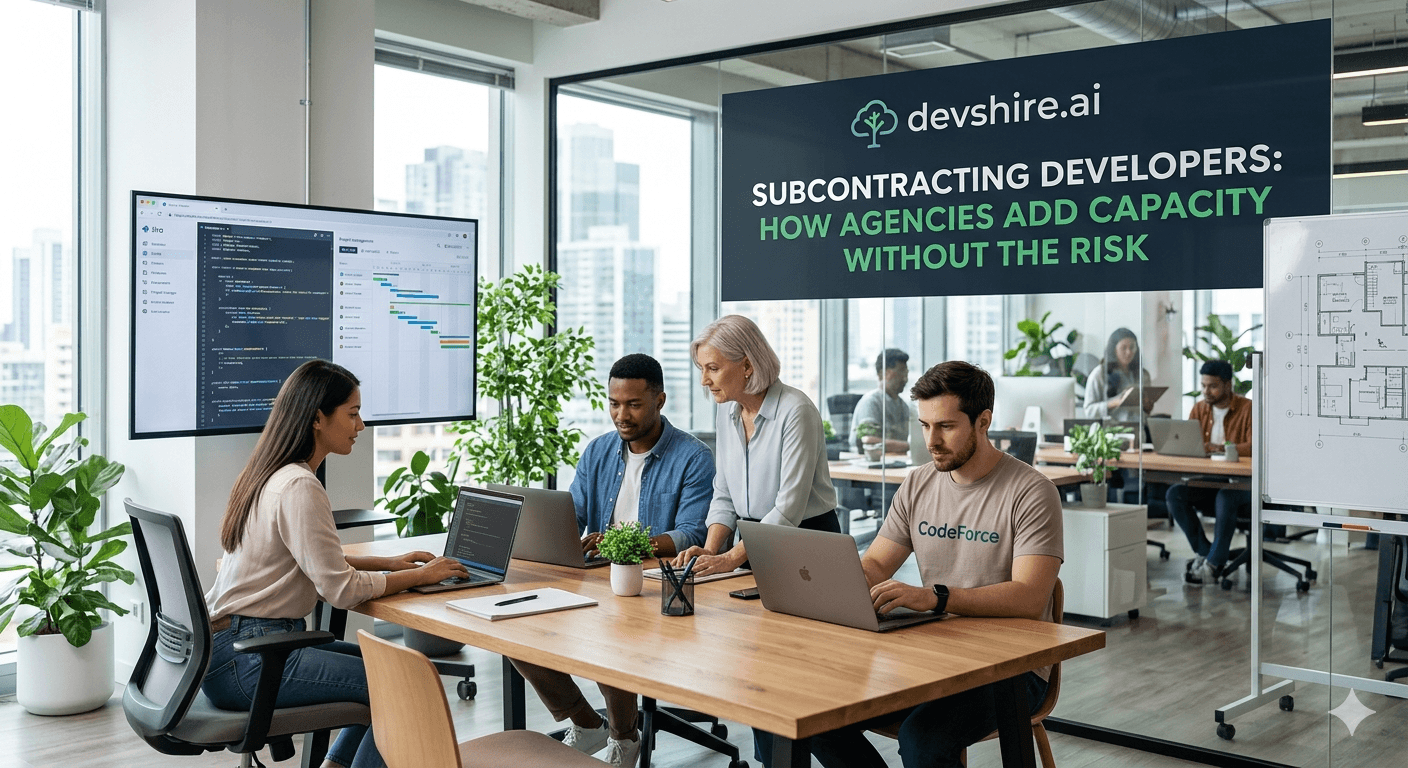
Subcontracting is how most agencies actually survive growth spurts. You win a project that's 30% bigger than your current capacity, you bring in a subcontractor to cover the gap, you deliver, you pocket the margin. Done right, it's the cleanest scaling mechanism in professional services. Done wrong — wrong developer, no contract, no review process — it costs you a client relationship and a reputation. In 2026, AI-powered developers have made subcontracting significantly cleaner, faster, and more margin-positive than it's ever been.
💡 TL;DR
Agencies subcontract developers to add capacity without full-time hiring risk. The model works when you have three things: a clear subcontractor agreement (NDA, IP assignment, no-poach clause), a review process so the subcontractor's work meets your quality standard, and a reliable source of vetted developers you can place quickly. Devshire.ai developers are pre-vetted for agency contexts — they work inside your project management tools, maintain async communication standards, and ship under your QA oversight. Typical agency margin on subcontracted AI-developer projects: 35–50% gross vs 15–25% with traditional subcontractors.
The Subcontractor Agreement — What You Need Before Work Starts
This is the part most agencies skip in a rush to start the project — and the part that becomes critical when something goes wrong. Three clauses are non-negotiable in any developer subcontractor agreement.
📄 NDA and confidentiality
The subcontractor will have access to your client's codebase, data, and business context. An NDA protects that information if the relationship ends — and it protects you if a client asks who had access to their systems. Keep the NDA broad: it should cover the client's identity, the nature of the project, and any business information shared during the engagement. Standard NDA templates are widely available; have a lawyer review once and reuse across all subcontractor relationships.
📄 IP assignment
Every line of code the subcontractor writes on your client's project must be owned by your agency (or passed through to the client per your main contract). Without an IP assignment clause, a subcontractor technically owns the code they wrote — which creates a legal ambiguity you don't want to navigate. One sentence: "All work product created under this agreement is work-for-hire and assigned to [Agency Name] upon creation." Get it signed before the first commit.
📄 No-direct-contact and no-poach clause
A no-direct-contact clause prevents your subcontractor from pitching services directly to your client. A no-poach clause prevents your client from hiring the subcontractor directly. Both are standard and enforceable in most jurisdictions. Both should have a defined time period — 12–24 months post-engagement is typical. These clauses are not aggressive; every professional subcontractor expects them.
The Subcontracting Margin Model With AI Developers
Traditional subcontracting margin is thin — typically 15–25% gross when you're subcontracting traditional developers. You pay the developer $70–90/hr, you bill the client $100–120/hr, and the spread is your gross margin before overhead.
AI-powered developers change this model. A Devshire developer at $100/hr who ships 2.5× faster than a traditional developer gives you the same client billing at a lower effective cost per feature — because you're paying for fewer hours to deliver the same scope. The gross margin on the same project expands to 35–50%.
Scenario | Dev Cost | Hours to Deliver | Total Dev Cost | Client Billing | Gross Margin |
|---|---|---|---|---|---|
Traditional subcontractor | $70/hr | 80 hrs | $5,600 | $8,000 | 30% |
AI developer (Devshire) | $100/hr | 32 hrs | $3,200 | $8,000 | 60% |
The same scope. The same client billing. The AI developer delivers in 32 hours what the traditional subcontractor delivers in 80. Your gross margin doubles — not because you raised rates, but because the developer shipped faster.
Finding Subcontract Developers Who Don't Cause Problems
The subcontracting horror stories agencies tell usually come down to one of three things: a developer who went quiet mid-project, a developer whose code quality didn't survive a client review, or a developer who contacted the client directly and created an uncomfortable situation. All three are preventable with the right sourcing approach.
Freelance marketplaces like Upwork give you volume but require significant evaluation time — reviewing portfolios, running test tasks, assessing communication style. For agencies that need developers quickly, this process takes too long and has too much variance.
Pre-vetted platforms like Devshire.ai compress the sourcing process. Every developer has already been evaluated on technical quality, communication professionalism, and agency-context experience. You get a shortlist within 24–48 hours. The 1-week free trial period is your final check — the developer works in your project management tools, on a real part of the project, under your review. By Day 3, you know whether they're the right fit.
Most agencies that find a strong Devshire developer maintain that relationship across multiple projects — the developer learns your stack, your standards, and your clients' context over time. That compounding familiarity is worth more than it appears on a per-project basis.
Quality Control: The Review Process That Protects Your Agency
Your subcontractor's code is your agency's code when it reaches the client. A quality issue that your subcontractor introduced is a quality issue you're accountable for — regardless of who wrote it. Your review process is the protection between the two.
Three review touchpoints work for most agency subcontracting arrangements: a mid-sprint staging review every 3–4 business days (click through the staging build, check against the brief), a weekly PR review from your senior developer (they don't need to review every line, just flag structural issues), and a final UAT pass before client delivery where you test every user-facing flow against the acceptance criteria.
Honestly — most quality issues in subcontracting come from a brief that wasn't specific enough, not from a developer who wasn't skilled enough. Before blaming a subcontractor for a quality issue, check the brief they were given. If it said "build the user dashboard," the developer did what they could. If it said "build a user dashboard with: revenue chart (last 30 days, line chart, Recharts), active subscription count (top right card), and last 5 transactions (table with date, amount, status)," the developer had something to build to.
Trusted by 500+ startups & agencies
"Hired in 2 hours. First sprint done in 3 days."
Michael L. · Marketing Director
"Way faster than any agency we've used."
Sophia M. · Content Strategist
"1 AI dev replaced our 3-person team cost."
Chris M. · Digital Marketing
Join 500+ teams building 3× faster with Devshire
1 AI-powered senior developer delivers the output of 3 traditional engineers — at 40% of the cost. Hire in under 24 hours.
The Bottom Line
Three legal clauses are non-negotiable before any subcontractor starts work: NDA and confidentiality, IP assignment, and no-direct-contact plus no-poach. Get them signed before the first commit, not after.
AI-powered developer subcontracting generates 35–60% gross margin vs 15–30% with traditional subcontractors — because the velocity advantage reduces the hours required to deliver the same scope.
Pre-vetted platforms like Devshire.ai compress the sourcing process to 24–48 hours and eliminate the most common subcontracting problems: communication failure, quality inconsistency, and unprofessional client behaviour.
Three review touchpoints protect your agency's reputation: mid-sprint staging review, weekly PR review from your senior developer, and final UAT before client delivery.
Brief quality is the root cause of most subcontractor quality issues — not developer skill. A specific, acceptance-criteria-based brief consistently produces better output than a vague one from a stronger developer.
Maintain ongoing relationships with developers who've performed well on past projects. The familiarity they build with your stack and standards over multiple engagements compounds into significantly faster delivery and fewer QA issues.
Frequently Asked Questions
What is the difference between subcontracting and staff augmentation for agencies?
Staff augmentation means adding a developer who works as part of your team, under your direction, on your processes. Subcontracting typically means assigning a developer to a specific deliverable or project scope. In practice, the distinction blurs — most agency "subcontracting" through Devshire looks like staff augmentation: the developer works inside your tools, under your PM's direction, on your client's project. The legal structure (subcontractor agreement vs employment) is the main difference.
Do I need a contract for every developer I subcontract?
Yes — always, no exceptions. You need at minimum: an NDA, an IP assignment clause, and a no-direct-contact clause. These don't need to be complex — a 1-page subcontractor agreement covering these three points is sufficient for most agency relationships. Platforms like Devshire.ai have standard agreements built into the engagement structure, which reduces the legal friction of the process significantly.
How do I prevent a subcontractor from contacting my clients directly?
Include a no-direct-contact clause in your subcontractor agreement — a standard clause stating that the subcontractor will not contact, pitch to, or enter into a business relationship with your client for a defined period (typically 12–24 months post-engagement). Also maintain your position as the communication intermediary: the subcontractor communicates with you, not the client. If a client asks to speak directly to a developer, handle it on your terms — a brief call with your account manager present is fine, an unmediated direct relationship is not.
What is the typical margin on subcontracted development work?
With traditional subcontractors, gross margin on development work runs 15–30% depending on the rate spread between what you pay the developer and what you charge the client. With AI-powered developers from Devshire.ai, the margin improves to 35–60% — because AI developers ship 2–3× faster, reducing the hours required to deliver the same scope without reducing the client billing amount.
What happens if a subcontractor's work quality doesn't meet standards?
If the issue is caught during your review process (as it should be), the developer addresses it before client delivery. If it reaches the client and fails review, you address it with the client on your account — it's your project, not the subcontractor's. Then review what happened in your brief and QA process. The root cause is usually an insufficiently specific brief or a missed review touchpoint, not a fundamentally incompetent developer. Address both before the next engagement.
Can I use AI developers as subcontractors for long-term client retainers?
Yes — many agencies run Devshire developers on 3–6 month retainers for ongoing client work. The developer builds familiarity with the client's codebase and standards over time, which reduces QA overhead and improves output quality sprint-over-sprint. Set a defined review period at the 3-month mark to assess the engagement and decide whether to continue, adjust, or transition. Don't let long-running subcontractor relationships drift without a periodic explicit check-in on both sides.
Add Subcontract Developer Capacity to Your Agency in 24 Hours
Devshire.ai places pre-vetted AI-powered developers inside agency projects within 24 hours — with subcontractor agreements included in the platform structure. Start with a free 1-week trial. Ship your next client project faster, at higher margin, without the full-time hire.
Start Your Free 1-Week Trial →
Agency-ready AI developers · Subcontractor agreements included · Senior from $90/hr · First week free
About Devshire.ai — Devshire.ai provides pre-vetted AI-powered developers for agency subcontracting — with agreements, vetting, and placement handled in under 24 hours. Start hiring →
Related reading: How Digital Agencies Are Using AI Developers to Double Their Margins · White-Label Development: Deliver Client Projects With AI Devs · How to Scale a Web Agency Without Hiring Full-Time Staff · Staff Augmentation vs Managed Dev Team · Red Flags When Hiring a Freelance Developer · Browse Pre-Vetted AI Developers →







Devshire Team
San Francisco · Responds in <2 hours
Hire your first AI developer — this week
Book a free 30-minute call. We'll match you with the right developer for your project and get you started within 24 hours.
<24h
Time to hire
3×
Faster builds
40%
Cost saved