
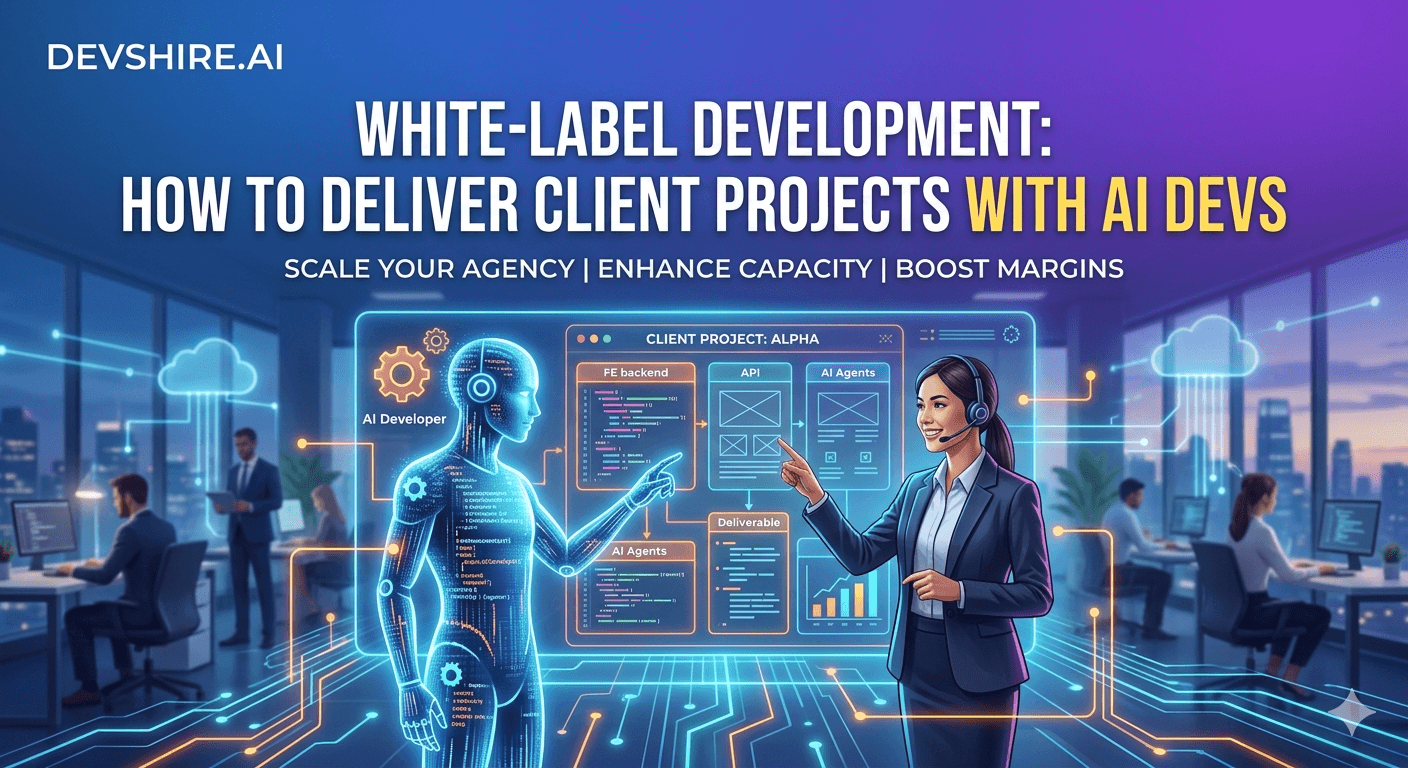
White-label development has existed for decades. An agency takes on client work, outsources the actual build to a third-party developer or team, and delivers it under their own brand. The client never knows. The agency takes the margin. It works — when the quality is consistent and the developer communicates like a team member. In 2026, AI-powered developers have made this model significantly more reliable, faster, and more profitable than it's ever been.
💡 TL;DR
White-label development with AI developers works when you source developers through a platform that vets communication style and professionalism alongside technical skill — because your client is interacting with your brand, not theirs. Devshire.ai developers are remote-native, async-first, and experienced working inside agency structures. The model: you handle the client relationship and project scoping, the Devshire developer handles the build, you review and deliver. Typical agency margin on white-label development using AI devs: 35–55% gross margin vs 15–25% with traditional outsourcing.
How White-Label Development With AI Developers Actually Works
The model has four stages. Most agencies get the first two right and the third one wrong — which is where client relationships break down.
Stage 1: Client scoping (you own this)
You run the discovery call. You write the brief. You set the timeline and budget with the client. The developer sees the brief, not the client. This stage is critical because the quality of your brief determines the quality of the developer's work. A vague brief produces vague output — and you're the one who has to explain it to the client.
Stage 2: Developer assignment (Devshire handles this)
You post the brief to Devshire.ai. Within 24–48 hours, you have a vetted shortlist. You select the developer who matches your tech stack and project type. They start with a free 1-week trial — which also functions as a project kickoff sprint. In that first week, you see the code quality, the communication style, and the delivery pace. Most agencies know by Day 3 whether this developer is the right fit for the account.
Stage 3: Development and review (the one most agencies underinvest in)
The developer builds. You review. The review is the stage most agencies underinvest in — either because they're not technical enough to evaluate the code or because they assume the developer will self-correct. Neither works reliably. Build a review checkpoint into every sprint: PR review every 2–3 days, a staging environment demo every week. You don't need to read every line of code, but you do need to click through the staging build and evaluate the UX against the client's brief.
Stage 4: Client delivery (you own this too)
You present the work to the client as your agency's output. The developer is not on the client call unless your model involves transparent outsourcing. Most white-label arrangements keep the developer invisible to the client — which is standard practice and entirely ethical as long as the quality meets the client's expectations.
White-Label Margin Structure in 2026
Here's the honest margin breakdown for white-label development using AI-powered developers. These are the numbers agencies running this model through Devshire are actually seeing.
Cost Item | Traditional Outsourcing | AI Developer (Devshire) |
|---|---|---|
Developer cost (senior) | $45–$65/hr | $90–$110/hr |
Output velocity | 1× | 2.5–3× |
Effective cost per feature | $45–$65 × 30hrs = $1,350–$1,950 | $90–$110 × 12hrs = $1,080–$1,320 |
Client billing rate | $150/hr | $150/hr (unchanged) |
Gross margin per feature | 22–28% | 47–58% |
Communication overhead | High (timezone, language friction) | Low (pre-vetted communication style) |
The counterintuitive result: the higher-rate AI developer is actually cheaper per deliverable — and produces significantly higher margin — than the lower-rate traditional outsourced developer. The velocity gap closes the cost gap and then some.
The Communication Standard That Protects Your Client Relationship
This is the part of white-label development that fails most often, and the part most agencies don't think about until it's already a client relationship problem.
When a developer is working under your agency's brand, their communication quality IS your agency's communication quality. A developer who sends vague status updates, misses async standups, or requires constant follow-up makes your agency look disorganised — even though the client never speaks to that developer directly.
The three non-negotiables for white-label developer communication: daily async update in Slack or Linear (what's done, what's next, any blockers — 3 sentences, not an essay), response to your messages within 2–3 hours during working hours, and a staging link ready for every weekly review. A developer who can't maintain these standards isn't suitable for a white-label arrangement regardless of their technical ability.
💡 Set the standard on Day 1
The first day of a white-label engagement, send the developer a one-paragraph communication brief: "For this project, I need an EOD async update in Slack by 5pm your time every day. Updates should cover: what you shipped, what you're building tomorrow, and any blockers I need to address. If you're going to be unavailable for more than 3 hours, flag it in advance." Set this expectation explicitly on Day 1 and you'll have it for the rest of the engagement. Skip it and you'll spend weeks chasing updates.
What Goes Wrong in White-Label Development (And How to Prevent It)
❌ Passing a vague client brief directly to the developer
The brief you give the developer should be more detailed than the brief the client gave you. Translate the client's vision into developer-readable requirements: specific pages or components, tech stack decisions already made, edge cases to handle, and what "done" looks like for each sprint. A vague brief produces a vague build — and you're the one explaining it to the client.
❌ Skipping the staging review before client delivery
Never deliver a white-label build to a client without clicking through it yourself first. This catches 80% of UX issues that a developer — focused on functionality — won't notice. Build a 1-hour staging review into your delivery process for every sprint. On a well-run white-label project, the developer will have flagged the same issues before you find them. On a poorly-run one, your review is the last line of defence.
❌ Using a developer who hasn't worked in an agency context before
Developers who've only worked for startups or on their own products often struggle with the agency context — multiple parallel projects, client-facing deliverables, strict timeline discipline, and review cycles that they're not the final decision-maker in. Ask specifically: "Have you worked with agencies before, and what did that look like?" Devshire.ai developers are pre-screened for agency-context experience as part of the placement process.
Trusted by 500+ startups & agencies
"Hired in 2 hours. First sprint done in 3 days."
Michael L. · Marketing Director
"Way faster than any agency we've used."
Sophia M. · Content Strategist
"1 AI dev replaced our 3-person team cost."
Chris M. · Digital Marketing
Join 500+ teams building 3× faster with Devshire
1 AI-powered senior developer delivers the output of 3 traditional engineers — at 40% of the cost. Hire in under 24 hours.
The Bottom Line
White-label development with AI-powered developers generates 35–55% gross margin vs 15–25% with traditional outsourcing — because AI developers deliver 2.5–3× the output per hour at a comparable effective cost per feature.
The four-stage model: you own scoping and client delivery, Devshire handles developer sourcing, the developer handles the build, you handle review and QA before client handoff.
Communication standard is non-negotiable for white-label work. Daily async update, 2–3 hour response window, weekly staging link. Set this explicitly on Day 1 or spend weeks chasing it.
The brief you give the developer must be more detailed than the brief the client gave you. Translate client vision into developer-readable specifications before the build starts.
Never deliver a white-label build to a client without a staging review. Your 1-hour review catches the UX issues a developer focused on functionality will miss — and protects your client relationship.
Use the Devshire 1-week free trial as your project kickoff sprint. By Day 3 you'll know whether the developer's communication style, code quality, and delivery pace are suitable for your agency's white-label model.
Frequently Asked Questions
What is white-label development and how does it work for agencies?
White-label development means an agency takes on client work and outsources the actual build to external developers, delivering the output under their own brand. The client pays the agency. The agency pays the developer. The agency keeps the margin. It's standard practice in the industry — what changes in 2026 is that AI-powered developers dramatically increase the output velocity and margin per project compared to traditional outsourced development.
Is white-label development ethical?
Yes — as long as the quality delivered meets the client's expectations and the contract doesn't explicitly prohibit outsourcing. Most agency-client contracts don't specify who builds the work, only that the agency is responsible for the quality and timeline. If a client asks directly, honesty is always the right answer. Most sophisticated clients care about deliverable quality and timeline adherence, not which individual developers built the product.
How do I find reliable developers for white-label agency work?
Use a pre-vetted platform that specifically assesses communication style alongside technical skill. Devshire.ai vets developers on both dimensions before placing them with agencies. For white-label work in particular, communication quality is as important as code quality — a developer who can't maintain a daily async standup will create client relationship problems even if their code is excellent.
What margin can I expect on white-label development projects?
With traditional outsourced developers, gross margins on white-label development run 15–25%. With AI-powered developers from Devshire.ai, agencies are seeing 35–55% gross margins — because the higher hourly rate is more than offset by the 2.5–3× output velocity. The effective cost per feature delivered is lower with an AI developer at $100/hr than a traditional developer at $50/hr, counterintuitive as that sounds.
How do I manage a white-label developer I've never met?
Set explicit communication norms on Day 1: daily async EOD update, 2–3 hour response window during work hours, weekly staging link for review. Use Linear or Jira for task tracking so you always know what's in progress. Build in a weekly 30-minute video check-in for the first month to establish rapport and catch issues early. The discipline required is the same as for any remote developer — the white-label context just means the stakes of communication failure are higher, because the client is watching.
Can a Devshire developer work directly in my agency's tools and workflow?
Yes. Devshire developers are experienced working inside existing agency structures — using client GitHub repos, Linear boards, Slack workspaces, and Notion docs. They're remote-native and async-first, which maps well to the agency model where communication needs to be documented and asynchronous rather than requiring constant availability. Most Devshire agency placements are fully integrated into the agency's tooling within the first 48 hours.
Add a White-Label AI Developer to Your Agency — Free for 1 Week
Devshire.ai places pre-vetted AI-powered developers inside agency structures within 24 hours. Async-first, communication-vetted, and experienced with white-label delivery. Start with a free 1-week trial on your next client project. See the margin difference immediately.
Start Your Free 1-Week Trial →
White-label ready · Senior AI developers from $90/hr · First week free · No commitment
About Devshire.ai — Devshire.ai places AI-powered developers inside digital agency white-label structures. Pre-vetted on communication, code quality, and AI tool proficiency. Hire in under 24 hours. Start hiring →
Related reading: How Digital Agencies Are Using AI Developers to Double Their Margins · How to Scale a Web Agency Without Hiring Full-Time Staff · Subcontracting Developers: How Agencies Add Capacity Without Risk · Deliver a 4-Week Project in 10 Days Using AI Devs · Agency vs In-House Dev Team: Which Scales Better With AI? · Browse Pre-Vetted AI Developers →







Devshire Team
San Francisco · Responds in <2 hours
Hire your first AI developer — this week
Book a free 30-minute call. We'll match you with the right developer for your project and get you started within 24 hours.
<24h
Time to hire
3×
Faster builds
40%
Cost saved