
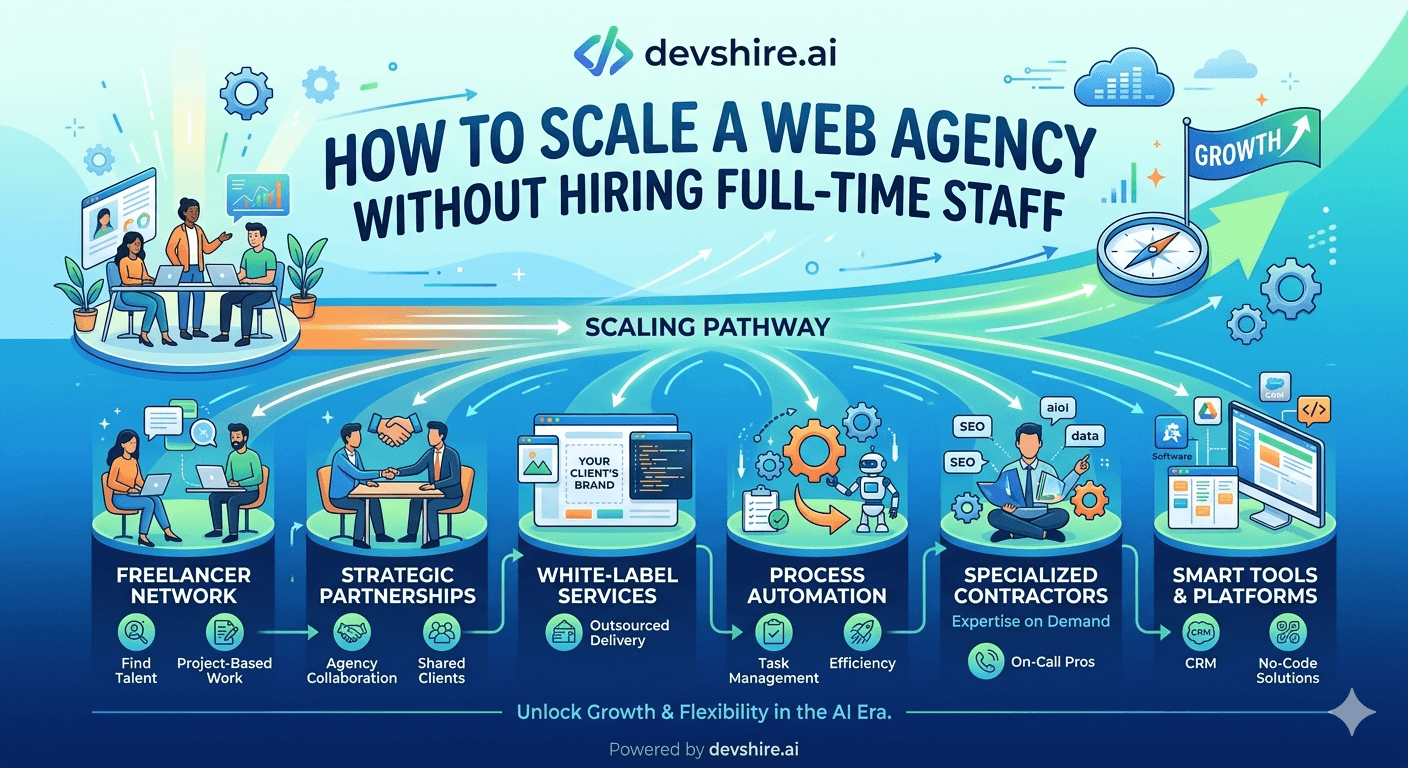
The traditional agency growth model is a trap. You win a big client, you hire two developers to service them, the project ends, and now you're carrying headcount costs on a slowdown. You win another client, you hire again. Then one client churns and you're stuck with a team built for a revenue level you're no longer at. In 2026, the agencies that scale profitably aren't doing this. They're building elastic development capacity — scaling up and down on demand, without a single full-time hire.
💡 TL;DR
Web agencies scale without full-time staff by building elastic development capacity through staff augmentation platforms like Devshire.ai — adding AI-powered developers per project, releasing them when the project ends, and maintaining a core team of 2–3 account and project management roles full-time. This model allows agencies to take on 2–4× the project volume with no headcount risk. A 4-person agency (2 account managers, 1 founder, 1 full-time developer) can service 8–12 concurrent client projects this way, generating $80,000–$150,000 in monthly revenue with a lean structure.
The Elastic Agency Model — How It Actually Works
The elastic model separates the two functions that most agencies bundle together: client relationships and development delivery. Client relationships require consistency — the same account manager, the same strategic voice, the same person who knows the client's business. Development delivery doesn't require that consistency. It requires quality, speed, and communication discipline.
In the elastic model, your full-time team owns client relationships and project oversight. Development delivery is handled by AI-powered developers from a platform like Devshire.ai — assigned per project, ramped up during busy periods, released when the project ends. You pay for the development hours you actually need, not a headcount that sits between projects.
Here's what this looks like in practice. A 4-person agency — 1 founder, 2 account managers, 1 senior full-time developer who handles code review and QA — takes on a new Shopify project. They assign a Devshire developer to the build. The Devshire developer ships the project. The full-time developer reviews the PRs. The account manager handles the client relationship. The project closes. The Devshire developer's engagement ends. The agency's payroll hasn't changed.
What to Keep Full-Time vs What to Make Elastic
Function | Full-Time or Elastic? | Why |
|---|---|---|
Client account management | Full-time | Client relationships require consistency and continuity |
Technical lead / code review | Full-time (1 person) | Quality oversight requires someone with full context |
Project management | Full-time or elastic | Can be outsourced once PM systems are documented |
Active development | Elastic (Devshire.ai) | Output-based, project-specific, high variance in volume |
Design / UI | Elastic | Project-based demand, easy to scope and assign |
QA / testing | Elastic or automated | Can be handled by dev + automated test suite |
Sales and business development | Full-time (founder or hire) | Pipeline building requires consistent effort and relationship |
Building a Capacity System That Scales Automatically
The agencies that execute this model well have a capacity system — a documented process for adding and releasing developer capacity based on project pipeline, not reactive hiring decisions. Here's the system that works.
Step 1: Define your capacity trigger
Set a clear rule for when you add a developer: "When our billable developer utilisation exceeds 85% for two consecutive weeks, we add one Devshire developer." A number-based trigger removes the subjective "are we busy enough?" conversation that delays decisions and causes capacity crunches.
Step 2: Maintain a warm relationship with your sourcing platform
Keep an active relationship with Devshire.ai between projects. When you need a developer, you need them in 24–48 hours — not after a 2-week sourcing process. Agencies that use Devshire consistently get matched faster because the platform knows their tech stack, communication preferences, and project type.
Step 3: Document your project onboarding
Create a 2-page onboarding document every developer gets on Day 1: the tech stack, the codebase structure, your PR process, your async update standard, and the current sprint priorities. When you can onboard a new developer in 4 hours instead of 4 days, elastic capacity becomes truly elastic.
Step 4: Set end dates, not open-ended engagements
Every Devshire developer engagement should have a defined end condition: "3-month project" or "until this feature set ships." Open-ended engagements create budget uncertainty and make it harder to release capacity when the project ends. Project-defined end dates keep both sides clear on the scope.
What This Model Looks Like at Scale
A 4-person agency running the elastic model with Devshire can realistically service 8–12 concurrent client projects — generating $80,000–$150,000/month in revenue with a lean team structure. Here's the revenue model for a mid-size execution of this.
Item | Monthly Cost | Notes |
|---|---|---|
Founder salary | $15,000/mo | Full-time, handles sales and strategy |
2 account managers | $14,000/mo total | Each handles 4–6 accounts |
1 full-time senior dev (code review) | $12,000/mo | Reviews PRs, sets quality standard |
3–4 Devshire AI developers (project-based) | $28,000–$40,000/mo | Elastic — scales with project volume |
Tools, ops, overhead | $4,000/mo | Figma, Linear, Vercel, comms tools |
Total monthly cost | ~$75,000/mo | |
Revenue (8–12 clients × ~$12K/mo avg) | $96,000–$144,000/mo | |
Net margin | $21,000–$69,000/mo (22–48%) | vs 15–22% traditional model |
Trusted by 500+ startups & agencies
"Hired in 2 hours. First sprint done in 3 days."
Michael L. · Marketing Director
"Way faster than any agency we've used."
Sophia M. · Content Strategist
"1 AI dev replaced our 3-person team cost."
Chris M. · Digital Marketing
Join 500+ teams building 3× faster with Devshire
1 AI-powered senior developer delivers the output of 3 traditional engineers — at 40% of the cost. Hire in under 24 hours.
The Bottom Line
The elastic agency model keeps full-time headcount to the roles that require consistency — account management, technical lead, business development — and makes development capacity elastic via platforms like Devshire.ai.
A 4-person agency can service 8–12 concurrent client projects using 3–4 Devshire AI developers on a project basis, generating $96,000–$144,000/month at 22–48% net margin.
Build a capacity system with a clear trigger rule: add a Devshire developer when billable utilisation exceeds 85% for two consecutive weeks. Remove subjectivity from the decision.
Document your project onboarding to a 2-page standard. When you can onboard a new developer in 4 hours instead of 4 days, elastic capacity actually works as intended.
Set defined end dates on every developer engagement. Open-ended engagements create budget uncertainty and make elastic capacity harder to manage.
The AI developer velocity advantage (2–3× output vs traditional developers) means you can service more clients with fewer developer hours — which directly improves the margin model of the entire agency structure.
Frequently Asked Questions
How do I scale a web agency without hiring full-time developers?
Build an elastic development capacity model. Keep client relationship and oversight roles full-time. Use a platform like Devshire.ai to add AI-powered developers per project — hired in under 24 hours, released when the project ends. Maintain one full-time senior developer internally for code review and quality oversight. This structure allows you to service significantly more client work than your full-time headcount would normally support.
What are the risks of not having full-time developers at a web agency?
The main risks: dependency on platform availability (mitigated by using a reliable platform like Devshire with fast placement times), inconsistency in code style across projects (mitigated by maintaining one full-time technical lead who sets standards and reviews PRs), and slower developer ramp-up on complex projects (mitigated by strong onboarding documentation). These risks are all manageable. The risk of the traditional model — carrying headcount through project slowdowns — is less manageable.
How many clients can a small agency handle with elastic development capacity?
A 4-person agency (1 founder, 2 account managers, 1 senior developer) can typically manage 8–12 concurrent client projects using 3–4 Devshire developers on a project basis. The bottleneck is usually account management capacity rather than development capacity. Each account manager can realistically handle 4–6 active client relationships, depending on project complexity and client communication intensity.
How quickly can I add a developer from Devshire.ai to a new project?
Within 24–48 hours of posting your requirements. Agencies that maintain an ongoing relationship with Devshire typically get matched even faster because the platform already knows their tech stack and project type preferences. This speed is what makes the elastic model practical — when you win a new client project on Friday, you can have a developer starting Monday.
Should I tell clients that I use external developers?
Most agency contracts don't prohibit using external developers — your responsibility is the quality and timeline, not which specific individuals build it. If a client asks, honesty builds trust. Frame it as a capability: "We work with a network of pre-vetted senior AI developers who let us scale to your project's specific needs." This is more compelling than "we have 3 developers on staff" — it signals flexibility and access to specialist skills.
Add Elastic Development Capacity to Your Agency — Starting Today
Devshire.ai places pre-vetted AI-powered developers inside agency workflows within 24 hours. Add capacity when you need it, release it when you don't. No full-time headcount risk. Start with a free 1-week trial on your next client project.
Start Your Free 1-Week Trial →
Agency-ready AI developers · Senior from $90/hr · Hire in <24 hours · No commitment
About Devshire.ai — Devshire.ai helps web agencies build elastic development capacity using pre-vetted AI-powered developers. Add capacity per project, release it when done. Hire in under 24 hours. Start hiring →
Related reading: How Digital Agencies Are Using AI Developers to Double Their Margins · White-Label Development: Deliver Client Projects With AI Devs · Subcontracting Developers: How Agencies Add Capacity Without Risk · Staff Augmentation vs Managed Dev Team · How to Price Development Projects When Using AI-Assisted Developers · Browse Pre-Vetted AI Developers →







Devshire Team
San Francisco · Responds in <2 hours
Hire your first AI developer — this week
Book a free 30-minute call. We'll match you with the right developer for your project and get you started within 24 hours.
<24h
Time to hire
3×
Faster builds
40%
Cost saved