
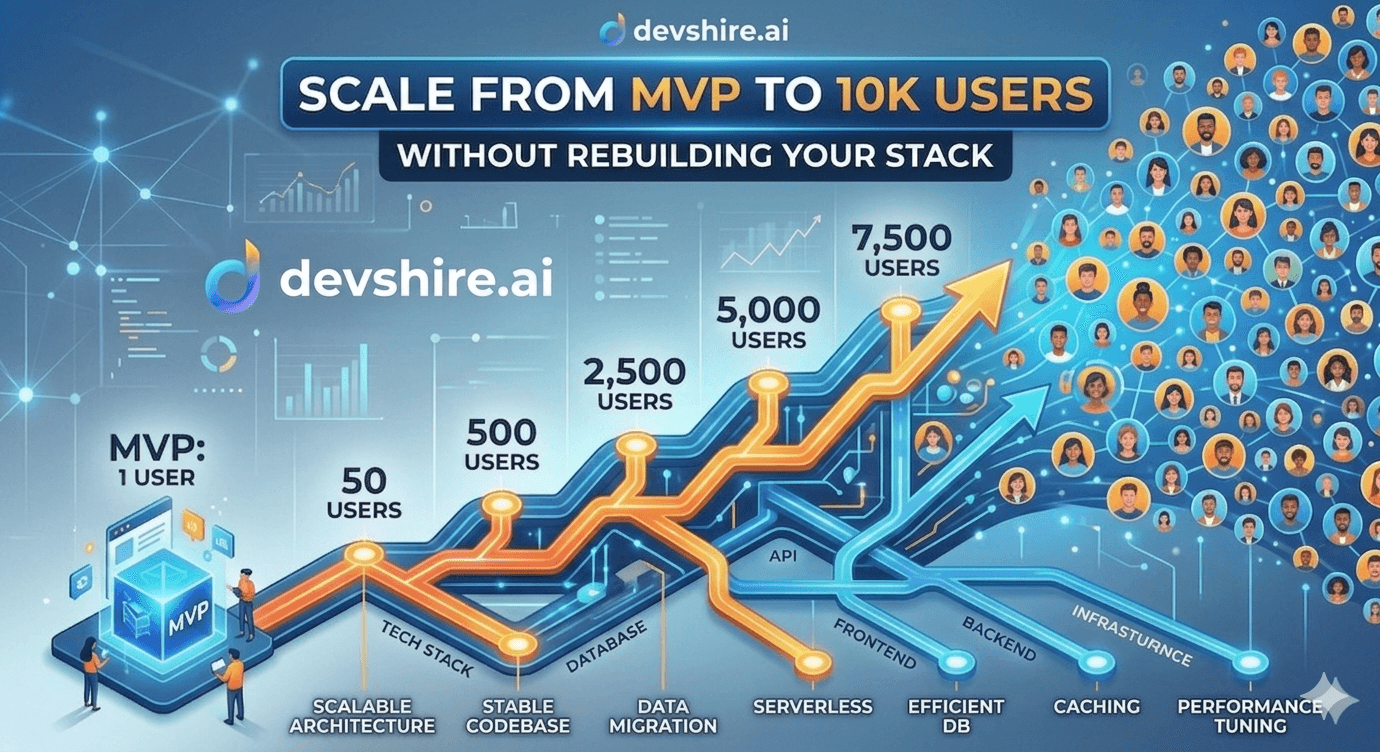
The most common scaling mistake is the full rewrite. A product reaches 500 users, slows down, and a developer convinces the founder that the stack needs to be rebuilt from scratch. Three months and $120,000 later, the rewrite is 60% done, the original product is still running, and the team has lost the feature velocity that drove the first 500 users. Most MVPs do not need a rewrite to scale to 10,000 users. They need specific, targeted changes to specific bottlenecks — and the wisdom to leave everything else alone.
💡 TL;DR
Most MVPs built on React plus Node.js plus PostgreSQL can scale from 0 to 10,000 users without a full rewrite. The bottlenecks that appear at scale are predictable: slow database queries above 1,000 users, missing database indexes above 5,000 users, N+1 query problems above 2,000 users, and missing background job queuing above 500 concurrent operations. Fix each bottleneck when you hit it — not before. AI tools accelerate the diagnosis and fix significantly. Cursor and Claude can identify most performance issues from code inspection in under 30 minutes.
When Scaling Problems Actually Appear — User Thresholds
Most scaling advice is written in the abstract. Here are the specific user thresholds where most MVP stacks start showing stress on standard SaaS workloads.
User Threshold | Typical Bottleneck | Severity | Fix Complexity |
|---|---|---|---|
0 to 500 users | None — standard MVP stack handles this easily | Low | No action needed |
500 to 2,000 users | Slow queries on frequently accessed tables, missing indexes | Medium | Index addition — 1 to 4 hours |
2,000 to 5,000 users | N+1 query problems, synchronous operations blocking API responses | Medium | Query optimisation + background job queue — 1 to 3 days |
5,000 to 10,000 users | Database read latency, missing caching layer, memory limits on hosting | High if unaddressed | Read replicas + Redis cache — 3 to 7 days |
10,000+ users | Horizontal scaling, dedicated database cluster, CDN for static assets | High | Infrastructure restructuring — 1 to 3 weeks |
The key insight: each threshold requires different work. None of them requires a rewrite. Each fix is targeted at the specific bottleneck — not at the entire architecture.
Diagnosing Bottlenecks Before Guessing at Fixes
Most developers guess at scaling problems based on intuition. That leads to optimising the wrong layer. Here is how to diagnose correctly before touching anything.
🔍 Step 1 — Add performance monitoring first
Before making any change, add Sentry performance monitoring and PostgreSQL query logging to your production environment. Sentry tracks API response times by endpoint. Query logging shows which queries are running slow and how often. You need this data before you know what to fix. A developer who proposes scaling fixes without performance data is guessing — and guessing costs 2 to 3 weeks of the wrong work.
🔍 Step 2 — Use Claude to review slow endpoints
Paste your slowest API endpoint code and the EXPLAIN ANALYZE output from your slowest queries into Claude. Ask it to identify the N+1 problems, missing indexes, and unnecessary database calls. Claude's long-context review catches cross-function query problems that a per-file review misses. This diagnostic step takes 20 to 30 minutes and usually identifies 80% of the actual performance issues.
🔍 Step 3 — Fix the 3 highest-impact issues first
Performance work follows the Pareto principle: 3 to 5 changes typically account for 80% of the impact. Fix the top 3 issues, redeploy, measure, and then reassess. Do not write a 20-item performance optimisation plan and execute it all at once. Each fix changes the performance profile and the next bottleneck may be different from what you expected before the first fixes landed.
The Specific Fixes for Each Scaling Stage
These are not theoretical. Each fix is directly tied to the specific bottleneck that appears at the user threshold it solves.
🔧 Fix 1 — Database indexes (500 to 2,000 users)
Most MVP databases are missing indexes on foreign key columns, email lookup columns, and any column used in a WHERE clause in a high-frequency query. Adding the right indexes reduces query time from 800ms to 20ms on affected queries. Use ChatGPT to analyse your schema and query patterns and recommend specific index additions. Time to implement: 1 to 4 hours. Impact: immediate and dramatic on the affected queries.
🔧 Fix 2 — N+1 query elimination (2,000 to 5,000 users)
N+1 queries happen when a list endpoint fetches 50 records and then makes 50 individual follow-up queries to get related data for each record. What looks like 1 database query in the code is actually 51. Use Cursor to refactor ORM calls to use include or join at the query level. Claude is particularly effective at identifying these across multiple files. Fix time: 1 to 3 days depending on how many endpoints are affected.
🔧 Fix 3 — Background job queue (2,000+ users)
Any synchronous operation that takes more than 200ms should be moved to a background job queue. Email sending, PDF generation, webhook processing, image resizing, and AI API calls are the most common candidates. BullMQ with Redis is the standard queue for Node.js in 2026. With Cursor, adding a BullMQ queue layer to an existing Node.js API takes 4 to 8 hours. Without this, slow operations block API response times and create cascading timeouts under load.
🔧 Fix 4 — Redis caching layer (5,000 to 10,000 users)
At 5,000 to 10,000 users, frequently accessed and rarely changed data — user permissions, product pricing, configuration settings, dashboard aggregates — creates repeated database load. Add a Redis cache with a 60 to 300 second TTL on high-frequency read endpoints. Upstash Redis is the managed Redis option with the lowest setup friction on Railway and Fly.io stacks. With Cursor, adding Redis caching to existing endpoints takes 1 to 2 days.
🔧 Fix 5 — Read replica (approaching 10,000 users)
As database read volume grows, routing read queries to a PostgreSQL read replica reduces load on the primary database by 40 to 60% on typical SaaS workloads. Railway and Fly.io both support read replicas. Prisma supports read replica routing natively via the read replica extension. Setup time: 4 to 8 hours. Impact: extends the primary database's capacity significantly before you need a dedicated database cluster.
Why You Almost Never Need a Full Rewrite to Reach 10K Users
The rewrite pressure usually comes from one of three places: a new developer who wants to use a different framework, a performance problem that feels architectural but is actually a missing index, or a founder who read about a competitor using microservices and concluded they should too.
Here is what a full rewrite actually costs at mid-stage: 10 to 14 weeks of developer time, $80,000 to $140,000 in development cost, zero new features for customers during the rewrite period, a codebase that is functionally equivalent to what you had but in a different framework, and the accumulated context of your original developers that is lost during the transition. That cost is only justified when you have a genuine architectural constraint that targeted fixes cannot solve. For most products at 5,000 to 10,000 users, you do not have that constraint.
⚠️ The question to ask before any rewrite conversation
Ask your developer to describe the specific technical constraint — not the general feeling — that the rewrite solves and that targeted fixes cannot solve. If they cannot name a specific constraint with a measured performance impact, the rewrite is a preference, not a requirement. Push back until you get a specific answer. Most rewrites fail this test.
Trusted by 500+ startups & agencies
"Hired in 2 hours. First sprint done in 3 days."
Michael L. · Marketing Director
"Way faster than any agency we've used."
Sophia M. · Content Strategist
"1 AI dev replaced our 3-person team cost."
Chris M. · Digital Marketing
Join 500+ teams building 3× faster with Devshire
1 AI-powered senior developer delivers the output of 3 traditional engineers — at 40% of the cost. Hire in under 24 hours.
Using AI Tools to Scale Faster and More Accurately
AI tools are particularly valuable for scaling work because the bottlenecks are predictable and the fixes are well-understood patterns. Here is how the best developers in our network use them.
🤖 Claude for performance code review
Paste your slowest endpoints and EXPLAIN output into Claude and ask for N+1 detection, missing index recommendations, and synchronous operation candidates for background job migration. Claude handles this better than ChatGPT on complex multi-file performance analysis because of its longer context window. This replaces 2 to 4 hours of manual performance review with a 20-minute Claude session.
⚡ Cursor for implementing the fixes
Once Claude has identified the issues, use Cursor to implement them. Cursor's multi-file context awareness makes it the right tool for refactoring N+1 queries across multiple endpoints simultaneously — a change that would take 2 to 3 days manually takes 4 to 8 hours with Cursor Composer handling the cross-file changes.
💬 ChatGPT for planning the scaling sequence
Describe your current performance data — slowest endpoints, query times, user count — and ask ChatGPT to recommend a prioritised scaling sequence. Ask it to distinguish between fixes that should happen now versus fixes that should happen when you hit specific thresholds. This planning session prevents over-engineering by keeping fixes targeted to current bottlenecks.
The Bottom Line
Most MVPs built on React plus Node.js plus PostgreSQL scale to 10,000 users without a rewrite. The bottlenecks at each threshold are predictable: indexes at 500 to 2,000, N+1 queries at 2,000 to 5,000, Redis caching at 5,000 to 10,000.
Add Sentry performance monitoring and PostgreSQL query logging before making any scaling changes. Fixes without data are guesses. Guesses cost 2 to 3 weeks of wrong work.
The five targeted fixes — indexes, N+1 elimination, background job queue, Redis caching, read replica — cover 90% of scaling needs from 0 to 10,000 users without restructuring the architecture.
A full rewrite to reach 10,000 users costs $80,000 to $140,000 and delivers zero new customer value. Only justified when a specific, measured architectural constraint cannot be solved by targeted fixes.
Claude identifies most performance bottlenecks from code and EXPLAIN output in under 30 minutes. Cursor implements the fixes 2 to 3x faster than manual refactoring. ChatGPT plans the sequence.
Before any rewrite conversation: ask the developer to name the specific technical constraint with a measured performance impact that targeted fixes cannot solve. Most rewrites fail this test.
Frequently Asked Questions
When does an MVP need to be rewritten to scale?
Rarely before 10,000 users if the MVP was built on a standard stack. The conditions that genuinely require a rewrite rather than targeted fixes: a fundamental architectural decision that prevents horizontal scaling (stateful architecture in a stateless environment, monolithic data model that cannot be partitioned), a stack that cannot be maintained by any available developer, or a compliance requirement that the current architecture cannot meet. Performance problems without these root causes are almost always solvable with targeted fixes.
What is an N+1 query problem and how do I fix it?
An N+1 query happens when a list endpoint fetches N records and then makes one additional database query for each record to get related data — resulting in N+1 total queries instead of 1 or 2. Fix it by using ORM includes or joins at the query level to fetch related data in a single query. Claude identifies N+1 patterns in code reliably. Cursor implements the ORM refactoring efficiently across multiple affected endpoints.
When should I add Redis caching to my SaaS product?
When specific high-frequency read endpoints show database query latency above 100ms under normal load — typically between 5,000 and 10,000 users on standard SaaS workloads. The best candidates for caching: user permissions and role data, product pricing and configuration, dashboard aggregate counts. Use Upstash Redis with a 60 to 300 second TTL. Do not cache data that changes frequently or that must be immediately consistent for correctness.
How do AI tools help with SaaS scaling?
Claude identifies performance bottlenecks from code and SQL EXPLAIN output faster and more comprehensively than manual review — most bottlenecks found in 20 to 30 minutes of Claude analysis. Cursor implements the fixes across multiple files simultaneously using Composer — N+1 refactoring that takes 2 to 3 days manually takes 4 to 8 hours with Cursor. ChatGPT plans the scaling sequence to prevent over-engineering. Together, these tools reduce scaling sprint time by 50 to 70%.
Hire Developers Who Scale Without Rewriting
Every developer in the devshire.ai network understands the difference between targeted performance fixes and premature rewrites. They use Claude for performance diagnosis and Cursor for efficient refactoring. No unnecessary rebuilds. No wasted runway. Shortlist in 48 to 72 hours.
Find Your Scaling Developer ->
Performance-focused devs · AI-toolchain vetted · Shortlist in 48 hrs · Freelance and full-time
About devshire.ai — devshire.ai matches SaaS teams with developers who know how to scale efficiently without unnecessary rewrites. Start hiring ->
Related reading: Best Tech Stack for Startups in 2026 · How to Build a Multi-Tenant SaaS App With React and Node.js · SaaS Security Best Practices Every Dev Team Must Implement · Browse Pre-Vetted SaaS Developers







Devshire Team
San Francisco · Responds in <2 hours
Hire your first AI developer — this week
Book a free 30-minute call. We'll match you with the right developer for your project and get you started within 24 hours.
<24h
Time to hire
3×
Faster builds
40%
Cost saved