
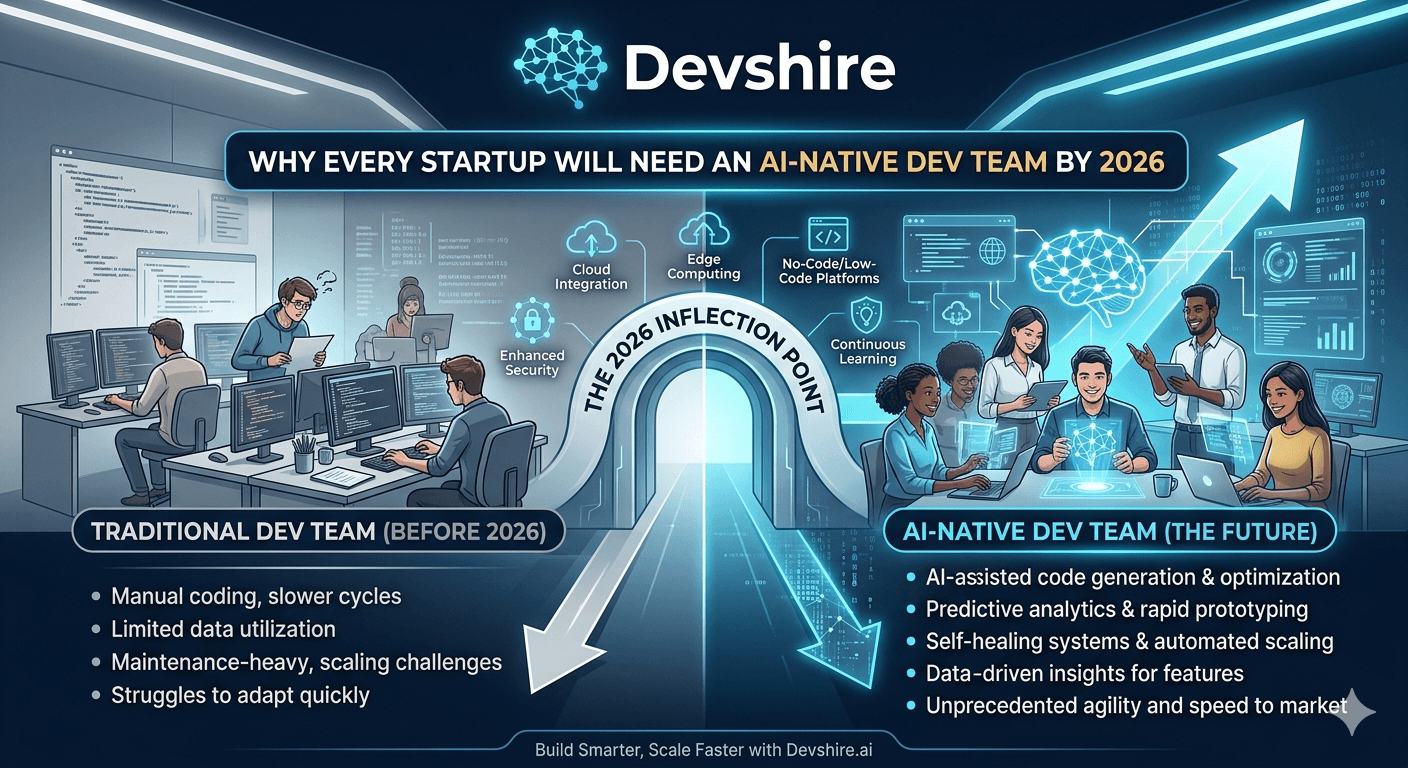
The shipping gap between startups with AI-native dev teams and those without is already significant. Teams building with AI tooling natively woven through their workflow are shipping two to three times more feature work per sprint, catching bugs faster, and iterating on product feedback in days instead of weeks. Their competitors — running the same hiring playbook from 2021, building the same way — are falling behind without fully realising it yet. This isn't hype. It's observable in velocity metrics, in time-to-ship comparisons, and in the hiring decisions that investors are now actively asking about in due diligence. If you're building a startup in 2026 without an AI-native team, you're not just missing a trend. You're carrying a structural disadvantage that compounds every sprint.
💡 TL;DR
An AI-native dev team isn't a team that uses AI occasionally — it's a team where AI tooling is baked into every stage of the development workflow: planning, coding, testing, review, and deployment. Startups with AI-native teams ship 2–3x more per sprint, reduce their headcount requirement by 30–40% for equivalent output, and maintain higher code quality because AI-assisted review catches more issues. The competitive gap between AI-native and traditional teams is already material and widening quarterly.
What "AI-Native" Actually Means for a Dev Team
This gets misused constantly. "AI-native" doesn't mean your developers have ChatGPT open in another tab. It means AI tooling is the default, not the exception, across every stage of how your team builds.
📋 AI in planning and specification
AI-native teams use language models to break down product requirements into technical specifications, identify edge cases in design documents, and generate test scenarios before a line of code is written. This catches ambiguity upstream, not after two days of implementation.
💻 AI in coding (not just autocomplete)
Cursor, Copilot, and Claude are used for full feature scaffolding, not just line completion. Developers are prompting for complete functions, reviewing AI output critically, and iterating. The developer's role shifts from writing every line to directing and validating. [INTERNAL LINK: Cursor AI for React development → devshire.ai/blog/cursor-ai-react-setup]
🧪 AI in testing and code review
AI-assisted code review tools flag security vulnerabilities, performance issues, and anti-patterns automatically. Test generation with AI means coverage gets written alongside the feature instead of months later. The quality bar is higher and the cycle time is shorter. [INTERNAL LINK: AI code review tools → devshire.ai/blog/ai-code-review-tools]
🚀 AI in deployment and operations
AI-native teams use automation tools that go beyond basic CI/CD — error pattern detection, automated rollback triggers, infrastructure right-sizing suggestions. The ops burden per developer is lower because automated intelligence handles more of the monitoring layer.
⚠️ What it's not
A team where one developer occasionally uses GitHub Copilot for autocomplete is not AI-native. A team that added a ChatGPT step to their ticket-writing process is not AI-native. AI-native means the workflow is fundamentally different — not that AI exists somewhere in the periphery of how you work.
The Velocity Gap: What the Numbers Look Like in Practice
Most founders underestimate the magnitude of the gap. It's not marginal. Across the teams devshire.ai has matched and tracked, the output difference between AI-native and traditional teams on comparable feature work is consistent.
Metric | Traditional Dev Team | AI-Native Dev Team |
|---|---|---|
Features shipped per sprint | 3–4 | 6–9 |
Time from spec to working PR | 4–6 days | 1.5–3 days |
Bug detection rate (pre-production) | ~60% | ~80% |
Test coverage on new features | 40–60% | 70–85% |
Headcount for same output scope | 5 developers | 2–3 developers |
The headcount row is the one that catches founders' attention. An AI-native team of 2–3 developers can produce comparable output to a traditional team of 5, at roughly half the salary and infrastructure cost. For seed and Series A startups watching burn rate, this changes the hiring equation entirely.
How to Actually Build an AI-Native Dev Team
The structure matters. An AI-native team isn't just a collection of developers who happen to like AI tools. It requires intentional hiring, deliberate tooling decisions, and workflow standards that the whole team shares.
1️⃣ Hire for AI toolchain proficiency, not just coding ability
The screening question isn't "do you use AI tools" — it's "show me how you'd build this feature using your AI toolchain." Watch for iterative prompting, output validation habits, and the ability to catch model hallucinations. These are learned behaviours, not certifications. [INTERNAL LINK: how to screen AI developers → devshire.ai/blog/hire-ai-developers-2026]
2️⃣ Standardise the toolchain across the team
Pick one IDE with AI integration (Cursor is the current standard), one LLM for complex reasoning tasks (Claude or GPT-4), and one AI review tool for PRs. Inconsistency in toolchain creates inconsistency in output quality. When everyone uses the same tools the same way, velocity compounds instead of staying individual.
3️⃣ Build AI output review into your PR process
Make AI-assisted code review a mandatory step, not optional. Tools like CodeRabbit or custom Claude-powered review scripts should flag issues on every PR automatically. This isn't about distrust — it's about catching the specific class of errors that AI-generated code is prone to: hallucinated APIs, over-engineered abstractions, subtle logic errors.
4️⃣ Set a quality bar, not just a speed expectation
Fast and wrong is worse than slow and right. Define explicit quality standards for AI-assisted output: what percentage of code needs test coverage, what review checklist applies to AI-generated code specifically, and what escalation path exists when AI output is low-confidence. Speed targets without quality floors produce technical debt faster than traditional development does.
Why Investors Are Now Asking About Your Team's AI Tooling
This is recent and worth paying attention to. In 2023 and early 2024, AI tooling was a nice-to-have signal in due diligence. In 2026, it's becoming a standard question in technical due diligence for growth-stage rounds: how does your team build, what's your output velocity per engineer, and what tooling supports it?
The reason is simple arithmetic. An investor evaluating two comparable startups — same market, similar traction, similar team size — will prefer the one whose engineering team produces 2–3x the output per dollar of burn. That preference is now being surfaced explicitly in the diligence process, not just inferred from velocity metrics.
Not gonna lie — this is one of the fastest-changing parts of what investors look at. Teams that adopted AI-native workflows early are now being specifically cited in investment theses. Teams that haven't are starting to look slow by comparison.
[INTERNAL LINK: building a startup app with AI → devshire.ai/blog/build-startup-app-with-ai]
Trusted by 500+ startups & agencies
"Hired in 2 hours. First sprint done in 3 days."
Michael L. · Marketing Director
"Way faster than any agency we've used."
Sophia M. · Content Strategist
"1 AI dev replaced our 3-person team cost."
Chris M. · Digital Marketing
Join 500+ teams building 3× faster with Devshire
1 AI-powered senior developer delivers the output of 3 traditional engineers — at 40% of the cost. Hire in under 24 hours.
The Bottom Line
AI-native means AI tooling is the default across planning, coding, testing, review, and deployment — not an occasional add-on. If AI is peripheral to your workflow, you're not AI-native.
AI-native teams ship 2–3x more feature work per sprint than equivalent traditional teams. The gap is consistent across project types and team sizes.
A 2–3 person AI-native team can produce comparable output to a 5-person traditional team. For startups watching burn rate, this changes the hiring equation significantly.
Build quality floors into your AI-native workflow from the start. Speed without output validation creates technical debt faster than traditional development.
Investors are actively asking about AI tooling and engineering velocity in due diligence for growth-stage rounds. This is now a signal, not a bonus.
The competitive gap between AI-native and traditional teams is material today and widening. Startups that delay adoption are carrying a structural disadvantage that compounds with every sprint.
Frequently Asked Questions
What is an AI-native dev team?
An AI-native dev team is one where AI tooling is integrated into every stage of the development workflow — from specification and planning through coding, testing, code review, and deployment. It's not a team that uses AI occasionally or in isolated steps. The workflow itself is fundamentally different: developers direct and validate AI output rather than writing every line manually, and the velocity and quality metrics reflect that difference.
How much faster do AI-native dev teams ship compared to traditional teams?
Across comparable feature work, AI-native teams typically ship 2–3x more per sprint than traditional teams of equivalent size. Time from spec to working PR drops from 4–6 days to 1.5–3 days. Bug detection rates before production improve from around 60% to around 80%. These aren't theoretical numbers — they're observable in teams running the full AI-native workflow versus teams running traditional development processes.
How many developers does a startup need if they're AI-native?
Rough rule: a 2–3 person AI-native team produces comparable output to a 5-person traditional team. This means startups can maintain higher velocity at lower burn — a significant advantage at seed and Series A when every dollar of runway matters. The exact ratio depends on the nature of the work and how deeply AI tooling is integrated into the workflow.
How do I hire developers for an AI-native team?
Screen for actual AI toolchain proficiency, not just AI awareness. Give candidates a live build task that requires AI tool use — watch how they prompt, what they check, and how they validate AI output. The critical skill isn't speed alone; it's knowing when the AI output is wrong. Developers who treat AI output as ground truth rather than first draft are not AI-native regardless of what tools they list.
Do investors care about whether a startup has an AI-native dev team?
Increasingly yes. In 2026, engineering velocity and output-per-engineer are standard due diligence questions at growth-stage rounds. Investors comparing two comparable startups will prefer the one producing more output per dollar of engineering burn. AI-native teams that can demonstrate 2–3x velocity at comparable headcount count have a measurable advantage in these conversations.
What tools should an AI-native startup dev team standardise on?
The current standard stack: Cursor (AI-integrated IDE), Claude or GPT-4 via API for complex reasoning tasks, GitHub Copilot or equivalent for secondary code completion, an AI-assisted code review tool (CodeRabbit or a custom Claude-powered PR reviewer), and an AI documentation tool for keeping specs and runbooks current. Consistency across the team matters more than the specific tools — fragmented toolchains produce fragmented output quality.
Can a traditional dev team transition to being AI-native?
Yes, but it requires deliberate effort over 2–4 months, not just installing new tools. The workflow changes need to be team-wide and standardised — one developer adopting Cursor while others don't doesn't change team velocity. Start with a toolchain pilot on one sprint, measure the output difference, then roll out the full workflow with explicit quality standards for AI-generated code. Most teams see meaningful velocity improvements within 4–6 weeks of full adoption.
Build Your AI-Native Team — Shortlist in 48 Hours
devshire.ai pre-screens every developer for AI toolchain proficiency, output velocity, and stack fit before you see a single profile. Get a shortlist of AI-native developers in 48–72 hours. Freelance and full-time options available.
Start Building at devshire.ai →
No upfront cost · Shortlist in 48–72 hrs · Freelance & full-time · Stack-matched candidates
About devshire.ai — devshire.ai matches AI-powered engineering talent with startups that need to move fast. Every developer has passed a live AI proficiency screen. Typical time-to-hire: 8–12 days. Start hiring →
Related reading: Hire AI Developers in 2026: Skip the Wasted Weeks · Startup Tech Team Size: How Many Developers Do You Actually Need? · How to Build a Startup App With AI · How to Reduce Developer Costs at Your Startup · AI Workflow Automation for Dev Teams







Devshire Team
San Francisco · Responds in <2 hours
Hire your first AI developer — this week
Book a free 30-minute call. We'll match you with the right developer for your project and get you started within 24 hours.
<24h
Time to hire
3×
Faster builds
40%
Cost saved