
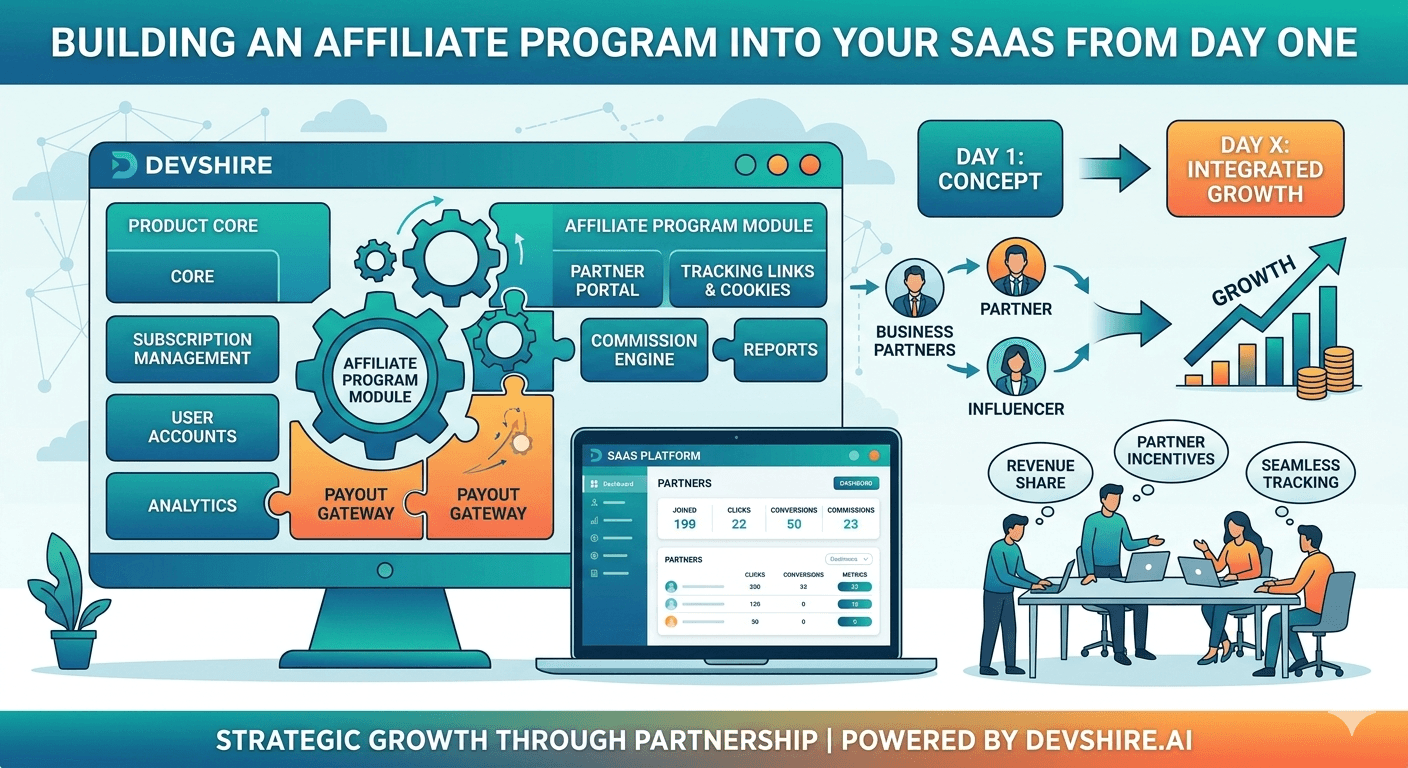
Most SaaS companies add affiliate programs as an afterthought — bolted on after the product is mature, tracked by a third-party tool that doesn't quite integrate cleanly, and administered manually by someone in ops once a month. Teams that do this usually get mediocre results because the program is an afterthought in the product, not a feature. The companies with affiliate programs that actually drive revenue — Notion, Webflow, ConvertKit — built the infrastructure early and built it properly. The tracking is clean. The attribution is accurate. The payouts are automated. And the affiliate experience is good enough that affiliates actively promote instead of signing up and going quiet. Here's how to build it right from day one.
💡 TL;DR
Building an affiliate program into your SaaS from day one requires four things: a clean tracking system (unique referral codes + UTM parameters), attribution that survives the signup flow, a commission structure that incentivises quality referrals over volume, and automated payouts that don't require manual ops work. You can build this on your own stack or use a platform like Rewardful or Tapfiliate. The custom build takes 4–6 weeks but gives you full flexibility. Third-party platforms get you live in days but limit what you can customise.
Build vs Buy: Choosing Your Affiliate Infrastructure
The first decision is whether to build your own affiliate tracking system or use a SaaS platform. Both are defensible — the right choice depends on your technical resources, your customisation needs, and your timeline.
Option | Time to launch | Monthly cost | Customisation | Best for |
|---|---|---|---|---|
Rewardful | 1–3 days | $49–$299 | Limited | Stripe-based SaaS, fast setup |
Tapfiliate | 2–5 days | $89–$199 | Moderate | More flexible commission structures |
PartnerStack | 1–2 weeks | $500+ | High | Mid-market, partner ecosystem |
FirstPromoter | 1–3 days | $49–$149 | Moderate | SaaS teams wanting simpler setup |
Custom build | 4–8 weeks | Hosting only | Full | Teams needing deep product integration |
For most early-stage SaaS teams: start with Rewardful or FirstPromoter. They integrate cleanly with Stripe, handle attribution and payout management, and get you live in days. Move to a custom build when you've validated that affiliates are a meaningful channel and you need capabilities the platforms don't support — multi-tier commissions, product-specific attribution, or deep CRM integration.
⚠️ The case against custom-first
Building a custom affiliate system before you've validated the channel is a common mistake. A custom build takes 4–8 weeks of engineering time. If your affiliate program launches and gets limited traction, that was 4–8 weeks you didn't spend on product. Validate first with a platform, then build custom when you have volume that warrants it.
Tracking Architecture: How to Build Attribution That Actually Works
If you're building custom, getting tracking right is the critical piece. Broken attribution means affiliates don't get credit for their referrals, which kills the program faster than anything else. Here's the architecture that works reliably.
🔑 Unique referral codes, not just UTM parameters
UTM parameters get lost — users click a referral link, leave the site, come back directly, and the UTM is gone. Store the referral code in a first-party cookie with a 30–90 day expiry. When a user signs up, read the cookie and attribute the signup to the affiliate. UTMs are useful for analytics but not reliable for attribution on their own.
🍪 Cookie-based attribution with fallback to URL parameter
The flow: user clicks yourapp.com?ref=affiliate123 → store affiliate_ref=affiliate123 in a first-party cookie → on signup, read the cookie and associate the new user with that affiliate ID → store the association in your database. If no cookie is found at signup, check the URL parameter as a fallback.
🗄️ Database schema for attribution
You need at minimum: an affiliates table (affiliate ID, payout details, status), a referrals table (referral ID, affiliate ID, referred user ID, signup date, conversion status), and a commissions table (commission ID, referral ID, amount, status, payout date). These three tables are the foundation of your entire affiliate system.
💳 Listen to billing events to trigger commissions
Don't pay commissions on signups — pay on revenue events. Connect to Stripe webhooks: invoice.payment_succeeded is your trigger. When a referred user's invoice is paid, create a commission record for the affiliate. This prevents paying commissions on trials that never convert.
[INTERNAL LINK: ETL pipelines and data architecture → devshire.ai/blog/etl-pipeline-startups-build-vs-buy]
Commission Structure: How to Design Incentives That Drive Quality Referrals
The commission structure determines what behaviour you incentivise. Get it wrong and you attract affiliates who game the system instead of genuinely promoting. Here's what works for SaaS specifically.
🔄 Recurring commissions, not one-time
For SaaS with monthly subscriptions, paying 20–30% recurring commission for 6–12 months is more attractive to high-quality affiliates than a flat one-time payment. Recurring commission incentivises affiliates to refer customers who stay — they earn more from a customer retained for 12 months than one who churns in month two. This aligns incentives properly.
📊 Benchmark commission rates by SaaS category
B2B SaaS tool (under $200/month): 20–30% recurring for 12 months. Higher-ACV SaaS ($200–$1,000/month): 15–25% recurring. Low-margin SaaS or usage-based: flat fee per converted customer. Check what established players in your category offer — affiliates compare programs and choose where to promote based on expected earnings per referral.
⏱️ Add a qualifying period
Don't pay commissions until a referred customer has been paying for at least 30–60 days. This protects against commission fraud (self-referrals, fake accounts) and ensures commissions are paid on customers who actually stick. Be transparent about this in your affiliate terms — legitimate affiliates understand and expect it.
The Affiliate Dashboard: What You Need to Build
The affiliate experience determines whether affiliates actively promote or sign up and go quiet. A good affiliate dashboard shows affiliates everything they need to manage their own performance without contacting you.
📈 Core dashboard metrics
Clicks, signups, conversions, pending commission, paid commission, and conversion rate. These six numbers tell an affiliate whether their promotion is working and when they'll get paid. Missing any of them creates support requests. Display them prominently above the fold on the affiliate dashboard.
🔗 Self-service link generation
Affiliates should be able to generate tracking links for any page on your site without asking you. Build a link generator that takes a destination URL, appends their referral code, and creates a clean trackable link. Affiliates who promote specific use-case pages outperform those limited to just the homepage.
💰 Payout transparency
Show the exact payout schedule and threshold. "Commissions paid on the 1st of every month for balances over $50" is clear. "Payouts processed periodically" creates confusion and erodes trust. Automated payouts via Stripe Connect or PayPal Payouts remove the manual ops burden and make the program feel professional.
Trusted by 500+ startups & agencies
"Hired in 2 hours. First sprint done in 3 days."
Michael L. · Marketing Director
"Way faster than any agency we've used."
Sophia M. · Content Strategist
"1 AI dev replaced our 3-person team cost."
Chris M. · Digital Marketing
Join 500+ teams building 3× faster with Devshire
1 AI-powered senior developer delivers the output of 3 traditional engineers — at 40% of the cost. Hire in under 24 hours.
Automating Payouts: The Part That Kills Programs If Done Manually
Manual payout processing is the operational bottleneck that kills affiliate programs. When affiliates have to wait for someone to manually run payments at the end of the month — and mistakes happen because it's a manual process — trust erodes and promotion stops. Automate it.
💳 Stripe Connect for direct bank payouts
Stripe Connect lets you pay affiliates directly to their bank accounts without handling their banking details yourself. Affiliates onboard into Stripe's platform (standard or express accounts), and you trigger payouts via the Stripe Transfers API. This handles compliance, currency conversion, and tax reporting automatically.
📅 Scheduled payout jobs
Run a scheduled job (cron or queue) on your chosen payout date: query all affiliates with pending commissions above your minimum threshold, verify the qualifying period has passed, calculate the payout amount, trigger the Stripe Transfer, and mark commissions as paid. This should run without human intervention every cycle.
📧 Automated payout notifications
Send an email to each affiliate when their payout is processed: amount paid, payment method, expected arrival time. This single email reduces "when do I get paid?" support tickets by 80%. Affiliates who feel paid reliably and transparently stay active longer.
[EXTERNAL LINK: Stripe Connect documentation → stripe.com/docs/connect]
Fraud Prevention: The Issues That Show Up at Scale
Affiliate fraud is real and increases as your program grows. The most common forms are self-referrals (affiliates signing up with their own link using different emails), coupon stacking, and fake account creation. Build protections in from the start.
🔒 Block affiliates from earning on their own accounts
Check the email domain of a referred signup against the affiliate's email domain. Same domain = flag for review. Also block the affiliate's primary email and any emails that share an IP address at signup with the affiliate's own account creation. These basic checks catch the majority of self-referral fraud.
⏰ Qualifying period before commission approval
A 30–60 day hold before commissions become payable means fraudulent accounts (which typically churn immediately) don't earn commissions. Set commissions to "pending" status at conversion and only move them to "approved" after the qualifying period. Review any accounts that cancel in the qualifying period before approving commission.
📍 IP and device fingerprinting
Log the IP address and device fingerprint at both affiliate signup and referred user signup. Flag cases where these match for manual review before paying commission. This catches cases where UTM and email domain checks fail. Not foolproof — VPNs circumvent IP checks — but it catches casual fraud effectively.
The Bottom Line
Validate your affiliate channel with a platform (Rewardful, FirstPromoter) before investing 4–8 weeks building a custom system. Build custom when you've confirmed the channel works and need capabilities platforms don't support.
Cookie-based attribution with a 30–90 day expiry is more reliable than UTM parameters alone. Store the referral code server-side on signup to prevent cookie loss from killing attribution.
Pay commissions on revenue events (first successful payment), not on signups. This aligns affiliate incentives with customer quality, not just volume.
Recurring commission for 6–12 months outperforms flat one-time payments for attracting high-quality affiliates. It incentivises referrals of customers who stay.
A 30–60 day qualifying period before commissions become payable catches most self-referral fraud and aligns payouts with customers who actually retain.
Automate payouts via Stripe Connect or PayPal Payouts. Manual payout processing is the operational burden that kills affiliate programs — build automation in from day one.
The affiliate dashboard needs: clicks, signups, conversions, pending commission, paid commission, payout schedule, and self-service link generation. Missing any of these creates support requests that add ops overhead.
Frequently Asked Questions
How do I build an affiliate program into a SaaS product?
The core components are: unique referral code generation for each affiliate, cookie-based attribution that survives the signup flow, a database schema tracking referrals and commissions, Stripe webhook integration to trigger commissions on payment events, an affiliate dashboard showing performance and payouts, and automated payout processing. You can build this custom in 4–8 weeks or use a platform like Rewardful or FirstPromoter to launch in days.
What commission rate should I offer SaaS affiliates?
For B2B SaaS under $200/month, 20–30% recurring commission for 12 months is competitive. For higher-ACV SaaS ($200–$1,000/month), 15–25% recurring is standard. Research what established tools in your category offer — affiliates compare programs and promote where expected earnings per referral are highest. Recurring commissions generally attract better affiliates than one-time flat fees because the long-term earnings potential is higher.
What's the best affiliate tracking platform for a SaaS startup?
For Stripe-based SaaS, Rewardful is the easiest setup — it integrates with Stripe in under an hour and handles attribution, commission calculation, and payout management automatically. FirstPromoter is a strong alternative with slightly more flexible commission structures. Tapfiliate supports more complex use cases. PartnerStack is designed for mid-market companies with full partner ecosystems. Start with Rewardful unless you have specific requirements it can't meet.
How do I prevent affiliate fraud in my SaaS program?
Three primary controls: a 30–60 day qualifying period before commissions are paid (catches fraudulent accounts that churn immediately), email domain matching to detect self-referrals, and IP address logging to flag cases where the affiliate's IP matches the referred user's signup IP. Add device fingerprinting for stronger coverage. These controls catch the majority of casual fraud without creating friction for legitimate affiliates.
Should I build my own affiliate tracking or use a third-party platform?
Start with a platform. Rewardful, FirstPromoter, or Tapfiliate get you live in days and cost $50–$200/month. Build custom only when you've validated the affiliate channel and need specific capabilities — multi-tier commissions, deep product integration, custom attribution logic — that platforms don't support. Custom builds take 4–8 weeks and ongoing maintenance. Don't invest that engineering time before you know affiliates will drive meaningful revenue.
How do I automate affiliate payouts for my SaaS?
Stripe Connect is the cleanest solution for direct bank payouts. Affiliates onboard to Stripe's platform and you trigger payouts via the Transfers API on your chosen schedule. PayPal Payouts is an alternative with broader global coverage. Build a scheduled job that runs on your payout date, queries approved commissions above your minimum threshold, triggers transfers, and marks commissions as paid. Send an automated email notification to each affiliate when their payout processes.
How long does it take to build a custom affiliate program from scratch?
A basic custom affiliate system — referral tracking, attribution, commission calculation, and a simple dashboard — takes an experienced developer 4–6 weeks to build properly. A more complete system with automated payouts via Stripe Connect, fraud detection, advanced dashboard analytics, and self-service link generation is typically a 8–12 week project. Factor in 2–4 weeks of tuning and bug fixing after initial launch before the system runs reliably.
Need a Developer to Build Your Affiliate System?
devshire.ai matches SaaS teams with developers who've built affiliate tracking systems, commission engines, and automated payout pipelines from scratch. Every developer is pre-screened for real-world experience. Get a shortlist in 48–72 hours.
Start Your Search at devshire.ai →
No upfront cost · Shortlist in 48–72 hrs · Freelance & full-time · Stack-matched candidates
About devshire.ai — devshire.ai matches AI-powered engineering talent with SaaS product teams building revenue-critical systems. Every developer has passed a live proficiency screen. Typical time-to-hire: 8–12 days. Start hiring →
Related reading: CRM Integration for SaaS: How to Connect HubSpot to Your App · How to Build a Growth Dashboard Your Whole Team Can Use · ETL Pipeline for Startups: When to Build vs When to Buy · Building a Customer Analytics Platform for a SaaS Product · Using AI to Automate Email Sequences That Actually Convert







Devshire Team
San Francisco · Responds in <2 hours
Hire your first AI developer — this week
Book a free 30-minute call. We'll match you with the right developer for your project and get you started within 24 hours.
<24h
Time to hire
3×
Faster builds
40%
Cost saved