
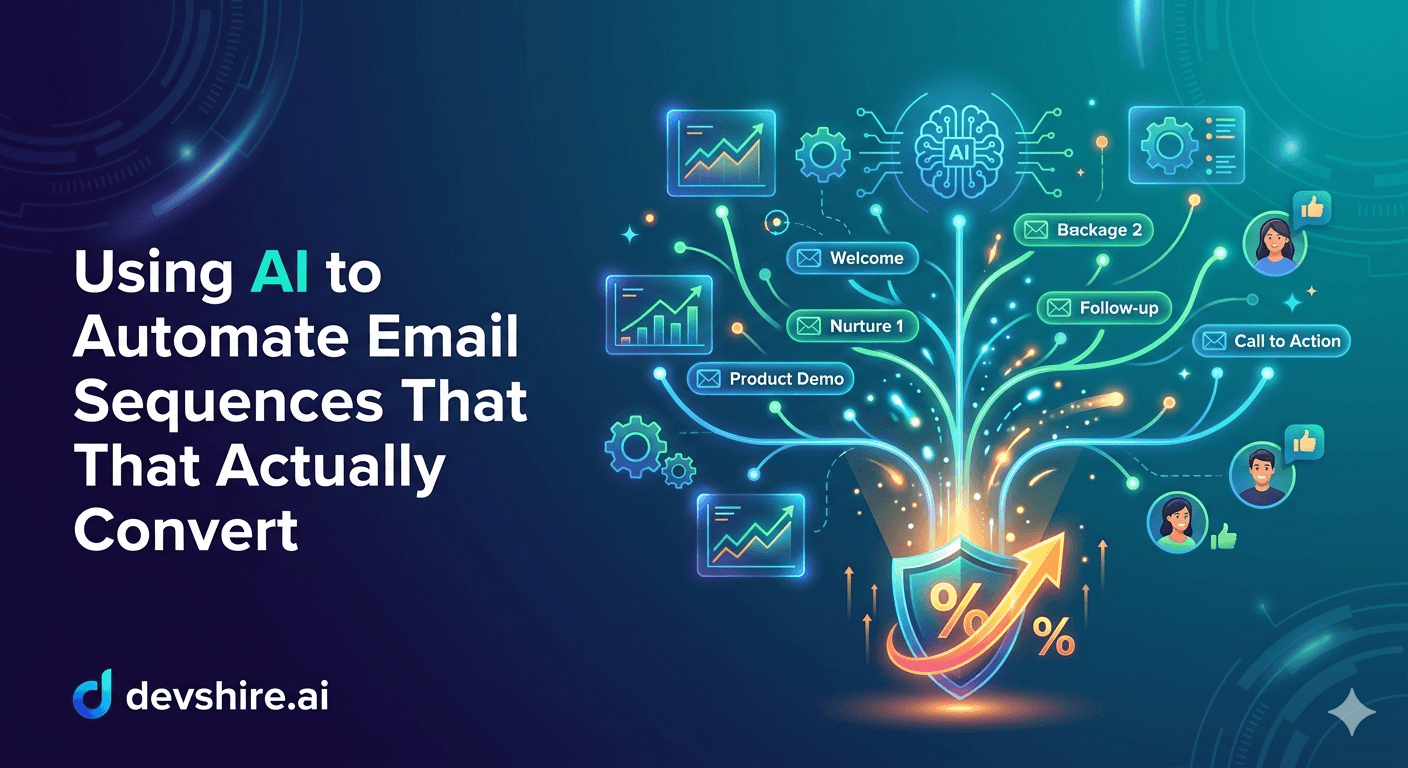
Your onboarding sequence has a 22% open rate. But only 4% of trial users are converting. You've tried tweaking subject lines. You've tested send times. Nothing's moved the needle. Here's the thing most teams don't want to hear: when conversion is that low, the copy isn't the problem. The segmentation is. You're sending the same sequence to a developer who signed up to test an API and a Head of Operations who wants to automate her team's workflows. Those are not the same email. And no amount of AI-generated copy improvements will fix a sequence that treats everyone like they're the same person. The teams using AI to build email sequences that actually convert aren't just generating better copy — they're building better systems. Here's the difference.
💡 TL;DR
AI can help you build email sequences that convert — but only if you've solved the segmentation problem first. A great sequence to the wrong audience converts at 2–4%. The same sequence, correctly segmented by role and intent, converts at 8–15%. Use AI for three things in email: generating segment-specific copy variants, analysing engagement patterns to identify what's working, and triggering behavioural sequences based on in-app activity. The copy is the easy part. The trigger logic and segmentation are where the leverage is.
Fix Your Segmentation Before You Touch the Copy
Most AI email guides start with prompts. I'm going to start somewhere more important.
You need to know who's in your list and what they need before any copy gets written. If you're sending the same onboarding sequence to a solo founder trialing your product and an enterprise team doing procurement evaluation, your sequence doesn't have a copy problem — it has a targeting problem. AI can't fix targeting. That's a data problem you need to solve upstream.
👤 Segment by intent signal, not demographics
Job title is a weak segmentation signal for SaaS. What matters more: what they did in their first session. Did they connect an integration? Invite a teammate? Use a specific feature? These actions tell you their intent far better than their LinkedIn title does. Build your segmentation logic around the first 24-hour in-app behaviour.
🎯 Define 3–4 segments maximum at first
The temptation is to create ten segments. Don't. Start with three or four meaningful ones. For a typical B2B SaaS: power users (high in-app activity in day one), passive signups (registered but haven't activated), team accounts (invited teammates), and API/technical users (integrated via API). Each of these needs a genuinely different sequence — different language, different value props, different CTAs.
Behaviour-Based Triggers: The Upgrade Most Teams Haven't Made
Time-based email sequences ("Day 1, Day 3, Day 7, Day 14") are the industry default because they're easy to set up. They also ignore everything the user actually did. A user who activated your core feature on day one and is already using it daily does not need your "Have you tried our core feature?" email on day three.
Behaviour-based triggers change this completely. The email fires when something specific happens — or doesn't happen — in the app. This is where AI adds real leverage, because you can use it to generate sequence copy for dozens of specific trigger conditions without manually writing each one.
Trigger | Sequence Type | Goal |
|---|---|---|
Signed up, no in-app activity in 24h | Activation nudge sequence (3 emails) | Get first action taken |
Completed core feature first use | Expansion sequence — next feature | Deepen engagement |
Invited 1+ teammates | Collaboration feature sequence | Drive team adoption |
No login in 7 days | Re-engagement sequence (2 emails) | Recover before they churn |
Viewed upgrade page 2+ times | High-intent conversion sequence | Close the upgrade |
That last trigger — viewed upgrade page twice — is the one most teams leave on the table. Someone who looks at your pricing page twice in three days is telling you something. An AI-generated sequence for that specific intent, sent within 30 minutes of the second view, routinely outperforms generic upgrade campaigns by 3–5x in conversion rate.
How to Actually Use AI to Write Sequence Copy
Once your segmentation is right and your triggers are defined, AI genuinely accelerates the copy generation. Here's the prompt structure that produces usable first drafts — not the generic output you get from a basic "write an email about" prompt.
1️⃣ Load the context: audience, trigger, and goal
"This email goes to: a SaaS product manager at a Series B company who signed up 24 hours ago, connected one integration, but hasn't run their first report. The goal: get them to run one report in the next 48 hours. Tone: direct and practical, not cheery. Under 120 words. No subject line with a question mark."
2️⃣ Specify what to avoid explicitly
"Avoid: 'just checking in', 'hope this finds you well', 'wanted to reach out', 'seamlessly', any opening that references the weather or time of year. The first sentence should not be a question. Don't end with 'Let me know if you have any questions.'" These negative constraints cut generic output dramatically.
3️⃣ Generate 3 variants and pick the strongest
Ask for three versions with different angles — one focused on outcome (what they'll be able to do), one focused on speed (how fast they can get there), one focused on a specific use case relevant to their segment. Pick the strongest, edit the human signals in, and test it against the current control.
[INTERNAL LINK: AI tools for productivity → devshire.ai/blog/ai-workflow-automation-dev-team]
Subject Lines: Where Most People Over-Engineer and Under-Test
Subject lines move open rates. Open rates don't move revenue. I've seen plenty of teams optimise their way to 40% open rates on sequences that convert at 2%. The subject line is not the bottleneck if your conversion rate is low — the body copy, the CTA, and the segmentation are.
That said, bad subject lines do cost you opens, so they're worth getting right. AI is genuinely useful here — not for generating the "perfect" subject line, but for generating 10 variants quickly so you can A/B test your way to what works for your specific audience.
The subject line rules that actually hold across B2B SaaS audiences: under 45 characters wins on mobile, specificity beats cleverness ("Your first report is 2 clicks away" beats "Don't miss this"), and first-name personalisation lifts opens by 10–15% on cold sequences but has almost no effect on warm user sequences where the sender is already known.
[EXTERNAL LINK: Litmus email benchmark report → litmus.com/email-client-market-share]
Trusted by 500+ startups & agencies
"Hired in 2 hours. First sprint done in 3 days."
Michael L. · Marketing Director
"Way faster than any agency we've used."
Sophia M. · Content Strategist
"1 AI dev replaced our 3-person team cost."
Chris M. · Digital Marketing
Join 500+ teams building 3× faster with Devshire
1 AI-powered senior developer delivers the output of 3 traditional engineers — at 40% of the cost. Hire in under 24 hours.
The Testing Framework: How to Know If It's Actually Working
Most teams measure open rate and call it done. But open rate tells you whether your subject line worked. It doesn't tell you whether your sequence drove the outcome you care about. Build your measurement framework around the action you're trying to drive, not the email metric.
📊 Measure the action, not the click
For an activation sequence, the metric is: what percentage of people who received this sequence activated within 7 days? Not click rate, not open rate. Did the sequence achieve its goal? Compare that against users who didn't receive the sequence (control group) to isolate the email's contribution.
🔬 Test one variable at a time
Testing subject line AND body copy AND send time simultaneously tells you nothing. Pick one variable per test. Run each test for a minimum of 2 weeks with at least 200 recipients per variant before drawing conclusions. Most email tests are called too early on too little data.
📅 Test send timing for your specific audience
Tuesday–Thursday, 9–11am local time is the generic best-practice answer. For developer audiences, evening sends (6–9pm) often outperform morning. For executive audiences, Friday morning has shown counterintuitively strong open rates in our experience. Test your actual audience — generic benchmarks are starting points, not rules.
The Tech Stack for AI-Powered Email Sequences
You need three things: a way to track in-app behaviour, a way to trigger emails based on that behaviour, and a tool to run and test the sequences. Here's what works at different stages.
Stage | Recommended Stack | Monthly Cost |
|---|---|---|
Early stage (<500 users) | Customer.io or Userlist + Segment | $100–$300 |
Growth stage (500–5,000 users) | Customer.io or Braze + product analytics | $400–$1,200 |
Scale (5,000+ users) | Braze or Iterable + data warehouse | $1,500+ |
Customer.io is the go-to for behaviour-triggered email at early to mid-stage SaaS — it connects to your event data, supports complex trigger logic, and has a clean sequence builder. Userlist is a simpler alternative focused specifically on SaaS onboarding. Both are meaningfully better than MailChimp or ConvertKit for product-triggered sequences.
[INTERNAL LINK: SaaS automation → devshire.ai/blog/automate-startup-backend-ai]
The Bottom Line
Low conversion rates are almost always a segmentation problem, not a copy problem. Fix the targeting before you touch the words.
Segment by first 24-hour in-app behaviour, not demographics. What users do in your product tells you their intent better than their job title.
Behaviour-based triggers outperform time-based sequences. A user who viewed your upgrade page twice in three days needs a sequence within 30 minutes — not your day-7 nurture email.
When using AI for email copy, load the context fully: audience, trigger event, goal, word count, and explicit phrases to avoid. Generic prompts produce generic copy.
Measure the action the email was designed to drive — not open rate or click rate. Did activation improve? Did upgrade rate lift? That's the metric.
Test one variable at a time with a minimum 200 recipients per variant over at least 2 weeks. Most email tests are called too early on too little data.
Customer.io is the right tool for behaviour-triggered sequences at early to mid-stage SaaS. MailChimp and ConvertKit are not built for product-triggered workflows.
Frequently Asked Questions
How do I use AI to write better email sequences?
Load the context fully before generating: who the recipient is (specific role, specific trigger event that put them in the sequence), what the email's single goal is, tone requirements, word count, and explicit phrases to avoid. Generate three variants with different angles and test them. The copy quality from AI improves dramatically with specific constraints — generic prompts produce generic copy. Fix your segmentation before optimising copy — bad targeting is a bigger conversion killer than weak copy.
What's the best tool for automated email sequences for SaaS?
Customer.io is the most capable tool for behaviour-triggered email sequences at early to mid-stage SaaS. It connects to your event data, supports complex trigger logic based on in-app behaviour, and has flexible sequence builders. Userlist is a simpler alternative focused specifically on SaaS onboarding. Both meaningfully outperform general-purpose tools like MailChimp for product-triggered workflows. At scale, Braze and Iterable are the enterprise-grade options.
What's a good email conversion rate for a SaaS onboarding sequence?
For trial-to-paid conversion via email, 8–15% is a strong benchmark for a properly segmented, behaviour-triggered sequence. If you're seeing 2–4%, it's almost always a segmentation issue — the same sequence is going to audiences with very different intent. Generic time-based sequences to unsegmented lists average 3–6% trial-to-paid conversion. Properly segmented behaviour-triggered sequences regularly hit 10–18% for high-intent segments.
Should I use time-based or behaviour-based email triggers?
Behaviour-based triggers outperform time-based for almost every SaaS use case. Time-based sequences send the same email to every user at the same point regardless of what they've done — which means you're sending activation emails to users who already activated, and upgrade prompts to users who just signed up. Behaviour-based triggers fire based on what actually happened (or didn't happen) in your app, making every email relevant to where the user actually is.
How many emails should be in an onboarding sequence?
For a SaaS product, 4–6 emails over the first 14 days covers the core onboarding window for most products. The right number depends on your activation timeline — a product where "aha moment" happens in 30 minutes needs fewer emails than one where it takes 2 weeks of use. Focus on the quality and relevance of each email over volume. An extra email that doesn't move behaviour is noise — and too much noise increases unsubscribes.
How do I segment email sequences for a SaaS product?
Start by identifying 3–4 meaningful segments based on first-session in-app behaviour: users who activated immediately (high engagement), users who browsed but didn't take a key action (low engagement), users who invited teammates (collaborative intent), and technical users who connected via API. Each segment needs genuinely different copy — different value props, different language, different CTAs. Segmenting by job title alone is a weak signal for most SaaS products.
What's the most important email metric to track for SaaS onboarding?
The metric that connects to revenue: what percentage of users who entered the sequence converted to paid (or activated, or reached the next milestone) within your defined window? Open rate tells you whether your subject line worked. Click rate tells you whether your CTA was compelling. Neither tells you whether the sequence achieved its goal. Always define the outcome metric before you build the sequence — then test against it.
Build Email Automation That's Wired to Your Product Behaviour
devshire.ai matches SaaS teams with developers who can build event-triggered email systems, Customer.io integrations, and behavioural segmentation pipelines — so your sequences fire at the right moment for the right users. Shortlist in 48–72 hours.
Find Your Automation Developer at devshire.ai →
No upfront cost · Shortlist in 48–72 hrs · Freelance & full-time · Stack-matched candidates
About devshire.ai — devshire.ai connects SaaS teams with developers who build real product-integrated automation. Every candidate passes a live proficiency screen. Typical time-to-hire: 8–12 days. Start hiring →
Related reading: Building a Customer Analytics Platform for SaaS · AI Workflow Automation for Dev Teams · Automate Your Startup Backend with AI · How to Build a Growth Dashboard Your Team Uses · How to Add AI Features to Your SaaS





Devshire Team
San Francisco · Responds in <2 hours
Hire your first AI developer — this week
Book a free 30-minute call. We'll match you with the right developer for your project and get you started within 24 hours.
<24h
Time to hire
3×
Faster builds
40%
Cost saved