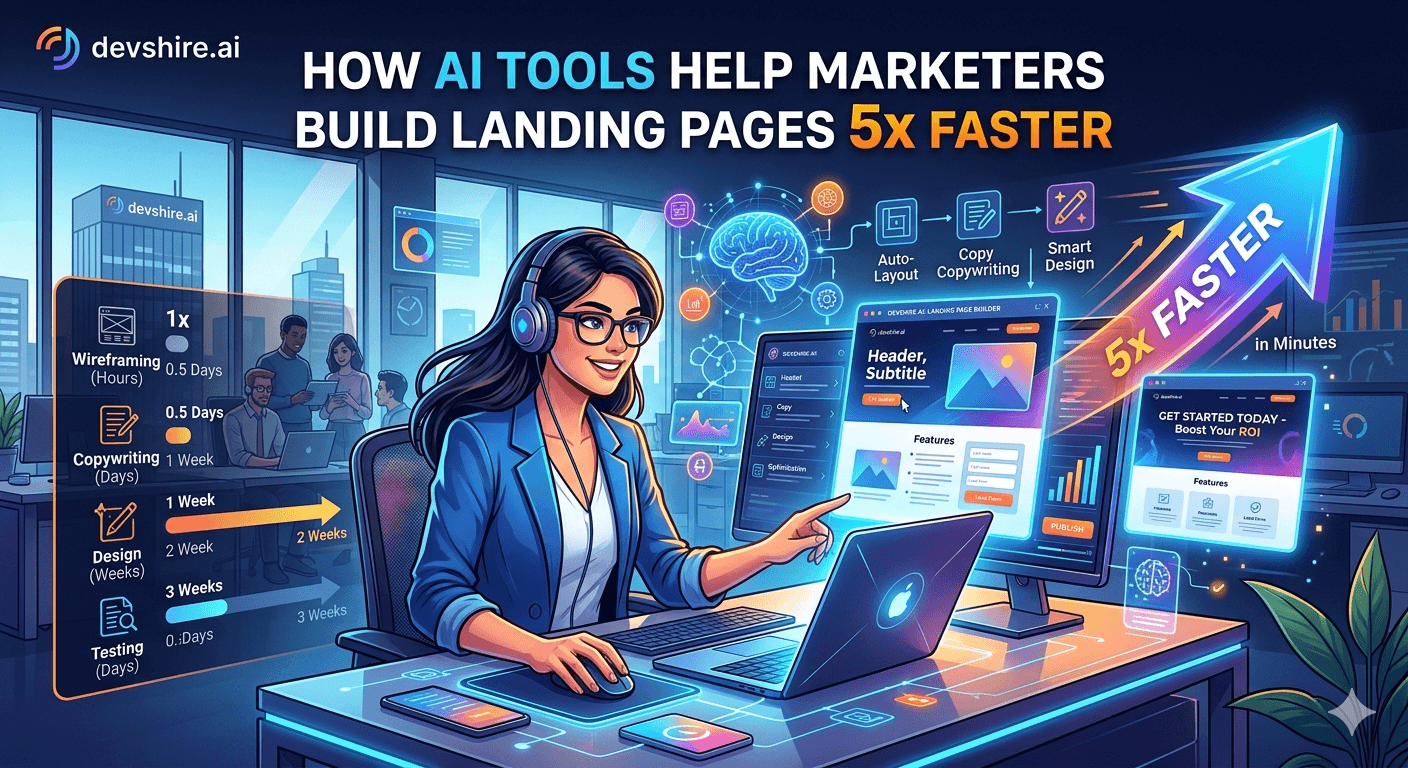
A landing page that used to take a week now takes a day. Not because the work is less important — because the bottlenecks have moved. Writing the first draft of copy used to be the slow part. With a well-prompted AI, a first draft of headline, subheadline, feature bullets, and CTA takes 20 minutes instead of two days. The time is now in refining, testing, and getting it live — not in staring at a blank page. But the speed advantage disappears fast if you're using AI tools wrong. Generic prompts produce generic output. And generic landing pages don't convert. Here's the workflow that actually produces fast, high-quality landing pages with AI — and where you still need human judgment to get the result right.
💡 TL;DR
AI tools can compress the landing page build cycle from 5–7 days to 1–2 days when used correctly. The speed comes from AI handling first-draft copy, section scaffolding, and initial image concepts — not from skipping the strategic thinking. The biggest mistake is prompting AI without giving it the positioning context it needs. Garbage in, garbage out. Arm the AI with your ICP, value prop, and competitors, and the output is usable. Skip that step and you'll spend more time fixing it than starting from scratch.
Where AI Actually Speeds Things Up
Not every part of the landing page build benefits equally from AI. Understanding which tasks accelerate and which still require human judgment is what separates teams that get genuine speed gains from those who feel like they're fighting the tool.
Task | AI speed gain | Human input still required |
|---|---|---|
First-draft headline copy | Very high — 10 options in 5 minutes | Positioning judgment to pick the right angle |
Feature bullet writing | High — structured output that's 80% there | Accuracy check against real product behaviour |
Section scaffolding | High — generates section order and headings | Judgement call on what to include vs cut |
Hero image concepts | Moderate — good for ideation, not production assets | Brand alignment and final asset production |
SEO meta description | High — fast and usually accurate | Keyword check and character limit review |
Strategic positioning | Low — AI doesn't know your market from the inside | This is entirely a human task |
Testimonial selection | None — AI can't pick what's credible to your audience | Entirely human judgment |
The pattern: AI handles volume and structure fast. Humans handle judgment, accuracy, and strategy. Teams that understand this distinction extract the full speed advantage. Teams that hand everything to AI end up with polished-looking pages that don't convert because the positioning is generic.
The Prompt Setup That Makes AI Copy Actually Usable
The biggest reason AI-generated landing page copy feels hollow is that the prompt didn't give the AI what it needed. Most people type "write a landing page for a project management SaaS" and then wonder why the output reads like every other project management SaaS landing page on the internet.
Give the AI your positioning context and the output changes dramatically.
🎯 ICP definition
Who is this page for, specifically? Not "marketers" — "marketing ops managers at B2B SaaS companies between 50 and 200 employees who are currently managing campaigns across three tools with no unified reporting." The more specific, the better the output. Vague ICP = generic copy.
🔑 One-sentence value proposition
Write the single sentence that captures what you do and for whom. Include the specific outcome. "We help B2B marketing teams unify campaign reporting across channels in one dashboard without BI tool setup" is a value proposition. "The best marketing tool" is not. Give this to AI verbatim and ask it to build copy around it.
⚔️ Competitor positioning context
Tell the AI what you're positioned against. "Buyers are currently using Looker or Tableau and find them too complex for their team's technical level" gives the AI enough context to write copy that addresses real objections instead of generic ones. Competitor context produces copy that differentiates; no context produces copy that could describe anyone.
💬 Voice and tone guidance
Give the AI three adjectives that describe your brand voice and one that explicitly does not. "Direct, plain-spoken, and confident — not corporate" produces a different output than the same brief without tone guidance. Include an example sentence that sounds like your brand if you have one.
The Full Workflow: From Brief to First Draft in Under 4 Hours
Here's the actual sequence that gets a landing page first draft done in a day using AI tools.
1️⃣ Write the positioning brief (30 minutes, no AI)
ICP, value proposition, main pain point addressed, top 3 features, competitors you're positioned against, tone. This is the input that determines everything else. Don't skip it or AI-generate it — positioning is a human strategic decision. Write it yourself, even if it's rough.
2️⃣ Generate the section scaffold (10 minutes with AI)
Paste your brief and ask for a landing page section structure: hero, problem statement, solution overview, feature highlights, social proof, pricing or CTA section, FAQ. Ask for 2–3 alternative orderings and pick the one that matches your conversion hypothesis.
3️⃣ Generate copy section by section (60–90 minutes with AI)
Don't ask for the entire page in one prompt. Prompt each section separately: "Write 5 headline variants for the hero section using this brief." Review, pick the best, then move to subheadline, then feature bullets. Section-by-section generation produces better output than one-shot full-page requests.
4️⃣ Human edit pass (60 minutes)
Read every sentence. Fact-check every claim against your actual product. Kill anything generic. Add specific numbers where you have them ("reduces setup time by 3 hours" instead of "saves you time"). This pass is what turns AI first-draft into publishable copy. Don't skip it.
5️⃣ Build in your page tool (60–120 minutes)
For marketers: Webflow, Framer, or Unbounce. Paste in your edited copy, add your product screenshots or mockups, and publish. AI layout tools like Framer AI can scaffold a visual structure — but you'll still need to refine the visual design to match your brand.
[INTERNAL LINK: A/B testing your landing page → devshire.ai/blog/ab-test-landing-page-ai-generated-variations]
The AI Tools Actually Worth Using for Landing Pages
The market for AI writing and design tools moves fast. Here's the current toolkit that produces real results for landing page work specifically.
✍️ Claude or ChatGPT for copy generation
Both produce strong landing page copy when given proper context. Claude tends to be stronger at maintaining a consistent voice across sections. ChatGPT's canvas mode is useful for iterating on a full document. Use either — the prompt quality matters more than the model choice at this use case.
🎨 Framer AI for layout scaffolding
Framer's AI can generate a full landing page layout from a text description. The output isn't production-ready, but it's a strong starting point that's faster than building from a blank canvas. Use it to get a structural wireframe, then replace the AI-generated copy with your edited version.
🖼️ Midjourney or DALL-E 3 for hero image concepts
Use AI image tools to explore visual directions for your hero section before committing to a photoshoot or custom illustration. Generate 10 concept directions in 20 minutes, pick the strongest, then invest in production-quality assets for that direction. It cuts the visual exploration phase significantly.
🔍 Clearscope or SurferSEO for on-page SEO
After your copy is written, run it through an AI SEO tool to check keyword coverage and content completeness. These tools tell you which related terms your competitors' ranking pages include that yours doesn't. Add what's missing, skip what doesn't fit your positioning.
[INTERNAL LINK: best AI SEO tools → devshire.ai/blog/best-ai-seo-tools-saas-startups-2026]
Trusted by 500+ startups & agencies
"Hired in 2 hours. First sprint done in 3 days."
Michael L. · Marketing Director
"Way faster than any agency we've used."
Sophia M. · Content Strategist
"1 AI dev replaced our 3-person team cost."
Chris M. · Digital Marketing
Join 500+ teams building 3× faster with Devshire
1 AI-powered senior developer delivers the output of 3 traditional engineers — at 40% of the cost. Hire in under 24 hours.
What AI Still Can't Do for Your Landing Page
The speed gains are real. But some things still require human judgment, and pretending otherwise produces pages that look polished but don't work.
🚫 AI can't tell you what your positioning should be
AI will write confidently in whatever direction you give it. It won't push back and say "actually, that's not a differentiated position." Competitive positioning strategy is a human decision that requires market knowledge, customer research, and judgment about where the real white space is. AI executes the strategy; it doesn't create it.
🚫 AI can't know which testimonials are credible to your audience
Social proof selection requires knowing what your buyers trust and why. A testimonial from a Fortune 500 logo might impress enterprise buyers and alienate SMB buyers. AI can format and rewrite testimonials but cannot make the selection judgment. That requires knowing your buyer's psychology.
🚫 AI can't fact-check claims about your product
If you ask AI to write feature bullets, it will write confident-sounding claims that may or may not accurately describe your product. Every AI-generated claim needs to be verified against your actual product behaviour. Publishing inaccurate claims on your landing page is worse than no claims at all.
The Bottom Line
AI compresses the landing page build cycle from 5–7 days to 1–2 days — when you use it for the right tasks. Copy first-drafts, section scaffolding, and image concept exploration are where AI delivers the highest speed gain.
The positioning brief — ICP, value proposition, competitor context, tone — must be written by a human before any AI prompt is run. Vague input produces generic output that takes longer to fix than writing from scratch.
Generate copy section by section, not the whole page at once. Section-by-section prompting produces better output and is easier to review and refine.
The human edit pass is not optional. Fact-check every claim. Kill generic sentences. Add specific numbers. This is what turns AI first-draft into copy that actually converts.
Framer AI can scaffold a layout structure. Midjourney or DALL-E 3 can explore visual directions. Neither produces production-ready assets — they reduce exploration time before you invest in final production.
AI can't determine your positioning, select your social proof, or fact-check claims about your own product. These remain human tasks regardless of how good the tools get.
A/B test the AI-generated variations against your current page. Speed of production means you can run more tests — take advantage of that.
Frequently Asked Questions
Can AI write a landing page that actually converts?
Yes — with the right input. AI-generated landing page copy can convert well when it's built on accurate positioning context (ICP, value proposition, competitor differentiation) and then refined by a human editor. The failure mode is using AI without providing this context, which produces generic copy that looks professional but doesn't speak specifically enough to convert. AI writes; human judgment drives positioning.
What's the best AI tool for writing landing page copy?
Claude and ChatGPT are both strong for landing page copy — the quality difference at this use case is smaller than the prompt quality difference. For longer-form consistency across sections, Claude tends to maintain voice better. For iterating on a full document in one view, ChatGPT's canvas mode is useful. The tool matters less than the briefing context you give it.
How much faster is AI at building landing pages?
For the copy-writing portion specifically, AI compresses first-draft time from 1–2 days to 2–4 hours with a good workflow. The full landing page cycle — strategy, copy, design, build, QA — goes from 5–7 days to 1–2 days when AI assists with the copy and layout scaffolding steps. The strategy and design refinement phases remain time-intensive regardless of tools.
What information should I give AI before asking it to write landing page copy?
At minimum: your ICP (specific, not "marketers"), your one-sentence value proposition, the main pain point your product addresses, the 3–5 features you're highlighting, what competitors you're positioned against and how you differ, and your brand voice (3 adjectives + 1 to avoid). With this context, AI output is 70–80% usable. Without it, you'll spend more time editing than if you'd written it yourself.
Can AI help with landing page design, not just copy?
Yes, with limitations. Framer AI can generate a structural layout from a text description — useful for scaffolding sections and getting a starting point faster. Midjourney and DALL-E 3 can generate hero image concepts for visual direction exploration. Neither produces production-ready design. Use AI for direction and scaffolding, then invest in proper brand-aligned design for the final output.
Will Google penalise AI-generated landing page content?
Google's guidance is that it evaluates content quality, not content origin. AI-generated content that's accurate, helpful, and demonstrates expertise is treated the same as human-written content that meets the same bar. AI-generated content that's generic, inaccurate, or thin will underperform — not because it was AI-generated, but because it fails the quality bar. The human edit pass that adds specificity, accuracy, and expertise is what protects against quality issues.
Should I A/B test AI-generated copy against my current landing page?
Yes — and the speed advantage of AI makes this more viable than it used to be. When generating copy takes hours instead of days, you can produce 3–4 test variants in a week and run proper A/B tests. The higher volume of variations means faster learning about what resonates with your audience. [INTERNAL LINK: landing page A/B testing → devshire.ai/blog/ab-test-landing-page-ai-generated-variations]
Need a Developer to Build and Integrate Your Landing Pages?
devshire.ai matches SaaS teams with developers who can build fast, conversion-optimised landing pages, integrate A/B testing infrastructure, and connect pages to your analytics and CRM systems. Get a pre-vetted shortlist in 48–72 hours.
Start Your Search at devshire.ai →
No upfront cost · Shortlist in 48–72 hrs · Freelance & full-time · Stack-matched candidates
About devshire.ai — devshire.ai matches AI-powered engineering talent with product teams that move fast. Every developer has passed a live proficiency screen. Typical time-to-hire: 8–12 days. Start hiring →
Related reading: How to A/B Test Your Landing Page With AI-Generated Variations · Best AI SEO Tools for SaaS Startups in 2026 · How to Use AI to Write 10x More Content Without Losing Quality · Using AI to Automate Email Sequences That Actually Convert · How to Build a Programmatic SEO Strategy for a B2B SaaS Site







Devshire Team
San Francisco · Responds in <2 hours
Hire your first AI developer — this week
Book a free 30-minute call. We'll match you with the right developer for your project and get you started within 24 hours.
<24h
Time to hire
3×
Faster builds
40%
Cost saved