
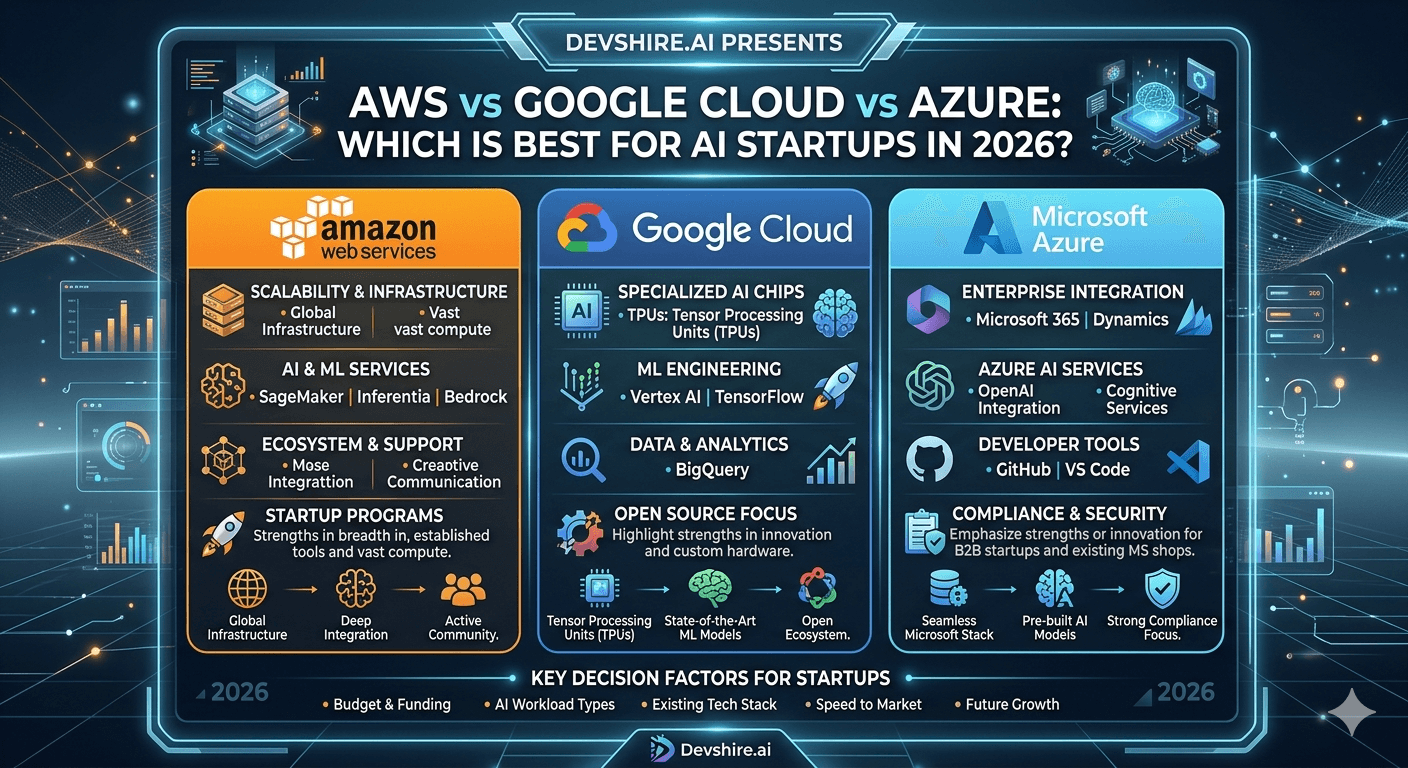
Every AI startup faces this decision early: pick a cloud platform and start building. The wrong choice costs you in migration pain 12 months later. The right choice gives you the infrastructure, managed AI services, and pricing model that match how your product actually works. But the comparison articles you'll find mostly compare marketing pages instead of production realities. So here's what actually matters in 2026: which AI services are mature enough to trust in production, which startup credit programmes are real (not just discounted sales calls), how pricing models behave at growth-stage scale, and where the engineering friction lives that polished demos hide. Tested against real AI startup architecture decisions, not vendor documentation.
💡 TL;DR
For AI startups in 2026: AWS is the safest default with the deepest ecosystem and highest ceiling on what you can build. Google Cloud wins on AI/ML infrastructure specifically — Vertex AI, TPUs, and Gemini integration are genuinely ahead. Azure wins if you need Microsoft enterprise integration or are building on OpenAI models (Microsoft has exclusive infrastructure access). Most startups should default to AWS unless they have a specific reason to choose otherwise. All three offer startup credit programmes worth evaluating before you pay full price.
Head-to-Head: What Actually Matters for AI Startups
Factor | AWS | Google Cloud | Azure |
|---|---|---|---|
AI/ML infrastructure maturity | Strong (Bedrock, SageMaker) | Best-in-class (Vertex AI, TPUs) | Strong (Azure AI, OpenAI integration) |
General infrastructure depth | Widest service catalogue | Narrower but solid | Solid, Microsoft-ecosystem integrated |
Startup credits | AWS Activate: up to $100k | Google for Startups: up to $200k | Azure for Startups: up to $150k |
LLM model access | Bedrock: Claude, Llama, Mistral, Titan | Vertex: Gemini, Llama, Claude | Azure OpenAI: GPT-4, o-series (exclusive) |
Serverless / functions | Lambda (mature, wide ecosystem) | Cloud Functions (solid) | Azure Functions (solid, .NET optimised) |
Managed Kubernetes | EKS (robust) | GKE (arguably best managed K8s) | AKS (solid) |
Pricing predictability | Moderate — egress fees can surprise | Moderate — sustained use discounts help | Moderate — enterprise agreements help large teams |
AWS: The Honest Assessment for AI Startups
AWS is the default because it has the widest service catalogue, the deepest documentation, the largest community, and the most StackOverflow answers for when things break. That last point matters more than people admit — debugging production issues is faster when thousands of teams have hit the same problem before you.
For AI specifically: Amazon Bedrock gives you access to Claude (Anthropic), Llama, Mistral, and Amazon's own Titan models via a unified API with IAM integration. SageMaker handles the full ML training and deployment pipeline. The integrations with S3, Lambda, and VPC are clean and well-documented.
⚠️ The AWS catch
Egress costs. AWS charges you to move data out of AWS — to users, to other services, to anywhere. For AI applications with high-bandwidth outputs (images, video, large documents), this adds up fast and doesn't show up in initial estimates. Run your expected egress volume through the pricing calculator before committing to architecture decisions that involve large output sizes.
Google Cloud: The Honest Assessment for AI Startups
Google Cloud's AI infrastructure is genuinely ahead. Vertex AI is more cohesive and better integrated than SageMaker. TPUs give you custom silicon for training workloads that can be significantly more cost-efficient than GPU clusters for specific model architectures. And as the organisation that invented the transformer architecture and employs a large portion of the world's top AI researchers, Google's model capabilities and tooling depth are not to be dismissed.
The honest limitation: Google has a well-documented track record of deprecating services. This makes architecture decisions that depend heavily on Google-proprietary services (not just commodity services like VMs and storage) carry more risk than equivalent AWS bets. If you're building on Vertex AI specifically, evaluate how dependent your architecture becomes on Google-specific features that have no AWS/Azure equivalent.
Google for Startups offers up to $200k in cloud credits — the largest of the three major programmes. If you're eligible, this is meaningful capital for an early-stage team.
Azure: The Honest Assessment for AI Startups
Azure's strongest card for AI startups in 2026 is the Microsoft-OpenAI relationship. Azure OpenAI Service gives you GPT-4, o1, and o3 model access through Microsoft's infrastructure — the same models as api.openai.com but with enterprise data handling agreements, regional deployment, and tighter compliance controls. For startups building on OpenAI models who need enterprise customers, Azure OpenAI is often the path that unblocks deals.
Beyond the OpenAI angle: Azure is the natural choice if your team is deep in the Microsoft ecosystem (Visual Studio, GitHub, Active Directory, Dynamics). The integration depth with Microsoft tools is genuinely better than AWS or GCP equivalents. For startups targeting enterprise sales cycles where Microsoft is a procurement pathway, Azure alignment also has commercial advantages.
[INTERNAL LINK: best tech stack for startups → devshire.ai/blog/best-tech-stack-startup-2026]
Trusted by 500+ startups & agencies
"Hired in 2 hours. First sprint done in 3 days."
Michael L. · Marketing Director
"Way faster than any agency we've used."
Sophia M. · Content Strategist
"1 AI dev replaced our 3-person team cost."
Chris M. · Digital Marketing
Join 500+ teams building 3× faster with Devshire
1 AI-powered senior developer delivers the output of 3 traditional engineers — at 40% of the cost. Hire in under 24 hours.
Startup Credit Programmes: What You're Actually Getting
All three major cloud platforms have startup credit programmes. These are worth pursuing seriously — but they're not all equal in terms of access requirements, credit applicability, and what happens when credits run out.
🟠 AWS Activate
Up to $100k in AWS credits. Accessible via the Activate portal directly or through accelerators and VCs in the AWS Activate network. Credits apply to most AWS services including Bedrock. Best path: apply via a recognised accelerator or VC firm for faster approval and higher credit tiers.
🔵 Google for Startups Cloud Program
Up to $200k over two years for eligible startups. The highest nominal credit value of the three. Apply via the Google for Startups portal — approval is reasonably fast for qualifying companies. Credits apply broadly including Vertex AI and BigQuery. The year two credit tier requires meeting year one usage milestones.
🟦 Microsoft for Startups Founders Hub
Up to $150k in Azure credits plus access to GitHub, Microsoft 365, and other Microsoft tools. The Azure OpenAI access included in this programme is particularly valuable for startups building on GPT-4 models. Application is via the Founders Hub portal and is accessible to early-stage companies without requiring VC backing.
The Bottom Line
Default to AWS unless you have a specific reason not to. The ecosystem depth, documentation quality, and community size reduce debugging time and hiring friction significantly.
Choose Google Cloud if your AI workload is training-heavy (TPU advantage), if Vertex AI's cohesion matters for your team's workflow, or if the larger startup credit amount is a material factor.
Choose Azure if you're building on OpenAI models and need enterprise data handling agreements, or if your team and target customers are deep in the Microsoft ecosystem.
All three have startup credit programmes worth applying for before paying full price. Google for Startups offers the highest nominal credits ($200k). Apply via accelerator networks for faster access to higher AWS Activate tiers.
Egress costs on AWS can surprise you. Model your expected data transfer volumes before committing to architectures with high output bandwidth requirements.
Google's service deprecation history is a real risk factor for architecture decisions that depend heavily on Google-proprietary managed services. Evaluate lock-in depth before going all-in on Vertex AI features with no cloud-agnostic alternative.
Frequently Asked Questions
Which cloud platform is best for AI startups in 2026?
AWS is the safest default with the broadest ecosystem and the most documentation. Google Cloud is the best choice for AI/ML infrastructure specifically — Vertex AI and TPU access are genuinely ahead. Azure is the best choice if you're building on OpenAI models and need enterprise compliance, or if your team is Microsoft-ecosystem-native. Most startups should default to AWS unless they have a specific reason to choose otherwise.
Does AWS Bedrock or Google Vertex AI have better AI model access?
Both have strong model access. AWS Bedrock includes Claude (Anthropic), Llama, Mistral, Cohere, and Amazon Titan. Google Vertex AI includes Gemini, Claude, and Llama. Azure OpenAI Service includes GPT-4 and OpenAI's o-series models with exclusive infrastructure access. The key differentiator is which models your application depends on — if OpenAI is central to your architecture, Azure's exclusive GPT-4 infrastructure access matters. If you want model provider flexibility, Bedrock and Vertex both support multi-model architectures.
How much in cloud credits can AI startups get in 2026?
AWS Activate: up to $100k. Google for Startups: up to $200k over two years. Microsoft for Startups Founders Hub: up to $150k. The actual amount accessible depends on your company stage, VC/accelerator affiliations, and application timing. Apply to all three programmes — they're not mutually exclusive — and use credits to validate architecture decisions before committing paid spend.
What are the hidden costs of AWS for AI startups?
Data egress fees are the most common surprise. AWS charges for data transferred out of its network — to users, to partner services, to anywhere external. For AI applications generating large outputs (images, long document completions, video), egress costs scale with usage and don't appear in initial prototype estimates. Also watch for EC2 instance scheduling inefficiencies (instances running idle), and Lambda cold start latency costs that affect real-time AI inference use cases.
Is Google Cloud a risk for startups because of its service deprecations?
It's a real risk factor that deserves consideration in architecture decisions. Google has deprecated products across most of its portfolio at various points — the risk is not zero. For commodity services (VMs, object storage, managed databases), the risk is low. For Google-proprietary managed services with no cloud-agnostic equivalent, evaluate carefully how deep your architecture's dependency goes. Building on Vertex AI features that exist identically as open-source alternatives is lower risk than building on Google-only managed services.
Can I use multiple cloud providers as an AI startup?
Yes, and it's increasingly common — particularly using a primary cloud (AWS or GCP) for infrastructure and Azure OpenAI specifically for model access under enterprise data agreements. Multi-cloud adds operational complexity and should be a deliberate decision, not an accident. If you're accessing LLM APIs from providers that aren't your primary cloud, manage API key security carefully and consider routing these calls through your primary cloud's networking for compliance.
What cloud platform do most AI startups use in 2026?
AWS still leads in total adoption among early-stage startups, driven by ecosystem familiarity and the breadth of available services. Google Cloud has the highest growth rate among AI-focused startups, particularly those doing model training and fine-tuning. Azure has strong enterprise startup adoption, particularly for companies targeting Microsoft-centric enterprise customers. The market isn't monolithic — stack choice increasingly follows the specific AI services required, not just brand familiarity.
Need a Developer Who Knows Your Cloud Stack?
devshire.ai matches AI startups with developers experienced in AWS, GCP, and Azure AI infrastructure — not just general cloud work. Get a stack-matched shortlist in 48–72 hours.
Start Your Search at devshire.ai →
No upfront cost · Shortlist in 48–72 hrs · Freelance & full-time · Stack-matched candidates
About devshire.ai — devshire.ai matches AI-powered engineering talent with startups building on modern cloud infrastructure. Every developer has passed a live proficiency screen. Typical time-to-hire: 8–12 days. Start hiring →
Related reading: Best Tech Stack for Startups in 2026 · How to Automate Your Startup Backend With AI · API-First SaaS Development · How to Scale Your MVP to 10k Users · Startup CTO for Hire







Devshire Team
San Francisco · Responds in <2 hours
Hire your first AI developer — this week
Book a free 30-minute call. We'll match you with the right developer for your project and get you started within 24 hours.
<24h
Time to hire
3×
Faster builds
40%
Cost saved