
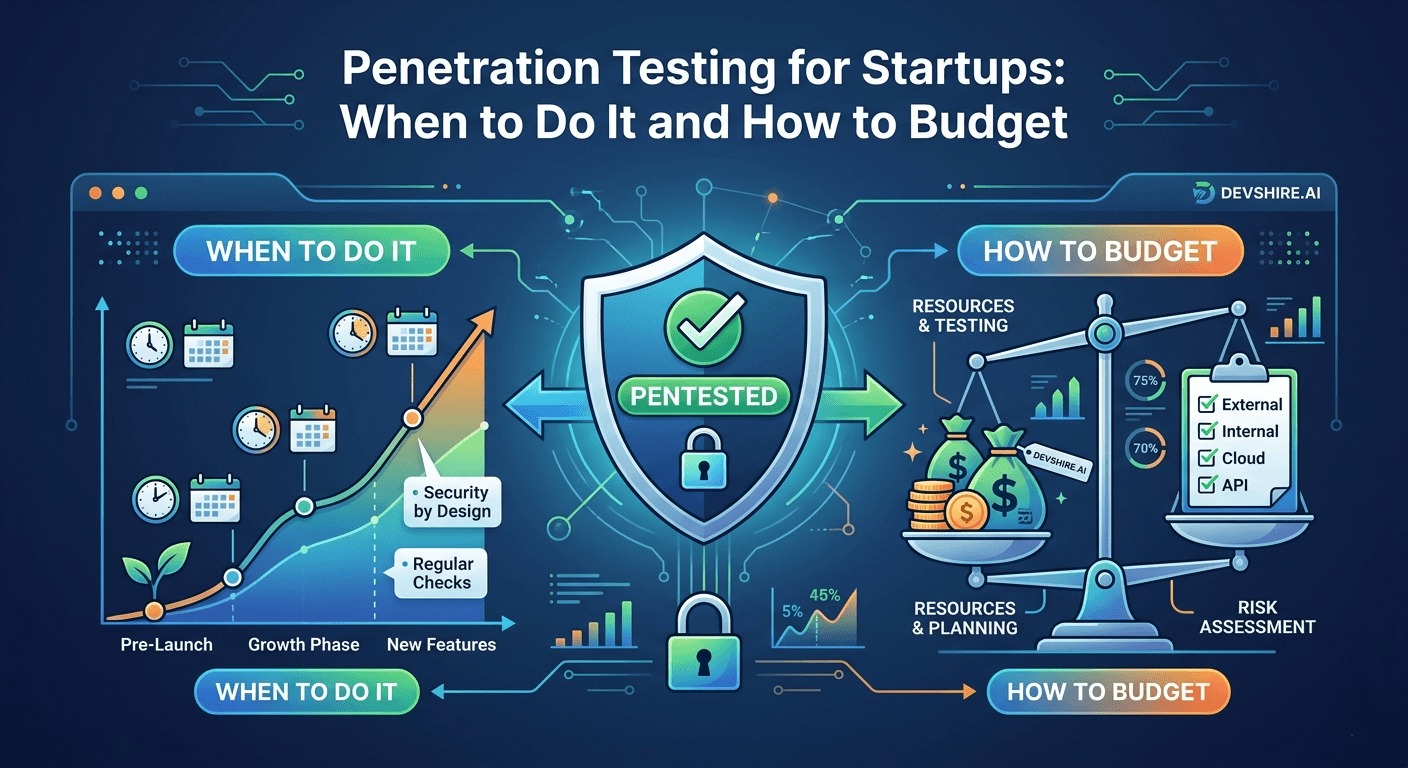
A prospect asks for your penetration test report. You don't have one. So you scramble, find a firm, pay $8,000, and get back a report full of findings you could have fixed yourself in a week. That's the wrong order of operations — and it's how most startups experience their first penetration test. Not as a proactive security exercise. As a checkbox for a deal that's already stalled. Penetration testing is genuinely valuable. But only at the right stage, with the right scope, and after you've done the internal security work that makes the external test meaningful. Here's when to get a penetration test, what it actually costs, how to prepare so you're not paying $10,000 for a report full of npm audit findings, and how to use the results once you have them.
💡 TL;DR
Penetration testing for startups makes sense at two specific stages: before your first enterprise deal closes (usually $20K+ ARR), and before SOC 2 Type II certification. Before that, an internal security audit is faster and cheaper and fixes the same issues. A web application pen test costs $5,000–$20,000 depending on scope and firm. Prepare by closing obvious gaps first — otherwise you're paying a specialist firm to tell you what npm audit already shows. The test report is a sales asset and a compliance artefact, not a substitute for building security in.
When You Don't Need a Penetration Test Yet
Honestly? Most pre-revenue startups don't need a penetration test. They need a security audit. The two sound similar but they're completely different in cost, scope, and what they actually find.
A penetration test is an adversarial simulation — a skilled tester actively attacks your application using real techniques to find vulnerabilities you missed. It's valuable. But it's most valuable after your internal security posture is reasonably solid. If your app has basic OWASP issues — SQL injection in query handlers, missing rate limiting on login, broken access control across accounts — a penetration tester will find all of those in the first two hours. You'll get a $10,000 report that looks like a beginner's mistake list. And you could have found every item on that list yourself.
The signal that you're ready for a penetration test is that your internal audit found things you fixed, not things you're still working on. If you can answer yes to these questions, you're ready: Have you run a two-account access control test and confirmed no cross-account data leakage? Are all dependencies current with no high or critical CVEs? Are passwords hashed with bcrypt or Argon2id? Is your TLS configuration scoring A or A+ on SSL Labs? If any answer is no, fix those first.
⚠️ The most common pen test waste
Engaging an external penetration testing firm before closing your obvious security gaps. You'll pay specialist rates for findings that a 30-minute internal audit would have surfaced. The penetration tester's value is in finding chained vulnerabilities, business logic flaws, and second-order issues — not in telling you that you're running an outdated dependency with a known CVE.
The Two Right Times to Get a Penetration Test
There are two specific stages where a penetration test provides clear return on investment. Outside of these two windows, you're probably better served by internal security work and automated scanning.
💼 Stage 1 — Before your first enterprise deal closes
Enterprise security questionnaires routinely ask whether you've had a third-party penetration test in the last 12 months. The answer "no" doesn't always kill deals — but it slows them down and sometimes kills them. A web application penetration test report from a credible firm, with a remediation summary showing you fixed the findings, is a sales asset. Budget for this once you're actively in enterprise sales conversations, typically when you're targeting contracts over $20,000 ARR.
📋 Stage 2 — Before SOC 2 Type II certification
SOC 2 doesn't require a penetration test — but most auditors and many enterprise customers expect to see one as evidence of a mature security programme. Running a penetration test 3–6 months before your SOC 2 audit window closes gives you time to remediate findings and include the remediation in your evidence package. It also demonstrates to the auditor that you're proactively looking for vulnerabilities, not just reactively patching them when found.
What Penetration Testing Actually Costs in 2026
Pricing varies significantly by firm type, scope, and how you structure the engagement. Here's what real pricing looks like across the different tiers available to startups.
Firm Type | Cost Range | Turnaround | Best For |
|---|---|---|---|
Automated + light manual (HackerOne, Cobalt) | $3,000–$7,000 | 1–2 weeks | First pen test, limited budget, clear scope |
Mid-tier boutique firm | $7,000–$15,000 | 2–4 weeks | Pre-enterprise sales, SOC 2 preparation |
Top-tier security consultancy | $15,000–$40,000+ | 4–8 weeks | Regulated industries, high-value targets, compliance mandates |
Bug bounty programme (ongoing) | $500–$5,000/month + bounties | Ongoing | Post-launch continuous testing |
For most early-stage SaaS startups, the mid-tier boutique firm sweet spot — $7,000–$12,000 for a web application test — gives you a credible report that satisfies enterprise security questionnaires without the premium pricing of the big-name consultancies. The automated platforms like Cobalt.io are faster and cheaper, but the report quality varies more and some enterprise security teams specifically ask for a named human-led engagement.
Scoping the Test — What to Ask For
The scope of your penetration test determines what the tester examines — and what they don't. A poorly scoped test is expensive and incomplete. Here's what most SaaS startups should include in a web application penetration test scope.
🌐 Web application testing
The core of most SaaS penetration tests. Covers authentication flows, session management, access control, injection vulnerabilities, business logic flaws, and API security. Provide the tester with test accounts at multiple privilege levels — admin, regular user, billing role — so they can test horizontal and vertical privilege escalation.
🔌 API testing
If your SaaS has a public API or an API consumed by a frontend, include it in scope. API endpoints are often tested less thoroughly than web UI flows and frequently have different access control implementations. Provide API documentation and test credentials. Ask the firm specifically to test for BOLA (Broken Object Level Authorisation) — it's the API equivalent of broken access control and extremely common.
☁️ Cloud configuration review (optional but recommended)
A cloud configuration review assesses your AWS/GCP/Azure setup against security benchmarks. It's often sold as an add-on and costs $2,000–$5,000 extra. Worth doing if you haven't run an internal cloud posture review already. If you have run Prowler or AWS Security Hub and fixed the findings, skip the external review for now — you've already covered the same ground.
Trusted by 500+ startups & agencies
"Hired in 2 hours. First sprint done in 3 days."
Michael L. · Marketing Director
"Way faster than any agency we've used."
Sophia M. · Content Strategist
"1 AI dev replaced our 3-person team cost."
Chris M. · Digital Marketing
Join 500+ teams building 3× faster with Devshire
1 AI-powered senior developer delivers the output of 3 traditional engineers — at 40% of the cost. Hire in under 24 hours.
Using the Penetration Test Report — What Comes After
A penetration test report without a remediation plan is a liability document, not a security improvement. Here's what to do with the findings once you have them.
First, triage. Most reports use a CVSS score or a severity rating (critical, high, medium, low). Fix every critical finding within 7 days of receiving the report. High findings within 30 days. Medium findings within 90 days. Low findings go on the backlog. Document your remediation against each finding — this becomes your evidence trail for compliance purposes.
Second, request a retest. Most firms include a retest of critical and high findings in the engagement fee — confirm this before signing. After you've remediated, the tester retests the specific vulnerabilities and issues an updated report. This updated report, showing that critical findings were identified and fixed, is more valuable as a sales artefact than the original report showing open vulnerabilities.
Third, share strategically. Enterprise customers want to see the summary and the remediation status — not necessarily the full technical report with exploitation details. Most firms issue an executive summary specifically for this purpose. Share the executive summary and remediation confirmation with prospects. Retain the full technical report internally.
When Penetration Testing Isn't the Right Move Yet
If you're pre-revenue, pre-enterprise-sales, and under 12 months post-launch, penetration testing is probably not the highest ROI security investment. What gets you further for less money:
A bug bounty programme through HackerOne or Bugcrowd costs a few hundred dollars a month plus bounty payments when researchers find real vulnerabilities. You get ongoing adversarial testing from a community of researchers, you only pay for valid findings, and you can start at almost any stage. The downside is you don't get the formal report that enterprise security teams want to see — but for early-stage continuous testing, it's excellent value.
An automated DAST scan (Dynamic Application Security Testing) using OWASP ZAP or Burp Suite Community runs against your staging environment and catches many of the same surface-level findings a penetration test would find in its first hour. Free tools, one afternoon to set up, runs continuously in your CI pipeline. Not a substitute for a full penetration test — but a way to catch the obvious issues before you pay a firm to find them for you.
The Bottom Line
Run an internal security audit before you engage a penetration testing firm. Paying specialist rates to find npm audit vulnerabilities is the most common pen test waste in startups.
The two right times for a penetration test are: before your first enterprise deal closes (typically over $20K ARR), and 3–6 months before your SOC 2 Type II audit window closes.
Web application penetration tests cost $5,000–$15,000 for most startup scopes. Automated platforms like Cobalt.io are cheaper and faster; mid-tier boutique firms produce more credible reports for enterprise sales.
Always include API testing in scope — not just the web UI. BOLA (Broken Object Level Authorisation) is among the most common API vulnerabilities and is frequently missed in web-only tests.
Fix critical findings within 7 days of receiving the report. Request a retest of critical and high findings. The remediated report is the sales asset — not the initial report with open vulnerabilities.
A bug bounty programme provides ongoing adversarial testing and is better value than a penetration test for early-stage startups who don't yet need the formal report.
Share the executive summary with enterprise prospects — not the full technical report. Most firms issue an executive summary specifically for this purpose.
Frequently Asked Questions
What is penetration testing for SaaS startups and why do you need it?
Penetration testing is an authorised adversarial simulation where a security professional actively tries to breach your application using real attack techniques. Startups need it primarily for two reasons: to satisfy enterprise customer security requirements (most enterprise security questionnaires ask whether you've had a third-party pen test in the last 12 months), and to find vulnerabilities that automated scanning and internal review miss — particularly chained attacks and business logic flaws.
How much does penetration testing cost for a startup?
A web application penetration test for a typical SaaS startup costs $5,000–$15,000 from a mid-tier boutique firm. Automated platforms (Cobalt.io, Synack) run $3,000–$7,000. Top-tier consultancies charge $15,000–$40,000 or more. Most startups don't need the top tier — a credible mid-tier firm produces a report that satisfies enterprise security reviews and provides genuine security value at a defensible cost.
When should a SaaS startup get its first penetration test?
The right trigger is enterprise sales activity — specifically when you're actively closing deals with customers who require a penetration test report as part of their vendor security review. For most SaaS startups, this happens between $200K and $1M ARR. Before that threshold, an internal security audit and automated scanning tools provide more ROI than a penetration test.
What should be included in a SaaS penetration test scope?
At minimum: the web application (all authenticated and unauthenticated flows), the API (with documentation and test credentials at multiple privilege levels), and your authentication system. Optionally: cloud configuration review if you haven't run an internal cloud posture assessment. The more test accounts and documentation you provide the tester, the more efficient and thorough the engagement will be.
What's the difference between a penetration test and a vulnerability scan?
A vulnerability scan is automated — a tool runs against your application or infrastructure and compares what it finds against known vulnerability signatures. It catches known, catalogued issues. A penetration test involves a skilled human tester who actively exploits vulnerabilities, chains them together, and finds issues that automated tools can't detect — particularly business logic flaws, insecure design, and complex authorisation bypass scenarios. You need both: automated scanning continuously, penetration testing at key milestones.
How do I choose a penetration testing firm?
Look for firms with web application focus specifically (not general IT security), a CREST or OSCP certification on their testers, and a sample report you can review before engaging. Ask how many testers will work on your engagement and what their individual backgrounds are. Avoid firms that can't clearly explain their methodology or won't share a sample report. Get quotes from at least three firms — pricing and quality vary significantly even at the same tier.
Is a bug bounty programme a substitute for penetration testing?
Not quite — but it's a complement. A bug bounty programme provides ongoing, continuous adversarial testing from a community of researchers and is excellent value for early-stage startups. What it doesn't provide is the formal report with a defined scope and methodology that enterprise security teams and compliance auditors expect. Once you need that formal report, you need a penetration test. Until then, a bug bounty programme through HackerOne or Bugcrowd is a strong alternative.
Build the Security Foundation Before the Pen Test — Hire Right
devshire.ai matches SaaS teams with pre-vetted developers who build security-first from day one. By the time your penetration test runs, your internal security posture is solid — so the test finds the things that actually matter, not basic hygiene issues.
Find a Security-Aware Developer at devshire.ai →
No upfront cost · Shortlist in 48–72 hrs · Freelance & full-time · Stack-matched candidates
About devshire.ai — devshire.ai matches AI-powered engineering talent with SaaS product teams. Every developer in the network has passed a live proficiency screen covering tool use, output validation, and real codebase review. Freelance and full-time options. Typical time-to-hire: 8–12 days. Start hiring →
Related reading: Security Audit Before SaaS Launch · SaaS Security Best Practices · SOC 2 Compliance for Developers · OWASP Top 10 for SaaS · MVP Development Cost in 2026 · SaaS Development Company vs Freelance







Devshire Team
San Francisco · Responds in <2 hours
Hire your first AI developer — this week
Book a free 30-minute call. We'll match you with the right developer for your project and get you started within 24 hours.
<24h
Time to hire
3×
Faster builds
40%
Cost saved