
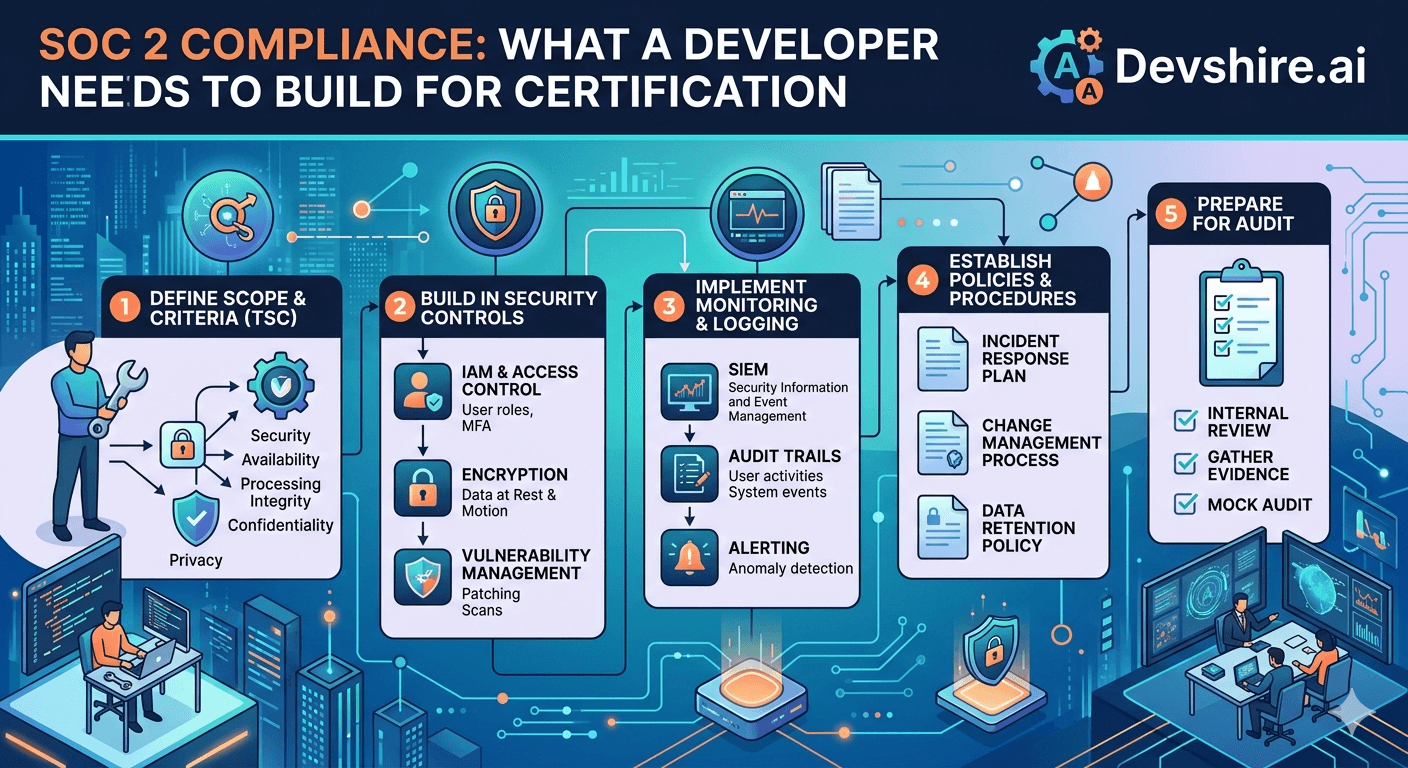
The enterprise prospect is interested. The sales call went well. Then their security team sends over a vendor questionnaire and the last item reads: "Please attach your SOC 2 Type II report." You don't have one. The deal stalls. This happens constantly to SaaS companies between $500K and $5M ARR — the moment enterprise customers show up and discover there's no compliance report to send them. SOC 2 compliance isn't a bureaucratic formality. It's a sales enabler. And the path to getting it runs directly through your engineering team. Most guides treat SOC 2 as an audit you prepare for. The smarter way to think about it: SOC 2 is a set of technical controls you build, and then an auditor comes to verify you built them. By the end of this, you'll know exactly what your developers need to build across the five Trust Services Criteria — and in what order to build it.
💡 TL;DR
SOC 2 compliance requires your developers to build specific technical controls across security, availability, and confidentiality — not just fill out paperwork. The non-negotiables are: access control with MFA and least privilege, audit logging on all sensitive operations, encryption at rest and in transit, vulnerability management processes, and incident response pipelines. Type I audits take 3–4 months to prepare for. Type II takes 12 months of evidence collection. Start building controls now — the audit clock starts the day you're ready, not the day you decide you need the report.
Type I vs Type II — and Why the Difference Matters for Your Dev Timeline
Let's clear this up fast because teams waste months confusing the two. SOC 2 Type I is a point-in-time assessment: an auditor looks at your controls on a specific date and verifies they exist. Type II is an assessment of whether those controls operated effectively over a defined period — typically 6 or 12 months.
Enterprise customers care about Type II. Type I is a starting point, not a destination. If your sales prospect asks for a SOC 2 report and you send a Type I, they'll accept it temporarily — but they'll ask for Type II at renewal.
Here's what this means for your engineering timeline: you need your technical controls running and logging evidence for a minimum of 6 months before your Type II audit window closes. That means the controls need to be live and operational well before you engage an auditor. Most teams get this backwards — they find an auditor first, then scramble to build the controls. Don't do that.
⚠️ The most expensive SOC 2 mistake
Engaging a compliance consultancy before your technical controls are built. They'll charge you $15,000–$40,000 to document controls that don't exist yet — and then you'll pay again to document the real ones after your developers build them. Build first. Document second. Audit third.
The Five Trust Services Criteria — What Developers Actually Build
SOC 2 is organised around five Trust Services Criteria (TSC). Security is mandatory for every SOC 2 report. The other four — Availability, Processing Integrity, Confidentiality, and Privacy — are selected based on what's relevant to your service. Most SaaS companies report on Security and Availability at minimum. Here's what each requires from your engineering team.
Trust Service Criteria | What You Must Build | Required? |
|---|---|---|
Security (CC) | Access controls, MFA, audit logs, vulnerability scanning, incident response, encryption | Always required |
Availability (A) | Uptime monitoring, alerting, disaster recovery plan, SLA tracking, performance metrics | Required if you make uptime commitments |
Confidentiality (C) | Data classification, encryption for confidential data, access restrictions, NDA processes | Required if you store client confidential data |
Processing Integrity (PI) | Input validation, error handling, completeness checks on data processing | Only if processing accuracy is a core service promise |
Privacy (P) | Consent management, DSAR handling, retention policies — overlaps with GDPR | Optional — include if you handle significant personal data |
For most B2B SaaS startups, Security + Availability covers 80% of what enterprise customers actually ask to see. Adding Confidentiality makes sense if you store customer files, documents, or sensitive business data. Start there and expand if prospects specifically request the others.
Security Controls: The Non-Negotiable Engineering List
The Security TSC is where most of the engineering work lives. Your auditor will verify each of these controls existed and operated correctly throughout the audit window. No hand-waving. You need logs, configuration records, and process documentation for all of them.
🔐 Access Control with Least Privilege
Every system account — developer, support, admin, service account — should have only the permissions it needs and nothing more. This means role-based access control (RBAC) on your application, your cloud environment (AWS IAM or equivalent), your database, and your third-party tools. Document every role, what it can access, and who holds it. Your auditor will ask for this list.
📱 Multi-Factor Authentication on Every Privileged Account
MFA is required on any account with access to production systems, customer data, or your cloud infrastructure. This includes developer accounts, admin accounts, and CI/CD service accounts where possible. TOTP-based MFA (Google Authenticator, Authy) is acceptable. SMS-based MFA is weak — most auditors will flag it but won't fail you on it alone. Hardware keys (YubiKey) are ideal for the highest-privilege accounts.
📋 Immutable Audit Logging
You need audit logs on: user authentication events (login, logout, failed attempts), privileged actions (data exports, deletions, configuration changes), and administrative actions (account creation, permission changes). Logs must be tamper-evident — stored separately from your application database, ideally in a write-once log store like AWS CloudTrail or a dedicated SIEM. Retention minimum: 12 months for SOC 2 evidence collection.
🔍 Vulnerability Management Programme
This isn't a one-time scan. SOC 2 requires an ongoing process: run automated vulnerability scans at least monthly (tools like Snyk, Tenable, or AWS Inspector), review the results, prioritise by severity, and track remediation timelines. Critical vulnerabilities should be patched within 30 days. High within 60 days. Keep the scan reports and remediation records — your auditor will ask for evidence across the full audit period.
🚨 Incident Response Plan — Written and Tested
You need a documented incident response plan that covers: detection, classification, containment, eradication, recovery, and post-incident review. And you need to test it. Tabletop exercises at least once per audit period — where your team walks through a simulated incident and documents the exercise. The plan in a Google Doc that nobody has ever read doesn't pass. Tested, documented, and with evidence of the test is what auditors want.
Evidence Collection: How to Not Panic in Month 11
This is the part that breaks teams. They build all the controls. They engage the auditor. Then the auditor asks for 12 months of evidence and they realise half of it wasn't being collected systematically. Evidence collection isn't something you do at the end of the audit period. It's something you set up at the beginning and automate throughout.
Start an evidence library on day one of your audit window. For each control, document what evidence you'll collect, from where, and how often. Then build or configure automated exports where possible. Your logging infrastructure should be generating the evidence continuously. The manual work at audit time should just be pulling it together — not generating it retrospectively.
Control Area | Evidence Required | How to Collect It |
|---|---|---|
Access control | User access list with roles, quarterly access reviews | Export from your IAM system quarterly |
MFA enforcement | Screenshot or config export showing MFA required | Monthly screenshot of SSO/IAM MFA settings |
Vulnerability scanning | Monthly scan reports with remediation status | Automated export from Snyk or equivalent |
Incident response | Incident logs, tabletop exercise notes | Manual — document each incident and exercise |
Security training | Completion records for all staff | Export from training platform (KnowBe4, etc.) |
Trusted by 500+ startups & agencies
"Hired in 2 hours. First sprint done in 3 days."
Michael L. · Marketing Director
"Way faster than any agency we've used."
Sophia M. · Content Strategist
"1 AI dev replaced our 3-person team cost."
Chris M. · Digital Marketing
Join 500+ teams building 3× faster with Devshire
1 AI-powered senior developer delivers the output of 3 traditional engineers — at 40% of the cost. Hire in under 24 hours.
SOC 2 Tooling: What Actually Speeds This Up
You can manage SOC 2 manually with spreadsheets and a shared Google Drive. Plenty of startups have. But if you're planning to maintain the certification year over year, compliance automation platforms save significant time in evidence collection and auditor communication.
Vanta, Drata, and Secureframe are the three most common platforms in the startup space. Each connects to your cloud provider, your SSO, your code repository, and your ticketing system — and automatically collects evidence for many controls continuously. They don't replace the engineering work of building the controls. But they reduce the manual evidence collection burden from weeks to days at audit time.
The cost is typically $10,000–$20,000 per year for a startup tier. If your average enterprise deal is over $30,000 ARR, the maths usually works. If your deals are smaller, manual management is defensible for the first audit cycle.
📌 One caveat on compliance automation platforms
These tools automate evidence collection — they don't build controls for you. Teams sometimes sign up for Vanta before they've built any controls and assume the platform will tell them what to do. It will identify gaps, but your developers still have to close them. Use the platform to manage evidence, not as a substitute for actually building the security controls.
Hiring a Developer Who Can Actually Drive SOC 2 Readiness
SOC 2 readiness requires a developer who thinks about security architecture, not just feature delivery. When we match engineering talent at devshire.ai for compliance-focused SaaS teams, the profile looks different from a standard full-stack hire.
You want someone who's set up CloudTrail or equivalent audit logging before. Someone who's written RBAC implementation from scratch — not just used a library that abstracts it away. Someone who knows what a quarterly access review actually involves and can run one. These aren't exotic skills, but they're specific enough that most generalist developers don't have all of them.
Ask candidates directly: "Walk me through how you'd set up audit logging for a multi-tenant SaaS app for a SOC 2 audit." A developer who's done this will immediately mention log immutability, separation of the log store from the application database, retention periods, and what events to capture. A developer who hasn't will describe application-level logging and stop there. That gap matters more than it might seem.
The Bottom Line
SOC 2 compliance is an engineering project first. The audit is just the verification step. Build your controls before you engage an auditor — not simultaneously.
Security is the only mandatory Trust Service Criteria. For most B2B SaaS startups, adding Availability covers 80% of what enterprise customers ask for. Start there.
Type II certification requires 6–12 months of evidence that your controls operated correctly. That evidence collection must be automated and running before the audit window opens.
The five non-negotiable engineering controls are: RBAC with least privilege, MFA on all privileged accounts, immutable audit logging with 12-month retention, monthly vulnerability scanning with remediation tracking, and a tested incident response plan.
Compliance automation platforms like Vanta or Drata reduce evidence collection time — but they don't build the technical controls for you. Build first, then automate the evidence.
Critical vulnerabilities must be patched within 30 days during the audit window. High-severity within 60 days. Keep the scan reports and remediation records as evidence.
Engaging a compliance consultancy before your controls are built is the most expensive SOC 2 mistake. Build, document, then bring in the auditor.
Frequently Asked Questions
What is SOC 2 compliance and why does a SaaS startup need it?
SOC 2 is a security certification framework developed by the American Institute of CPAs (AICPA) that verifies your organisation has controls in place to protect customer data. SaaS startups need it because enterprise customers — particularly in finance, healthcare, and professional services — require it before signing vendor contracts. Without a SOC 2 report, many deals won't close regardless of how good your product is.
How long does it take to get SOC 2 certified?
SOC 2 Type I takes 3–4 months from when your controls are built and operational. Type II requires a minimum 6-month observation window after controls are live, plus 4–8 weeks for the auditor's report. Realistically, plan for 12–18 months from starting the engineering work to having a Type II report in hand. Companies that try to rush this almost always extend the timeline by not starting the evidence collection early enough.
How much does SOC 2 certification cost for a startup?
Audit fees range from $15,000–$50,000 depending on the auditor and scope. Add $10,000–$20,000 per year for a compliance automation platform if you use one. Engineering time to build the controls typically runs 4–8 weeks of one senior developer's time. Total first-year cost for most startups: $30,000–$80,000. Year two is significantly cheaper since the controls are already built and just need to be maintained.
What's the difference between SOC 2 Type I and Type II?
Type I is a point-in-time assessment — an auditor verifies your controls exist on a specific date. Type II verifies that those controls operated effectively over a defined period, usually 6 or 12 months. Enterprise customers generally require Type II. Type I is useful as an interim credential while you're accumulating the Type II observation window, but it won't satisfy procurement requirements at most large organisations.
What technical controls do developers need to build for SOC 2?
The core engineering deliverables are: role-based access control with least privilege, MFA enforcement on all privileged accounts, immutable audit logging with at least 12 months retention, automated vulnerability scanning with remediation tracking, encryption at rest and in transit, and a documented and tested incident response plan. The availability criteria adds uptime monitoring, alerting, and a disaster recovery plan.
Do I need a compliance tool like Vanta or Drata for SOC 2?
No — it's optional. Plenty of startups pass SOC 2 audits with manual evidence collection managed in spreadsheets and shared drives. Compliance automation platforms reduce the ongoing time burden of evidence collection, which is valuable if you're maintaining the certification year over year. If your first audit is your main goal, you can manage it manually and decide whether to automate after seeing how much work the evidence collection actually takes.
Can a small startup team handle SOC 2 without a dedicated security engineer?
Yes, but someone on the team needs to own the process. The engineering work — building the controls — is the biggest lift and requires real development experience. The ongoing compliance work — quarterly access reviews, evidence collection, vulnerability triage — can be managed by a senior developer who's familiar with the requirements. For most startups under 20 people, this is a part-time responsibility rather than a full headcount.
Find Developers Who've Built SOC 2 Controls Before
devshire.ai matches SaaS teams with pre-vetted developers who understand compliance-driven development — audit logging, RBAC, vulnerability management, and incident response pipelines. Get a shortlist in 48–72 hours, already screened for security architecture experience.
Find a SOC 2-Ready Developer at devshire.ai →
No upfront cost · Shortlist in 48–72 hrs · Freelance & full-time · Stack-matched candidates
About devshire.ai — devshire.ai matches AI-powered engineering talent with SaaS product teams. Every developer in the network has passed a live proficiency screen covering tool use, output validation, and real codebase review. Freelance and full-time options. Typical time-to-hire: 8–12 days. Start hiring →
Related reading: GDPR Compliance for SaaS Startups · SaaS Security Best Practices · Vetted AI Developers for Hire · Build a SaaS MVP Fast · API-First SaaS Development · SaaS Development Company vs Freelance







Devshire Team
San Francisco · Responds in <2 hours
Hire your first AI developer — this week
Book a free 30-minute call. We'll match you with the right developer for your project and get you started within 24 hours.
<24h
Time to hire
3×
Faster builds
40%
Cost saved