
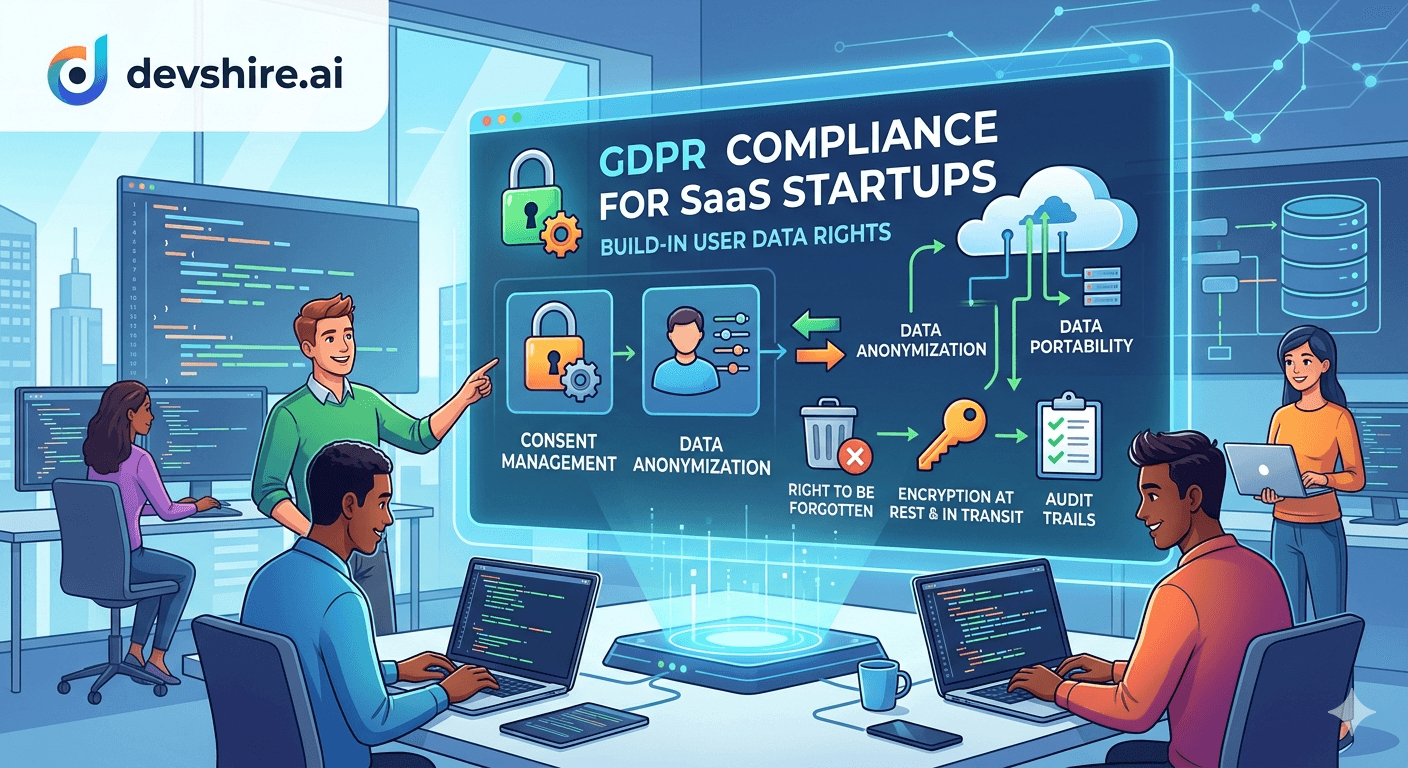
Your SaaS just signed its first EU customer. Congratulations. Now someone on the team asks: "Are we GDPR compliant?" And nobody has a clean answer. This is the moment most startups realise they've been building for weeks — sometimes months — without baking in the privacy architecture that EU law requires. The fine for getting it wrong isn't a slap on the wrist. Under GDPR, regulators can issue penalties up to €20 million or 4% of annual global turnover, whichever is higher. For a startup, either number is existential. But here's the thing: GDPR compliance for SaaS startups isn't a legal checkbox you handle after launch. It's an engineering problem. And if your developers don't build it in from the start, retrofitting it later costs 3–5× more in time and money. At devshire.ai, we've helped dozens of product teams bring on developers who know how to build privacy-first from day one. This is what they actually build.
💡 TL;DR
GDPR compliance for SaaS startups isn't a legal form — it's a set of technical features your developers must build: consent management, data subject rights (access, deletion, portability), audit logging, data minimisation, and breach notification pipelines. Miss any of these before your first EU user signs up, and you're already non-compliant. The cost to retrofit is 3–5× higher than building it right the first time. Start with the six core technical controls outlined in this post.
GDPR Compliance Is an Engineering Problem, Not a Legal One
Most startup founders treat GDPR as a legal task — hire a lawyer, generate a privacy policy, tick the box. That's wrong. The privacy policy is maybe 5% of what GDPR actually requires. The other 95% is technical: what data you collect, where you store it, who can access it, how long you keep it, and what happens when a user asks you to delete it.
Your lawyers can't write code. And the developers you bring in need to understand what they're building toward — not just receive a vague instruction to "make it GDPR compliant." The gap between those two things is where most startup compliance failures actually live.
In practice, this means your engineering brief needs to call out six specific technical controls. Each one maps directly to an article in the GDPR regulation. Skip one and you have a gap. Have a gap when a regulator or an angry user comes knocking, and the policy document won't save you.
⚠️ Common advice that's wrong
"Just add a cookie banner and you're fine." This is repeated constantly and it's almost completely false. A cookie banner handles one narrow slice of GDPR — consent for analytics cookies. It doesn't touch data retention, deletion rights, breach notification, or data processing agreements. Startups that stop at the banner are non-compliant the moment they store a single user record.
The Six Technical Controls Every SaaS Developer Must Build
These aren't optional extras. Each one is a direct requirement from the GDPR text, and each one is an engineering deliverable. Walk your developer through all six before they write a single line of your auth system.
1️⃣ Consent Management (Article 7)
Consent must be freely given, specific, informed, and unambiguous. That means no pre-ticked boxes, no bundled consent, and a record of exactly when and how each user consented. Your database needs a consent log table — not just a boolean field. Store the timestamp, the consent version, and the IP or session ID. When your privacy policy changes, you need to re-collect consent and log that too.
2️⃣ Data Subject Access Requests — DSAR (Article 15)
Any EU user can ask you to send them everything you hold about them. You have 30 days to respond. If your data is scattered across five tables, three third-party tools, and an S3 bucket, assembling that response manually will take your team a full day per request. Build a DSAR endpoint from the start. It should query all user-linked data across your schema and export it as a structured JSON or PDF. Do this in sprint one, not sprint twenty.
3️⃣ Right to Erasure — "Right to Be Forgotten" (Article 17)
When a user asks to be deleted, you can't just flip a soft-delete flag. You need to actually remove or anonymise their personal data across your entire stack — your primary DB, backups, analytics events, email lists, and any third-party processors. Build a deletion pipeline that triggers across all of these. Pseudonymisation (replacing PII with a hash or UUID) is acceptable for records you legally need to retain, like financial transactions. But it has to be systematic, not manual.
4️⃣ Data Portability (Article 20)
Users have the right to receive their data in a machine-readable format and transfer it to another service. In practice, this means building a data export feature — usually a JSON or CSV download of everything tied to their account. It's not a huge build, but it needs to be complete. Partial exports don't satisfy the requirement.
5️⃣ Audit Logging (Articles 5 and 30)
You need to be able to prove what happened to personal data and when. That means immutable audit logs on any action that reads, modifies, or deletes personal data. Store who did it, what they did, when, and from where. These logs are your legal defence if a regulator ever questions your data handling. They're also your debugging trail if something goes wrong internally.
6️⃣ Breach Notification Pipeline (Article 33)
If you have a data breach involving personal data, you have 72 hours to notify your supervisory authority. That's not 72 business hours — it's 72 calendar hours. Build an internal alerting and reporting pipeline before you launch. Your security monitoring should automatically classify incidents by whether personal data was involved. If it was, the 72-hour clock starts the moment your team becomes aware.
Data Minimisation: Stop Collecting What You Don't Need
Here's a rule that saves you from most GDPR headaches: don't collect data you don't use. GDPR's data minimisation principle (Article 5) says you should only process personal data that's necessary for your stated purpose. If you're collecting date of birth but you're not using it anywhere — delete the field. If you're logging full request payloads that include personal data but you're only debugging with status codes — stop.
Most early-stage SaaS apps are data hoarders by default. The developer adds a field "just in case," the analytics setup logs everything, and nobody ever reviews what's actually needed. That pile of unnecessary data is liability, not value.
Walk through your schema with your developer before launch and ask, for every field: why do we have this, what do we do with it, and how long do we need it? If you can't answer all three, the field probably shouldn't exist.
Data Type | Commonly Collected | Usually Necessary? | GDPR Risk If Retained |
|---|---|---|---|
Full IP address on every request | Yes | Rarely | High — IP is personal data under GDPR |
Date of birth on signup | Common | Only if age verification needed | Medium |
Email open tracking pixels | Default in most ESPs | Only with explicit consent | High without consent |
Full name + job title | Yes | Yes — B2B context | Low if deletion pipeline exists |
Device fingerprint / user agent | Common in analytics | Rarely essential | Medium — borderline personal data |
Third-Party Processors: The Gap Most Startups Miss Completely
You are personally responsible under GDPR for what your data processors do with your users' data. That includes every SaaS tool your product talks to — your analytics platform, your email provider, your error tracker, your CRM, your payment processor. All of them.
You need a Data Processing Agreement (DPA) with every processor that touches EU personal data. Most major vendors (Stripe, Segment, Intercom, Sentry) have standard DPAs you can sign in their settings panel. But you actually have to go do it. And you need to maintain a Record of Processing Activities (ROPA) — a document that lists every processor, what data you send them, why, and where their servers are located.
This matters more than most founders realise. If Segment sends your EU user data to US servers without an adequacy mechanism in place, that's your problem — not Segment's. Check that every processor either has EU servers or operates under the EU-US Data Privacy Framework.
📌 Quick audit checklist for third-party processors
Go through every tool in your stack. For each one: (1) Does it process EU personal data? (2) Have you signed their DPA? (3) Is their data stored in the EU or under an adequacy mechanism? (4) Is it listed in your ROPA? If any answer is no, fix it before your next EU signup.
Trusted by 500+ startups & agencies
"Hired in 2 hours. First sprint done in 3 days."
Michael L. · Marketing Director
"Way faster than any agency we've used."
Sophia M. · Content Strategist
"1 AI dev replaced our 3-person team cost."
Chris M. · Digital Marketing
Join 500+ teams building 3× faster with Devshire
1 AI-powered senior developer delivers the output of 3 traditional engineers — at 40% of the cost. Hire in under 24 hours.
Encryption and Access Controls Are Not Optional
GDPR requires "appropriate technical measures" to protect personal data. In practice, that means encryption at rest and in transit, role-based access controls, and proper secrets management. None of this is exotic — but it needs to be intentional from day one.
Encryption in transit means HTTPS everywhere — no exceptions, no HTTP fallback. Encryption at rest means your database volumes and S3 buckets are encrypted. Most cloud providers make this a toggle. Make sure your developer actually toggles it.
Role-based access is the one teams skip most often. In a 4-person startup, everyone has admin access to everything. That's fine for a week. It's a compliance problem by month three. Define access roles early: who can see raw user data, who can run exports, who can trigger deletions. Log every access event. The moment you bring on customer support staff, this becomes a real risk surface.
🔐 Minimum encryption baseline
TLS 1.2+ for all connections. AES-256 for data at rest. Secrets (API keys, DB passwords) stored in a vault like AWS Secrets Manager or HashiCorp Vault — never in .env files committed to git. Database credentials rotated at least every 90 days.
👥 Access control minimum
Define three roles minimum: admin, support, and read-only. Restrict raw PII access to admin only. Add MFA to any role that can access personal data. Audit access logs weekly — even manually at early stage. A developer who can show you clean access logs is worth more than one who can't explain who saw what last Tuesday.
When to Build Each Control: A Realistic Timeline
You don't have to build all of this on day one. But you do have to build it before EU users start signing up. Here's a sequencing that works for most early-stage SaaS teams.
The goal is to be fully compliant before your first paying EU customer — not after. Retrofitting a deletion pipeline into a messy schema after 10,000 users have signed up is a genuinely painful project. Build it clean the first time.
Sprint | What to Build | Why This Order |
|---|---|---|
Sprint 1–2 | Consent logging, data minimisation review, encryption baseline | Foundational — everything else depends on clean data collection |
Sprint 3 | DSAR endpoint, data export feature | Medium complexity — needs schema to be settled first |
Sprint 4 | Deletion pipeline, pseudonymisation for retained records | Depends on knowing all data locations first |
Sprint 5 | Audit logging, access controls, role definitions | Can be added incrementally but must be complete before launch |
Pre-launch | Breach notification pipeline, DPAs signed, ROPA complete | Non-negotiable before first EU user |
Fair warning: if you're already post-launch with EU users and none of this is built, start with the deletion pipeline and audit logging. Those are your two highest-risk gaps if a regulator or a user makes a formal request.
Hiring a Developer Who Actually Knows GDPR Requirements
Here's the honest problem: most developers know how to build web apps. Fewer know how to build privacy-first web apps. GDPR-aware development is a distinct skill — it means knowing what data you shouldn't collect, not just how to store the data you do collect.
When we match developers at devshire.ai for SaaS teams that need GDPR compliance built in, we look for three things: experience with consent management systems, prior work on deletion pipelines or DSAR tooling, and familiarity with encryption-at-rest configuration on at least one major cloud provider. Generic backend experience doesn't guarantee any of these.
The teams that get this right treat GDPR compliance as a feature spec — not a legal afterthought. They give the developer a clear list of technical requirements mapped to GDPR articles, a timeline, and a definition of done for each control. That's it. The developer builds. The lawyer reviews. Nobody is surprised six months later when an EU user submits a deletion request and the team has no pipeline to handle it.
✅ What to look for when hiring for GDPR-compliant SaaS
Ask candidates: "Walk me through how you'd build a user deletion pipeline in a SaaS app." A strong answer covers cascading deletes or pseudonymisation across the schema, handling of third-party processors, backup data handling, and a confirmation mechanism. A weak answer says "I'd just delete the row." That gap is the difference between a compliant product and a liability.
The Bottom Line
GDPR compliance for SaaS startups is an engineering deliverable, not a legal checkbox. Your developers must build it — the privacy policy alone won't protect you.
Build six core controls before your first EU user signs up: consent logging, DSAR endpoint, deletion pipeline, data portability export, audit logging, and breach notification pipeline.
Data minimisation is the fastest way to reduce your compliance surface. Every field you don't collect is a field you'll never have to delete, protect, or explain.
Sign DPAs with every third-party processor that touches EU personal data. Most major tools have them — you just have to actually go sign them.
Retrofitting GDPR controls post-launch costs 3–5× more than building them in from day one. Get the deletion pipeline right in sprint four, not after 10,000 signups.
Under GDPR, you have 72 calendar hours to notify regulators of a data breach. Build the alerting pipeline before launch — not while the incident is happening.
When hiring developers for GDPR-compliant SaaS, ask specifically about deletion pipelines and DSAR handling. Generic backend experience doesn't cover it.
Frequently Asked Questions
What does GDPR compliance mean for a SaaS startup?
It means building technical controls that give EU users rights over their data — the right to access it, delete it, and export it — while also implementing security measures like encryption, audit logging, and breach notification. It's not just a privacy policy. It's a set of engineering requirements that must be built into your product before EU users start signing up.
What happens if a SaaS startup isn't GDPR compliant?
Regulators can issue fines up to €20 million or 4% of annual global turnover — whichever is higher. Beyond fines, users can file formal complaints, which trigger investigations. For early-stage startups, the reputational and operational cost of an investigation often hurts more than the fine itself. Enterprise customers in the EU will also walk away from a vendor that can't demonstrate compliance.
Do I need GDPR compliance if my startup is based outside the EU?
Yes. GDPR applies to any organisation that processes the personal data of EU residents — regardless of where the organisation is based. If you have EU users, GDPR applies to you. The jurisdiction of your incorporation doesn't change that.
What is a data subject access request (DSAR) and how do I handle it?
A DSAR is a formal request from a user asking you to provide all personal data you hold about them. You have 30 calendar days to respond. The most reliable way to handle this is to build a DSAR endpoint that queries all user-linked data across your database schema and exports it in a structured format. Handling it manually is fine for the first few requests but breaks down fast as you scale.
How long can a SaaS startup retain user data under GDPR?
Only as long as necessary for the stated purpose. There's no fixed number — it depends on what the data is used for. Financial records typically need to be retained for 7 years for legal reasons. Analytics data usually has no legal retention requirement and should be deleted or anonymised within 12–24 months. Define a retention policy per data type and build automated deletion jobs to enforce it.
What's the difference between anonymisation and pseudonymisation under GDPR?
Anonymised data is outside GDPR's scope — it can no longer be linked to an individual. Pseudonymised data still falls under GDPR because it can theoretically be re-linked with a key. Most "deleted" records in SaaS apps are actually pseudonymised — the user row is replaced with a UUID but the activity records remain. That's acceptable under GDPR for records you legally need to retain, but the pseudonymisation must be systematic and the key must be securely managed.
How do I find developers who know how to build GDPR-compliant SaaS?
Ask specifically about deletion pipelines and DSAR handling during the interview. A developer who's built GDPR controls before will walk you through cascading deletes, third-party processor handling, and backup data management without prompting. One who hasn't will give vague answers about soft deletes and privacy policies. Platforms like devshire.ai pre-screen for this kind of compliance-aware development experience so you're not discovering the gap after you've hired.
Need a Developer Who Builds GDPR Compliance In — Not On?
devshire.ai matches SaaS startups with pre-vetted developers who've built consent pipelines, DSAR tooling, and deletion workflows before. You get a shortlist in 48–72 hours — already screened for the compliance-aware development skills your product needs.
Find a GDPR-Ready Developer at devshire.ai →
No upfront cost · Shortlist in 48–72 hrs · Freelance & full-time · Stack-matched candidates
About devshire.ai — devshire.ai matches AI-powered engineering talent with SaaS product teams. Every developer in the network has passed a live proficiency screen covering tool use, output validation, and real codebase review. Freelance and full-time options. Typical time-to-hire: 8–12 days. Start hiring →
Related reading: SaaS Security Best Practices · How to Add AI Features to Your SaaS · Build a SaaS MVP Fast · API-First SaaS Development · SaaS Boilerplate vs Custom Build · Vetted AI Developers for Hire







Devshire Team
San Francisco · Responds in <2 hours
Hire your first AI developer — this week
Book a free 30-minute call. We'll match you with the right developer for your project and get you started within 24 hours.
<24h
Time to hire
3×
Faster builds
40%
Cost saved