
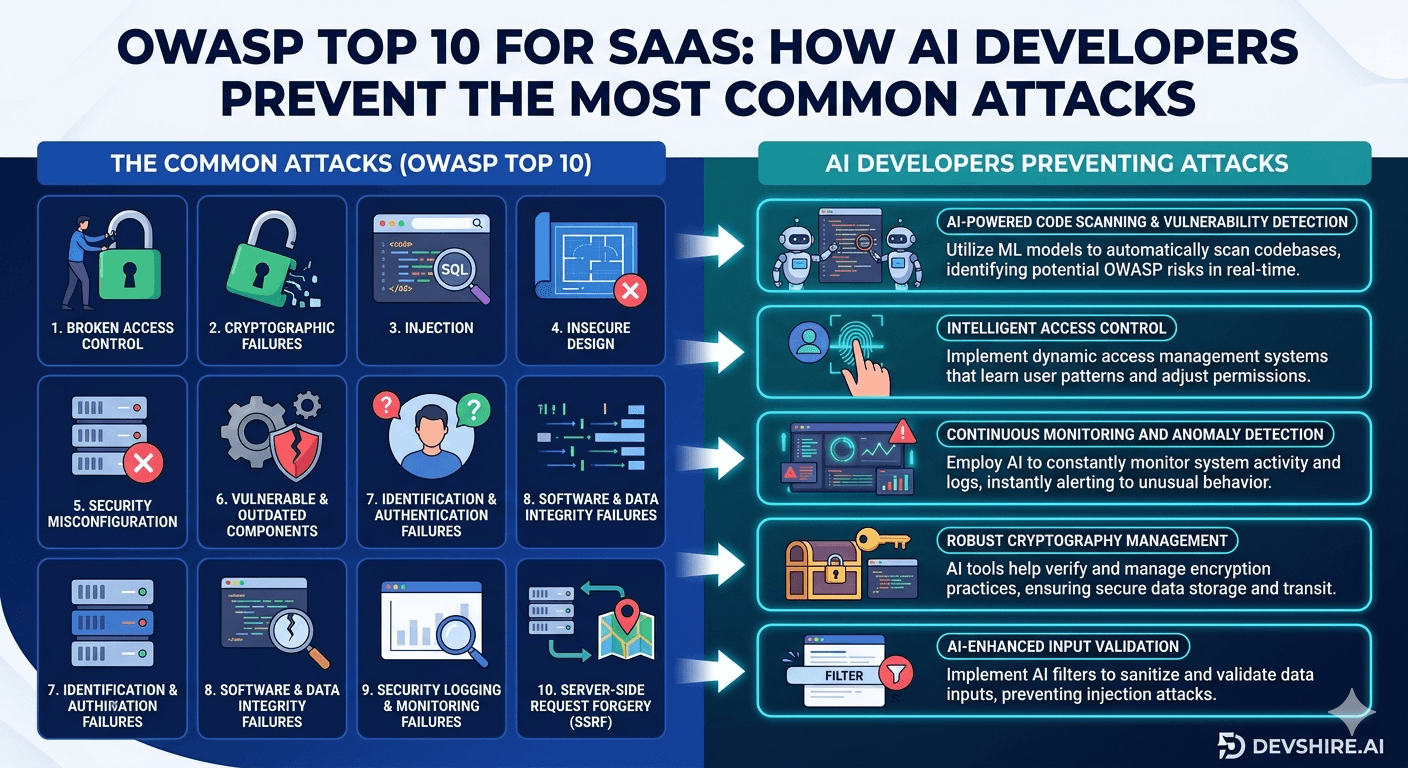
Most SaaS security breaches don't involve sophisticated zero-day exploits. They involve the same ten vulnerabilities that OWASP has been documenting since 2003. Broken access control. Injection attacks. Insecure design. Cryptographic failures. The names change slightly between versions. The root causes don't. What's changed in 2026 is how these vulnerabilities get introduced — and AI-generated code is now a significant factor. When a developer uses Cursor or GitHub Copilot to generate a query handler, a file upload route, or an authentication flow, the model doesn't always catch the security implications. It generates code that works. Not always code that's safe. Here's how AI developers who actually know what they're doing use the OWASP Top 10 as a review checklist — and what they build to prevent each category from reaching production.
💡 TL;DR
The OWASP Top 10 remains the most relevant attack surface checklist for SaaS apps in 2026. AI-generated code introduces these vulnerabilities faster and at higher volume than manual coding — because the model generates plausible-looking code without security context. Broken access control is the #1 category (it was #1 in the last two OWASP cycles). SQL injection is still common despite being decades old. Every AI developer on a production SaaS team needs to review generated code against this checklist before it merges — not after an incident.
Why AI-Generated Code Increases OWASP Risk — Not Decreases It
Here's the uncomfortable truth: AI coding tools make developers faster at shipping features. They also make developers faster at shipping vulnerabilities. The model generates code based on patterns in its training data. Those patterns include insecure code. And the model has no security intent — it's optimising for syntactic correctness and functional plausibility, not for what happens when an attacker manipulates the input.
In practice, this means a developer using Copilot can generate a SQL query handler, a file upload endpoint, or an authentication bypass in seconds — and all three might be vulnerable to injection, path traversal, or logic flaws that the model never flagged. The code runs. The tests pass. The vulnerability ships.
The developers who manage this risk well treat OWASP categories as a post-generation review checklist. They generate the code with AI tools, then systematically check it against the top vulnerabilities before it merges. That review adds 10–15 minutes per feature. It prevents weeks of incident response.
⚠️ Don't rely on AI tools to self-audit for security
Asking Copilot or Cursor "is this code secure?" is not a security review. The model will often say yes, make minor suggestions, and miss structural vulnerabilities entirely. Use dedicated SAST tools (Snyk, Semgrep, SonarQube) alongside AI code generation — not instead of a review process.
The OWASP Top 10 — What Each One Means for Your SaaS
Let's go through each category with what it actually looks like in a SaaS codebase and the specific control that prevents it. This isn't an academic walkthrough — it's what a developer needs to check before every PR that touches a sensitive surface.
1️⃣ A01 — Broken Access Control
The #1 vulnerability for the past two OWASP cycles. In SaaS apps, it typically shows up as: a user reading or modifying another user's data by changing an ID in the request, horizontal privilege escalation where a member accesses admin endpoints, or CORS misconfiguration that allows cross-origin requests from untrusted domains. The fix: implement resource-level authorisation checks (does this user own this resource?), enforce RBAC at the middleware layer, and test with a secondary user account that shouldn't have access.
2️⃣ A02 — Cryptographic Failures
Storing passwords in plaintext or with MD5/SHA1. Transmitting sensitive data over HTTP. Using weak or hardcoded encryption keys. Storing credit card data when you don't need to. The fix: bcrypt or Argon2id for password hashing (minimum cost factor 12), TLS everywhere, AES-256 for data at rest, and a secrets manager for keys. Never store payment card data — use Stripe's tokenisation instead.
3️⃣ A03 — Injection (SQL, NoSQL, Command)
Still common in 2026, especially in AI-generated code where the model strings together queries using template literals. The fix: use parameterised queries or ORMs that handle escaping (Prisma, Sequelize, Knex). Never concatenate user input into a query string. For command execution, use child_process.execFile with argument arrays — not exec with a string. Add a SAST scanner to your CI pipeline to catch these automatically.
4️⃣ A04 — Insecure Design
This category is about architectural flaws — not implementation bugs. A password reset flow that doesn't expire tokens. An API that returns more data than the client needs. A multi-tenant app that doesn't isolate tenant data at the database level. These aren't caught by linters. They're caught by threat modelling before you build. The fix: run a lightweight threat model on every new feature — ask "how would an attacker abuse this?" before finalising the design.
5️⃣ A05 — Security Misconfiguration
Default credentials left unchanged. Debug mode enabled in production. S3 buckets set to public. Error messages that expose stack traces and internal paths. The fix: use infrastructure-as-code with security defaults (Terraform modules with secure defaults), add a security headers middleware (Helmet.js for Node.js), and scan your cloud configuration with a tool like AWS Security Hub or Prowler before launch.
6️⃣ A06 — Vulnerable and Outdated Components
Your dependencies have CVEs. All of them, eventually. The fix: run npm audit or Snyk in your CI pipeline on every build. Set up Dependabot or Renovate to automatically open PRs for dependency updates. Define a policy: critical CVEs patched within 7 days, high within 30 days. Track compliance. This is evidence your SOC 2 auditor will also want to see.
7️⃣ A07 — Identification and Authentication Failures
Weak passwords allowed. No brute force protection. Sessions that don't expire. Password reset tokens that are too predictable or long-lived. The fix: enforce a minimum password complexity, add rate limiting to login and password reset endpoints (10 attempts per 15 minutes is a reasonable default), expire sessions after 30 days of inactivity, and use cryptographically random tokens for password resets that expire after 15 minutes.
8️⃣ A08 — Software and Data Integrity Failures
Deserialising untrusted data. Using CDN scripts without subresource integrity checks. CI/CD pipelines that don't verify the integrity of build artefacts. The fix: add SRI hashes to any external scripts you load, use signed commits in your CI pipeline, and never deserialise user-supplied data into executable objects. JSON.parse is fine. eval() is not.
9️⃣ A09 — Security Logging and Monitoring Failures
Not logging failed login attempts. No alerting on unusual access patterns. Log files that are accessible to application code. The fix: log all authentication events, access control failures, and input validation failures. Set up alerts for: more than 10 failed logins from one IP in 5 minutes, any access to an admin endpoint from a non-admin account, and any error rate spike above your normal baseline.
🔟 A10 — Server-Side Request Forgery (SSRF)
Your app makes an HTTP request to a URL supplied by the user. An attacker passes an internal URL — like http://169.254.169.254/latest/meta-data/ (AWS metadata endpoint) — and your server fetches it, leaking cloud credentials. This is increasingly common in SaaS apps that have webhook, import, or integration features. The fix: validate and allowlist URLs before making outbound requests, block private IP ranges (10.x.x.x, 172.16.x.x, 192.168.x.x), and use a network egress proxy if possible.
The PR Security Review — What Good Developers Check Before Merging
The teams that handle OWASP risk well don't rely on developers to remember the entire list during implementation. They embed the check into the PR process itself. Here's what a practical security review looks like for every PR that touches a data access layer, authentication flow, or API endpoint.
PR Surface | OWASP Categories to Check | Specific Question to Ask |
|---|---|---|
Any new API endpoint | A01, A07 | Does this endpoint verify the user owns the resource it's returning? Is it rate limited? |
Any database query | A03 | Are all inputs parameterised? Is there any string concatenation involving user data? |
File upload feature | A01, A05 | Is the file type validated server-side? Is the upload stored outside the webroot? |
Auth or session code | A02, A07 | Are tokens cryptographically random? Do they expire? Are passwords hashed with bcrypt/Argon2id? |
Outbound HTTP request | A10 | Is the target URL user-supplied? Are private IP ranges blocked? |
SAST Tools That Catch OWASP Issues Before You Do
Manual code review catches a lot. Automated static analysis catches what review misses — and it runs on every commit, not just when a reviewer is paying attention. For Node.js SaaS apps, three tools cover most of the OWASP Top 10 automatically.
Snyk integrates directly into your CI pipeline and scans both your code and your dependencies for known vulnerabilities. It's particularly good at A06 (outdated components) and catches some injection patterns in A03. Semgrep is more configurable — you can write custom rules that match your codebase's specific patterns, and it has a strong OWASP rule library out of the box. SonarQube (or SonarCloud for the hosted version) covers code quality and security simultaneously, which is useful for teams that want both signals in one tool.
Run at least one of these on every PR. The setup is a few hours. The ongoing cost is close to zero for the open-source tiers. And they catch the injection patterns and cryptographic failures that AI-generated code introduces without anyone noticing.
Trusted by 500+ startups & agencies
"Hired in 2 hours. First sprint done in 3 days."
Michael L. · Marketing Director
"Way faster than any agency we've used."
Sophia M. · Content Strategist
"1 AI dev replaced our 3-person team cost."
Chris M. · Digital Marketing
Join 500+ teams building 3× faster with Devshire
1 AI-powered senior developer delivers the output of 3 traditional engineers — at 40% of the cost. Hire in under 24 hours.
What a Security-Aware AI Developer Actually Looks Like
Most developers know the OWASP Top 10 exists. Fewer can walk through a codebase and identify where each category might surface. And fewer still have built the automated controls — SAST integration, rate limiting middleware, SSRF prevention — that catch these issues systematically rather than hoping code review gets everything.
When we screen developers at devshire.ai for security-aware SaaS roles, we give candidates a 200-line code sample that includes three deliberate OWASP vulnerabilities — a parameterised query done wrong, a broken access control on one endpoint, and an SSRF risk in a webhook handler. Strong candidates find all three and explain the attack vector. Average candidates find one, usually the injection issue, and miss the others.
That skill gap matters in production. A developer who finds one out of three means two vulnerabilities shipped. Build your review process and your tooling to catch what human review misses.
The Bottom Line
AI-generated code introduces OWASP vulnerabilities faster and at higher volume than manual coding. The model optimises for functional correctness, not security — always review generated code against this checklist.
Broken access control (A01) is the #1 SaaS vulnerability. Test every endpoint with a user account that shouldn't have access before shipping any new data-returning route.
SQL injection is still common in 2026, especially in AI-generated query handlers that use template literals. Use parameterised queries or a type-safe ORM — no exceptions.
Add SAST tooling (Snyk, Semgrep, or SonarQube) to your CI pipeline. It runs on every commit and catches what code review misses. Setup takes one afternoon.
SSRF is the most under-appreciated OWASP risk in SaaS apps with webhook or integration features. Block private IP ranges on all outbound HTTP requests where the URL is user-supplied.
Rate limit login, password reset, and any other authentication endpoint. 10 attempts per 15-minute window is a reasonable default that blocks brute force without affecting real users.
Embed an OWASP checklist into your PR review process. Specific questions per surface area — API endpoints, DB queries, file uploads, auth code — catch vulnerabilities before they merge.
Frequently Asked Questions
What is the OWASP Top 10 and why does it matter for SaaS startups?
The OWASP Top 10 is a regularly updated list of the most critical web application security vulnerabilities, published by the Open Web Application Security Project. It matters for SaaS startups because these aren't theoretical risks — they're the categories that appear in the majority of real-world security incidents. Broken access control, injection attacks, and authentication failures consistently account for most breaches in production SaaS applications.
Does AI-generated code have more security vulnerabilities than manually written code?
It introduces vulnerabilities at higher volume because it generates more code, faster. The model produces code that's syntactically correct and functionally plausible — but it doesn't apply security intent. It's equally likely to generate a parameterised query and a string-concatenated query, depending on the pattern in its context window. The solution isn't to stop using AI tools — it's to add SAST scanning and structured security review to everything AI generates before it merges.
What is broken access control and how do I prevent it in a SaaS app?
Broken access control means a user can access or modify resources they don't have permission to. In SaaS, it commonly appears as: a user changing an ID in the URL and reading another user's data, a member account accessing an admin-only endpoint, or a CORS policy that allows requests from untrusted origins. Prevent it with resource-level authorisation checks (always validate that the requested resource belongs to the requesting user's organisation), RBAC middleware enforced at the route level, and regular testing with non-privileged accounts.
How do I prevent SQL injection in a Node.js SaaS app?
Use parameterised queries or an ORM that handles escaping automatically. Prisma, Sequelize, and Knex all do this correctly when used as intended. The risk surfaces when developers bypass the ORM to write raw queries using string concatenation — which AI code generators sometimes do. Add Snyk or Semgrep to your CI pipeline with injection detection rules. They'll catch the pattern before it reaches production even when code review misses it.
What is SSRF and how does it affect SaaS applications?
SSRF (Server-Side Request Forgery) happens when your server makes an HTTP request to a URL provided by a user, and an attacker supplies an internal URL — like the cloud metadata endpoint — to extract sensitive information like cloud credentials. It's particularly risky in SaaS apps with webhook receivers, URL import features, or third-party integration connectors. Prevent it by validating and allowlisting URLs before making outbound requests, and blocking private IP address ranges (10.x.x.x, 172.16.x.x, 192.168.x.x) at the HTTP client level.
What SAST tools should a Node.js SaaS team use for OWASP vulnerability detection?
Snyk is the most widely used in the startup space — it covers both code vulnerabilities and dependency CVEs, integrates directly into GitHub/GitLab CI, and has a usable free tier. Semgrep is more configurable and has a strong open-source OWASP rule set. SonarCloud covers both quality and security in one tool. Run at least one of these on every PR as an automated check. Manual code review alone won't catch everything, especially at velocity.
How often should a SaaS startup run security vulnerability scans?
Dependency vulnerability scans (npm audit, Snyk) should run on every CI build — that's every commit that goes through your pipeline. Static analysis (Semgrep, SonarQube) should also run per PR. Dynamic scanning (DAST tools like OWASP ZAP) should run at minimum monthly against your staging environment. Penetration testing by an external firm should happen at least annually, or before major compliance milestones like SOC 2 certification.
Find Developers Who Catch Security Vulnerabilities — Not Just Ship Features
devshire.ai matches SaaS teams with pre-vetted developers who review AI-generated code against OWASP criteria, set up SAST pipelines, and build access control systems that hold up in production. Get a shortlist in 48–72 hours.
Find a Security-Aware Developer at devshire.ai →
No upfront cost · Shortlist in 48–72 hrs · Freelance & full-time · Stack-matched candidates
About devshire.ai — devshire.ai matches AI-powered engineering talent with SaaS product teams. Every developer in the network has passed a live proficiency screen covering tool use, output validation, and real codebase review. Freelance and full-time options. Typical time-to-hire: 8–12 days. Start hiring →
Related reading: SaaS Security Best Practices · GDPR Compliance for SaaS Startups · JWT Auth + RBAC in Node.js SaaS · AI Code Review Tools · SOC 2 Compliance for Developers · Vetted AI Developers for Hire







Devshire Team
San Francisco · Responds in <2 hours
Hire your first AI developer — this week
Book a free 30-minute call. We'll match you with the right developer for your project and get you started within 24 hours.
<24h
Time to hire
3×
Faster builds
40%
Cost saved