
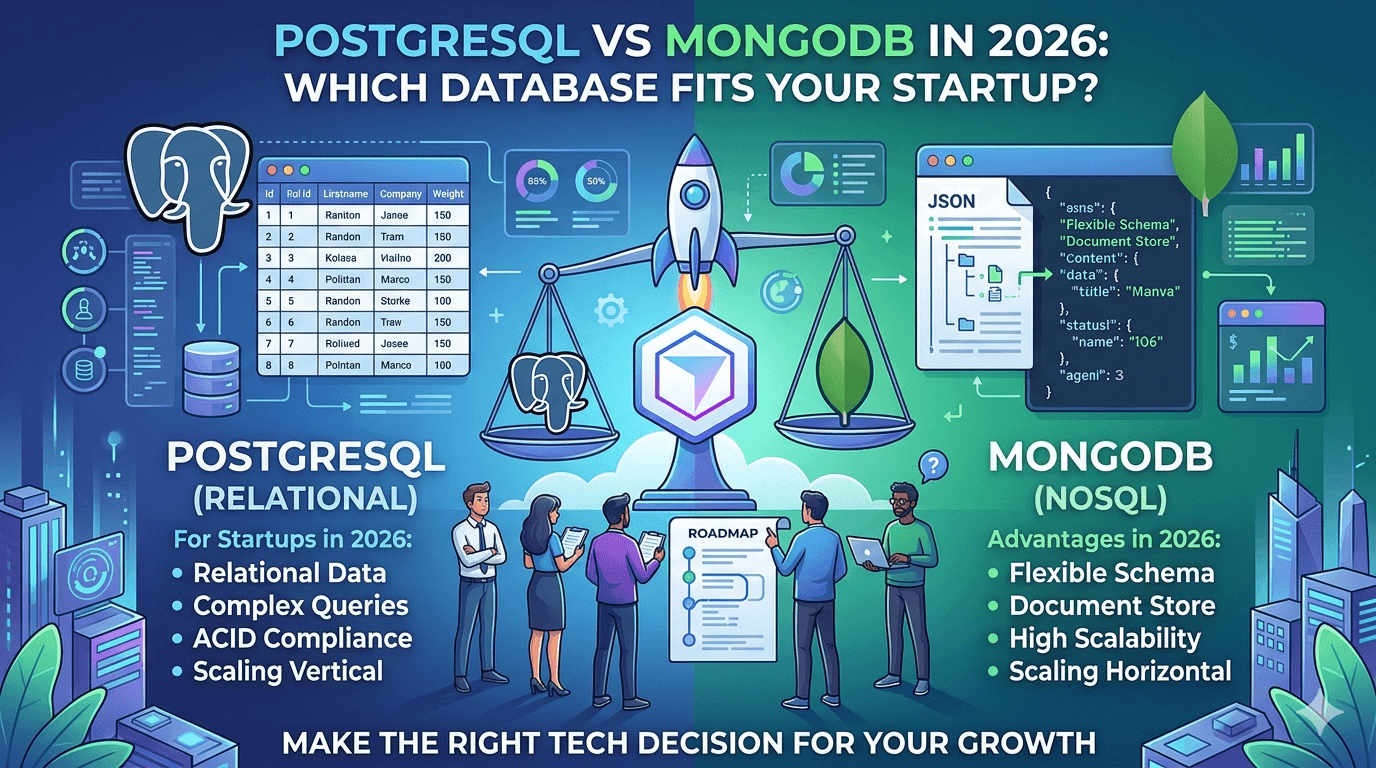
The PostgreSQL vs MongoDB debate has been running for over a decade. And in 2026, it's still the wrong framing. Both databases are excellent. Both have matured significantly. The question isn't which database is better — it's which database is better for what you're actually building. Most startups pick one based on what their first developer knew, or what a tutorial used, or what a CTO used at their last job. That's not a strategy. The choice between a relational model and a document model has downstream consequences for your query patterns, your schema flexibility, your scaling approach, and the kinds of bugs that will ruin your Friday afternoon. This guide is the comparison you actually need — not a feature list, but a decision framework built around the specific scenarios startups face.
💡 TL;DR
In 2026, PostgreSQL wins for most SaaS products — especially anything with relational data, financial records, or complex queries. MongoDB wins when your data is genuinely document-shaped, schema varies widely across records, or you're building for horizontal write scale from day one. For most early-stage startups, start with PostgreSQL. Its JSONB column type covers most flexibility needs without giving up relational guarantees. Only choose MongoDB if the document model is a genuine fit — not because it feels more flexible.
The Core Difference: Relational vs Document Model
The database choice starts with the data model. Get this wrong and you're fighting the database on every complex query for the life of the product.
Dimension | PostgreSQL | MongoDB |
|---|---|---|
Data structure | Tables, rows, strict schema with foreign keys | Documents (JSON), flexible schema per record |
Relationships | Native JOINs, foreign key constraints | References or embedding — no enforced FK constraints |
Schema changes | Migration required (ALTER TABLE) | Fields can vary per document — no migration needed |
Transactions | Full ACID across tables | ACID within a single document; multi-document transactions added in v4.0 but with overhead |
Query language | SQL (industry standard) | MQL (MongoDB Query Language) — powerful but non-standard |
Aggregations | SQL window functions, CTEs, powerful analytical queries | Aggregation pipeline — flexible but verbose for complex queries |
The decision axis is: does your data have natural, consistent relationships between entities? If yes, PostgreSQL's relational model makes those relationships explicit, queryable, and enforced. If your data is more like bags of heterogeneous properties that don't share a common schema, MongoDB's document model reduces friction.
⚠️ The flexibility trap
"MongoDB is more flexible" is the most dangerous reason to choose it. Flexibility without schema enforcement means inconsistent data at scale. You'll spend weeks writing defensive code to handle missing fields, null values, and varying data shapes that PostgreSQL would have rejected at write time.
Which Database Wins for Each Startup Use Case
Skip the abstract comparison. Here's how the decision maps to real product types.
✅ Use PostgreSQL for: B2B SaaS with multi-tenant data
Users, organisations, subscriptions, permissions, billing — all relational. PostgreSQL's foreign keys, JOIN performance, and row-level security make multi-tenant SaaS architectures significantly cleaner. Trying to model this in MongoDB leads to complex application-level relationship management that belongs in the database.
✅ Use PostgreSQL for: Anything involving money
Financial transactions, invoicing, payment records — these need ACID transactions across multiple tables. A failed payment that partially updates three records is a compliance and reconciliation nightmare. PostgreSQL gives you atomic multi-table transactions. MongoDB's multi-document transactions exist but add latency and complexity.
✅ Use MongoDB for: Content management with variable schema
CMSs, product catalogues, form builders, and event systems where each record type has a different shape are genuine MongoDB use cases. A product catalogue where electronics have 15 attributes and clothing has 10 completely different ones fits the document model well. Modelling this in SQL requires complex EAV (Entity-Attribute-Value) tables or wide nullable schemas.
✅ Use MongoDB for: Real-time data ingestion at high write volume
IoT telemetry, event logs, clickstream data, sensor feeds — MongoDB's horizontal write scaling via sharding handles high-write, schema-variable workloads well. Though ClickHouse or TimescaleDB are often better choices for pure analytics workloads at this scale.
Performance in 2026: Where Each Database Wins
Both databases have matured to the point where raw performance is rarely the deciding factor for startups. The performance differences are workload-specific — and choosing the wrong database for your workload will bite you regardless of which one you pick.
Workload | PostgreSQL | MongoDB |
|---|---|---|
Complex multi-table queries | Faster — native JOIN optimiser | Slower — requires aggregation pipeline or multiple queries |
Single-document reads | Fast with good indexing | Fast — documents are pre-joined |
High-volume writes | Good — WAL write performance strong | Excellent — especially with sharding |
Full-text search | Good (tsvector) — covers most use cases | Good (Atlas Search with Lucene) — more advanced but managed only |
Analytical aggregations | Excellent with materialised views and window functions | Aggregation pipeline works but verbose at complexity |
One underappreciated PostgreSQL advantage in 2026: the JSONB column type. You can store document-style JSON in a PostgreSQL column with full indexing and querying support. This covers 80% of MongoDB's flexibility use cases while keeping relational integrity everywhere else in your schema.
Scaling Trade-offs: How Each Database Grows With You
The scaling story has changed significantly in the last two years. Both databases have managed cloud options that remove a lot of the operational overhead that used to be a differentiating factor.
📈 PostgreSQL scales vertically first
PostgreSQL scales remarkably well on a single large instance. Most SaaS products running millions of users are fine on a well-tuned single Postgres instance with read replicas. Horizontal sharding (Citus, Neon, Aurora) exists but is complex — you likely won't need it for years. Supabase and Neon make managed PostgreSQL easy to start and scale.
🌐 MongoDB scales horizontally by design
MongoDB's sharding architecture was designed for horizontal scale from the beginning. If you genuinely anticipate write volume that will saturate a vertical PostgreSQL setup, MongoDB Atlas makes horizontal scaling more accessible. The trade-off: you need to design your shard key correctly from the start — poor shard key choices are very expensive to fix.
💸 Cost at scale
MongoDB Atlas pricing scales with storage and compute separately, which can get expensive at high data volumes. PostgreSQL on RDS, Supabase, or Neon is typically cheaper at equivalent scale. For early-stage startups, Supabase's free tier or Neon's branching model significantly lowers the barrier to starting with Postgres.
Trusted by 500+ startups & agencies
"Hired in 2 hours. First sprint done in 3 days."
Michael L. · Marketing Director
"Way faster than any agency we've used."
Sophia M. · Content Strategist
"1 AI dev replaced our 3-person team cost."
Chris M. · Digital Marketing
Join 500+ teams building 3× faster with Devshire
1 AI-powered senior developer delivers the output of 3 traditional engineers — at 40% of the cost. Hire in under 24 hours.
Developer Experience and Ecosystem in 2026
The ecosystem gap between the two databases has narrowed considerably. Both have mature ORMs, type-safe query builders, and hosted solutions. But there are still meaningful differences worth knowing.
Tool Category | PostgreSQL | MongoDB |
|---|---|---|
Primary ORM (Node.js) | Prisma, Drizzle, Sequelize | Mongoose, Prisma (MongoDB adapter) |
Type safety | Excellent with Drizzle or Prisma + TypeScript | Good with Mongoose + zod, but looser by default |
Migrations | Required (Prisma Migrate, Flyway, Liquibase) | Optional — schema can evolve without migrations |
Managed hosting | Supabase, Neon, RDS, PlanetScale (Vitess) | MongoDB Atlas (excellent managed offering) |
AI tooling support | Excellent — SQL is universal, LLMs generate SQL reliably | Good — MQL is less commonly generated by AI tools |
One notable 2026 development: AI coding tools (Cursor, GitHub Copilot, Claude) generate SQL for PostgreSQL queries more reliably than MongoDB aggregation pipelines. For teams using AI-assisted development heavily, this is a practical advantage for Postgres — the feedback loop between writing a complex query and getting it right is faster.
The Decision Framework: Four Questions to Get to the Right Answer
If you're still undecided, answer these four questions in order. The first one that gives a clear answer is your answer.
1️⃣ Does your data have consistent, enforced relationships between entities?
If yes — users belong to orgs, orders have line items, subscriptions have plans — choose PostgreSQL. Relational integrity is the database's job, not your application code's job.
2️⃣ Does your schema vary significantly per record and need to evolve rapidly without migrations?
If yes — product catalogues with variable attributes, form builder outputs, event systems with varied payloads — MongoDB's document model reduces friction. But first check whether PostgreSQL's JSONB covers it.
3️⃣ Do you need ACID transactions across multiple records?
If yes — financial data, inventory, multi-step workflows — choose PostgreSQL. Full multi-table ACID is its core strength. MongoDB's multi-document transactions work but are not the primary design case.
4️⃣ Do you genuinely need horizontal write scaling from launch?
If yes — IoT ingestion, high-volume event pipelines, social platform at scale — MongoDB's sharding architecture is designed for this. PostgreSQL can scale horizontally but it's more complex to set up and operate.
📌 When in doubt, start with PostgreSQL
PostgreSQL's JSONB column gives you document flexibility inside a relational database. Most early-stage startups that choose MongoDB for flexibility end up fighting schema inconsistency later. PostgreSQL handles 90% of use cases and migrating from Postgres to Mongo is harder than migrating to a bigger Postgres instance.
Can You Switch Later? Migration Reality Check
One question startups always ask: what if we pick wrong? Here's the honest answer about switching.
Migration Direction | Difficulty | What Makes It Hard |
|---|---|---|
MongoDB → PostgreSQL | Hard | Normalising document data into relational tables, handling missing fields, rewriting queries from MQL to SQL |
PostgreSQL → MongoDB | Medium | Denormalising relational data into documents, replacing JOINs with embedding or references, losing FK constraints |
PostgreSQL → different PostgreSQL host | Easy | pg_dump / pg_restore, logical replication — standard tooling |
MongoDB → MongoDB Atlas | Easy | mongodump / mongorestore, Atlas live migration tool |
The MongoDB to PostgreSQL migration is the hardest direction — and it's the one startups most often need to do after growing into a relational data model. If there's uncertainty about which model fits, the cost of being wrong with PostgreSQL is lower.
The 2026 Verdict by Product Type
🏢 B2B SaaS → PostgreSQL
Multi-tenancy, billing, permissions, audit logs — all relational. Use Supabase or Neon for managed hosting. JSONB for any flexible metadata needs.
🛒 E-commerce / marketplace → PostgreSQL
Products, orders, payments, inventory — all relational with transaction requirements. PostgreSQL wins clearly.
📰 CMS / content platform → MongoDB or PostgreSQL + JSONB
Genuine document model fit. MongoDB is a reasonable choice here. But evaluate PostgreSQL + JSONB first — it covers most CMS flexibility requirements without leaving the relational world.
📡 IoT / telemetry / event ingestion → MongoDB or TimescaleDB
High write volume, variable schema, time-series data. MongoDB is competitive here. TimescaleDB (PostgreSQL extension) is often a better choice for time-series specifically.
🤖 AI / LLM application with vector search → PostgreSQL + pgvector
pgvector brings vector similarity search to PostgreSQL. For AI apps that need both relational data and vector embeddings in the same database, this is the 2026 default stack.
The Bottom Line
PostgreSQL wins for most SaaS products in 2026 — especially anything with relational data, financial records, multi-tenancy, or complex analytical queries.
MongoDB wins when data is genuinely document-shaped with highly variable schemas, or when horizontal write scaling is a day-one requirement.
PostgreSQL's JSONB column type covers most flexibility needs — evaluate it before choosing MongoDB for schema flexibility alone.
AI coding tools generate PostgreSQL queries more reliably than MongoDB aggregation pipelines — a practical advantage for AI-assisted development teams.
Migrating from MongoDB to PostgreSQL is significantly harder than the reverse. When uncertain, start with PostgreSQL.
For AI applications needing vector search, PostgreSQL + pgvector is the 2026 default — no separate vector database required for most use cases.
Cost: Supabase and Neon make managed PostgreSQL competitive on price. MongoDB Atlas scales well but gets expensive at high data volumes.
Frequently Asked Questions
Is PostgreSQL or MongoDB better for startups in 2026?
PostgreSQL for most startups. The relational model handles the majority of SaaS data patterns better, JSONB covers flexibility needs, and the managed options (Supabase, Neon) make it easy to start. Choose MongoDB when your data model is a genuine fit — not because it feels more flexible.
Can PostgreSQL handle MongoDB-style flexible schemas?
Yes — via JSONB columns. You can store arbitrary JSON documents in a PostgreSQL column with GIN indexing and full query support. This covers most flexibility use cases without sacrificing relational integrity on the rest of your schema.
Which database is better for a B2B SaaS with multi-tenancy?
PostgreSQL. Multi-tenancy requires consistent relationships between users, organisations, subscriptions, and permissions. PostgreSQL's foreign keys, JOINs, and row-level security (RLS) make this significantly cleaner than managing equivalent relationships in application code with MongoDB.
Is MongoDB still relevant in 2026?
Yes, for the right use cases. MongoDB Atlas is excellent for document-oriented data, high write volume, and teams that genuinely need schema flexibility. It's a mature, well-supported database. The question is whether your use case is a genuine fit — not whether it's still a good database.
What database should I use for an AI application with vector search?
PostgreSQL + pgvector. This gives you relational data management and vector similarity search in the same database. For most AI applications that need to store embeddings alongside structured data, this eliminates the need for a separate vector database.
Need a Developer Who Knows This Stack Cold?
devshire.ai matches you with pre-vetted AI developers experienced in PostgreSQL, MongoDB, Supabase, and modern data architecture — and they can start in days, not weeks.
Find Your Developer at devshire.ai →
No upfront cost · Shortlist in 48–72 hrs · Freelance & full-time · Stack-matched candidates
About devshire.ai — devshire.ai matches AI-powered engineering talent with product teams. Every developer in the network has passed a live AI proficiency screen covering tool use, output validation, and codebase review. Freelance and full-time options. Typical time-to-hire: 8–12 days. Start hiring →
Related reading: Supabase vs Firebase: Which Backend Is Better for Startups in 2026? · How to Build a Real-Time Analytics Dashboard for Your SaaS App · How to Set Up a Data Pipeline From Scratch Using Python + Airflow · How AI Developers Use SQL + Python to Automate Business Reporting · GDPR Compliance for SaaS Startups: What Your Developers Must Build In







Devshire Team
San Francisco · Responds in <2 hours
Hire your first AI developer — this week
Book a free 30-minute call. We'll match you with the right developer for your project and get you started within 24 hours.
<24h
Time to hire
3×
Faster builds
40%
Cost saved