
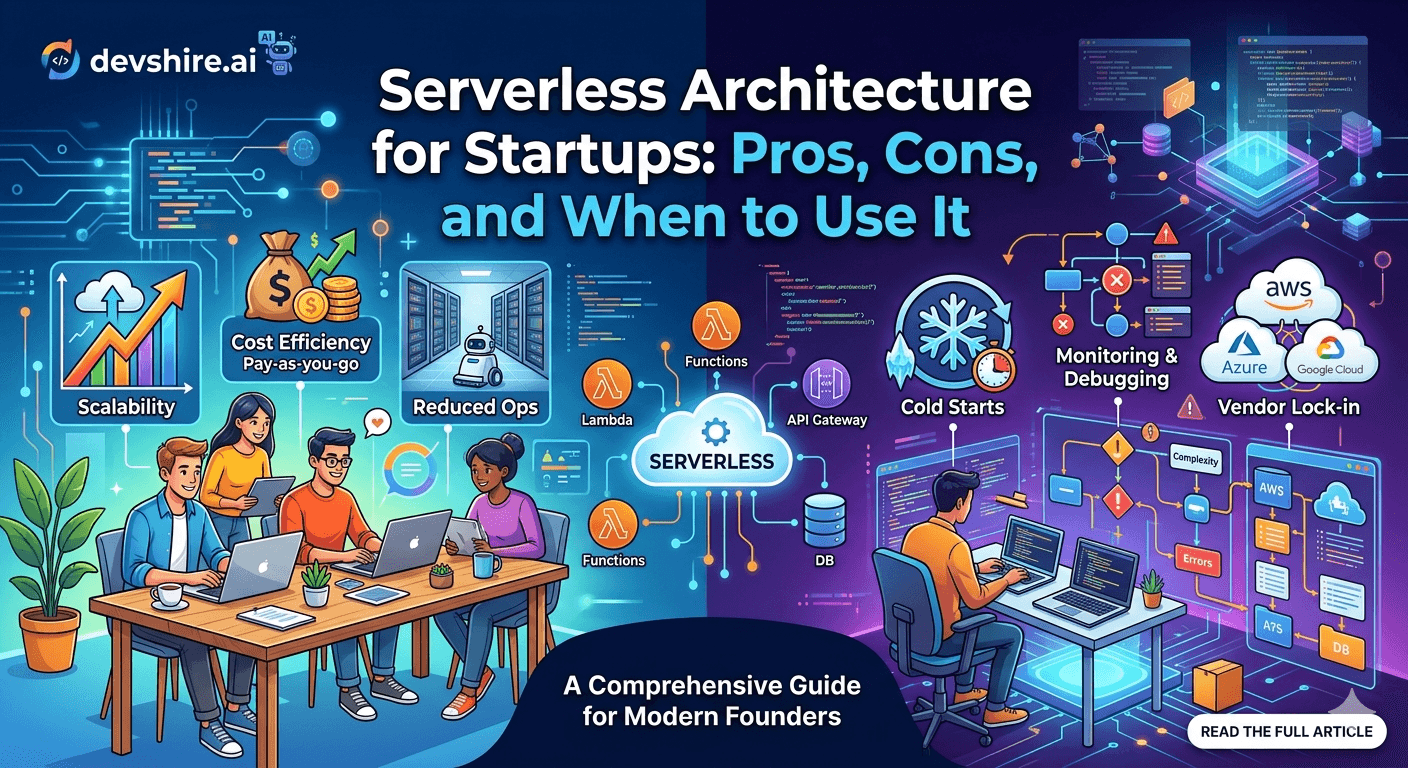
Serverless gets polarised coverage. The evangelists describe it as the end of infrastructure management — pay only for what you use, scale to infinity automatically, never provision a server again. The sceptics point to cold starts, vendor lock-in, and the debugging nightmare of distributed cloud functions. Both are describing real characteristics of the same architecture. The more useful question for a startup isn't "is serverless good or bad" but "does serverless fit the specific workload I'm building, and does its operational model fit the team I have?" That's what this guide answers directly — including the decision criteria that most serverless guides skip because they're written by people who want to sell you on the architecture.
💡 TL;DR
Serverless (Lambda, Cloud Functions) is genuinely good for: event-driven workloads, infrequent or spiky traffic patterns, background processing tasks, and teams that want to minimise infrastructure management. It creates real problems for: high-frequency low-latency API workloads (cold starts), long-running processes, applications with complex local dependencies, and teams that need detailed profiling and debugging. Most startups benefit from a hybrid: serverless for specific event-driven workflows, always-on containers for their core API. All-in serverless for a primary API is often the wrong call.
What Serverless Actually Means (And What It Doesn't)
"Serverless" is a misleading name — there are servers, you just don't manage them. Specifically, serverless refers to Function-as-a-Service (FaaS) platforms where you deploy individual functions that are invoked on demand, scale automatically, and are billed per invocation rather than per hour of running infrastructure.
Platform | Cloud | Max timeout | Cold start range | Free tier |
|---|---|---|---|---|
AWS Lambda | AWS | 15 min | 100ms–3s | 1M requests/month free |
Google Cloud Functions | GCP | 60 min (v2) | 200ms–4s | 2M requests/month free |
Azure Functions | Azure | 10 min (Consumption) | 300ms–5s | 1M requests/month free |
Vercel Functions | Vercel infra | 60s (Hobby), 800s (Pro) | 50ms–500ms | Generous free tier |
Cloudflare Workers | CF edge | ~30s CPU | Sub-10ms (edge) | 100k requests/day free |
Cloudflare Workers is architecturally different from Lambda and Cloud Functions — it runs at edge locations with a V8 isolate model rather than a container-per-function model. This gives it near-zero cold starts but restricts the runtime (no Node.js APIs that require system access). Worth knowing as a separate category.
Where Serverless Genuinely Helps Startups
The advantages are real for the right workloads. The key is matching serverless to the workload characteristics where its model is beneficial.
✅ Event-driven and webhook processing
Webhooks from Stripe, GitHub, or third-party services arrive unpredictably. A Lambda function that triggers on the webhook event, processes it, and exits is a perfect fit — it costs virtually nothing at low volume, scales automatically at high volume, and requires no always-on server. Building a Stripe webhook handler as a Lambda function is simpler and cheaper than a dedicated Node.js service for this purpose. [INTERNAL LINK: Stripe SaaS integration → devshire.ai/blog/stripe-saas-integration-guide]
✅ Scheduled background jobs
Cron-style jobs — generate weekly reports, send digest emails, clean up expired records, sync data from external APIs — are natural Lambda use cases. The job runs on schedule, does its work, and exits. You pay for the execution time, not for an always-on worker. EventBridge Scheduler (AWS) provides cron and rate-based triggers for Lambda at no additional cost beyond Lambda execution time.
✅ Spiky, unpredictable traffic patterns
A product that gets launched on Product Hunt gets 10,000 requests in 2 hours and then drops to near-zero. Serverless scales to handle the spike without pre-provisioned capacity and costs almost nothing at baseline. For an always-on container service, you'd either over-provision for the peak (expensive always) or under-provision and fall over during spikes. The auto-scale model is genuinely better for bursty traffic.
✅ Low-volume internal tooling and APIs
Internal tools, admin APIs, and low-frequency endpoints don't justify always-on infrastructure. A Lambda function serving 100 requests per day costs pennies. An EC2 instance or container service running for the same purpose costs $15–$50/month. For internal tooling that doesn't need sub-100ms response times, serverless is the right economic choice.
Where Serverless Creates Real Problems
The serverless trade-offs are real and don't get enough coverage in comparison articles. These are the specific problems that cause serverless architectures to underperform or create operational headaches.
❌ Cold start latency in user-facing APIs
When a Lambda function hasn't been invoked recently, the first invocation after a cold start takes 100ms–3 seconds longer than warm invocations. For a background job, this is irrelevant. For a user-facing API where your SLA is under 200ms, a 1-second cold start is a user experience problem. Provisioned concurrency eliminates cold starts but costs money and negates the scale-to-zero pricing advantage.
❌ Long-running processes have hard time limits
Lambda has a 15-minute maximum execution timeout. Cloud Functions (v2) has 60 minutes. Processes that run longer — large file processing, model training, complex batch operations — can't run on serverless without breaking them into smaller chunks with state management. This is a genuine architectural constraint, not a configuration option.
❌ Local filesystem dependency
Lambda functions have a read-only filesystem except for /tmp (512MB–10GB depending on config). Applications that read from or write to local files need to use S3 for any persistent storage. This is a non-trivial code change for applications built with local filesystem assumptions baked in.
❌ Debugging and observability are harder
Debugging a distributed system of Lambda functions is significantly harder than debugging a single running process. Logs are fragmented across CloudWatch log groups. Distributed traces require X-Ray or a third-party APM. Local development requires emulation tools (SAM local, Serverless Framework offline) that don't perfectly replicate the production environment. Small teams often discover that the operational simplicity of serverless is offset by the debugging complexity when things go wrong.
⚠️ The cost model inverts at scale
Serverless is cheaper than always-on infrastructure at low volume. At high volume, it often becomes more expensive. A Lambda function serving 100 million requests/month at 200ms average duration costs roughly $400–$600. An ECS Fargate service handling the same load costs $100–$200. If your application is at consistent high volume, the per-invocation pricing model stops being an advantage. Always model your projected volume before choosing serverless for a primary API path.
The Hybrid Approach Most Successful Startups Use
"All serverless" and "no serverless" are both usually wrong. The architecture that performs well in practice uses containers for the core API and serverless for the specific workloads where its model is a clear fit.
🏗️ Always-on container for your primary API
Your main API — the endpoints that serve user requests, require consistent low latency, and handle authenticated sessions — runs on a container service (App Runner, ECS, or Cloud Run). No cold starts, full observability, predictable performance. The cost of an always-on small container ($15–$50/month) is justified by the latency reliability and debugging experience.
⚡ Lambda for event-driven off the critical path
Every startup has a set of operations that are triggered by events and don't need to happen synchronously with the user request: sending confirmation emails, processing uploaded files, indexing content for search, syncing data to analytics systems. These are exactly what Lambda is designed for. Fire the event, Lambda picks it up, processes it in the background. If it takes 2 seconds to process, the user doesn't experience it.
🕐 Scheduled Lambda for maintenance jobs
Billing cycle processing, report generation, database cleanup, external data sync — all natural Lambda + EventBridge Scheduler use cases. These jobs run on a schedule, have generous time tolerance, and don't justify dedicated always-on workers. Running them as Lambda functions saves the cost of worker instances that are idle 95% of the time.
[INTERNAL LINK: scaling startup backend → devshire.ai/blog/automate-startup-backend-ai]
Trusted by 500+ startups & agencies
"Hired in 2 hours. First sprint done in 3 days."
Michael L. · Marketing Director
"Way faster than any agency we've used."
Sophia M. · Content Strategist
"1 AI dev replaced our 3-person team cost."
Chris M. · Digital Marketing
Join 500+ teams building 3× faster with Devshire
1 AI-powered senior developer delivers the output of 3 traditional engineers — at 40% of the cost. Hire in under 24 hours.
The Bottom Line
Serverless is genuinely good for: event-driven workloads (webhooks, background processing), scheduled jobs, spiky unpredictable traffic, and low-volume internal tooling. The economic and operational model fits these workloads well.
Serverless creates real problems for: user-facing APIs where cold starts affect latency, long-running processes over 15 minutes, applications with local filesystem dependencies, and teams that need straightforward debugging.
The cost model inverts at scale. Serverless is cheaper at low volume. At high consistent volume, per-invocation pricing often exceeds always-on container costs. Always model your projected volume before choosing serverless for high-traffic paths.
The hybrid architecture that works: always-on containers for the core API, Lambda for event-driven background processing and scheduled jobs. This uses each model for the workload it fits best.
All-in serverless for a primary user-facing API is often the wrong call. The cold start problem affects real users and the debugging complexity is higher than it appears in tutorials.
Cloudflare Workers is a separate category — edge compute with near-zero cold starts but a restricted runtime. Worth evaluating specifically for latency-sensitive edge logic, not as a Lambda replacement.
Frequently Asked Questions
What is serverless architecture and how does it work?
Serverless architecture (specifically Function-as-a-Service) lets you deploy individual functions that run on demand rather than deploying an always-on application server. You write a function, deploy it to a platform like AWS Lambda, and the platform handles provisioning, scaling, and billing. You pay per invocation and per millisecond of execution time rather than per hour of running infrastructure. The "serverless" name is misleading — there are servers, you just don't manage them.
Should a startup use serverless architecture in 2026?
Selectively yes. Serverless is a good fit for specific workloads — event-driven background processing, webhooks, scheduled jobs, and spiky traffic patterns. It's not a good fit for a startup's primary user-facing API if consistent low latency matters. Most startups benefit from a hybrid: always-on containers for the core API, serverless for specific background workloads. "Go fully serverless" is advice that usually ignores the cold start problem for user-facing APIs.
What is a cold start in serverless and why does it matter?
A cold start occurs when a Lambda function hasn't been invoked recently and the platform needs to provision a new container instance for it. This adds 100ms–3 seconds to the first invocation after an idle period. For background processing and scheduled jobs, this is irrelevant. For user-facing APIs that need consistent sub-200ms response times, a 1-3 second cold start is a real user experience problem. Provisioned concurrency eliminates cold starts but adds cost and removes the scale-to-zero pricing benefit.
Is serverless cheaper than containers for startups?
At low volume, usually yes — especially compared to always-on container instances. Lambda's free tier covers 1 million requests per month, and low-volume workloads cost pennies. At high consistent volume, the cost model inverts: a Lambda function serving millions of requests per month often costs more than an ECS or Cloud Run service handling the same load. Model your projected volume at 6 and 12 months before choosing serverless for high-traffic paths.
What are the best use cases for serverless in a SaaS startup?
The strongest use cases: webhook processing (Stripe payments, GitHub events, third-party notifications), file processing after upload (image resizing, document parsing, virus scanning), scheduled maintenance jobs (report generation, database cleanup, data sync), email and notification sending triggered by user events, and search indexing triggered by data changes. These workloads share characteristics that fit serverless well: event-driven, tolerate cold start latency, don't run longer than the time limit, and don't justify always-on infrastructure.
How do I avoid vendor lock-in with serverless?
Serverless inherently involves some vendor coupling — Lambda's trigger model, IAM integration, and event source mappings are AWS-specific. Reduce lock-in by: keeping your business logic in plain Node.js/Python modules that don't reference Lambda SDK APIs directly, using the Lambda handler as a thin wrapper around framework-agnostic code, and choosing event formats that can be replicated on other platforms. Some teams use abstraction frameworks (Serverless Framework, AWS SAM) to reduce platform-specific code, at the cost of additional abstraction layer complexity.
What is the difference between serverless and microservices?
Microservices is an architectural pattern for structuring an application as a set of independently deployable services. Serverless (FaaS) is a deployment model where functions run on demand without always-on infrastructure. They're orthogonal concepts: you can build microservices as containers (not serverless) or as Lambda functions (serverless). Many teams build event-driven microservices using Lambda as the runtime — this is "serverless microservices" and combines both patterns. You can also have a monolith deployed to Lambda — serverless but not microservices.
Need a Developer Who Knows Serverless and Cloud Architecture?
devshire.ai matches product teams with developers experienced in Lambda, serverless architectures, and hybrid cloud infrastructure — pre-screened for production experience. Get a shortlist in 48–72 hours.
Start Your Search at devshire.ai →
No upfront cost · Shortlist in 48–72 hrs · Freelance & full-time · Stack-matched candidates
About devshire.ai — devshire.ai matches AI-powered engineering talent with product teams. Every developer has passed a live proficiency screen. Typical time-to-hire: 8–12 days. Start hiring →
Related reading: How to Automate Your Startup Backend With AI · API-First SaaS Development · Best Tech Stack for Startups in 2026 · How to Scale Your MVP to 10k Users · SaaS Security Best Practices







Devshire Team
San Francisco · Responds in <2 hours
Hire your first AI developer — this week
Book a free 30-minute call. We'll match you with the right developer for your project and get you started within 24 hours.
<24h
Time to hire
3×
Faster builds
40%
Cost saved