
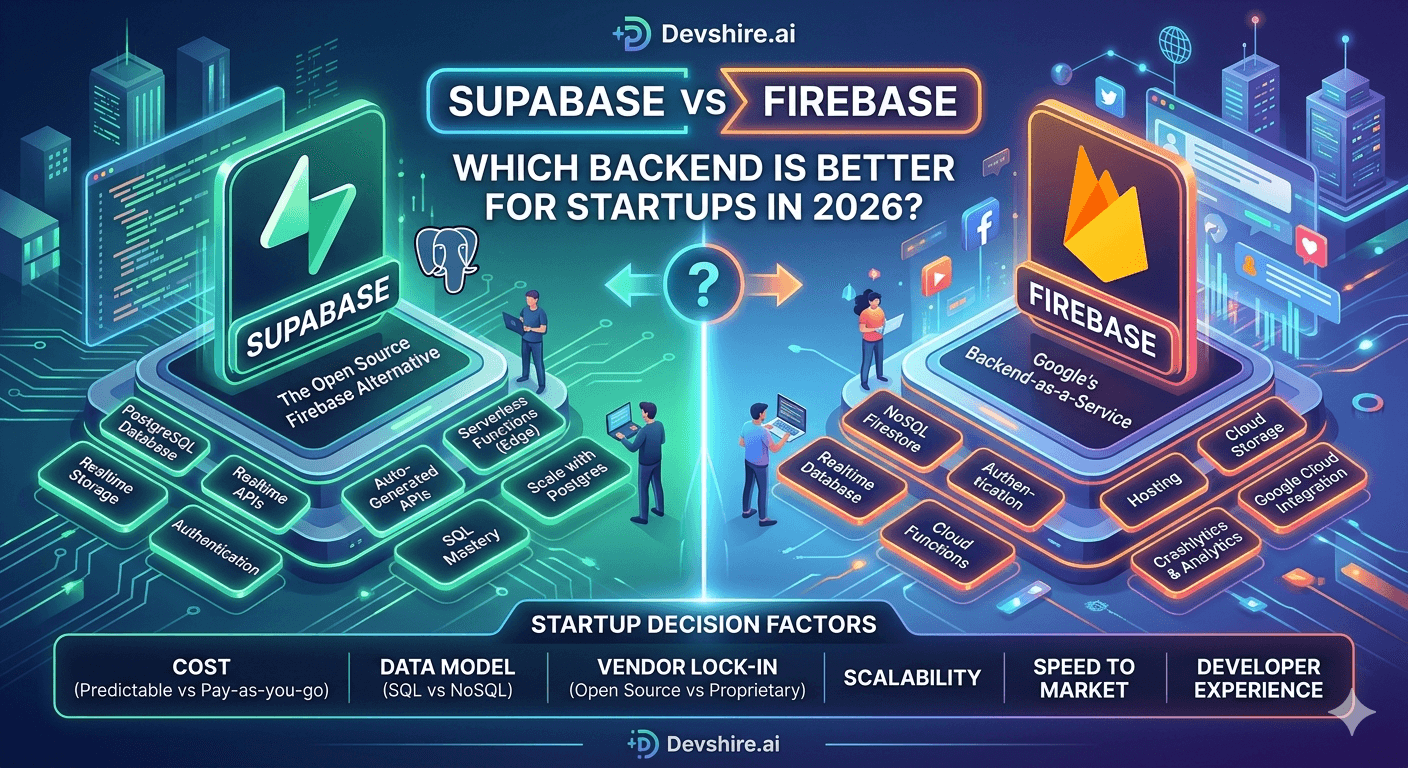
The Supabase vs Firebase question comes up in almost every early-stage technical conversation. Both promise to let you build backend features faster than managing your own infrastructure. Both deliver on that promise to a meaningful degree. The real question is: which one sets you up better for where your product is going, not just where it is today. Firebase is mature, widely adopted, and deeply integrated with the Google ecosystem. Supabase is the open-source alternative that's gained serious traction since 2022 — built on PostgreSQL and designed to feel familiar to developers who know SQL. This is the comparison that goes beyond the feature list to the decisions that actually matter when you're picking a backend for a product you're planning to scale.
💡 TL;DR
In 2026, Supabase wins for most SaaS and B2B products — especially anything with relational data, complex queries, or a team that knows SQL. Firebase wins for mobile-first apps, real-time consumer products, and when you're deep in the Google/Firebase ecosystem already. For AI applications: Supabase + pgvector is the default stack for vector search. For pure mobile apps with offline sync: Firebase's Firestore still leads. The vendor lock-in risk is higher with Firebase — Supabase is open source and self-hostable.
Database Model: SQL vs NoSQL Is Still the Core Decision
Every other comparison flows from this one. Firebase's Firestore is a NoSQL document database. Supabase is PostgreSQL. If you've read our PostgreSQL vs MongoDB comparison, this maps directly.
Dimension | Supabase (PostgreSQL) | Firebase (Firestore) |
|---|---|---|
Data model | Relational — tables, rows, foreign keys, JOINs | Document — collections, documents, subcollections |
Schema | Enforced — migrations required for changes | Flexible — no schema enforcement |
Querying | Full SQL — CTEs, window functions, aggregations | Limited — no JOINs, simple filters only, aggregation pipeline |
Transactions | Full ACID multi-table transactions | Transactions within a document/collection group |
Complex reports | Native SQL — simple and fast | Requires client-side logic or Cloud Functions |
The Firestore query limitation is the most frequent pain point teams hit when scaling Firebase beyond a simple app. You can't JOIN collections, you can't do complex aggregations natively, and you end up with Cloud Functions handling logic that would be a single SQL query in Supabase. If you know your product will need complex reporting, analytics, or multi-entity queries, Supabase is the significantly cleaner choice.
⚠️ The Firestore query ceiling
Teams often hit Firestore's query limitations around the time they need their first proper analytics dashboard or a report that spans multiple collections. Building this requires denormalising data at write time, writing Cloud Functions for aggregations, or maintaining a separate reporting database. With Supabase, it's a SQL query.
Authentication: Feature Parity With Key Differences
Both platforms offer auth out of the box. The differences matter for specific use cases.
Auth Feature | Supabase Auth | Firebase Auth |
|---|---|---|
Email/password | ✅ | ✅ |
OAuth providers | 20+ providers | 20+ providers |
Magic link / OTP | ✅ | ✅ |
Phone / SMS auth | ✅ (requires Twilio) | ✅ (native) |
Row-level security integration | ✅ — RLS policies use auth.uid() directly | Requires Firestore Security Rules (different language) |
Enterprise SSO (SAML) | ✅ (Team/Enterprise plan) | Firebase + Identity Platform add-on |
Custom claims / roles | Via user_metadata or custom RLS policies | Via custom claims on Firebase tokens |
For B2B SaaS with multi-tenancy, Supabase's Row Level Security integration with auth is a significant advantage. Your database security policies can reference the authenticated user's ID and org directly — meaning your API can't accidentally return another tenant's data even with a buggy query. Firebase's Firestore Security Rules achieve similar isolation but with a different, more verbose syntax that operates at the Firestore query layer rather than the database layer.
Real-Time Features: Different Architectures, Different Trade-offs
Both platforms offer real-time data sync. The approach is different in ways that affect how you build with it.
🔥 Firebase Firestore: real-time by default
Firestore's client SDK uses persistent connections — onSnapshot() gives you a live listener that fires whenever data changes. This works brilliantly for collaborative apps, chat, live feeds, and mobile apps that need seamless offline/online sync. Real-time is Firestore's architectural strength, not a feature bolted on.
⚡ Supabase Realtime: PostgreSQL change events via WebSocket
Supabase Realtime listens to PostgreSQL's change data capture (CDC) stream and broadcasts changes to subscribed clients over WebSockets. You subscribe to specific tables, filtered by conditions. It's powerful and works well for most SaaS use cases. It's not as seamlessly integrated as Firestore's onSnapshot() for mobile apps with offline requirements.
📱 Offline sync: Firebase wins clearly
Firestore's client SDK handles offline persistence natively — data is cached locally, mutations queue when offline, and sync when reconnected. Supabase has no equivalent offline persistence SDK. For mobile apps where offline functionality is a core requirement, Firebase's offline sync is a genuine differentiator.
Pricing Reality Check: How Each Platform Scales in Cost
Both platforms have generous free tiers. The cost differences appear at growth stage — and Firestore's pricing model can create unexpected bills.
Pricing Dimension | Supabase | Firebase (Firestore) |
|---|---|---|
Free tier | 2 projects, 500MB DB, 2GB bandwidth | Spark plan — 1GB storage, 50K reads/day |
Paid entry point | $25/mo (Pro) — 8GB DB, 250GB bandwidth | Pay-as-you-go (Blaze plan) — no flat fee, per-operation billing |
Cost model | Flat monthly + overages — predictable | Per-read, per-write, per-delete — can spike unpredictably |
Self-hosting option | Yes — fully open source | No — Google Cloud only |
⚠️ Firestore read costs at scale
Firestore charges per document read ($0.06 per 100K reads on Blaze). An analytics dashboard that reads 10,000 documents to aggregate data will rack up costs fast. Supabase queries don't bill per row read. For read-heavy workloads, Supabase is typically significantly cheaper at scale.
Trusted by 500+ startups & agencies
"Hired in 2 hours. First sprint done in 3 days."
Michael L. · Marketing Director
"Way faster than any agency we've used."
Sophia M. · Content Strategist
"1 AI dev replaced our 3-person team cost."
Chris M. · Digital Marketing
Join 500+ teams building 3× faster with Devshire
1 AI-powered senior developer delivers the output of 3 traditional engineers — at 40% of the cost. Hire in under 24 hours.
Ecosystem, Storage, and Functions
Beyond database and auth, both platforms offer storage and serverless functions. Here's how they compare on the surrounding ecosystem.
Feature | Supabase | Firebase |
|---|---|---|
File storage | Supabase Storage — S3-compatible, CDN included | Firebase Storage — backed by Google Cloud Storage |
Serverless functions | Edge Functions (Deno, TypeScript) | Cloud Functions (Node.js, Python, Java, Go) |
Vector search (AI) | pgvector — native PostgreSQL extension | Vertex AI Vector Search — separate service |
Full-text search | PostgreSQL tsvector — native | Not native — requires Algolia or Elasticsearch |
Vendor lock-in | Low — open source, self-hostable | High — Google Cloud only, proprietary APIs |
The vector search story is a meaningful differentiator in 2026. Supabase + pgvector gives you vector similarity search inside your existing PostgreSQL database — no separate service, no additional cost at small scale. For AI applications that need to store embeddings alongside relational data, this is the default stack. Firebase requires a separate Vertex AI service for equivalent functionality.
The Decision Framework: Which Backend Wins for Your Product
✅ Choose Supabase for: B2B SaaS with relational data
Users, orgs, subscriptions, billing, permissions — all relational. Supabase's PostgreSQL + RLS gives you the cleanest multi-tenant architecture. SQL queries handle analytics and reporting without Cloud Functions. Type-safe with Prisma or Drizzle. This is the 2026 default for SaaS products.
✅ Choose Supabase for: AI applications with vector search
pgvector brings vector similarity search to your existing PostgreSQL database. For AI apps that need to store embeddings, search by semantic similarity, and join results with relational data — Supabase is significantly simpler than Firebase + a separate vector service.
✅ Choose Firebase for: Mobile-first apps with offline sync
Firestore's offline persistence SDK is unmatched for mobile apps that need seamless online/offline behaviour. If your product is a mobile app where offline functionality is a core feature, Firebase's architecture is designed for exactly this.
✅ Choose Firebase for: Real-time consumer apps (chat, live feeds)
Firestore's onSnapshot() real-time listeners are the most seamless implementation for apps where real-time is the primary interaction model — collaborative tools, live chat, gaming leaderboards, social feeds. The client SDK handles connection management and reconnection automatically.
Vendor Lock-In and Migration Risk
This is the dimension most teams don't think about until they need to leave. The lock-in risk is asymmetric between the two platforms.
🔓 Supabase: low lock-in by design
Supabase is open source and built on PostgreSQL. If you outgrow Supabase's managed offering or want to self-host, you take your Postgres database with you. The client SDK wraps PostgREST APIs but your data is portable SQL — pg_dump works. Firebase-specific code in your app is limited to the auth SDK, which can be replaced.
🔒 Firebase: high lock-in by architecture
Firestore's data model, Security Rules, and client SDK are proprietary. Migrating away from Firestore means: exporting documents and normalising them into a relational or alternative document model, rewriting Security Rules as application-layer access control, and replacing Firebase SDK calls throughout your codebase. Teams that have done this report it as a significant multi-week project.
📌 The portability question
If there's any uncertainty about your long-term infrastructure strategy, Supabase's portability is worth weighting heavily. PostgreSQL is a standard — you can move to Neon, RDS, self-hosted Postgres, or keep Supabase. Firestore is a Google product with no direct equivalent elsewhere.
The 2026 Verdict by Product Type
Product Type | Winner | Reason |
|---|---|---|
B2B SaaS | Supabase | Relational data, RLS multi-tenancy, SQL analytics |
Mobile app (offline-first) | Firebase | Best-in-class offline persistence SDK |
AI / LLM application | Supabase | pgvector, relational data alongside embeddings |
Real-time consumer app | Firebase | onSnapshot() real-time architecture |
Internal tools / admin dashboards | Supabase | SQL queries, easy to connect BI tools |
Social / chat app | Firebase | Real-time + offline sync for mobile |
E-commerce | Supabase | Transactions, inventory, order relationships |
The Bottom Line
Supabase wins for most SaaS and B2B products in 2026 — relational data, SQL querying, multi-tenant RLS, and low vendor lock-in make it the stronger default.
Firebase wins for mobile-first apps with offline sync requirements and real-time consumer applications where Firestore's onSnapshot() architecture is a genuine fit.
Firestore's per-read pricing can become expensive at scale for read-heavy workloads. Supabase's flat pricing model is more predictable.
For AI applications needing vector search: Supabase + pgvector is the 2026 default — vector embeddings alongside relational data in one database.
Firestore's query limitations (no JOINs, no complex aggregations) require workarounds (Cloud Functions, denormalisation) that add complexity as the product grows.
Vendor lock-in risk is significantly higher with Firebase. Supabase is open source and your PostgreSQL data is fully portable.
When uncertain between the two, Supabase's lower lock-in risk makes it the safer long-term bet for products with evolving requirements.
Frequently Asked Questions
Is Supabase better than Firebase for startups in 2026?
For most SaaS startups — yes. Supabase's relational model, SQL flexibility, lower lock-in risk, and predictable pricing make it the better default for products with relational data and reporting needs. Firebase is the better choice for mobile-first apps with offline sync or real-time consumer applications.
Can Supabase handle real-time features like Firebase?
Yes — Supabase Realtime listens to PostgreSQL CDC and broadcasts changes over WebSockets. It works well for most SaaS real-time needs (live dashboards, collaborative editing, notifications). For mobile apps needing seamless offline persistence with automatic sync, Firebase's Firestore SDK is still stronger.
How does Supabase pricing compare to Firebase?
Supabase uses flat monthly pricing ($25/mo Pro) with overages for storage and bandwidth — predictable. Firebase Firestore uses per-read/write/delete billing that can spike with high-traffic apps. For read-heavy workloads like analytics dashboards, Supabase is typically significantly cheaper at scale.
Is Firebase still worth using in 2026?
Yes, for specific use cases. Firebase is still the strongest choice for mobile apps with offline-first requirements, consumer apps with real-time collaboration, and teams already invested in the Google/Firebase ecosystem. Firestore is a mature, well-supported product — the question is whether your use case is a genuine fit.
Can I self-host Supabase?
Yes — Supabase is fully open source and can be self-hosted on any infrastructure. The self-hosted version includes the database (PostgreSQL), auth, storage, and realtime components. This is a meaningful advantage for teams with data residency requirements or cost constraints at high scale.
Need a Developer Who Knows Supabase and Firebase Inside Out?
devshire.ai matches you with pre-vetted AI developers experienced in Supabase, Firebase, and modern backend architecture — ready to start in days, not weeks.
Find Your Developer at devshire.ai →
No upfront cost · Shortlist in 48–72 hrs · Freelance & full-time · Stack-matched candidates
About devshire.ai — devshire.ai matches AI-powered engineering talent with product teams. Every developer in the network has passed a live AI proficiency screen covering tool use, output validation, and codebase review. Freelance and full-time options. Typical time-to-hire: 8–12 days. Start hiring →
Related reading: PostgreSQL vs MongoDB in 2026: Which Database Fits Your Startup? · How to Build a Real-Time Analytics Dashboard for Your SaaS App · How to Set Up a Data Pipeline From Scratch Using Python + Airflow · How AI Developers Use SQL + Python to Automate Business Reporting · How to Implement JWT Auth + Role-Based Access in a Node.js SaaS App







Devshire Team
San Francisco · Responds in <2 hours
Hire your first AI developer — this week
Book a free 30-minute call. We'll match you with the right developer for your project and get you started within 24 hours.
<24h
Time to hire
3×
Faster builds
40%
Cost saved